
(…continued from Part 4…)
Command Environment
The General Staff of Ukraine (‘GenStab’ in colloquial Ukrainian) used to provide details such as engagement counts, strike tallies and sector-by-sector descriptions that said nothing. This no longer happens.
In addition, we have grown used to units publishing videos of their actions on the front lines. They were never authorized to do that but this is now being enforced. Front-line reporting now will come only from the General Staff.
The purpose for the information shutdown is basic operational security. They do not want to provide Russia with any details they could use to kill Ukrainians. This means it could be weeks to months before the army releases updates about territorial shifts in the front line. Russia is expected to continue to try and sell its narrative.
As previously reported, replacements will be directed to units based on need, which does not include the 225th and 425th assault regiments for now, and their excessive personnel are being transferred to about ten other units. The 425th regiment will remain intact and was assigned to the operational control 1st National Guard Corps Azov, which is responsible for the Dobropillia to Kostiantyniva sector. The 425th is still part of the Assault Forces and is not formally transferred to the 1st Corps.
Some of the 425th battalions were already fighting in Kostiantynivka and the rest will eventually be brought to the corps’ sector. At one time, elements of the (division-sized) regiment were fighting in ten different locations at once. The spokesman for the regiment says they view the assignment positively.
Busification, or snatching recruits off the streets, continues. This is an issue the Khmara and Drapatyi have to resolve. Drapatyi has begun working with Ukraine’s ombudsman to review proposals for comprehensive mobilization reform.
The Politics of Doctrine
The chain of command in Ukraine should be, by law, the President, the Minister of Defense and the Commander-in-chief. They all can have their ideas on how the war should be fought, but when a superior makes a decision, the subordinate needs to act on that decision or must expect be replaced.
Zelensky knew of Fedorov’s vision on how to fight the war before he named him as minister. Presumably, he agreed with it or he wouldn’t have selected him. After hiring Fedorov in January, Zelensky said he wanted him to focus on technology and innovation to “counter Russia’s desire to make this war endless.”
Syrsky represented the opposite of asymmetric operations and how Fedorov wanted to fight the war. When he became the minister of defense, Fedorov asked Zelensky if he could replace Syrsky. Zelensky refused the request. That immediately undercut Fedorov’s ability to implement his plan. Fedorov and Syrsky were ideologically incompatible, and Syrsky resisted all of Fedorov’s plans. When Fedorov asked for the casualty numbers of all the units, Syrsky’s General Staff said to Fedorov, their boss, that they would not release the numbers to his office.
That was reason enough for Fedorov to fire Syrsky, but Zelensky’s micromanagement did not allow Fedorov to exercise his authority.
Zelensky said that the reason he fired Fedorov was because Fedorov and Syrsky had differences of opinions on what equipment and ammo should be procured. Fedorov bought drones and long-range ammo for artillery that supported his idea of fighting as much as possible from a distance in order to reduce casualties. Syrsky wanted short-range artillery ammo to bombard Russian forces at a closer range, which was in line with his ideas of frontal assaults with infantry at close range. His methods had a much higher casualty rate.
Fedorov and Syrsky could not work together with their competing visions, and since Zelensky restricted Fedorov’s ability to fire Syrsky, Zelensky had to choose between the two people and their ideas. He chose to keep Syrsky.
If Zelensky had a change of mind and decided to back Syrsky’s doctrine that created higher casualties then there would be a certain amount of logic behind his decision. But when he hired Khmara and asked him to continue on with Fedorov’s reforms, it contradicted logic.
Ukraine is fortunate that Zelensky reacted to the pressure of the protestors and ended up with firing Syrsky. The country is also fortunate that Zelensky chose to replace Syrsky with Drapatyi, Syrsky’s ideological opposite and a general that closely aligns with Fedorov’s vision. If Zelensky had fired Syrsky instead of Fedorov, Drapatyi and Fedorov would have had the close working relationship that Zelensky said he was looking for.
But this is how Zelensky chose to run his government.
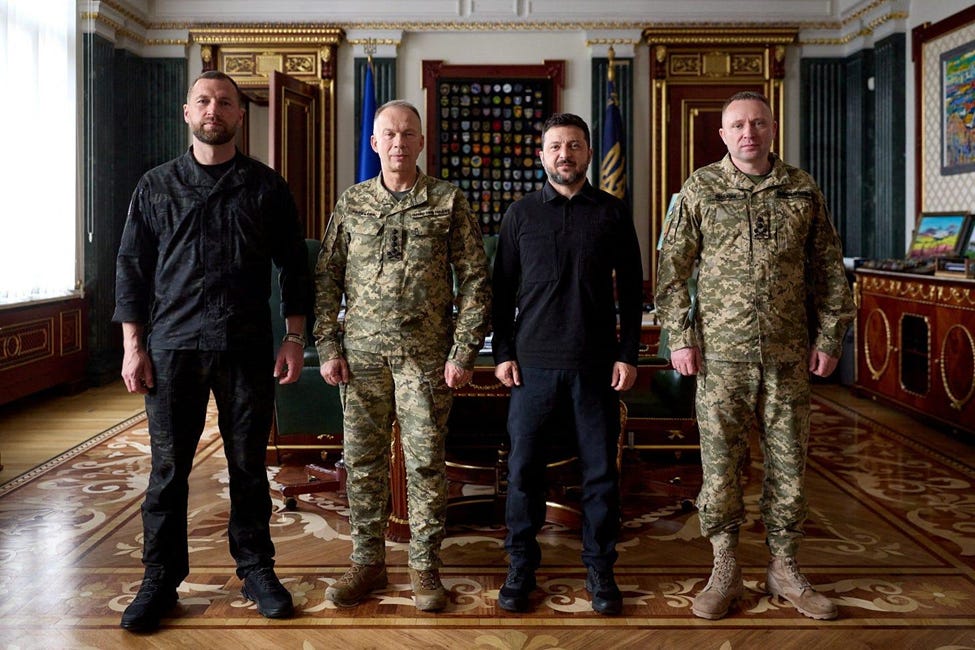
Khmara is the acting minister. Parliament will meet on 18 August and that will be the first chance to endorse him as the permanent minister, for however long ‘permanent’ lasts. His background and public statements all align with Fedorov’s and Draypatyi’s views of asymmetric warfare.
Khmara served in SBU’s Alpha Unit from 2011 until taking command of it in 2023. Asymmetrical combat is their specialty and the June 2025 Operation Spiderweb is their best known achievement, but they also conducted assassinations and used both long-range and FPV drones. In January, Khmara became the head of the SBU.
On 29 July, Khmara said that Ukraine cannot confront Russia “punch for punch” but would have to use resources carefully and act in an “asymmetric” fashion, adding, “I have a real picture in my head of what is being used, what can be used against the enemy, and what can be most effective moving forward,”
Khmara also met with Fedorov, who explained his vision and how he had planned to support it through procurement.
The following is the status of four issues that Fedorov was working on before he was fired.
When Fedorov first arrived on the job in January, he conducted an audit of the army and found that 20 of the 120 brigades had weak leadership and poor performance. He wanted to disband them and redistribute them to undermanned competent brigades.
Syrsky did not want to consolidate brigades. When he was fired, he was in the process of creating five new brigades even though there was already a shortage of qualified leaders. In order to create the new brigades, he pulled personnel from existing brigades, weakening them.
Drapatyi disbanded four of the five brigades that were forming and kept one because it was already at full strength. Soon after he became commander-in-chief, there was a report that Drapatyi was conducting an audit of unit performances and he would disband the bottom 20-30% of the units and redistribute the personnel. Drapatyi’s staff said that was a false report.
Units were supposed to be rotated out at least once every 40 days but the brigades didn’t have the resources to rotate, or they didn’t have the firepower to create safe conditions for a rotation, so some soldiers remained on the front for 200 days. Instead of all the brigades in a corps being deployed next to each other to fight as a unit, some brigades are serving under their corps commander and the rest are scattered throughout the country temporarily serving under another corps commander.
…and in some cases, nobody knows where is what part of what brigade…
Fedorov wanted all the brigades assigned to a corps to serve side-by-side so they could establish systematic routines and have ample firepower that would, among other things, support regular rotations. He ordered Syrsky to consolidate them.
Syrsky oversaw the creation of the corps and the scattered assignment of brigades to the different corps. He also said that it would be impossible to move the brigades so they could all fight adjacent to each other within the same corps command. Yet he found it possible to pull some of the best brigades away from their corps and move them to other locations. He certainly showed little interest in the welfare of the soldiers and their basic human need to rotate.
Khmara and Drapatyi have not publicly addressed this issue yet.
Fedorov wanted to reduce losses through technology and wanted to identify commanders that would best use that technology. He would then provide them with extra personnel and equipment. In fact, he made sure all the units had a sufficient number of drones and then provided the more effective units with even more drones since they would obtain better results with the additional equipment. He ordered those same brigades to be enlarged with more personnel.
Syrsky did not enlarge any of the brigades that were using stand-off technologies. Instead, he enlarged the 225th and 425th assault regiments with four times the number of personnel a regiment should have. These regiments continued to conduct frontal attacks and suffered extremely high losses among personnel and equipment, which were always replaced.
Drapatyi will reduce the size of the two expanded assault regiments. There is no word on whether he will increase the size of the technologically-proficient brigades.
Fedorov was tasked with fixing the mobilization system, a difficult situation in which no solution would please everyone. Instead of grabbing people off the streets, he decided to inform people ahead of their draft so they could arrange their affairs, have clearly defined and limited periods of duty, and would be held accountable if they tried to evade. It required changing personnel management, how troops were trained and eliminating corruption.
Syrsky refused to cooperate with any of those reforms and only a minority of those mobilized ended up in combat units. The failure of the reforms was another reason why Zelensky said he fired Fedorov.
Khmara cannot functionally address this issue until he is confirmed as the minister. It is very likely that he and Drapatyi will work together on this issue. It is unknown if he will try to reduce corruption and reorganize the ministry as Fedorov attempted to do.
Zelensky asked Fedorov to change the system and then failed to support him as he tried to change the system. Against all apparent logic, he fired Fedorov and retained Syrsky, the opposite of change. He was pressured to fire Syrsky soon after. Zelensky then replaced Fedorov and Syrsky with two individuals that support asymmetrical warfare and Zelensky asked them to continue pursuing those goals.
“Because we can’t look at things in isolation or pin the blame on anyone – and someone else is not – the issue of the no-fly zone, the issue of the TCC [recruitment], the issue of the normal, if one can put it that way, face of mobilization – all of this, until the war ends, will have to be done together, in unity,” Zelenskyy said.
He added that “unfortunately, such an alliance did not come about earlier.” At the same time, the president noted that Syrsky’s experience should not be lost.
“It is very important to ensure a smooth transition and the stability of the army. I take this very seriously. There are some things that Syrsky did that we don’t see, but it is very important that we don’t lose them,” he emphasized.
At the same time, Zelenskyy emphasized that it is “very important that we pull some of the innovative ideas from Drapato’s plan out of the drawer and implement them now.”
It appears that the president and the current minister of defense and commander-in-chief all broadly agree on the same objectives now. It also seems clear that the minister and commander will work together to achieve those objectives. Time will tell if they have the capability to accomplish their goals.
Equipment
The FP-7 is being jointly developed as a ballistic interceptor with a target cost of $1.35 million. Fire Point built the missile that has a speed of 1,500-2,000 m/s. It has an infrared seeker and there are plans to install a German semi-active seeker, as well, which means the ballistic missile will be illuminated by radar from the ground and the interceptor will follow that signal. Radars from Sweden, France and Germany are being considered for long-range detection. The illumination and guidance radar will come from either Germany or Italy. The control center will be Norwegian and the mobile launcher will be made in Ukraine. The network communications system will be Link 16, which Ukraine already uses under license for Delta and other NATO-standard systems. Building hit-to-kill missiles are much more difficult and expensive so the warhead will be blast fragmentation. Blast fragmentation warheads are not very effective against ballistic missiles, but if the FP-7 is as effective as a $2-4 million PAC-2 missile it will be very useful.
Fire Point’s FP-9 with a 850 km range and 800 km warhead is still supposed to be operational in the Fall. The government’s Sapsan ballistic missile will have a 500 km range with a 500 kg warhead and utilizes inertial and satellite guidance. Fedorov said on his last day that a test in July increased Sapsan’s accuracy and reduced cost by 30%, although the actual costs were not reported. Preparations for serial production were announced a year ago, so those were delayed.
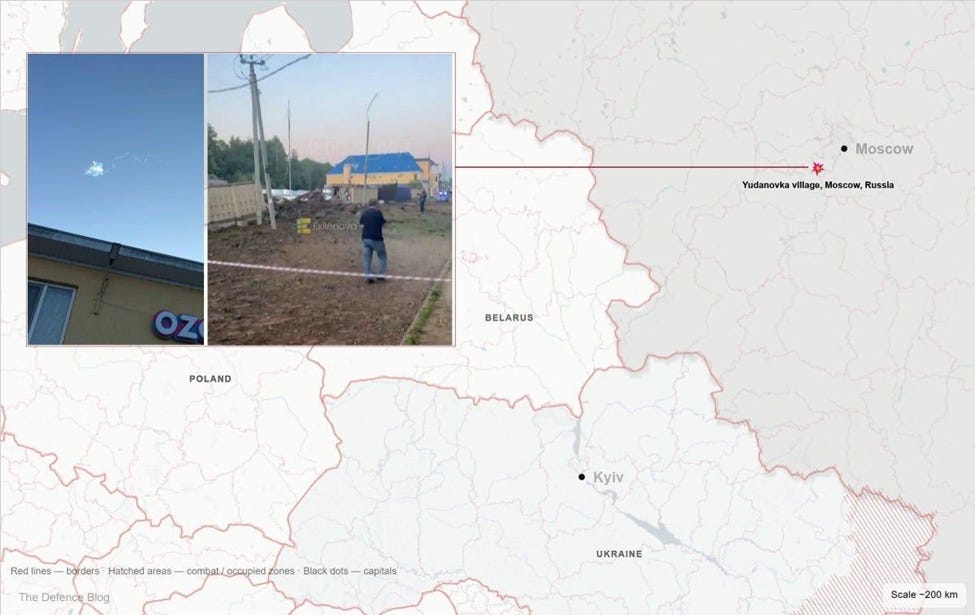
Putin once claimed the Kinzhal missile was unstoppable but by 2023 it already had a poor performance record. Russia stopped the production of the Kinzhal and Kh-32 missiles and used the resources to increase production of the Iskander to 65 missiles a month. The Votkinsk factory that makes the Iskander was partially damaged in February by Ukrainian Flamingo missiles. Two more attacks by Flamingos in July and August were all shot down.
Russia is currently exceeding their missile production goals by 110-120%. The RM-48U ballistic missile, launched from an S-400, has a stockpile of 400 units and 40 are being produced a month. Russia isn’t drawing down on their stockpile, they’re launching the missiles as soon as they come off the production line.
When air defense missiles are available they intercept the Kalibr cruise missile almost 100% of the time. The North Korean Kn-23 ballistic missile that was recently launched missed its target by 15 km.
The Soviet-era S-300 and S-400 systems were designed as air defenses but their missiles could always be used for ground attacks. The S-300 first demonstrated that capability in May 2011 when it fired five missiles at stationary targets on a training range. When the Russians started running low on cruise missiles and ballistic missiles in 2022 they began using S-300 missiles as ballistic missiles, and in December 2022 they had more than 7,000 of the missiles in stock.
As air defense weapons, they are very accurate, but they rely on inertial and radio-command guidance when engaging aerial targets. In the ballistic mode, they lose that guidance once the missile passes the radio horizon and it continues on to the target with only inaccurate internal guidance using mechanical gyroscopes and sensors. Hitting a bunker is unlikely, but landing in a city block or large factory is possible. The further the missile flies, the more its accuracy suffers.
Russia started using S-400 missiles in ground attacks at least since January 2023. Older missiles were used then, but in 2025 Russia produced more than 200 RM-48U missiles that could not intercept aircraft but were less expensive and could be used in a ground attack role. Their first use was reported in January 2026 and expected to produce 480 by the end of this year. It has a 400 km range with a 130 kg warhead. When it reaches its top speed, it can travel 2.5 km per second. Both an S-300 and S-400 can launch the RM-48U missile.
Russians are using radio-controlled drones that can fly up to 40 km without being jammed by using frequency hopping. EW jammers can only jam a few frequencies at a time. Frequency hopping bounces around multiple bandwidths. The time spent on jammed bandwidths is so small that it does not interfere with communications or operations. Bluetooth changes channels 1,600 times a second over 79 channels. Both the sending and receiving stations hop at the same time, and the US SINCGARS radios change frequencies 100 times a second.
There have been multiple cases in which Russians have been prosecuted for buying Chinese equipment and selling it to the military or security services as Russian-produced. There is a report that Ukrainian companies buy electronic warfare systems from China and sell them as domestically produced. A year ago, procurement rules were simplified to speed acquisition so now the government relies on the contractor for the accuracy of the information about the product.
Communications intelligence is the interception and analysis of voice, text or data messages. The NSA in America collections an incredible amount of data every day and uses computers to process it and extract data for analysis. In 2022, a private company used AI to extract data from unencrypted Russian radio transmissions and trained it to identify individuals speaking, activity, equipment and locations. It provided summaries of hours of radio traffic and could provide tactical insights in near real time. It was updated by human operators to learn new terms, such as the use of “helis” for “helicopters.”
In addition to using these methods, Ukraine used facial recognition to identify individual Russians in videos. The US Army detects electronic signals and other data sources to develop insights and both Ukraine and Russia have their own data-flow systems that integrate and display information from sensors, friendly unit status and other information to present a real time situational report available to users at different levels of command.
Two Ukrainian companies are identifying Russian propaganda on the internet and counter with psychological operations of their own.
Ukraine is still using the unencrypted Motorola radios it had at the beginning of the war. It received some encrypted Harris radios but at $20-30,000 each, Ukraine can’t equip their entire army. Flash argues that Ukraine should develop their own domestic encrypted radio production. 90% of Russian forces use Chinese radios that are comparable to Motorola.
A mid-strike drone that was tested in early 2025 had problems with software, batteries, camera feed and, after a few minutes, controls would be unresponsive. It underwent so many changes it is now considered to be a different model from the one first tested over a year ago.
There are now many models of Ukrainian mid-strike drones, most of them domestically produced, and they have varying levels of reliability. Though considered combat ready, they are all tested before being used. Drones that have problems are rigorously tested. One pilot said, “If a manufacturer is not responsible, I do everything possible to prevent their system from reaching combat crews in our unit.” Once it passes testing on the range, it is tested in combat. If it performs well, it is considered combat-ready.
Drone manufacturers are competing with each other and some have insufficient testing in order to get their drone to the market, forcing the military to take pilots and crews off the line to do the testing. Failure to do so could cost lives on the front.
The downside of Ukraine’s open-market procurement system is that many companies do not provide good solutions and there are inefficiencies and overlap. The upside is that the barriers to companies with good solutions are low and there is a rapid iteration of improvements with the feedback between the combat units and the manufacturers.
No posts
Comments
Nothing yet. Say the first thing.
Sign in to join the conversation.