
Well, here I am again. It is precisely twenty-four minutes past four in the morning, an hour that possesses a distinct lack of any pleasant qualities whatsoever, and I am sitting at my kitchen table blinking heavily at a mug of black coffee that is currently doing a remarkably poor job of waking me up. The blame for this ungodly vigil lies entirely with Tigger, my ginger cat. Tigger apparently operates on a financial clock that is wholly detached from reality. He decided that breakfast service was desperately overdue, a crisis he communicated by perching squarely on the bedroom windowsill, meowing with the rhythmic intensity of a faulty car alarm while violently assaulting the cord of the window blinds.
Having fulfilled my duties as a glorified tin opener, I now find myself staring at a laptop screen, trying to make sense of a global financial system that appears to have completely lost its mind. The reason for my sudden interest in macroeconomic plumbing is that the United States Department of the Treasury has just done something exceedingly strange, rather desperate, and quietly terrifying. They have decided to double the size of their government debt buyback operations to at least $4 billion per operation.
Now, to the average person trying to figure out how to pay their electricity bill, the phrase Treasury buybacks sounds like the sort of high level administrative jargon designed specifically to reduce a perfectly healthy intellect to pure jelly. But it actually matters quite a lot. In simple terms, the American government has just looked at the massive mountain of IOUs it has issued to the world and decided that it needs to buy a lot of them back. Specifically, they are throwing billions of dollars at buying back their own long term bonds, those bits of paper that promise to pay people back in ten, twenty, or thirty years.
This is where the brain starts to itch. If you owe someone a staggering amount of money, your usual strategy is not to turn around and buy your own debt back from them using more money. If I tried that with my local bank, the manager would gently escort me from the premises. Yet, the American Treasury is doing precisely this, to the tune of at least $4 billion per operation. They are doing it because the global bond market, which is supposed to be the most boring and dependable thing on Earth, has recently developed the emotional stability of a toddler who has missed a nap.
The problem is that nobody wants to buy these long term American bonds anymore. For decades, the system worked beautifully because countries like Japan would take their vast reserves of cash, convert them into dollars, and buy American debt because it was deemed safer than houses. But lately, the world has looked at the sheer volume of debt the Americans are printing and staged a polite, silent strike. With no one left to buy the bonds, the interest rates on them began to rocket upward, reaching heights not seen since the global financial crash. When government interest rates go up, everything from your mortgage to the price of a pint of milk gets dragged up with it.
So, the Treasury stepped in. They became their own customer. They are essentially buying their own old, dusty, unloved bonds from the market to artificially force interest rates back down. Wall Street traders are currently running around in circles, hyperventilating into paper bags and whispering that this looks suspiciously like Yield Curve Control. That is a very polite financial term for when a government fixes prices because the free market has decided it doesn't like the product.
But there is a much larger, much juicier plot twist occurring across the Pacific Ocean, and it involves what is affectionately being called the Bessent Backstop. This is where my early morning coffee starts to feel entirely necessary. For thirty years, smart financial institutions in Japan have engaged in a lovely little game called the carry trade. They would borrow money in Japan at zero percent interest, swap those yen for American dollars, and buy American bonds that paid a nice, juicy return. It was free money, provided the Japanese yen remained completely worthless.
Unfortunately for everyone involved, the Japanese yen recently decided it didn't want to be worthless anymore. It began to collapse so violently that the Japanese government had to step in and spend $85 billion to rescue its own currency. To get $85 billion in a hurry, you have to sell something valuable. The only valuable thing the Japanese government holds in massive quantities is U.S. Treasuries.
This created a terrifying nightmare for Washington. If Japan dumps a trillion dollars of American bonds onto the market all at once to save the yen, the American bond market collapses, interest rates go through the roof, and the global financial system grinds to a catastrophic halt. Enter the Bessent Backstop, a brilliant piece of geopolitical theater orchestrated by the American Treasury Secretary, Scott Bessent.
Instead of letting Japan dump American bonds, the U.S. Treasury has effectively stepped in with a gigantic net. By doubling their buybacks, they are standing right there, ready to absorb the massive shock of any Japanese selling. Even more clever, they have started selling European currency to buy Japanese yen directly, helping Tokyo prop up their currency without having to touch their core American debt holdings. It is a stunningly complex game of financial musical chairs, played with trillions of dollars, all to ensure that the music never stops.
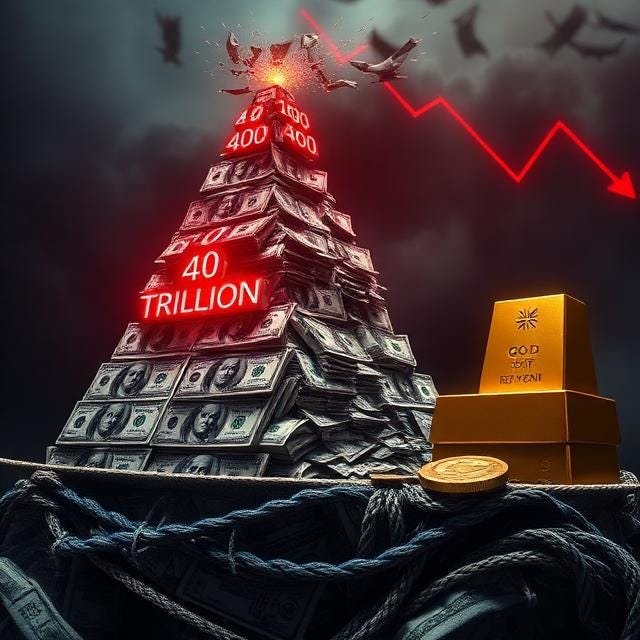
The truly alarming part of this grand illusion is what happens next. The United States national debt has just officially passed the staggering milestone of $40 trillion. Meanwhile, it can be confirmed that the Treasury holds only about $22 billion in actual, liquid foreign currency reserves. When a nation has a mere $22 billion left in the global piggy bank to defend its currency while staring at a debt mountain that has officially breached $40 trillion, the conventional arithmetic completely breaks down. To keep funding these multi-billion dollar buybacks and supporting global allies, the US government cannot rely on savings or reserves. It has to manufacture the money out of thin air.
When you flood an economy with freshly created paper money to buy up your own bad debt, you trigger a very old, very mathematical monster: the hyperinflationary spiral. At first, inflation creeps up incrementally, making your weekly grocery shop feel uncomfortably steep. But when the global public realizes that the government is permanently trapped as the only buyer of its own debt, faith in the currency completely evaporates. People rush to exchange their rapidly depreciating paper money for anything tangible. The velocity of money explodes as everyone tries to get rid of dollars before they lose value by nightfall. The more money the Treasury creates to fix the bond market, the less that money buys, requiring them to create even more. It is a dog chasing its own tail into economic oblivion.
Tigger has just wandered back into the kitchen, looking entirely unbothered by the fact that the foundational architecture of global capitalism is currently being held together by sticky tape, hope, and extraordinary government interventions. He licks his paw, completely oblivious to the reality that when a government has to become the primary buyer of its own debt to keep its own bond market from breaking, you are no longer dealing with a normal, healthy economy. You are dealing with a system that is actively fighting off a quiet, slow motion currency crisis.
For the average person holding physical gold and silver, this chaotic morning is the ultimate moment of validation. If you already have a stash of physical precious metals tucked away securely, now is the time to quietly thank your own foresight. Gold and silver cannot be devalued by a desperate Treasury intervention, they cannot be printed by decree, and they do not rely on the survival of the bond market to hold their worth. They are the only real money that has survived every hyperinflationary collapse in human history.
If you do not own any, now is the moment to seriously begin thinking of buying some as financial insurance. When the safety net of the global reserve currency shows structural tears, holding an asset that exists entirely outside the digital banking system is no longer an eccentric hobby. It is basic survival.
The average man is told that everything is perfectly under control, that these are merely routine adjustments to ensure market liquidity. But as I take the final, bitter sip of my cold coffee, it seems blindingly obvious that the people in charge are simply rearranging the deckchairs on a very expensive, very debt laden Titanic. They have managed to stop the bond market from cracking for now, but they have done so by rewriting the rules of the game. I look at Tigger, who has now curled up on the sofa for a post breakfast nap. I think I might join him. After all, if the global financial system is going to pretend that everything is normal, I might as well pretend that four o'clock in the morning is a perfectly sensible time to be awake.
If you enjoyed this blog you may want to share it to your MyFace socials and consider subscribing, it's free after all.
No posts
Comments
Nothing yet. Say the first thing.
Sign in to join the conversation.