
Over a year ago, XRC transitioned from a traditional accelerator model to a pre-seed fund structure. We made this strategic shift after listening closely to what early-stage founders said they truly needed: distribution and capital—preferably in that order.

Easier and Easier to Build but Harder and Harder to Sell:
What has changed? AI and new technologies have dramatically simplified product development, resulting in many look-alike solutions hitting the market simultaneously.
Let's take the legal vertical market. Asking Perplexity, I was told:
“While an exact count is not available, there are likely at least several dozen widely recognized legal AI applications, with hundreds more in development or deployment across different legal specialties and regions. The landscape is dynamic, with new tools emerging regularly as AI technology advances and adoption accelerates”
If you are a law firm, are you prepared to evaluate hundreds of legal applications, however specialized some of them may be? Remember, that developing these applications do not take significant venture funding, so venture signals may not be enough to filter the list. What will be the criteria for evaluation? AI itself?
As a result, the real bottleneck for startups isn’t building products—it’s getting them into the hands of customers. So while the development of solutions in any given market has multiplied dramatically, the number of potential customers hasn’t. Hence, bottleneck and the oversupply of solutions compared to demand.
That’s why XRC is more focused than ever on distribution as the primary driver of value for our portfolio companies. Traction trumps almost every other signal.
But doesn’t AI eliminate the need for sales execs/distribution?
One school of thought is that AI can eliminate the traditional sales force and process. That may be true for applications that empower development, creation, analysis and other important but non-mission critical tasks. But for applications that serve as the glue to an organization’s revenue or costs, we will not see corporate America simply plug in solutions. The impact of failure in any one of those touchpoints can bring down the revenue and value of a corporate faster than thought possible. Our contention is that sales expertise and network connectivity to key decision makers is more important than ever.
But I am getting all these inbound requests for pilots?
Let us be really clear - Pilots <> Production License Agreements.
If you are being contacted by enterprise teams that are based in innovation or corporate development or corporate venture, understand that they are paid to bring forward interesting solutions to test, often without business line support. Pilots are a small step toward eventual license agreements and often are disconnected from full scale commitments.
9 Steps to a Sale?
On average there are north of 9 steps to an enterprise sale. Some of these steps can happen simultaneously, but they all happen, whether you are aware of them or not. The more visible each step is, the more likely you will. Will these steps be reduced in future corporate buying patterns?
I borrowed this diagram from an old tech firm, called BEA, who prided itself in enterprise middleware sales and was acquired by Oracle in 2008. They built tools that were used for developing, deploying, and managing enterprise applications, especially for e-commerce and other mission-critical systems. Clearly their technology is no longer sold, but their sales diagram and the people in them seem to remain in most of corporate America.
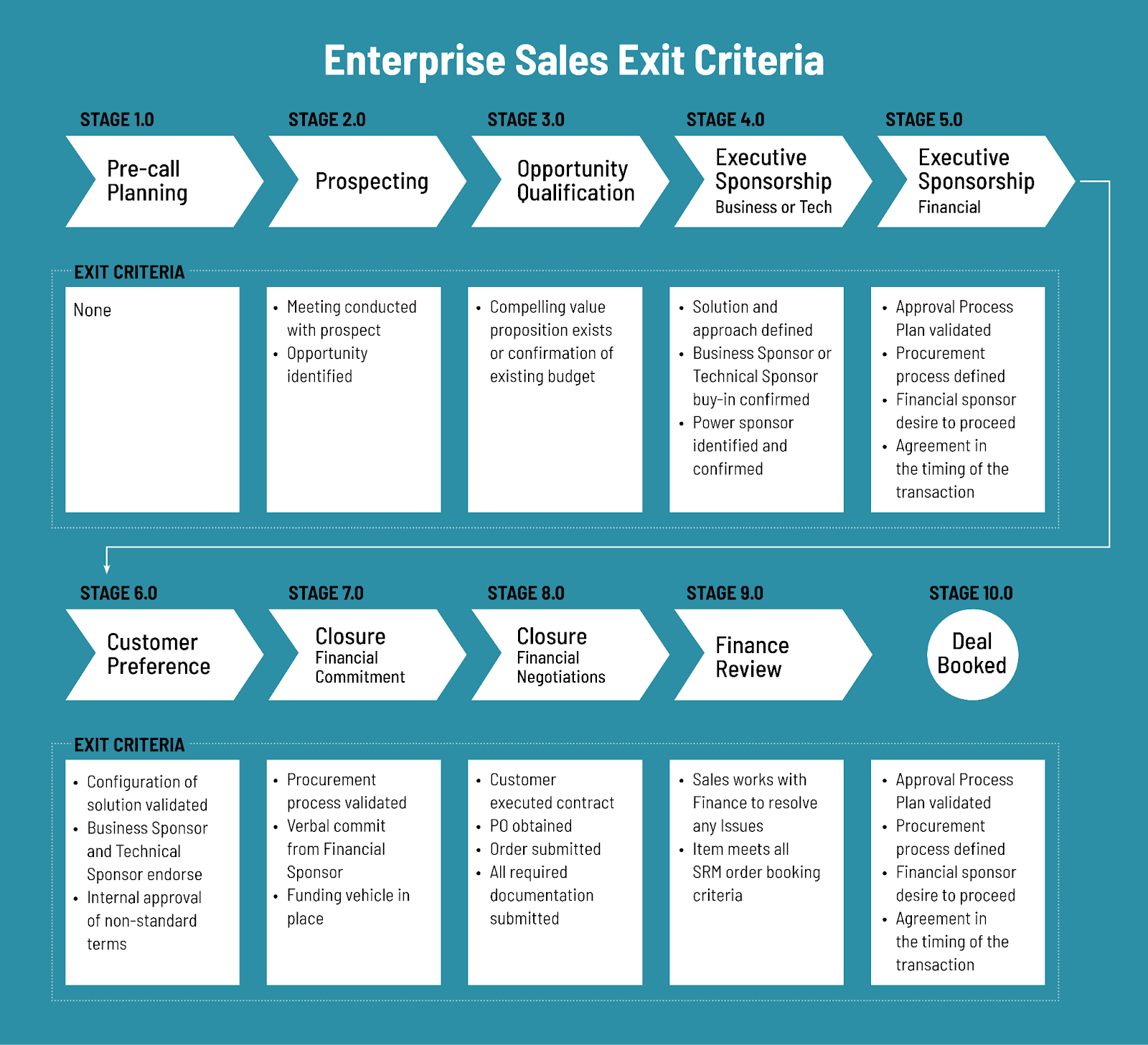
BEA’s logic was that to get to a decision, a corporation goes through 10 logical steps that a sales executive must understand and manage.
The diagram works as follows: A sales executive could not identify a sales prospect as a qualified opportunity (Stage 3.0) until that exec had identified a compelling value proposition or confirmed the existence of a budget to buy a solution.
Of course, your mileage may vary, but the premise of having multiple stakeholders and gatekeepers that must approve a deal is very much alive and causes sales cycles to take months, if not years in very large deals and enterprises.
If you look carefully at the diagram the steps drill down to business, technical, financial and legal approvals. While financial justification may be waived in some cases because of board or CEO urgency, the other dimensions still need to be considered. And given the sheer number of solutions for any given problem, bakeoffs, RFP’s and the like will be much more likely than in greenfield vertical environments.
Of course, AI is making the top of these enterprise orgs very receptive and interested and engaged and pushing for new systems that drive out cost and increase productivity.
But the “gates” are still there.
AI vertical application startups will have to navigate these layers to build recurring revenue streams and drive sustainable growth. They will have to “walk the halls” to expand their footprint (think net revenue retention of >1).
So while Pilots are plentiful, enterprise agreements are few and far between in the corporate world.
What’s Next: One Person Dev Team with Lean but Expert Sales Team:
We admire the idea of the “one-person unicorn.” And for many applications that service developers, this model can work. You can see the results of a Cursor or any of a number of dev tools where the new tool enables far more productivity and hence impact to the developer’s business than ever before.
The Developer Tool Market is not the Enterprise:
There are some important learnings from the success of startups like Cursor and so many others.
Build something that helps the end user make more money. If you are a developer and make your livelihood from developing, anything that helps you build faster will be looked at and tested seriously.
Similarly, enterprise solutions that focus on increasing revenue meaningfully, will get attention. Cost reduction solutions will only get real focus if they are serious contributors to EBITDA, not headcount reductions. Headcount reductions often don’t happen or they cannot be wholly attributed to one solution.
Find markets where the decision maker is also the user.
In the developer tool market for example, the only customer that has to decide to use the solution, is the developer. No other decision makers typically need be involved.
But for vertical application startups that have to sell to the enterprise, the reality is that enterprise application sales require high level access to decision makers across technology, business and legal dimensions. Then once “sold”, the startup must build ongoing relationships and account management.
How does XRC help?
Like any venture fund, our main objective is startup success. That comes in two focal points in this order: traction in the business and the right venture forward introductions for future capital needs.
For traction in the business, our job is to facilitate introductions into two areas of businesses:
For startups targeting enterprises, those corporate introductions have to happen at the right levels of the organization - the C-Suite. Without that level of access, the introductions often get lost in a sea of competing priorities.
For startups targeting other SMB’s/startups, our tracking system for over 2MM consumer-oriented startups provides a very complete gateway to communicate the value of a given startup and elicit pilot and production agreements. Think of how Stripe grew, targeting e-commerce brands that needed a simpler, less costly checkout process.
In today’s market, with traction in the business, comes funding. More on that in a later post.
No posts
Comments
Nothing yet. Say the first thing.
Sign in to join the conversation.