
After two sturdy years as a teaching assistant, I finally get to teach my own course this fall. More, I get to design it practically from scratch. The guard rails are gelatinous, the world is my freshly shucked oyster. As a TA I kicked off each semester with a show of hands: How many of you are taking this class because you want to? Because you have to? The results were heavily, predictably skewed. “I don’t see how literature is relevant to my life,” a perfectly reasonable student once told me. Another said she was skeptical of self-proclaimed bookworms because, as she noted, “reading is now fashionable again.”
Where the intro-lit courses I TAed were online and asynchronous (think pre-recorded lecture videos, minimal instructor contact), Writing Fiction will meet twice a week in person. Where an intro-lit course might enroll up to nine-hundred students, many of whom need it to graduate, my course will be an opt-in adventure capped at eighteen.
My credentials, you ask? How the heck did I land such a gig?
I am not so early-career as I once was. My debut short story came out last year and was liked by at least eighteen people (proof below). On top of this I have three unpublished novels to my name and am now at work on a fourth, and I have received a half-dozen tiered rejections from respectable publications. I could go on.
I ask the writing gods what I’m allowed to say in class and when, what I must withhold for my students’ sake or my own, why any of this is even important when we are all going to die one day, etc. For instance:
Write what you know. Write who you know. Write what you don’t know. Write every day. Write when you want to. Write when you can. Write to live. Write to live on. Write crap, lots of it. Write toward your trauma. Write toward your shame. Write in the shower. Write when you’re mad. Just write, goddamit. Or don’t. No one cares. Publishing is dying lol. Literature is dead, ha! A.I. is coming, funding is going! A.I. is here, funding is gone!
I could say all these things and any number of other things besides. The truth is that I can say whatever I want, without evidence, or with anecdotal evidence at best. It’s all about the storytelling, really—which brings me to my biggest strength, the reason I feel confident in my ability to teach fiction to eighteen bright minds this fall:
Baby I’m addicted to narrative! (This is also the subtitle of my course.)
I am a dramatic person, always have been, though I’ve never cared much for drama in my own life. The entrapment of a good book, or movie, or TV show, on the other hand—the thrill of being in the thick of it—that is my favorite feeling in the world. I know when I feel it, I know to seek it out, I’m moved to ecstasy by it. Last month it was Hemingway’s “A Farewell To Arms.” Last week it was “Righteous Gemstones.” In my own work I am spider and fly both. I dream up imaginary worlds and find myself stuck in them. I conjure plots that put me to sleep. I am loved, loathed, and haunted by my characters. When I wake up in the morning, there’s nothing else I’d rather do. My husband knows not to talk to me in the mornings. Mornings are my madness time, writing is my madness. This fall I’ll peddle it merrily in my class.
In a writing class I took in college, the instructor dedicated a week to studying gorgeous sentences; we were each asked to bring in an example (“Not your own!” the instructor stressed). I was not so invested in writing back then—let’s say I did not know myself—so I put it off until the last moment, at which point I turned to Google. “Most beautiful sentence,” I typed in, or some such phrase, and I was tickled to discover a curious consensus. This was 2012, there was no AI Overview back then. Even so, from one obscure personal blog to the next, the same example kept cropping up:
This private estate was far enough away from the explosion so that its bamboos, pines, laurel, and maples were still alive, and the green place invited refugees—partly because they believed that if the Americans came back, they would bomb only buildings; partly because the foliage seemed a center of coolness and life, and the estate’s exquisitely precise rock gardens, with their quiet pools and arching bridges, were very Japanese, normal, secure; and also partly (according to some who were there) because of an irresistible, atavistic urge to hide under leaves.
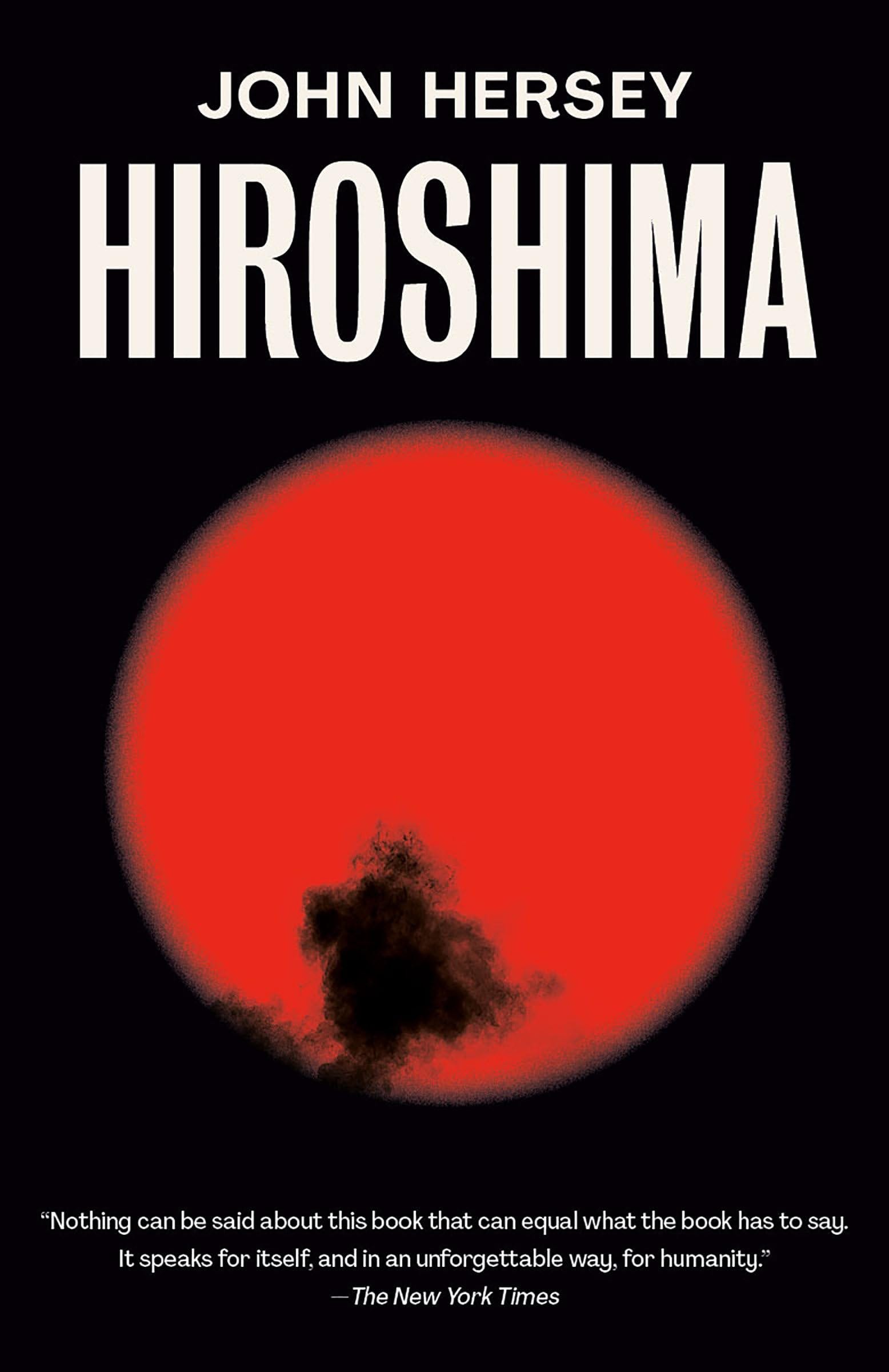
As it happens I agree with those blogs. Take our word for it, or don’t, but the most beautiful sentence in the English language, if such a thing exists, comes from John Hersey’s book “Hiroshima.”
Hersey was chauffeur to a novelist, a novelist himself, a Far East correspondent at Time, and a master at Yale, in no particular order. In his long eventful life he survived four plane crashes, married an old flame of JFK, accompanied Allied troops on their invasion of Sicily, and served as chancellor of the American Academy of Arts and Letters. Somewhere in there he happened to meet a Jesuit missionary who had survived the atom bomb dropped in Hiroshima in 1945. The missionary introduced Hersey to other survivors: two doctors, a seamstress, a factory worker and so on. This book is the result of those remarkable conversations.
“Hiroshima” is about ordinary people made extraordinary by war, and in the most terrible way. A hundred thousand innocents perished in the bomb, and the ones who survived came to be known in Japan as the hibakusha—literally, radiation-affected persons. Hersey traces the lives of six of those people from bomb until death, in some cases decades later. There is nothing in there about the glory of science, nothing about Openheimer’s skullduggery or regret, nothing about Churchill and Truman, and very little about the Japanese Emperor. “Hiroshima” is nothing more or less than a grassroots tale of nuclear war. Another quote:
Over everything—up through the wreckage of the city, in gutters, along the riverbanks, tangled among tiles and tin roofing, climbing on charred tree trunks—was a blanket of fresh, vivid, lush, optimistic green; the verdancy rose even from the foundations of ruined houses. Weeds already hid the ashes, and wild flowers were in bloom among the city’s bones. The bomb had not only left the underground organs of the plants intact; it had stimulated them.
According to the American Society of Authors & Writers, one of Hersey’s four plane crashes found him plunging into the ocean. He managed to extricate himself from the wreckage and swim to the surface, and the first thing he did was search around for all his notes. He looked in his pockets but the journals weren’t there. “Then something bumped my head, and there they were floating in the water within easy reach...I never could figure out how they got there. By rights they should have sunk straight off.”
It seems that Hersey was addicted to narrative just like me. His “Hiroshima” is a masterpiece of language. Read it and be mesmerized, spooked, appalled, humbled. Read it to feel something, to see yourself in the hibakusha’s shoes. This could be me, this could be us.
Comments
Nothing yet. Say the first thing.
Sign in to join the conversation.