
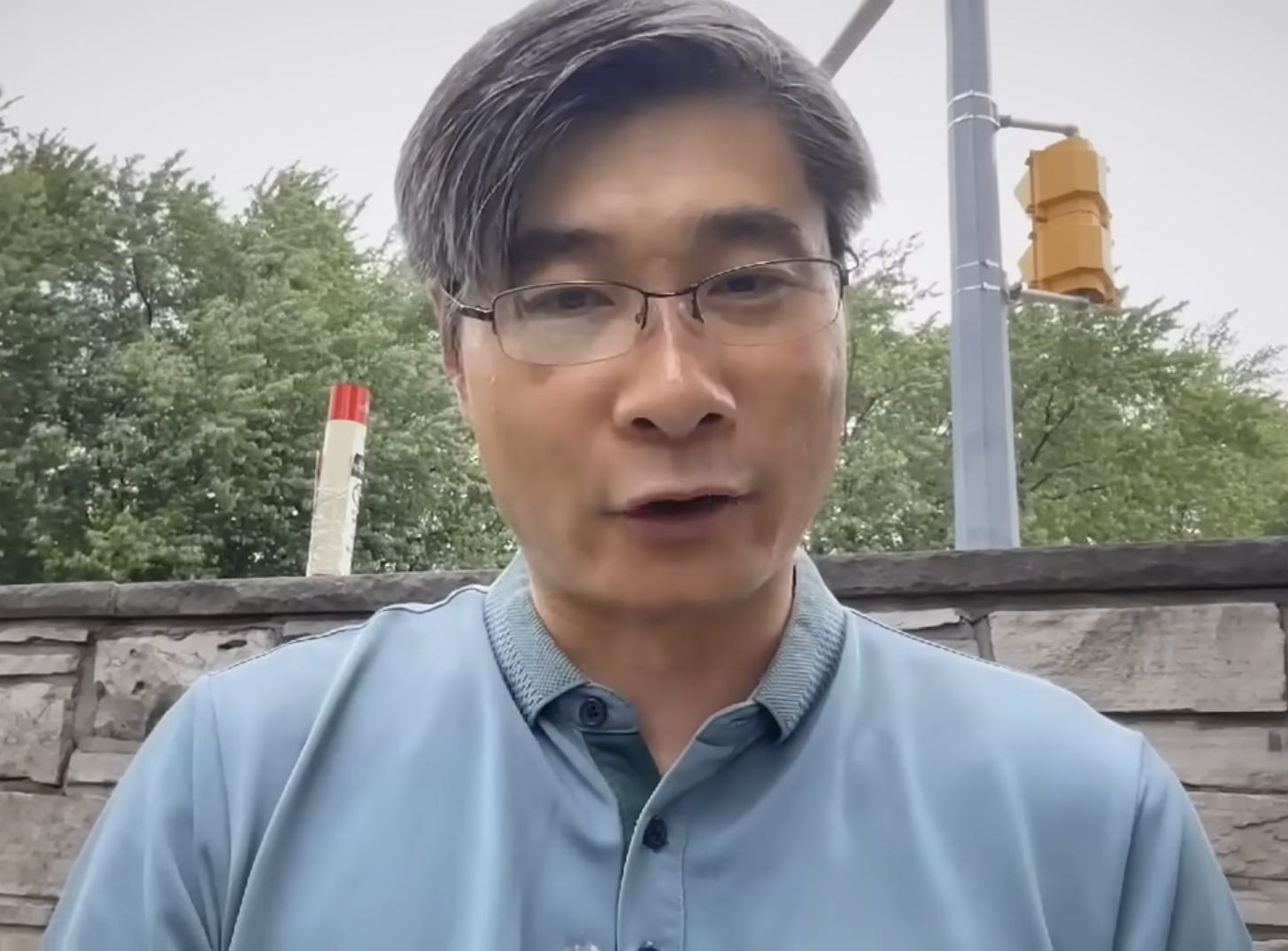
Okay, I’m ready to admit that I’ve been fascinated by Professor Jiang Xueqin. If you haven’t seen him, he’s this up-and-coming YouTube sensation somehow turning all that boring Western philosophy into pop culture.
He’s originally from China, was an English student at Yale, but now he’s just a professor on Youtube. Not a real one as far as I could tell. Some of his shit is plain nonsense. Most of it is “known knowns.” If you’re looking for genuinely new information in his lectures, there is very little of it. What he mostly does is reinterpret information that already exists.
Jiang rose to prominence after “predicting” the U.S. attack on Iran. Calling it a prediction is generous. It was obvious to anyone paying attention, and conspiracy spaces had been making similar claims for years. But that detail doesn’t really matter.
What matters is how he positioned himself. He’s playing the kid who points out that the emperor is naked. And because he’s a kid, he gets excused for confusing a man walking around with his exposed genitalia as merely being “naked.” The sloppiness is part of his performance.
His facts are debatable. Many of his arguments are stretched. But that’s not what his audience is actually responding to. What he’s really saying is: Look guys, there is another way to look at what’s happening in the world that makes sense to me—and I doubt I’m alone. Okay?
And the size of his YouTube following has vindicated that instinct.
That vindication matters because it points to a much deeper problem than one professor’s popularity. It points to the collapse of how we used to agree on reality.
For a long time, governments, global institutions, tech platforms, and intellectual elites took for granted the power that comes with hoarding attention. They forgot that trust is abusable. And when you stain attention by abusing trust, you don’t destroy trust—you redistribute it. You hand it over to competing ideas.
Like energy, trust is conserved in a closed system.
Trust is the foundation of attraction. It can hide inside aesthetics (beauty), intellect (explanation), imagination (vision), memory (tribe), or transcendence (cult). But none of these replace trust itself. They’re just the pillars that hold it up.
Trust is also the other side of the coercion coin. Her opposite is violence.
So when you choose dishonesty while holding massive attention, you’re flipping that coin toward violence. And people like Jiang are not waiting for the coin to land. They’re already building new ways of playing the game of trust.
This is why his weird style makes a lot of sense.
His work intentionally devalues polish and sophistication. It quietly tells the audience that beauty and explanation have been overused—abused, really—to manipulate trust. We’ve seen too many TED Talks. Too many wrong experts. Too many confident liars.
So Jiang leans away from elegance and accuracy and tilts hard toward imagination and transcendence. His videos are long. They don’t look good. The arguments wander. The facts wobble. His work interprets the past through the Eurocentric lens. His beliefs on transcendence are monotheist. His vision is creative emancipation over coercive strength.
It doesn’t matter whether Jiang is betting on himself, being manipulated by an intelligence agency, or even if he is part of a cult. What matters is that this kind of approach is now possible. His approach is heavier on cult, vision, and tribe—in that order—than on explanation or presentation.
I don’t think he’s playing the winning game. But I am sure that he’s going to go very far as a public intellectual. He feels like the Chinese version of Jordan Peterson.
So the real question isn’t whether Jiang is right or wrong.
The question is whether he’s tilting the coin toward violence or toward trust.
Some fear the global psychosis that comes with overly distributed trust. If there’s no single source of truth, can we still call it truth at all? But that anxiety confuses truth with trust.
Truth is monotheistic. It demands a single authority. Facts require adjudication. Someone has to decide.
Trust is different. Trust is multidimensional. It’s a continuous game. It can be earned, lost, fragmented, and recombined. It doesn’t exist somewhere waiting to be discovered. It exists in relationships.
The Church tasked Jesus with revealing truth. The Royal Society tasked Newton with revealing truth. And Jiang is playing the same game—claiming authority in a world that no longer agrees on who gets to have it.
As a Catholic and a student of physics, I’ll admit this: I admire the move.
The people who command the most attention today take Eurocentric philosophy far too seriously. It’s overdue for religion. Only by turning it into religion can we finally see it for what it is. And maybe—just maybe—that clears space for something else.
Maybe it makes way for Satoshi Nakamoto. But Jiang has claimed that Bitcoin is a CIA conspiracy in his usual style without bothering to add meat.
Jiang has inspired me, I won’t lie. I’m more convinced that he chose to bet on himself rather than be absorbed by institutions already hemorrhaging trust. I could be wrong. I could be fooled. I’m okay with that.
What he’s pushed me to imagine is a future of trust with the least possible potential for violence. And if there’s one metric that tracks how close we are to that future, it’s poverty—specifically relative poverty.
The data is clear: increases in relative poverty—the gap between rich and poor—track directly with violence. At a certain point, democracy becomes theater. It no longer distributes power. It no longer distributes trust.
The powerful have learned that attention is the true center of trust. They’ve also learned how to hoard it.
What Jiang has discovered is that there is still room for new players in the trust game—but he’s still relying on the old model of truth, where authority lives in a person.
And this is where the whole thing can go wrong.
Because the same dynamics that let Jiang tilt the coin toward trust can just as easily flip it hard toward violence. Distributed distrust doesn’t automatically produce wisdom—it produces competition. And competition for trust, at scale, produces something that looks less like disagreement and more like collective psychosis.
In that context, the funniest possible twist would be learning that Jiang isn’t even real—that it is a YouTube generated channel trained on western academic literature.
If Jiang becomes the arbiter of meaning rather than a signal of collapse, the pillar turns brittle. Cult hardens. Tribe closes. Imagination collapses into dogma. At that point, dissent stops being disagreement and starts feeling like betrayal.
History is very clear about this pattern.
When institutions lose trust, prophets emerge. When prophets capture trust, they stop diffusing violence and start redirecting it. The aesthetic of sincerity that once felt honest becomes proof of authenticity. Inaccuracy becomes heresy-resistant. Correction becomes an attack.
At that point, it no longer matters whether Jiang is right. What matters is that he is the one deciding.
That’s the danger of playing the truth game in a world that has already moved on to trust. You end up rebuilding the same hierarchy using different symbols. The new emperor simply finds a different way of undressing.
This is why imagination is not enough. Transcendence is not enough. Even memory is not enough.
Without a mechanism that prevents trust from re-centralizing, every rebellion against authority eventually recreates it. And when authority collapses again—as it always does—the fall is more violent than the last.
This is where Satoshi Nakamoto comes in.
We need to move trust beyond scripture and toward computation. Beyond tribes and toward teams. Beyond explanations towards systems. Toward a form of trust that isn’t monopolized by the beautiful, the eloquent, the visionary, the charismatic, or the holy—but distributed by code.
Jiang is telling us that the emperor is naked once again.
Satoshi is telling us that we’ve outgrown emperors entirely.
No posts
Comments
Nothing yet. Say the first thing.
Sign in to join the conversation.