
I remember the day I finished my last secondary school exam at around 4 PM. I actually don’t quite remember what paper it was; I am one of those people who went through school paying very little attention to what was being taught in class, and by extension, what was being examined.
At around 7 PM that day, I was in the car with my father driving in Wandegeya when something came on the news about Obama’s recent election win. The car was dead silent until then. My father, with a strong breath, wondered out loud, “I can’t believe they actually let him rule them.”
You see, my father never experienced an election that was not rigged. In Uganda, all elections were either rigged or the government changed under the gun. This kind of bias formed an image of the democratic election in my father’s head as a performative system overlooked by invisible, powerful people who decided what the outcome would be. But like wrestling, the appeal of elections depended on some people believing that the fight was real. So either Obama’s performance was so convincing that the result of the 2008 American presidential election could not be predicted by his(my father’s) model, or he put too much weight on the White skin that he never thought the powerful invisible hands would allow a Black man to rule the golden head of the hydra. I obviously shrugged him off. Obama was so popular at my secondary school that I, like many students, didn’t even know who he was running against.
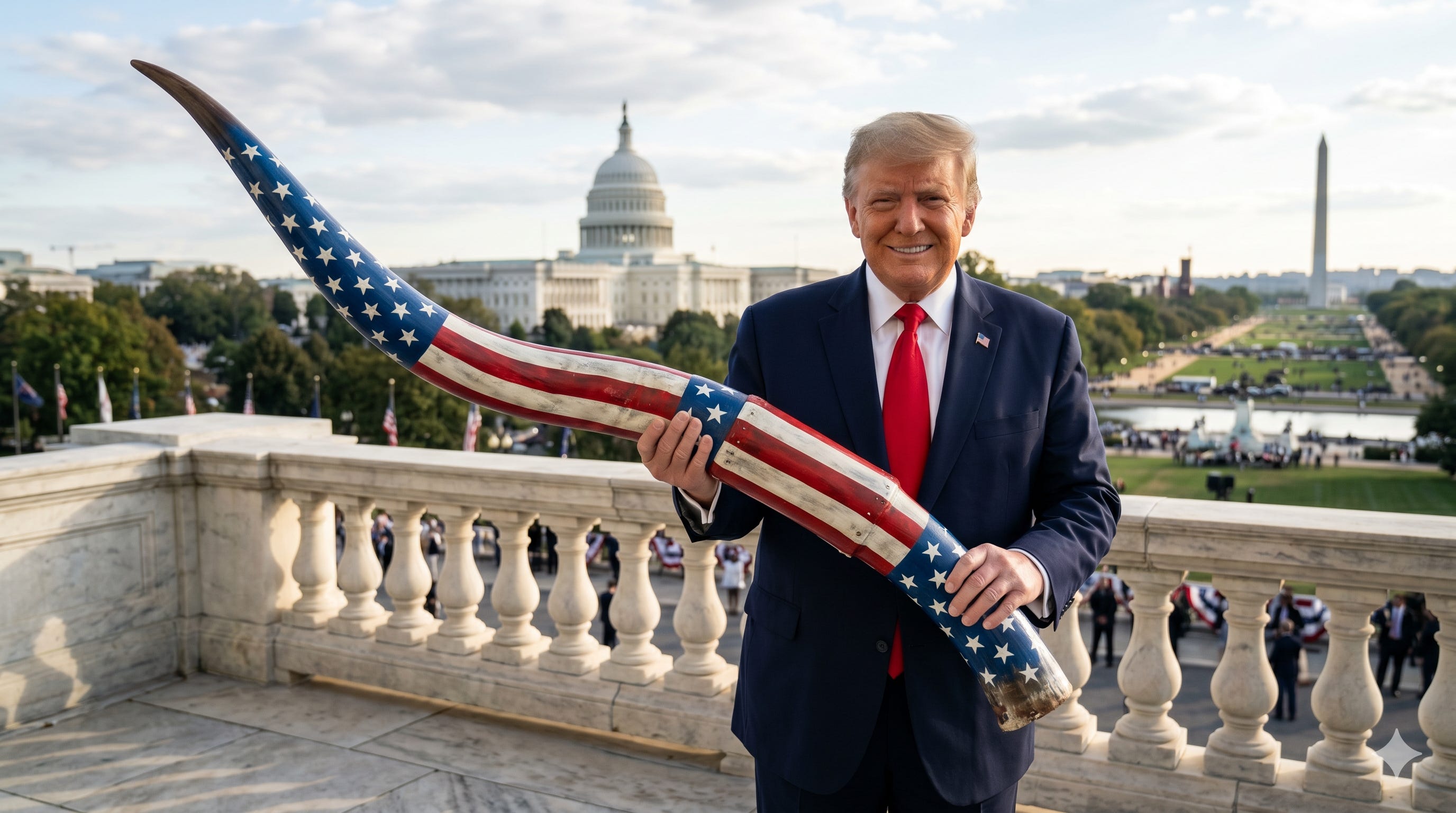
In 2016, I was in Amsterdam, high as a kite, when they announced Donald Trump’s victory. I hated Hillary Clinton because her arrogant interventionism alongside Obama murdered Gaddafi and brought the slave trade back to Africa, but I actually wanted Trump to win for another reason. Not just because I preferred him to Clinton, but because I was persuaded by his performance. He felt real. I think in the same way Obama felt real to my dad in 2008, Trump felt real to me in 2016. He was a white man who did not bend to any authority. Unlike Obama, Trump did not count on his cleverness to game the system; he counted on his unapologetic authenticity to give the system the middle finger.
He was only interested in impressing the Americans that considered voting for him. He was not waiting around for permission or any kind of endorsements that we had grown accustomed to associating with American democracy. He prioritized his voters over the institutions that had self-appointed themselves kingmakers. You see, like my father, I too was now old enough to stop pretending that the mysterious ventriloquist hand did not exist. But because Obama had already falsified the model of this hand being a white-only hand, the predictive model I constructed assumed this hand belonged to the institutions that shaped the American mind: Education, Entertainment, News, Banking, and the Military.
So you have to understand why, when Trump gave the middle finger to all these institutions, I had no option but to root for him. I didn’t really care what Trump stood for; I am not American. I was sophisticated enough at this point to see through fancy modernist phraseology like “Democracy,” or the new opposite created just to vilify Trump: “Populism.” Apparently, democracy was no longer about having majority support, but about having the correct majority support. Otherwise, what you have is populism. This framing was especially odd in America’s case, considering Hillary actually won the popular vote. Trump won the Electoral College—a system intentionally designed to prevent a candidate from gaming an election through populism. Yet, populism was suddenly deemed so bad for so many reasons that no one had the time to list them all, though the list always included Hitler. And what can you say after someone drops Hitler?
So yes, I suspected Trump was going to be a disaster—not any worse than Obama, or Bush, or Clinton before him—but I wanted him to win so badly just because I could not get myself to believe that he could. And his victory was announced when I was like ten times as high as I had ever been in my whole life. You can imagine how such a coincidence can trigger a marijuana-induced psychosis in someone.
Like any self-respecting nutjob, I started connecting the dots in retrospect in order to convince myself that I in fact predicted the Donald Trump election victory. The first sign of his victory was his performance on the comedy central roast of Donald Trump where he seemed a little too insecure about his bank balance. His performance during the debates and media appearances during the campaign were unlike anything expected of any country’s president, let alone America. For the dots that I couldn’t quite fit easily, considering how high I was at the time, I was even willing to go as far as convincing myself that I manifested his victory.
One important thing that comes out of watching a successful rebel beat an establishment is the hope and permission to create that the rest of society suddenly feels entitled to. Eventually, any game played within an establishment is reduced to rule-following. And if all players are following the same rules, then success within such a game is reduced to favor from that establishment. That is why every bureaucracy inevitably decays into nepotism and other forms of corruption. So the moment one person is able to succeed without the favor of the establishment, such a player introduces chance into the game. And for most players, such chance is all the hope they need to believe in the game again.
Dr. King is claimed to have said that, “No one is free until we are all free.” That sounds nice when you’re rallying a tribe up for war, but the truth is people can only be free in a system that has people who are not free. Otherwise, freedom wouldn’t be a thing. It is not a constant of the universe. I believe what Dr. King meant to say is that, “As long as there exists one free man, we all have the potential to be free.” He perhaps preferred sounding lyrical, or maybe considering the situation he was addressing, using a negative statement was more resonant to his audience.
All this to say, that Trump’s victory—and perhaps a significant dose of marijuana—made me believe again. History is not complete. The rules of the world aren’t written in stone. There is still a contribution to be made.
When we came back from Amsterdam, I decided not to renew my contract with my employer then, a big and important global institution. I was frustrated by the bureaucracy. It was not just too big for me to change; my decisions while there made no impact at all to the organization’s approach, direction, or momentum. I felt that my contribution was insignificant. It was like the way any action one takes on Earth doesn’t alter in an observable way the trajectory of the Earth around the sun. So I decided that leaving that big gravitational field of my employer and finding a small place where my curvature of spacetime is significant is the best way for me to start. If I am lucky, I will be able to attract enough attention to accelerate with me until our collective force is big enough to matter.
Bureaucracy is not all bad. It has some redeeming factors; a mechanized system of decision-making that relies on seeking permission before action immunizes society from the volatility of impulsive radicals. But like all vaccines, immunizing someone against polio and infecting them with polio is a matter of careful precision. This friction can sometimes turn into complacency, and a tool designed to regulate the rate of change becomes a weapon to exploit that rate. In societies with a power higher than the bureaucracy, corruption can be utilized to grow the society while redesigning that bureaucracy to primarily concentrate power in the hands of a dictator or monarch. Or for America, what nutjobs like myself call the Deep State.
America, or what the rapper Tupac called “The System,” is a structure of power with roots in the days of slavery that is sustained by the exploitation of one tribe of people by another. The tribe that does the exploiting and the tribe that gets exploited will always change, but for this system to function, there always has to be an exploiter and an exploited.
With advances in mechanical engineering, the manual labor that the Black slave provided was cheaply and more reliably replaced by machines. Slaves had to be freed to prepare for the intellectually demanding work they were being promoted into. With this freedom, hard work or favor from the exploiter was no longer the only path for the exploited to become exploiters. A new path—mobilizing the victimized—was opened. Essentially, the way such a tribe is made is when someone broadcasts their values and hopes their charisma attracts the right attention, allowing them to reel in followers who share those values.
Victimization allowed power-mongers to create tribes out of individuals who shared a similar perception of exploitation. This tribalism by victimization reached its peak during Obama’s presidency, a time when almost all Americans identified as victims in one way or another. The institutions that shape the American mind ranked these new tribes based on their level of victimization: placing Black people and women at the top of the ranking, and men, white people, and billionaires at the bottom. Some groups were even clever enough to merge into massive political blocs based on proximity of victimhood—giving birth to the modern LGBTQA+ political machinery. This bloc climbed the rankings so fast that, even after the killing of Osama bin Laden, most people consider the legalization of gay marriage under Obama his biggest contribution to American politics. The lesbians did not invent this trick. Europeans had previously merged into the so-called “white” race in an attempt to create a resilient, and what they perceived as a superior, race of humans until Hitler overplayed that script.
In the same way the Industrial Revolution effectively ended the need for manual slavery, the digital revolution—especially social media—effectively ended the need for tribal leaders. Leaderless uprisings in Egypt, Tunisia, and Libya served as clear case studies that a political cause no longer needed a Dr. King.
Then came Donald Trump and the new tribe against victimhood. His rise was a reaction to the victim power grab in America—the so-called “woke” movement. He rallied the whites. He rallied the men. He rallied the Christians. He converted the billionaires. He even appealed to the victims directly, bypassing their leaders. He made the case that the tribal leaders of the victim tribes weren’t victims themselves; they were just politicians. And if their power was based on you staying a victim, why would they dare to liberate you?
Then he won.
Trump’s first term was not bad actually. He delivered what he promised the best he could given the friction he was working against. Then COVID-19 hit and the American democratic process changed at his re-election. I am not saying the election was rigged or any weird conspiracy about COVID, but I hope you can understand why a nutjob like myself saw COVID as the most convenient coincidence that almost felt like a conspiracy between God and Satan.
While sitting out Biden—or like Trump called it, Obama’s third term—Trump read Taleb’s Antifragile. He used his expulsion on Twitter to launch a one-man Twitter clone he could control, literally dodged a bullet or two during his third campaign—another convenient coincidence to a nutjob like me—and asked the American people to trust him again. He won much more than he did the first time.
But no one is bigger than America. No one is bigger than the System. Not even Trump. A man who stood on ending the forever wars has instead turned war into daylight terrorism. Schools and hospitals have been bombed in his name in Gaza and Iran. He has gone on social media and threatened to bomb an entire civilisation, including the infrastructure and civilians he claims to have started the war to liberate from their bad leaders. Like typical Osama bin Laden terrorism shit. The System used his pride and antifragility to get him to own all this carnage on his own social media for the history books. Perhaps his grand plan is to delete his social media site to confuse future historians.
Among the Baganda, we call the system that America is today Ejembe. Okuwanga(creating) ejembe is the ritual of building a spiritual and symbolic system to force the favor of gods to protect you, build wealth for you, and harm your enemies. The Baganda believe that when an Ejembe outgrows its builder, it can only be calmed by feeding it blood. And it prefers human blood to animal blood.
The American forefathers were powerful occultists(bali balogo ddala). But they would be sad to see how those they trusted to maintain their Ejembe have turned it into a bloodthirsty musambwa (spirit).
Usually, when an Ejembe runs out of control, it needs a very strong musamize (priest) to destroy it. But Amelika is so wild that no single musamize can tame it anymore. The System has perfected the art of corrupting anyone who attempts to take it on. Or at least this is an intentional signal the deep state is broadcasting. That America is a nonliving thing on a trajectory that no American is capable of altering. The bureaucracy has completed its job of transferring all the power away from the Americans to the deep state. And that Democracy is now even less like wrestling and more like Rocky, a fully scripted feature film.
People assume that there is a “normal” to go back to after Trump. In the exact same way, Trump supporters believed there was a normal to go back to after Biden. But there is no normal.
A big part of the reason the American democratic experiment has held strong so far is because the American System is designed to deliberately tarnish the image of its presidents within the eight years they run the country. The System grinds them down, exposing every flaw and manufacturing enough friction so that they don’t get tempted to engineer a third term or declare a life presidency—a temptation that Ugandan and many other African presidents have so easily succumbed to. So now that you know there is no normal to return to, where does America go from here? What could be worse than a president who literally threatened to terrorize a whole civilization openly on social media?
You’ve probably heard the historical adage that the Roman Empire did not fall; it just turned into the Catholic Church. Or, looking closer at modern history, you can see how the fading British Empire didn’t vanish; it transformed its center of power into the financial capital of the world, The City of London, turning the empire into a bank. We’ve been told that every time an empire dies, a new one is born, but the truth is empires never really die. Like Ejembe, empires can never be destroyed; they can only be transformed. The political center can pivot—like it did from Westminster Abbey to Washington D.C.—but the mechanics and goals of the bureaucracy almost always stay the same.
The only way America survives the damage that its recent leaders have done to its name is if it gracefully retreats in the same way the Mighty Great Britain did. Washington D.C. can no longer hold the political center of the empire. But before we even ask where the center goes, we need to ask what the American equivalent of the Church or the Bank looks like. What does Ejembe Amelika transform into?
It is most likely going to be a Data Center.
The Church was needed to wake civilization out of the Dark Ages. The Bank was needed to defend and spread capitalist ideology. And we now know that the Data Center is the ultimate tool of control in the age of Artificial Intelligence.
Americans will likely have many more presidents after Trump, but most of them are going to be tasked with managing a smooth migration of the empire’s political center to the East, most likely to China. The incoming era isn’t going to be a hot war over territory; it will be a Cold War-style standoff as the globe fractures into the declining Western bloc and the rising multipolar East.
Which begs the question: What does a world led by China look like?
The brutal truth is that a world led by China looks like just another massive, hyper-centralized Ejembe.
If the American Empire becomes the world’s algorithmic landlord—the Data Center tracking your every move, thought, and transaction—and China becomes the new Political Center controlling the physical infrastructure and global supply chains, humanity is simply trapped between two massive black holes. You aren’t achieving freedom by moving from one orbit to another; you are just choosing which gravitational field crushes you.
So, where is the hope?
Replacing the Ejembe requires replacing it with a new one. But the solution is not a stronger musamize. It isn’t finding a new populist rebel to grab the steering wheel of the American Data Center, nor is it submitting to the new Chinese political center.
The solution is a decentralized Ejembe—a system with multiple points of power that can accommodate many basamize, built on interconnection rather than centralized authority.
We cannot destroy the American Ejembe by fighting it head-on, because it feeds on that friction. Instead, we must starve it of our attention and energy. We do this by escaping its massive gravitational pull and organizing ourselves like a galaxy.
We already have the theoretical tricks to build this new Ejembe, even if it is still a work in progress. Look at the core philosophy of the blockchain: strip away the crypto-casinos, and what you have is an architecture designed for trust without a center. It is a mathematical system that distributes power away from the gatekeepers, immunizing itself from corrupt bureaucrats. Look at the global shift toward multipolarism; while it is messy, it proves that the unipolar center cannot hold forever.
The ultimate rebellion today isn’t voting for a populist to capture the center. The ultimate rebellion is walking away. It is taking your energy out of the black hole’s orbit, creating your own localized curvature in spacetime, and joining a decentralized galaxy of free men. Let the old empires retreat into churches, banks and data centers. We have a new universe to build.
No posts
Comments
Nothing yet. Say the first thing.
Sign in to join the conversation.