
I found “my people” on twitter around 2018-2019. A loose group discussing Slate Star Codex and Ribbonfarm and Meaningness, and I thought they were sooo cool. Reading their tweets felt like drinking big gulps of insight and over time I relaxed into it and they became my real-life friends and conspirators.
This scene has enriched my life so much that I can’t help but love it and seek to understand it - how come these people are so generative? A big part of why I started the Community Archive is that I wanted to do digital anthropology on it and needed the data.
The Core Loop
Remember when Nick Cammarata tweeted about the Jhanas? And then Scott Alexander spread it in rationalist communities? Then Jhourney schlepped jhana retreats to get you there much faster, and now jhanas are blowing up so much they get hit pieces?
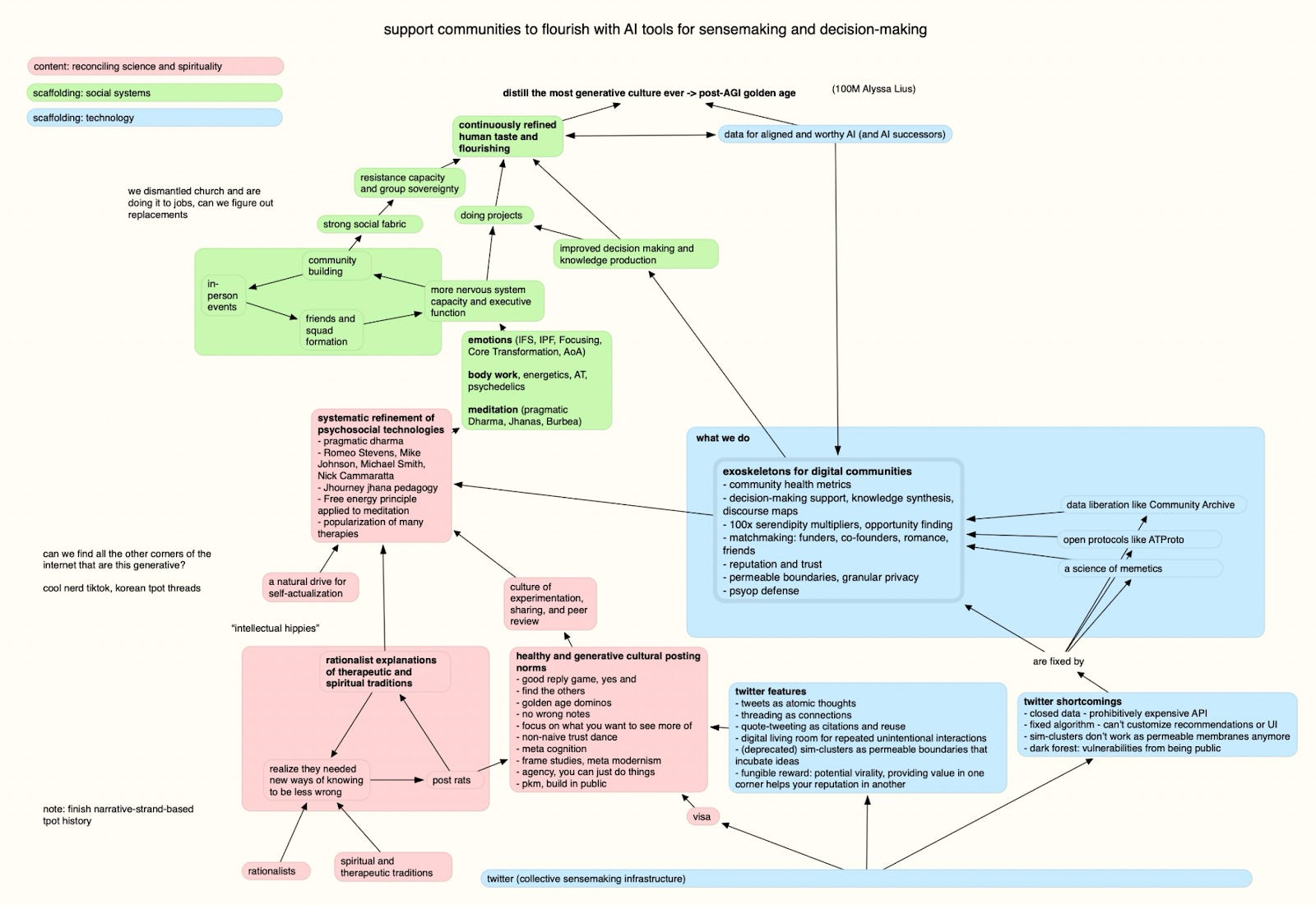
This is a specific instance of a larger pattern I claim is the core loop of tpot. Or to be more specific, the subset of it I would call “postrat” twitter.
As far as I can tell, this loop has surfaced, refined, and popularized practices like meditation and different schools of buddhism, different interpretations of Christianity, Internal Family Systems, Ideal Parent Figure, TRE, Core Transformation, clowning, improv, Circling, somatic therapy, qi gong, fighting monkey, different kinds of event organizing, experience design, and community building.
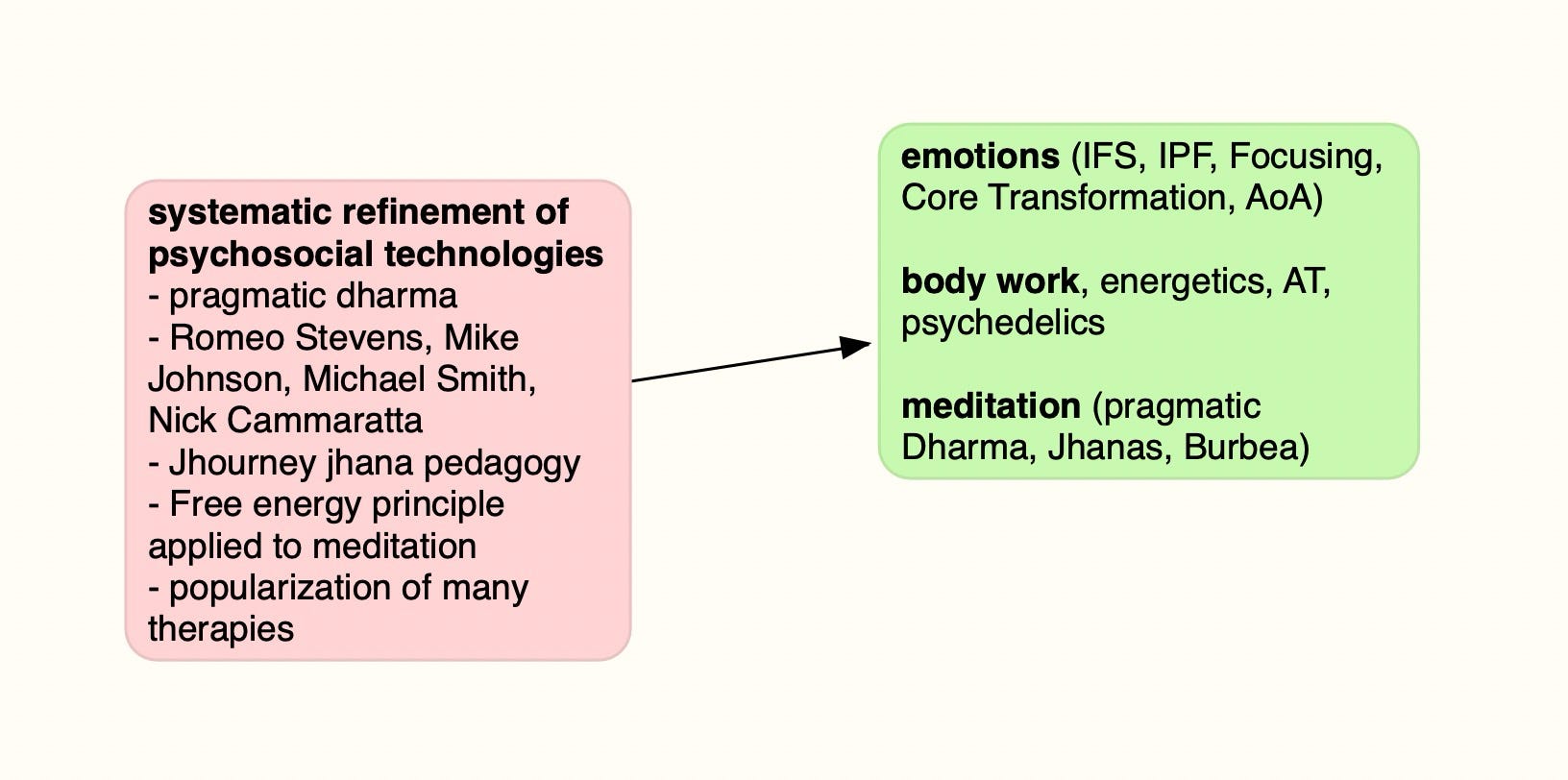
The loop goes something like
Some ex-rationalist learns about a new-agey practice or an old religious text
They then explain them in “rationalist terms” that others are persuaded by;
Other rationalists try them, peer-review (real peer-review), try different tweaks, and knowledge accumulates based on what works
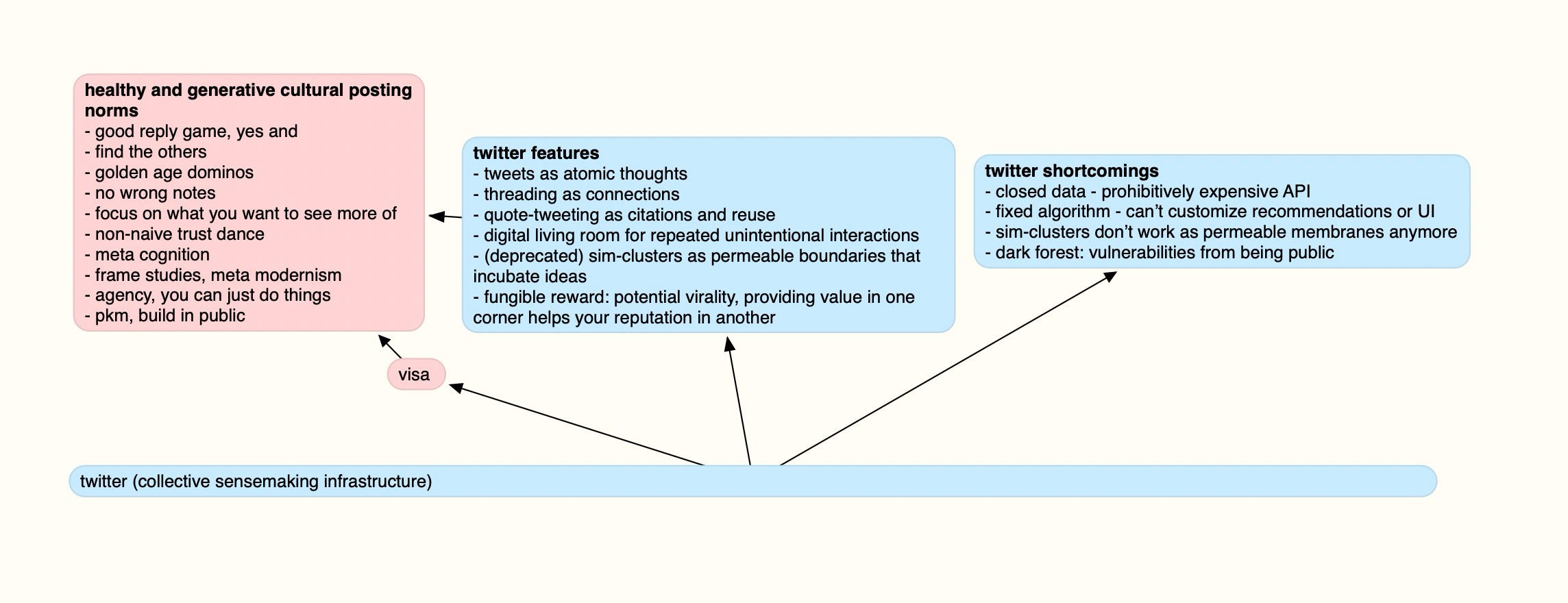
The success is partially owed to the content of discussion. But another key is the healthy and generative norms around posting on twitter that tpot adheres to. Many of these can be attributed to Visa, who has been prolific on Twitter since 2014.
good reply game and twitter as improv, twitter as an mmo rpg
“focus on what you want to see more of” and “joke about the outcomes you want”,
Plus Visa’s heavy use of threads and quote-tweets and threads of threads to grow a corpus, stretching the medium of twitter, got tpot to do the same.1
The two spheres of “twitter poaster” and “post-rationalist” collided to birth a scene of *checks notes*... “poast-rats”.
Poast rats try a bunch of practices and share them, peer-review amongst themselves,, and the best methods become more popular and more validated and tweaked and evolve and make people better and more capable of doing research and other projects.
The core loop of tpot is supported by 2 scaffolds. On one hand, it originates from a technical substrate: people talk on twitter. On the other, it gives rise to a social scene that reinjects energy and bandwidth into the core loop.
Tpot people spent COVID having a great time chatting on twitter, researching, shitposting, booking zoom calls, even occasionally travelling and meeting in small groups, and by 2021 everyone is excited to meet in real life. And they do because Jess runs the first Jesscamp in Lisbon Feb 2022, and Brooke and company run Vibecamp near Austin in Mar 2022! It felt like a magical moment when lightning was waiting to strike for a long time and boy did it strike.
These events started a steady stream of camps, events, and gradually even local long-term loose scenes in Lisbon, SF, Berlin, Boulder, and later, inspired by communities like Fractal NYC, neighborhoods in NYC, London, Porto, Geneva, Boston, etc.
My claim here is that the ecology of practices that emerges from the core loop makes people more resourced and competent at being in relationship with one another, which forms a feedback loop with building community, running events, and other arbitrary projects.
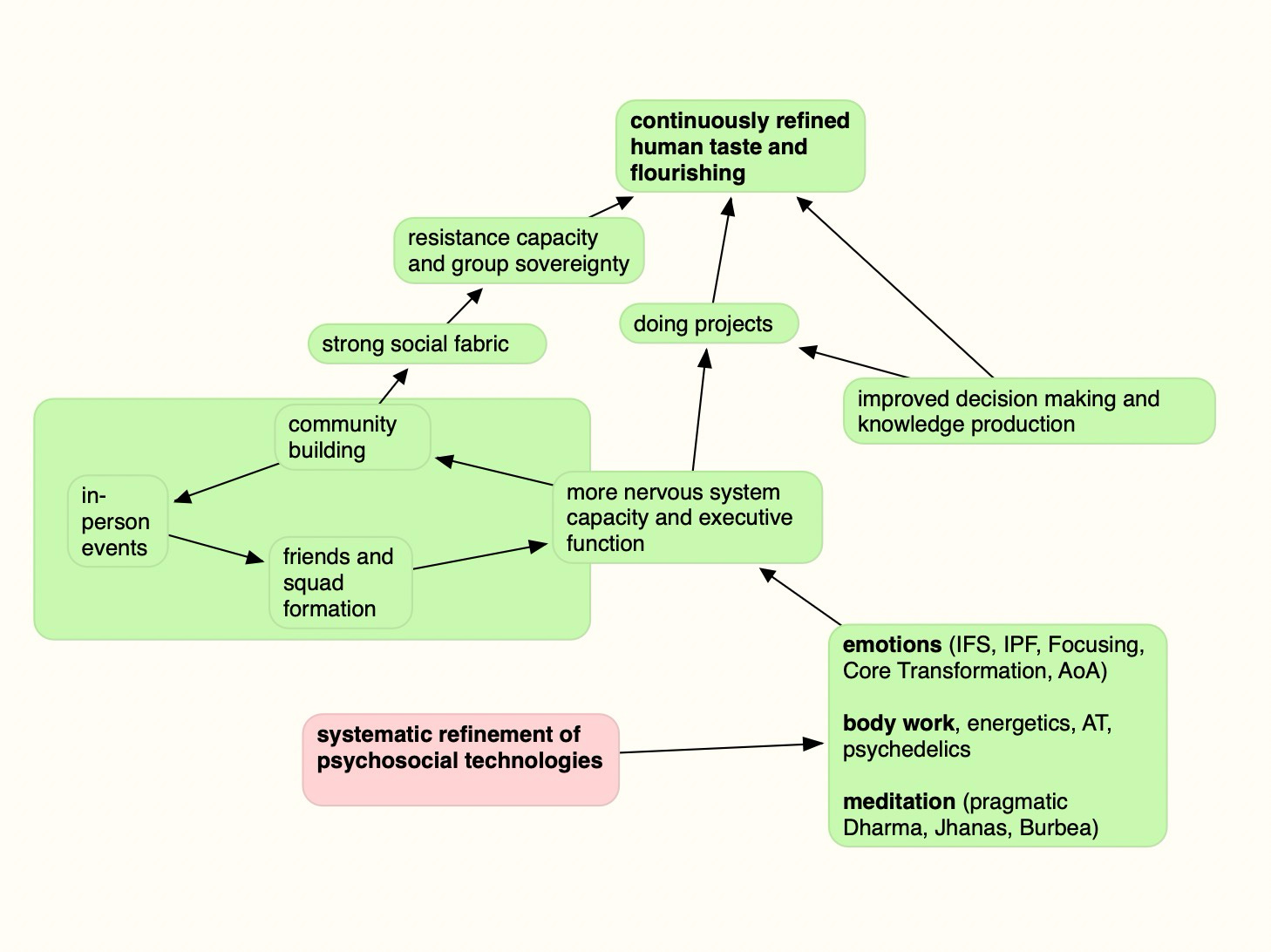
Being together in real life gives you more bandwidth to develop your practices and research further, but even after getting irl tpot cities, the online layer still hums. It connects hubs, diffuses ideas in real time, and hosts the written record where knowledge crystalises as threads and blog posts.
I think it’s really cool that Visa set up a system of self-reinforcing memes for how to play the game of twitter well, in a way that maximizes insights, collaboration, serendipity.
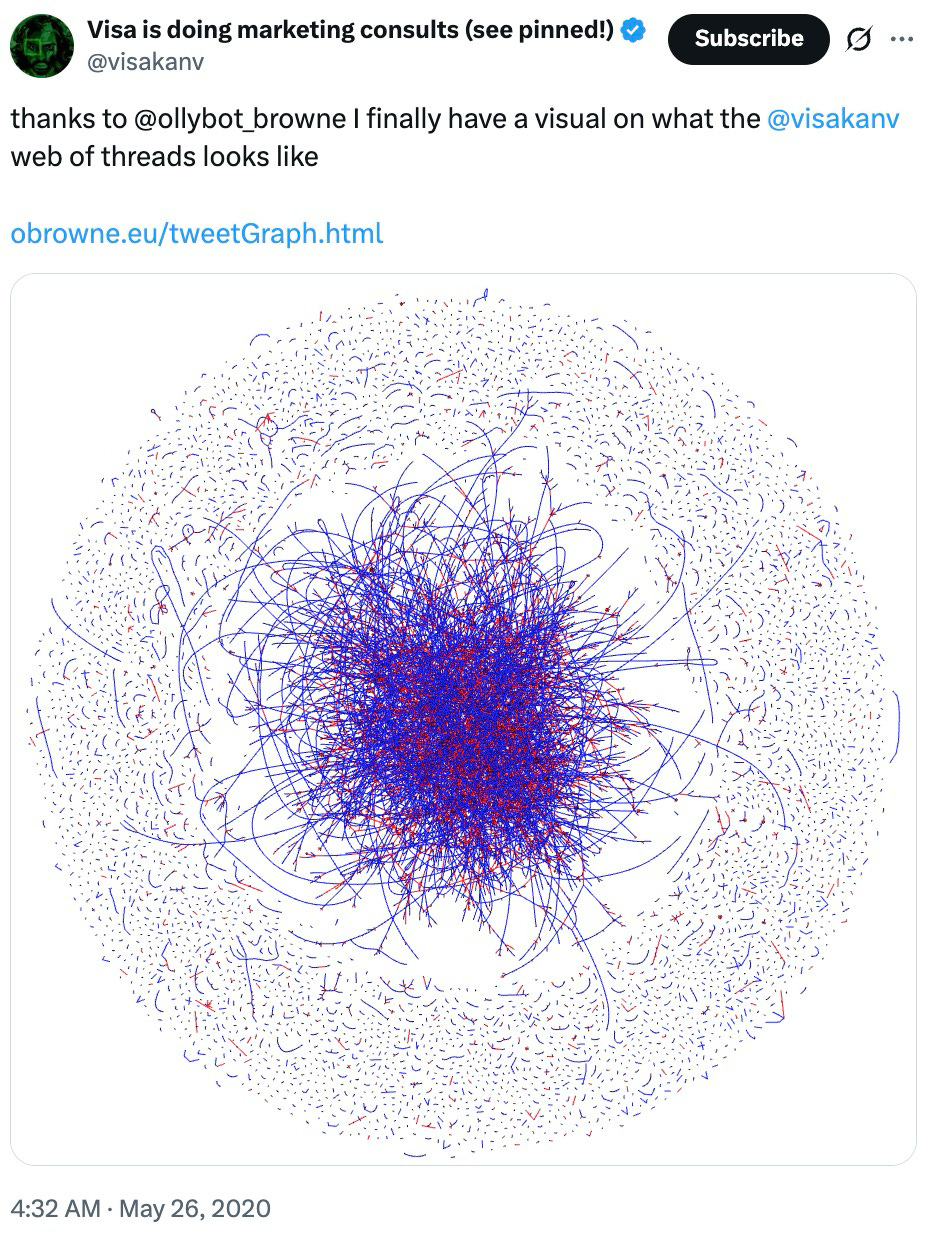
He also regularly took Twitter features to the limit, like with his massive threads of threads.
The reason this can even happen, is that twitter has well designed primitives:
Tweets work as atomic units of thought;
Threads compose atomic tweets into longer form;
The quote-tweet feature allows you to cite existing tweets in new contexts;
At its best, the feed works as a digital third space where people can interact in low stakes ways and incubate their ideas. It has permeable boundaries where your tweets are mostly seen by your homies unless you go viral.
Rewards are fungible - the likes and followers you gain by being helpful or going viral in one part of twitter translate to all other ones, unlike in topic-specific forums.
All this emerged on twitter despite it not being designed for the sensemaking purposes I’m describing in this post! Imagine what we could do if the technical substrate actually supported community and knowledge production! What if we could have 100x more serendipity?
Postrat twitter has worked as a pre-paradigmatic research scene that consistently uncovers and polishes wisdom from spiritual and therapeutic traditions! This has paid off in in-person community, regulated nervous systems, and generally impressive projects in the world.
I want a more exhaustive list of projects that came out of the scene, as well as specific instances of wisdom being surfaced and refined. I would probably make a long empirical post with lots of tweets and minimal commentary.
Nick Cammaratta on jhanas
Romeo Stevens on mistranslating the buddha, Core Transformation and a million other things
Mike Johnson: symmetry theory of valence, principles of vasocomputation
Michael Smith: explaining subjective science, embodiment, enneargram
QRI: mathematical models for phenomenology
Roger Thisdell: explaining meditation in philosophically rigorous ways
Jhourney: teaching jhanas 100x more effectively
Brent: Aletheia and IFS AI tools
Anita: IFS
Kristijan: movement and meditation
Pranab: attentional copiloting
Max Shen: chronic pain with contemplative practice
Art of Accomplishment: emotional fluidity
The intended audience for this is tpot regulars. May broaden in the future. Special thanks to Christine for lots of input on the green sections. Grateful to @nosilverv for editing. Thanks Andrew Rose, Priya Rose, Mark Estefanos for proof reading and feedback.
No posts
Comments
Nothing yet. Say the first thing.
Sign in to join the conversation.