
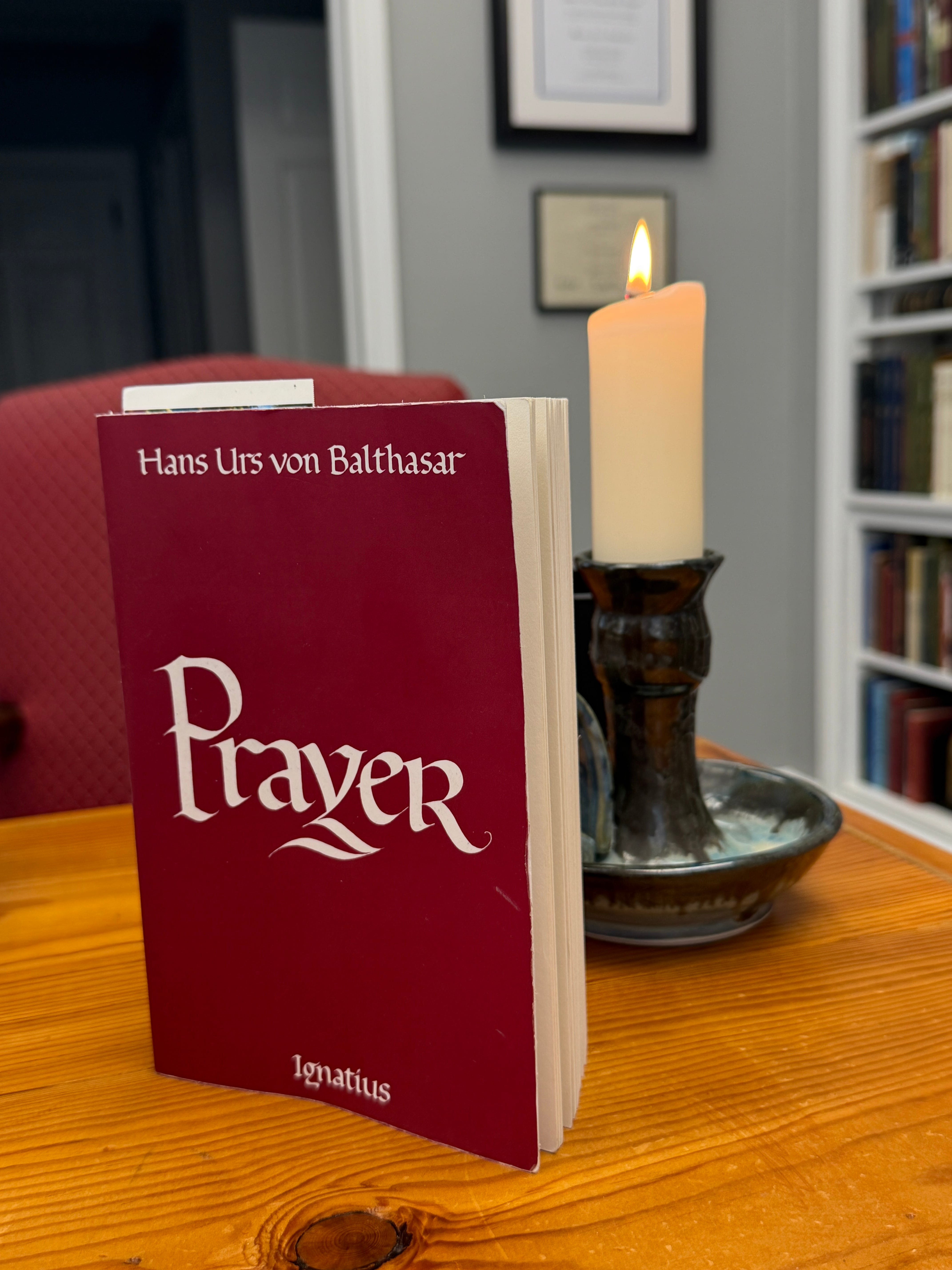
It’s been nine months, dear readers, since I last wrote about Hans Urs von Balthasar’s beautiful and fascinating book, Prayer. I started this review in the interim between leaving Central Baptist Church in North Little Rock, AR, and coming as the pastor at First Baptist Church in Camden, SC. I am happy to return to it now.
We now turn to Chapter 1 of Part 2 of the book, “The Word is Made Flesh.”
I was immediately reminded, in picking this review back up with the second half of the work, of just how stunning and beautiful this book is. Balthasar was a fascinating thinker who wrote with a pastoral heartbeat. Once again I found myself marveling at much of what he has said here.
In short, in this chapter, Hans Urs von Balthasar turns the spotlight on Jesus Christ. He invites us as believers to marvel at the hypostatic union of the two natures of Christ (divine and human) and ground our contemplation of the greatness and beauty of God in the mystery of this union.
He begins by drawing a clear distinction between God as the ultimate ground of being and human beings, who can never be God.
Everything is possible to the creature except one thing: it cannot be God. The creature is in root and marrow fundamentally different from him and will remain so for ever. (155)
Balthasar frequently waxes eloquent and moving:
Fundamentally, God is the “Other” in every possible way, and so he is the answer to the question which I am. (156)
The question being, essentially, “How can I be if God is all, ‘the ocean of Being’ (156)?” Balthasar leans into this to highlight the sheer marvel of the incarnation of Jesus.
There was only one way out of this impasse, namely, that infinite, eternal Being should utter its own self in the form of a relative being. (p.157)
That is, that God (i.e., “infinite, eternal Being”) should become man (i.e., “relative being”). This is “the mystery of the hypostatic union.” (157)
That God became flesh, that Jesus has come, should cause us to tremble with awe and wonder! I loved this:
Unless a person is acquainted with trembling awe, reaching down to the very ground of his being, at the thought of God’s nature (not merely the awe he feels in the face of the “mysteries of existence” and the deep things of the world), he will not be ready for the contemplation of Jesus Christ…Anyone contemplating the life of Jesus needs to be newly and more deeply aware every day that something impossible, something scandalous has occurred: that God, in his absolute Being, has resolved to manifest himself in a human life… (159)
This is not dry theology! This is worship! My own heart thrilled to read this. I agree completely!
Balthasar calls for contemplation to “take up residence in the mysterious environs of the hypostatic union, where it will be able to observe all that is human opening out into the divine, and the divine entering into the human.” (p.164)
There is more here, but this is the great point, and it is enough: Prayer is the awestruck, amazed, worshipful contemplation of God by man offered at the feet of the beautiful God who has become man in Christ Jesus.
My goodness, what a chapter! My goodness, what a truth!
No posts
Comments
Nothing yet. Say the first thing.
Sign in to join the conversation.