
I am aware that I have some readers who believe in and practice infant baptism. I would like to be clear on something out of the gate: I do not believe infant baptism is the biblical model, but neither do I consider the baptism of infants to be heretical or diabolical. I disagree with it, but I do not detest it the way I detest, say, denials of the bodily resurrection of Jesus. For this reason: The basic argument (as I take it) behind infant baptism—that it finds its precedence in circumcision—is, in fact, an actual, substantive argument and one around which a biblical case can be legitimately asserted by well-intended believers. There is an internal logic to it that takes scripture seriously. Simply put, it is not absurd to argue and believe that just as the children of the people of God received the physical mark of their covenant belonging in their infancy in the Old Testament, so too they do so through baptism in the new covenant. I think this is a mistake. I think it is an error. I do not think it is wicked. My feelings concerning this can be seen in my own conviction that all who have trusted in Christ, whether baptized as believers or as infants, should be welcome to the table of the Lord, even as I would continue to call for all to be baptized on this side of their confession of faith.
So what I am about to write is not intended to attack, even if some who I quote from yesteryear do indeed attack (as they were prone to do!). Rather, it is intended to explain my own mindset and my own journey.
Interestingly enough, I never felt the pull of infant baptism during my journey, and I do not feel it now. As I stated, I hear and appreciate the argument, but I am not swayed by it. In fact, I believe that the baptism of believers is ingrained in the earliest historical strata of the Christian story.
I believe that baptism is (1) for believers and (2) by immersion. The former concerns its subjects and the latter concerns its mode. I consider the question of the subjects (who is to be baptized) to be of more importance than the mode (how they are to be baptized), though I do indeed hold that the mode is by immersion. I note that there is some evidence that the question of the subjects of baptism was agreed upon by the Baptists of England before the question of the mode, though, fairly early on, the vast majority of Baptists came to the same conclusion on both.
In short, I believed and I still believe that the order of the Great Commission in Matthew 28 still holds:
19 Go, therefore, and make disciples of all nations, baptizing them in the name of the Father and of the Son and of the Holy Spirit
That is:
Make disciples.
Baptize them.
The absence of any clear picture of the baptism of infants in the New Testament is significant to me. So, too, is the evidence that the baptism of infants was not practiced until the 2nd century and that, in its earlier forms, it appears to have been at the panicked request of parents as they stood by the deathbeds of their infants (i.e., infant baptism in its origin was an emergency concession for worried parents and not a positive practice intended to be normative).
I have also been struck over the years by the number of people in infant-baptizing communions who express their recognition of the desirability of baptizands giving consent to and having conviction concerning the gospel, their own faith, and their baptisms.
This recognition of the need for actual conviction is what gave rise to the practice of confirmation. Those in infant baptizing communions today will sometimes say that the Baptist “baby dedication service” is simply baptism without water. From their perspective it is. I wholeheartedly concede that credobaptist communions (like Baptists) desired to develop some way of recognizing the significance of and place of infants in the church. But Baptists look at confirmation services in paedobaptist churches and call these baptisms without water! Believers baptism folk created a ceremony to acknowledge infants. Infant baptism folk created a ceremony to acknowledge the moment when a child of God owns their own faith. (Interestingly enough, in 1526, the Paris faculty of theology condemned as “rebaptism” the proposal of Erasmus that “that baptized adolescents be given instruction in the faith and then, in solemn ceremonies, be asked to swear an oath of allegiance to the faith.”1)
The question is, at which of these ceremonies should the application of the waters of baptism be applied?
One feels this, intuitively: the preferability of belief preceding baptism. Be honest: Do we not all recoil or at least flinch at Luther’s naked and blunt mockery of the idea that baptism needs belief to be valid? Amazingly, Luther wrote the following:
How can baptism be more grievously reviled and disgraced than when we say that baptism given to an unbelieving man is not good and genuine baptism!…What, baptism rendered ineffective because I do not believe?…What more blasphemous and offensive doctrine could the devil himself invent and preach? And yet the Anabaptists and the Rottengeister are full up to their ears with this teaching. I put forth the following: Here is a Jew that accepts baptism, as happens often enough, but does not believe, would you then say that this was not real baptism, because he does not believe? That would be to think as a fool thinks not only, but to blaspheme and disgrace God moreover.2
I would contend that baptism without belief is a water rite, a water ceremony, but not true baptism.
Nor can the issue be sidestepped by arguing, as some have, that the New Testament does not contain an explicit prohibition of infant baptism, a clear, “You are not to baptize infants.” In response to Zwingli’s arguments along these lines, the Anabaptist theologian Balthasar Hubmaier thundered:
But that it is not written explicitly: “Do not baptize them,” to this I answer: Then I may also baptize my dog and my donkey, circumcise little girls, mumble prayers and hold vigils for the dead, call wooden idols St. Peter, or St. Peter and St. Paul, take infants to the Lord’s Supper, bless palm branches, herbs, salt, butterfat, and water, sell the mass as a sacrifice. . . . You say: It is forbidden to baptize donkeys because Christ told us to baptize people. Well, then, let us also baptize a Jew and a Turk. You say: Yes, one should baptize people who believe. Answer: why, then do you baptize infants?3
I am persuaded that the apostolic and early church baptized believers. Many who hold to infant baptism admit as much. Zwingli, who held to infant baptism, observed that “in former times, the young were taught before baptism.”4 Martin Bucer, who held to infant baptism, writing to Luther in 1524, noted that “it would be better and more in keeping with the custom of the early Church and [the teachings of] Scripture—which desires that those who have been taught about Christ should be baptized—that only adults be baptized since they have been taught Christian doctrine and can therefore confess Christ in baptism.”5
It is interesting to find those in infant-baptizing communions expressing their preference for believers baptism, even while not rejecting infant baptism. For instance, the Methodist New Testament scholar Ben Witherington III writes:
Eighth, because infant baptism was not the normal sort of baptism the New Testament writers had in mind, I suggest that we should not treat it as the normal practice, much less the normative practice, of the modern church…There is no doubt…that water baptism is more meaningful and more appropriate for those who receive it if they are of an age when they can at least begin to appreciate its significance.”6
Søren Kierkegaard, a Lutheran, rejected infant baptism, and wrote:
So they notify the priest, the midwife arrives with the baby, a young lady holds the infant’s bonnet coquettishly, several young men who also have no religion render the presumptive father the service of having, as godfathers, the Evangelical Christian religion, and assume obligation for the Christian upbringing of the child, while a silken priest with a graceful gesture sprinkles water three times on the dear little baby and dries his hands gracefully with the towel - -
And this they dare to present to God under the name of Christian baptism. Baptism—it was with this sacred ceremony the Saviour of the world was consecrated for His life’s work, and after Him the disciples, men who had well reached the age of discretion and who then, dead to this life (therefore were immersed three times, signifying that they were baptized into communion with Christ’s death), promised to be willing to live as sacrificed men in this world of falsehood and evil.7
To be fair, Kierkegaard, who I otherwise admire, held some pretty bonkers views alongside some deeply profound ones! Which is to say, he was a human being. My noting the dissent of these prominent figures from infant baptism is not an endorsement of all their views. Nor, of course, does the citing of such solve the issue. Indeed, one can marshal quotes from those who left the Baptist fold to join paedobaptist communions as well. A perusal of Substack will reveal as much. Truth is not determined by quotations compiled!
The Swiss Reformed theologian Karl Barth shocked everybody by rejecting infant baptism and arguing that it was a necessary prop for and tool of the state church. He wrote:
The real reason for the persistent adherence to infant baptism is quite simply the fact that without it the church would suddenly be in a remarkably embarrassing position. Every individual would then have to decide whether he wanted to be a Christian. But how many Christians would there be in that case? The whole concept of a national church (or national religion) would be shaken. That must not happen; and so one proposes argument upon argument for infant baptism and yet cannot speak convincingly because fundamentally he has a bad conscience. The introduction of adult baptism in itself would of course not reform the church which needs reforming. The adherence to infant baptism is only one-a very important one-of many symptoms that the church is not alive and bold, that it is afraid to walk on the water like Peter to meet the Lord, that it therefore does not seek a sure foundation but only deceptive props.
The consequence of this adherence to infant baptism is the devaluation of baptism by so-called confirmation, in which baptism is supposed to be confirmed by faith, in which therefore the confession and desire which ought to precede baptism are supposed to be made up for later. Fifteen years later one is supposed to confirm his faith. This procedure is impossible. But it cannot be avoided so long as we hold to infant baptism, which is indeed incomplete without this subsequent confirmation.8
Note that final sentence: Baptism is incomplete without confirmation of faith. The Baptist joins the two acts (baptism and confirmation of faith) because we believe they are joined in scripture.
We are fortunate in our day to have seen the publication of Everett Ferguson’s massive and exhaustive study entitled Baptism in the Early Church: History, Theology, and Liturgy in the First Five Centuries.
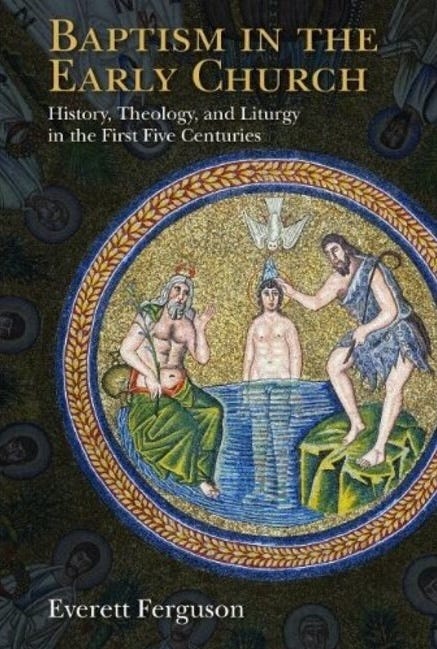
Widely and rightly regarded as the most significant modern publication on the question of how the early church viewed baptism, Ferguson’s impressive work has much to be commended, as well as things with which we might disagree (i.e., his strong emphasis on baptismal regeneration). This much is clear, his arguments need to be reckoned with.
In his “Conclusions,” which being on page 853 (!!!) of the book, Ferguson argues on the basis of his evaluation of scripture, early Christian art, catacomb art, and the writings of the church fathers, the following:
Christian baptism was distinct from John the Baptist’s baptism in that it called for “faith in Jesus” and being baptized in Jesus’ name.9
The Old Testament lessons to which the early church looked when thinking of baptism were the Red Sea crossing in the Exodus and Noah and the flood, “both already in the New Testament—1 Cor. 10:1–4 and 1 Pet. 3:20–22 repectively…”10
“Essential to baptism were faith (expressed in a verbal confession apparently from the beginning) and repentance…”11
“There is general agreement that there is no firm evidence for infant baptism before the latter part of the second century. This fact does not mean that it did not occur, but it does mean that supporters of the practice have a considerable chronological gap to account for.”12
In my own journey toward a healthy catholicity, the prevalence of infant baptism for most of the church’s history was outweighed by what I see as both the biblical arguments for believer’s baptism as well as the practice of the earliest church. That “chronological gap” referenced by Ferguson between the New Testament and “firm evidence for infant baptism” is, indeed, “considerable” and does indeed need to be “accounted for.”
I hold my belief in believer’s baptism by immersion with both conviction and humility. I certainly do not hold it in a posture of rancor or belligerence toward those who differ.
I am a Baptist on the question of baptism.
Friesen, Abraham. “Erasmus, the Reformers, and the Birth of Swiss Anabaptism.” The Anabaptists and Contemporary Baptists: Restoring New Testament Christianity. (Kindle Locations 4313-4320). B&H Publishing Group. Kindle Edition.
Patterson, Paige. “What Contemporary Baptists Can Learn from the Anabaptists.” The Anabaptists and Contemporary Baptists: Restoring New Testament Christianity. (Kindle Locations 442-447). B&H Publishing Group. Kindle Edition.
Caner, Emir F. “Sufficientia Scripturae: Balthasar Hubmaier’s Greatest Contribution to Believers.” The Anabaptists and Contemporary Baptists: Restoring New Testament Christianity. (Kindle Locations 2300-2305). B&H Publishing Group. Kindle Edition.
Friesen, Kindle Locations 4321-4332.
Friesen, Kindle Locations 4304-4308
Witherington, Ben, III, Troubled Waters: The Real New Testament Theology of Baptism (Waco, TX: Baylor University Press, 2007) 134
Kierkegaard, Søren. Attack Upon Christendom. (Princeton, NJ: Princeton University Press, 1968) 205.
Barth, Karl. Learning Jesus Christ through the Heidelberg Catechism. Translated by Shirley C. Guthrie Jr. (Eugene, OR: Wipf & Stock, 1948) 104–5.
Ferguson, Everett. Baptism in the Early Church. (Grand Rapids, MI: William B. Eerdmans Publishing Company, 2009) 853.
Ibid.
Ibid., 855.
Ibid., 856.
No posts
Comments
Nothing yet. Say the first thing.
Sign in to join the conversation.