
Our recent article, “A Day Trip to Djebel Tanngoucha,” by Philip Eliason, explored the battlefield landscape around Djebel Tanngoucha, Heidous and the ridgelines above the Majerda Valley. The article looked at how the ground can still be explored today and how the landscape helps us understand the fierce fighting that took place there in April 1943 during the final campaign for Tunis.
The article also prompted a remarkable response on social media.
Richard O’Sullivan commented on the post, sharing the memories of his father, Edmund O’Sullivan, who served with the 2nd Battalion, London Irish Rifles and was present at Heidous during the Easter 1943 fighting.
His father had later recorded a detailed recollection of the attack on the village. His words offer a very different way of experiencing the same landscape that Philip Eliason describes in his battlefield walk: not from the perspective of a visitor exploring the ridges more than eighty years later, but through the eyes of a soldier who was there.
What follows is Edmund O’Sullivan’s account, together with some context about the fighting around Heidous and its place in the wider Battle of the Peaks.
The London Irish Rifles were allocated the task of attacking Heidous. The attack was planned for the evening of 22 April 1943.
At 5:45 pm, an enormous artillery barrage began.
Edmund remembered it as the most concentrated barrage he had experienced.
F and G Companies moved down the rocky rear slope of Bettiour. F Company formed up around the outskirts of Heidous before advancing towards the village, where the troops encountered intense machine-gun and sniper fire.
The attack quickly descended into confusion.
The forward platoons were held up, while the reserve platoon under Sergeant Norman attacked from the right. E Company was ordered forward to support F Company.
At the same time, G Company suffered a setback and its commander was wounded. Although the company had reached its objective, it withdrew at dawn after receiving no support.
The remnants of F Company remained concealed until daylight before withdrawing. E Company returned to Bettiour.
The fighting had been fierce and costly.
The following night, E Company descended from Bettiour once again.
Edmund followed immediately with his mules.
His description of the approach to Heidous is particularly haunting:
“It was eerie making our way by the light of the fires still burning in Heidous.”
As they entered the village, everything was silent.
They passed lines of dead London Irish soldiers, three or four together, led by an NCO, with their weapons placed in front of them.
Heidous had been taken, but at a terrible cost.
For a modern visitor following the route described in Philip Eliason’s article, it is difficult to imagine this same landscape filled with artillery fire, smoke, burning buildings and exhausted soldiers. Edmund’s recollection provides that missing human dimension.
This is what makes Richard O’Sullivan’s contribution so valuable.
Philip Eliason’s article encourages readers to walk the ground and look at the ridges, stone walls and valleys from the perspective of the battlefield. Richard’s comment brings one of the soldiers who fought there into that same landscape.
The two accounts, separated by more than eighty years, complement each other.
One begins with a modern walk through the countryside.
The other begins with a soldier descending towards a village under fire.
Together, they help us understand what happened at Heidous—and why these apparently quiet hills remain such important historical ground.
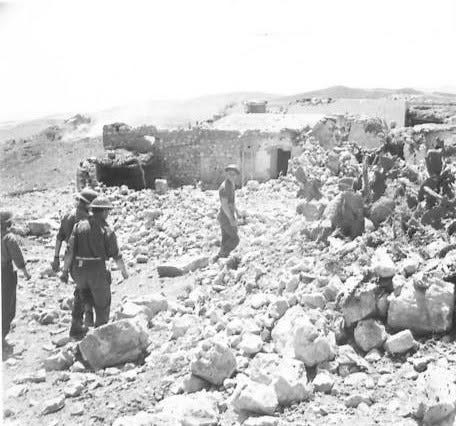
With thanks to Richard O’Sullivan for sharing his father Edmund’s recollections and the wartime photograph.
No posts
Comments
Nothing yet. Say the first thing.
Sign in to join the conversation.