
Individual submission by Jill Ovens - Women’s Rights Party co-leader and national secretary.
1 July 2026
I first became aware that something was up around 2018 or 2019, when, as co-leader of MERAS, the midwives’ union, I was attending a meeting of the Council of Trade Unions National Affiliates Council. We were considering a section on equity in the Draft Strategic Plan. There was to be equity for Māori, for Pasifika, for people with disabilities, for people of different ethnic groups.
I asked innocently: “I think there is a typo. The word ‘woman’ is missing. Did you forget to include women?” There was silence. “Oh,” I said. “I see you have included ‘different gender identities’. Is this meant to include women? But being a woman isn’t a gender identity.” More silence.
I posted this on my fb page and was piled on by my union friends, my Labour friends and my Green Party friends. “Do you admit that transwomen are women?” they asked over and over in what appeared to be a mantra. I didn’t think transwomen were women, but then I didn’t know whether a transwoman was a woman identifying as a man or a man identifying as a woman. I asked: “If I identify as Māori does that make me Māori?” “No,” they responded. “You have to whakapapa to Māori to be Māori.” I wondered, don’t you have to be born a woman to be a woman?
Apparently not, because soon after there was an article in a Sunday newspaper headed “Not all pregnant people are mothers, or women”. It went on to say “not only are not all people who have babies not mothers, not all of them are even women.” This convoluted erasure of women dumbfounded me, as did the suggestion that people who weren’t women could be pregnant.
A letter I wrote to the Editor of the Sunday paper in response was published, resulting in more backlash against me. A friend saw what was happening on-line, she told another friend, who met up with me to explain what was behind all this. She told me how she had lost her job at what was then called Family Planning when she questioned the removal of the word “woman” from the organisation’s women’s health pamphlets about cervical cancer. Women had been rebranded as “cervix havers”.
Around this time, Milli Hill, UK author of “Give Birth Like a Feminist” and founder of the Positive Birth Movement, was invited to speak at a College of Midwives Conference, that was subsequently cancelled, after a petition against having her come here. She had been talking about obstetrical violence against women, and was refusing to use the term “birthing people”. For this heresy, she was thrown out of the movement she started. Finally, she had declared she would not be silenced.
But I was silenced. Because I was in a leading role within the midwives’ union, I stayed quiet about these issues even though it seemed that birthing and mothering was at the epi-centre of the so-called “culture wars”. I was challenged about my use of the word “women” in a flyer for a campaign we were running about valuing midwives as part of our pay equity campaign. I was told off for accidentally “misgendering” a midwifery student.
At a meeting of the then Green Party MP Jan Logie to plan a campaign to include birth injuries in the ACC regime, we were discussing stakeholders. “Women” were suggested, whereupon Jan’s Executive Assistant immediately wiped the word from the whiteboard and replaced it with “birthing parent”. We were literally erased.
During the next four years the Midwifery Council determinedly struggled to rewrite the scope of practice for midwives without using the word “women”, or even at first missing out babies. The Council finally landed on: “The primary obligation of a kahu pōkai | midwife is to provide whānau-centred care for wāhine | women and gender diverse people, who are preparing for pregnancy, are pregnant, birthing, and postpartum, and for their pēpi | baby, up to six weeks. “
The only claim from Health NZ | Te Whatu Ora in the employed midwives Collective Agreement negotiations of 2022 was to replace references to women with gender-inclusive language. This was despite the fact that midwifery is the most women-dominated occupation in New Zealand and that those few male midwives employed by Health NZ would have been excluded from the Collective Agreement as they were in management.
I was leading a team of midwives in the Nurses and Midwives Pay Equity claims. We were encountering blatant sexism as the DHBs (later Health NZ) argued strongly against the male comparators we had put up, then against the weightings we were giving nurses and midwives as we applied factors such as knowledge and understanding, skills required, physical and emotional demands, level of responsibility, and so on. At one stage, when we pointed out the emotional toll on midwives because mothers and babies die, one of the men in the process said: “Not very often.” We were shocked. Women’s lives matter. Babies’ lives matter.
Largely under the radar, activist groups had been pushing an agenda that was putting the rights of women at risk. That agenda had infiltrated the Police with serious implications for women whose lives were put at risk at Auckland’s Albert Park in 2023. We learned then that we could not rely on the Police to treat us as citizens worthy of protecting our right to assemble and to speak. We know from a subsequent Independent Police Complaints Authority Report (IPCA) that the head marshal at the Let Women Speak event was dismissed as being hysterical. “She was all in a flap,” the Police officer said, as he described the head marshal’s desperate pleas to get Police to intervene to stop the violence.
The head marshal told the IPCA: “As soon as I cleared the mob I walked over to the Police standing by the edge of the park on Princes Street and again begged for help for any women still trapped. I moved from one Police officer to another and those that did speak could only say we are not here to protect you.”
In the name of “inclusivity”, women’s interests were being ignored – we lost our right to speak; we were cancelled in academia, in the public service, and the mainstream media. Those of us of the Left were cancelled by our unions and our former political parties.
We lost our language. Women were being renamed as “cervix havers”, “menstruators”, “birthing people” and so on. Meanwhile televised campaigns about prostate cancer were being clearly aimed at “men”, and ads running on TV for weight loss supplements for “Real Men”. Yet health services couldn’t use the word “woman” for exclusively female health issues.
When it comes to women’s rights, sex matters. That is because, in addition to “sex” being a prohibited ground in terms of discrimination in the Human Rights Act 1993, there are a number of exceptions in the Act that allow positive discrimination to protect women on the basis of sex.
We are not debating whether anyone should be denied basic human rights. We are not asking to extend women’s rights at the expense of any group. What we are debating is whether the interests of any group should override the existing, hard won, sex-based rights and protections of women and girls – rights and protections our country signed up to when our government ratified the UN Convention on the Elimination of Discrimination Against Women (CEDAW).
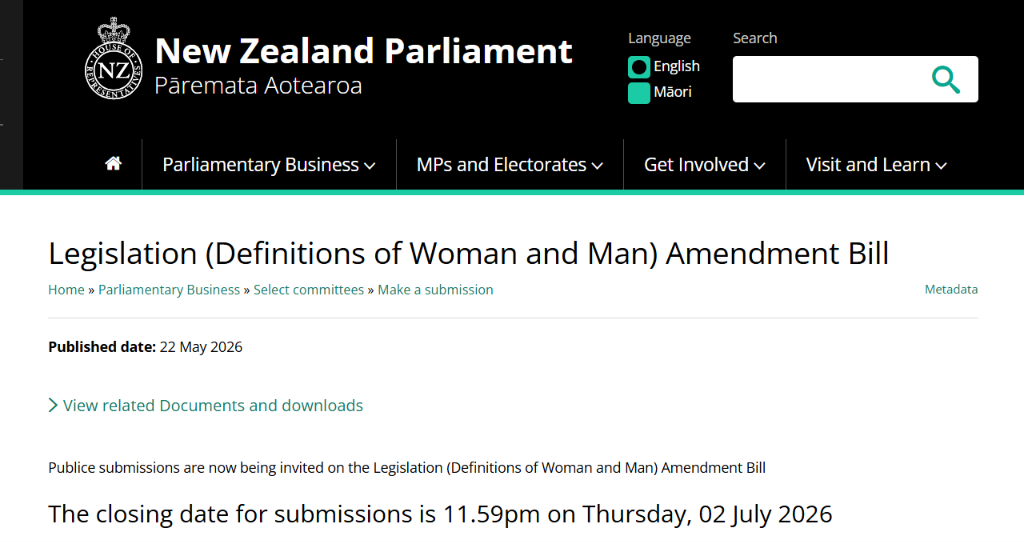
The Legislation (Definitions of Woman and Man) Amendment Bill
I support the aim of the Legislation (Definitions of Woman and Man) Amendment Bill. Previously, there was no need to define the terms “woman” and “man”, because there was universally held centuries-long societal understanding of what these words meant.
However, with the push to include beliefs driven by “transgender ideology” in legislation and in policy as if they are reality, it is now necessary to define sex more clearly, as the Women’s Rights Party said in its submission to the Select Committee.
I welcome the Bill, but it will not achieve the goals it sets to address in its current form. This is why I support the Women’s Rights Party’s submission that suggests amendments to strengthen the Bill in achieving its aims.
Despite claims by opponents of the Bill that it will “erase transgender people”, the Bill simply seeks to define “woman” as a human biological female and “man” as a human biological male (with parallel definitions for “female” and “male”) so that sex-based rights already in New Zealand law are clearly protected.
Many of the organisations opposing the Bill (such as the Council of Trade Unions, the Public Service Association and the NZ Nurses Organisation; the National Council of Women and Auckland Women’s Centre; and liberal churches) are misrepresenting the Bill. They have prioritised solidarity with trans and gender‑identity politics over women’s sex‑based interests. Ironically in all these cases, the majority of their members are women.
Through my union and political experience, I have observed legal and policy shifts from “sex” to “gender” and “gender identity” that have eroded protections originally intended for women and girls. I have searched legislation that is key to women’s rights and protections (such as the Human Rights Act and the Crimes Act) and I have seen how references to “women” have been removed or neutralised.
In 2002, “sex” was left out of a list of aggravating factors in the Sentencing Act in crimes motivated by hostility towards a specific group (such as racial or religious groups). However, “gender identity” was included.
In 2005, clauses using the word “women” in the Crimes Act were repealed. Rape is a gender neutral act done by anyone with a penis.
The untested 2006 Crown Law opinion that “gender identity” is included under the prohibited ground of discrimination “sex” in the Human Rights Act has been treated as if it were law.
This has undermined the 19 sex‑based exceptions in the Human Rights Act that permit single‑sex facilities, services and sports, for example, and makes it harder to protect same‑sex orientation, since “same‑sex” cannot be defined if “sex” is undefined.
The UK Supreme Court decision (For Women Scotland) affirmed that “sex” in the Equality Act, the equivalent of our Human Rights Act, refers to biological sex.
The Australian litigation (Tickle v Giggle) shows that unclear sex definitions prioritise “trans rights” over sex-based protections. Australians are now campaigning to restore definitions of women and men in the Sex Discrimination Act – definitions removed in 2013 amendments when “gender identity” was added to the prohibited grounds of discrimination.
I note that “intersex” has been used as an argument against defining woman and man. However, disorders or differences of sex development (DSDs) are rare medical variations occurring at 0.018% of the population within the two existing sexes; not a third sex. It is possible to define woman and man without affecting the provision of medical and support services for those with DSDs.
I support the following amendments:
1. Define “sex” first, then define woman and man, female and male, making it explicit that women/girls are human females and men/boys are human males.
2. Confirm that existing provisions for people with differences of sex development (DSDs) remain unaffected by defining woman and man in law.
3. Explicitly state that “sex” in New Zealand legislation means biological sex, not gender identity.
4. Delete “regardless of gender identity” from the Bill and resolve a conflict with section 16 of the Legislation Act (which says words denoting a “gender” include every other gender) by ensuring the new definitions for sex and for woman/man and female/male override that section.
5. Remove the word “adult” by adding “girl” to “woman” and “boy” to “man”, so that minors currently covered under existing laws (e.g. in the Sterilisation, Contraception and Abortion Act, and the Parental Leave in Employment Act) are not unintentionally excluded. What constitutes a minor in NZ law varies by specific legislation and should be made explicit where this is relevant.
6. Provide clear scientific definitions of “female” and “male”; also emphasising that cosmetic masculinisation or feminisation surgery or hormonal interventions change one’s appearance, but do not change one’s sex.
I note that the Women’s Rights Party submission challenges claims that the Bill is discriminatory, and a “waste of time”, citing polling showing that support for defining a woman and man in law has increased between two polls taken a year apart (Curia polls for Family First and Speak Up For Women). These show majority support across party lines for defining woman and man in biological terms, with growing support among Labour, Green and Te Pāti Māori voters. Thus, public opinion contradicts those MPs and organisations arguing against the Bill.
I urge Parliament to adopt clear, sex‑based definitions so that women‑only facilities and services, lesbian spaces, women’s and girls’ sports and other sex-based rights can be preserved and defended in law.
Ends.
Make your submission here.
Website: The New Zealand Women’s Rights Party (membership NZD$5/yr)
Facebook: Women’s Rights Party NZ
X: @WRP_NZ
No posts
Comments
Nothing yet. Say the first thing.
Sign in to join the conversation.