
By: Jill Ovens - Women’s Rights Party co-leader and national secretary.
28 July 2026
The Free Speech Union (FSU) has booked a room at the Ellen Melville Centre in Central Auckland tomorrow night - Wednesday, 29 July - for a discussion between Auckland University of Technology Chancellor Rob Campbell and Free Speech Union board member Ani O’Brien.
This has upset Auckland Councillor Julie Fairey, who chairs the Auckland Council’s Community Committee. She emailed council staff on Friday to query whether the booking was ‘appropriate’ for a council venue.
Councillor Fairey told the NZ Herald that she imagined the FSU booking “will be a conscious attempt on their behalf to create similar controversy and division, which is a really disappointing use of our community venues which [are] provided for booking to create community connection, and not drive people apart”.
Goodness! What terrible vile thoughts and incorrect world views might be on the FSU’s agenda?
The topic is ‘Public Service, Neutrality, and the Limits of Free Speech’. Rob Campbell is the former Te Whatu Ora (now called Health NZ) Board Chair who was dumped by Labour Leader Chris Hipkins for comments he made on his personal social media criticising the National Party’s opposition to the Labour Government’s Three Waters reforms. Campbell was said to have breached the Public Service Commission’s neutrality policy.
Nothing to do with ‘trans’ issues, which appeared to be what Councillor Fairey was alluding to.
I wasn’t going to go to the event, but after I saw that she was promoting a post on Bluesky encouraging members of the public to write to the centre “demanding cancellation”, I bought two tickets.
She described Ani O’Brien as “known to be opposed to transgender rights” and said the booking was likely to be inconsistent with the venue’s status as a long-standing ‘Proud Centre’.
Really, a long-standing Proud Centre? That is news to most people. I see that Rachel Kelleher, the council’s community director, told the NZ Herald that the Ellen Melville Centre was “an accessible Proud Centre and community hub in the city centre”.
Not too accessible, it seems. Ani O’Brien is lesbian, but word is the TQ+ crowd is organising a protest at the venue tomorrow.
The Auckland Council’s website describes the centre in Auckland’s CBD as an important heritage centre named after Ellen Melville, who, in 1913 was elected the first female councillor in New Zealand. The website records that Ellen Melville suggested a hall for women’s societies and a memorial to pioneer women in the province.
In other words, her idea was to have a space for women to meet.
It was not until after Ellen Melville’s death in 1946 that the Centre was opened. Designed by Austro-Hungarian-born architect Tibor Karoly Donner, the distinctive building was opened in 1962. The website reports that tukutuku (woven panels) were presented to the centre for the opening by Mr and Mrs Eruera Stirling and were restored by Ngati Whatua Orakei weavers in 2017 when the Centre was refurbished.
The Centre was originally called the Pioneer Women’s and Ellen Melville Centre, and the main hall is to this day called the Pioneer Women’s Hall.
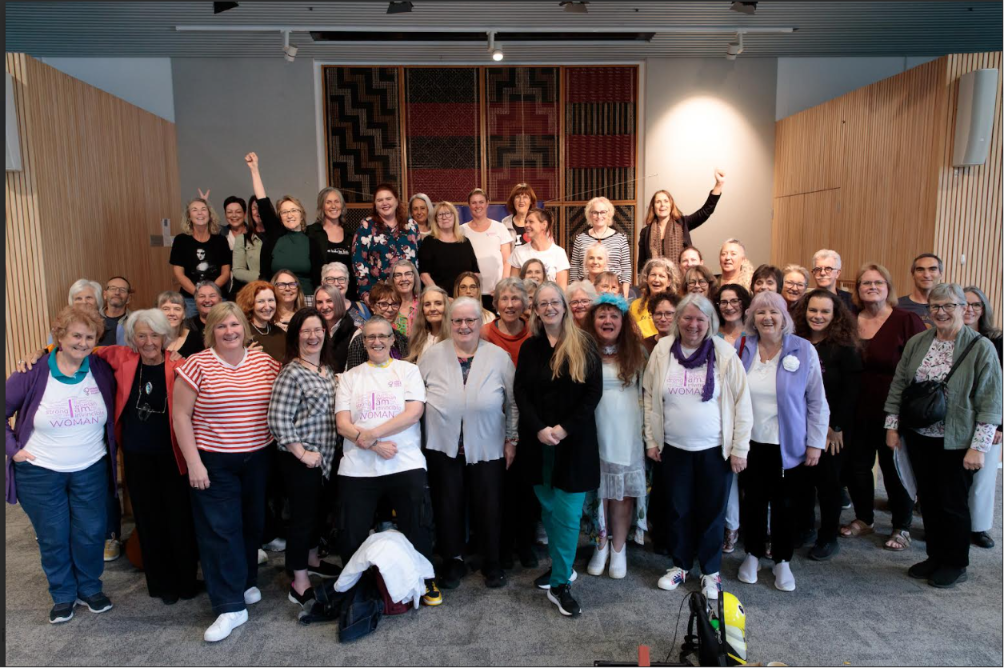
The Women’s Rights Party uses the Centre for regional meetings, and in 2024 we held our national conference in the Pioneer Women’s Hall. That is also where we hosted an all-day seminar for Helen Joyce in November last year.
The Centre is a wonderful community facility owned by our Auckland City Council. The last time we were there, in April, two other groups were also meeting there and we co-operated together to direct our people to the appropriate rooms. Downstairs another group was packing food bags for the homeless people gathered outside, who were sheltering from the torrential rain. As we left, we gave them the remaining sandwiches from our meeting, which they very much appreciated.
Who are the women whose names are commemorated in the rooms available for the community within the centre?
Elizabeth Yates (1845 – 1918)[1]
Elizabeth Yates’ election as mayor of Onehunga on 29 November 1893 – the day after New Zealand women had led the world by voting in a general election for the first time – cemented her place as a pioneer of women’s political rights. She was the first woman in the British Empire to hold the office of mayor.
Elizabeth received congratulations from Premier Richard Seddon and Queen Victoria. But not everyone was happy; four councillors and the town clerk resigned immediately in protest. Council meetings were often disruptive, and three councillors opposed every proposal she submitted. At the following local body election, she was defeated, returning as a councillor on the Onehunga Borough Council from 1899 until 1901.
A pioneer in the participation of women in public life, she was a Justice of the Peace and officiated as a magistrate for cases involving women.
Ellen Melville (1882 – 1946)[2]
Eliza Ellen (known as Ellen) Melville was born on 13 May 1882 at Tokatoka, Northern Wairoa. In 1895 Ellen won a scholarship to attend Auckland College and Grammar School. The law as a profession was just opening up to women, and in 1904 she began studying law at Auckland University College night classes. In December 1906 she became the second New Zealand woman to be admitted to the Bar and, three years later, the second to establish herself in sole practice.
Ellen’s main interest of life was the advancement of women. The feminist movement in New Zealand was at a low ebb and she devoted herself to rebuilding it through the formation of women’s societies, and through advocating women’s involvement and participating personally in public life.
In March 1911 she was the prime mover behind the formation of the YWCA Women’s Club in Auckland as a place for working women, mainly office workers, to meet and discuss current issues.
She was a leading figure in the revival of the National Council of Women (NCW), which had been founded in 1896 by Suffragist Kate Sheppard, but was no longer active. Ellen called the inaugural meeting of the Auckland branch, and the following year she travelled to Wellington to attend the national conference at which the NCW was formally reconstituted. She became the first president and was nine times president of the Auckland branch of the NCW, and between 1919 and 1922 was dominion president.
In 1913 she formed the Civic League with some other women, to encourage women to stand for public office. In that year she was successful in becoming the first woman in New Zealand to be elected to a city council. She retained her seat until 1946.
In 1919, when the Women’s Parliamentary Rights Act was passed allowing women to stand for Parliament (a reform Ellen had agitated for), she stood for the Reform Party in the Auckland electorate of Grey Lynn, a Labour stronghold. At the next election her Party chose an ex-Liberal to contest the seat. Ellen said bitterly that “the only conclusion to be taken was that they did not want a woman in Parliament.”
She stood as an independent candidate in Roskill in 1922, and in Eden in 1926 where she split the vote, causing Reform to lose the seat. She continued to seek election in 1928, 1931, 1941, and 1943, standing a total of seven times, but although she polled strongly each time, she was never successful. In 1944 she founded the ‘Women to Wellington’ movement to encourage Auckland women to run for Parliament.
As a long-serving member of the key finance committee of the Auckland City Council, she invigorated Auckland’s library system, and although usually near the top of the poll, she was several times passed over as deputy mayor. This led to protests from Auckland women’s groups who objected “to sex being regarded…as a disqualification for leadership”.
Her parliamentary campaigns gave her the opportunity to publicly advance the agenda of the NCW, including the raising of the age of consent, the appointment of women police, and the need for a motherhood endowment.
Although she worked tirelessly to complete the work of the nineteenth century feminists, Ellen represented a new breed of feminism. She was an independent professional woman who vigorously sought full participation in public life. She encouraged other women to follow her and to form strong women’s societies, which would take women’s concerns into the arena of public affairs. Ellen was one of the key figures in the revival of the feminist movement in the twentieth century.
Eleitino (Paddy) Walker (1917 – 2015)[3]
Known as Paddy, Eleitino Edwina Diana Patricia Walker was born in Samoa, the eldest of six children of a chiefly family, hence Eleitino, the title given to her. At age 10, she was sent to St Cuthbert’s boarding school in Auckland with only a suitcase and a ukulele.
She married traveling salesman Bill Walker who caught tuberculosis during World War 2 and spent five years in hospital in Auckland and later at Hamner Springs. With two young children to raise by herself while her husband was having treatment, she set about finding paid employment, introducing herself to Sir James Hay of Hays Department Store in Christchurch, where she worked with buyers and organised fashion parades. In 1952 the family moved back to Auckland and Paddy took up a similar role at Milne & Choyce.
Paddy stood for the Auckland City Council in the 1974 local body elections and was elected on a Citizens and Ratepayers ticket. She was the first Auckland city councillor of Pacific descent and served two terms as a councillor until 1980 when she did not stand for re-election.
In 1976 Paddy was the founding president of Pacifica, a nationwide Pacific women’s organisation. She had also joined the Pan Pacific South East Asian Women’s Association in 1975, and was later their Peace Ambassador. She was involved in creating ‘peace gardens’ in several countries, including the Cook Islands where she later lived after retiring in 1989.
In 2009 she was one of 1000 ‘peace women’ globally who were nominated for that year’s Nobel Peace Prize. In 2014 Paddy returned to Auckland from the Cook Islands, where she died the following year aged 98.
Betty Wark (1924 – 2001)[4]
Elizabeth Te Wheao was born at Ōmanaia, a small settlement in southern Hokianga, on 6 June 1924 to an unmarried mother. Known as Betty, she was raised as a tamaiti whāngai (foster child) and was given the surname of one of her initial foster families, Te Wake.
In 1938, aged 14, Betty received a government scholarship to attend St Joseph’s Māori Girls’ College, near Napier. St Joseph’s stressed service to humanity as a spiritual path, and the nuns provided Betty with strong female role models and a period of relative stability. She credited them with giving her a strong moral base, and pride in herself as a Māori Catholic woman with a social conscience, integrity, and an ethical framework.
Betty left school at the end of 1941 and worked as a trainee nurse at Wairoa for six months before becoming a housekeeper. She met American marine Charles Turner at a dance. They got engaged, and Betty was soon pregnant, but Charles was killed in action in the Pacific at the age of 22. Their son was born in St Helen’s Hospital in Wellington in 1944. There were then few social welfare provisions or employment and childcare opportunities for unmarried mothers, not to mention the social stigma of giving birth ‘out of wedlock’. Betty’s first-born thus became a tamaiti whāngai like his mother.
Betty’s second son, Danny, was born in 1948. She moved to Waihi, where Danny was raised by a family while Betty, finding herself again an unmarried mother after the baby’s father returned to England, continued to work. She returned to Auckland in 1950 where she met and married a Canadian merchant mariner, and their son, Conrad, was born in 1952. When her husband decided to return to Canada, Betty chose to remain behind. She was entitled to a deserted wife’s benefit, so was able to keep baby Conrad.
Betty met her second husband, Jim Wark, in the mid-1950s. Their first son Robert was born in 1959, and their second, Gary, in 1961. By 1960 Betty and Jim had settled in the inner Auckland suburb of Freemans Bay. It was here that she became involved in the urban Māori movement. She was actively involved with the Ponsonby branch of the Māori Women’s Welfare League and the Ponsonby Māori Community Centre. She also attended Te Unga Waka, the Māori Catholic church and marae in Epsom.
Through her work with urban Māori groups, Betty developed a strong sense of community responsibility, social justice and ‘heart politics’ (grassroots community work). Freemans Bay was going through a period of urban renewal, with older homes being demolished to make way for new housing developments. This process saw many low-income Māori forced out of their rented homes, and Betty grew concerned about the welfare of displaced and disenfranchised young people who reminded her of her younger self. She joined the Freemans Bay Advisory Committee, which represented the interests of Auckland City Council tenants in negotiations and in the setting of rental and housing policies. Her work with this committee was the catalyst for her future life as a community worker and advocate.
In the late 1960s Betty helped establish a hostel for young Māori displaced by urban renewal, with support from the Māori Women’s Welfare League and the Catholic church. She ran the hostel during the day and returned to her family in the afternoon. In 1974 Betty helped set up Arohanui Incorporated, a community-based organisation that provided housing and assistance to young people referred from the courts, prisons, Social Welfare and other sources.
Arohanui, Betty’s home for at risk youth, was the main focus of the rest of her life. Betty and her colleague Fred Ellis patrolled the streets on winter nights, taking creamed mussel soup and scones to street kids, and urging them to make contact with Arohanui. As Arohanui grew and began applying for government funding, the trust also began offering literacy and numeracy programmes. Arohanui strengthened its Māori culture and language programmes and introduced several innovative health and exercise programmes which used martial arts and Māori weaponry drills. Many residents were addicted to solvents, drugs, or alcohol, and Betty investigated various programmes to help them overcome these afflictions.
Betty was 62 when she was elected to represent Ponsonby ward on the Auckland City Council (1986–9). She was never completely comfortable working within the constraints of being a councillor, and often felt isolated as the only Māori woman. Her main areas of strength were working with people and housing issues. Betty’s community work with young people was recognised with a number of awards, including the Queen’s Service Medal, which was bestowed by the Queen herself in 1986.
Betty was diagnosed with lung cancer shortly after her 76th birthday in June 2000 and died peacefully on 16 May 2001.
Marilyn Waring (1952 - )
One of the rooms in the Ellen Melville Centre is dedicated to Dame Marilyn Waring, who in 1973 was the youngest MP ever to be elected to the NZ Parliament.
Marilyn championed the anti-nuclear movement, which led to a split in the ruling National Government under Robert Muldoon, and a snap Election in 1984.
Marilyn wrote several books, including ‘Counting for Nothing’, which exposed how women’s contribution to the economy is not counted because much of what women do is unpaid.
She also initiated the People’s Select Committee into Pay Equity after the Government passed legislation under urgency that excluded hundreds of thousands of women in women-dominated occupations from accessing pay equity claims
Helen Clark (1950 - )
Helen Clark was New Zealand’s 37th Prime Minister and the first woman elected into this position in 1999. As a member of the Council of Women World Leaders, she advocated for global action for women’s equality.
In 2009, she was the first woman appointed as Administrator of the United Nations Development Programme (UNDP). At the time Forbes ranked her the 21st most powerful woman in the world. She also chaired the United Nations Development Group.
She is a member of the Order of New Zealand for services to the country.
Let us be proud of our women’s herstory.
There is much to be proud of in these women. Councillor Julie Fairey and the council’s community director Rachel Kelleher have no business using that word to turn the Ellen Melville Centre into something that denies its proud herstory.
It is yet another example of the exclusion of women in the name of inclusivity.
[1] Elizabeth Yates | NZ History
[2] Melville, Eliza Ellen | Dictionary of New Zealand Biography | Te Ara
[4] Wark, Elizabeth Cecilia (Betty) | Dictionary of New Zealand Biography | Te Ara
Website: The New Zealand Women’s Rights Party (membership NZD$5/yr)
Facebook: Women’s Rights Party NZ
X: @WRP_NZ
No posts
Comments
Nothing yet. Say the first thing.
Sign in to join the conversation.