
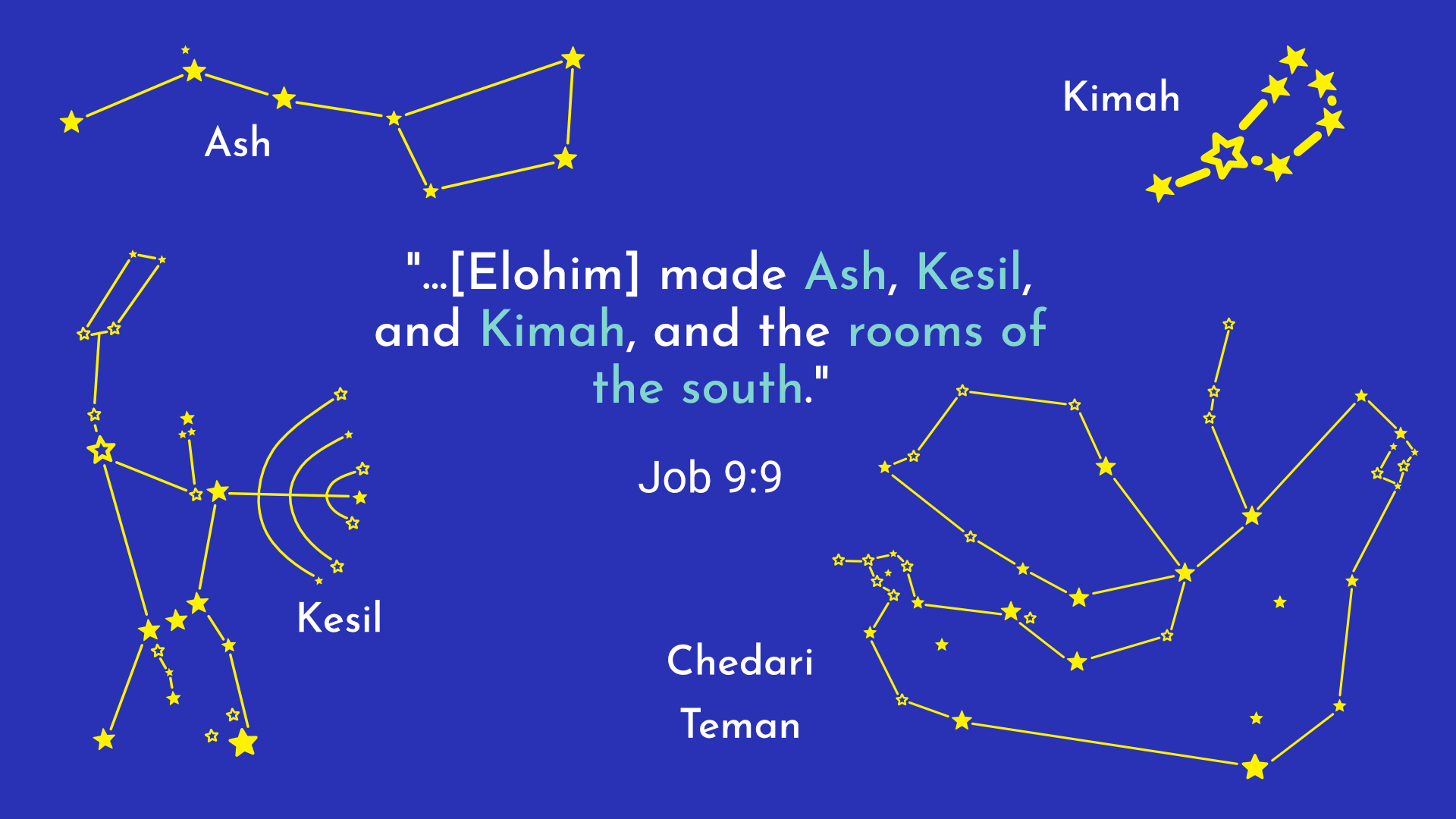
The story in the constellations was circulated in Job’s day. In his book, The Gospel in the stars, Joseph Seiss wrote,
“And yet, already in the time of Job the heavens were astronomically laid out and arranged in the manner just described, with the Zodiac formed, the constellations named, the figures of them drawn and recorded, and the same accepted and celebrated by God’s people as the particular adornment of the sky in which to read the Almighty’s glory.”
In today’s post, we will identify four constellations Job called by name.
Bible translators have attempted to interpret Job 9:9. A variety of translations creates confusion surrounding this verse. Let’s look at a few translations. I hope to clear up some of the confusion.
Job 9:9 “Who [Elohim] made Ash, Kesil, and Kimah, and the rooms of the south.” (TS 2009)
Job 9:9 “Which [God] maketh Arcturus, Orion, and Pleiades, and the chambers of the south.” (KJV)
Job 9:9 “Who [God] made the Bear and Orion, the Pleiades and the chambers of the south.” (ESV)
The Scriptures 2009 version translated these constellations directly from Hebrew, but it was not consistent in naming the fourth.
The King James used Latin names for the constellations. The first was called “Arcturus.”
If you study along with me, you know that I prefer to study the Hebrew names. Sometimes the Latin names either misrepresent the constellations or are altogether wrong.
Job used the Hebrew names, and I prefer to use them as well.
The ESV uses a combination of English translations and Latin names. There is nothing wrong with using English names as long as we correctly interpret them. “The Bear” does not convey the Hebrew meaning of the constellation. However, “the chambers of the south,” although vague, does match the Hebrew meaning.
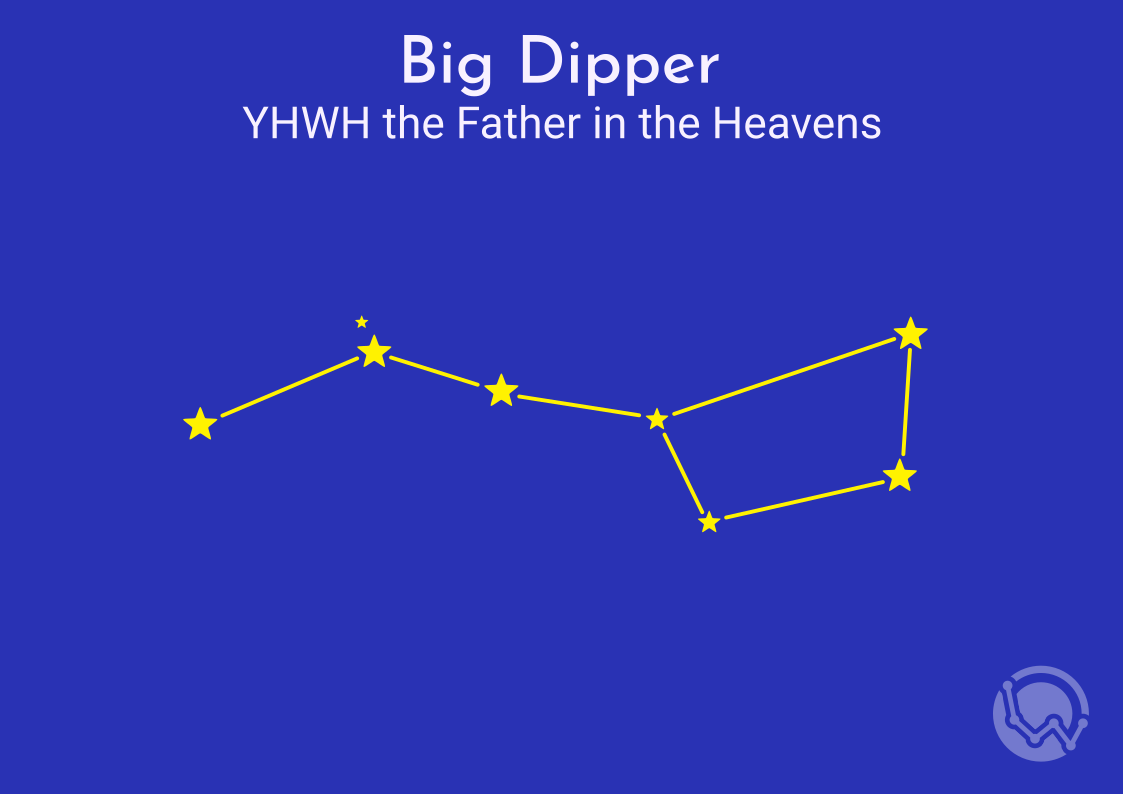
The first constellation mentioned in Job 9:9 is the Big Dipper.
The Hebrew name of this constellation is Ash (עוש), which translates as to hasten or assemble one’s self. This word is closely related to the Hebrew verb asah (עשה), which translates as to make, create, or labor.
This constellation is a picture of YHWH the Father, the Creator of Heaven and Earth.
In the post linked below, I demonstrated how the Big and the Little Dipper together form the Hebrew letter Aleph (א). The Little Dipper represents the Son.
The Aleph
·
April 1, 2025
Today we will examine the meaning of two well-known constellations: the Big and Little Dippers. Together, they form a very significant figure—the Aleph.
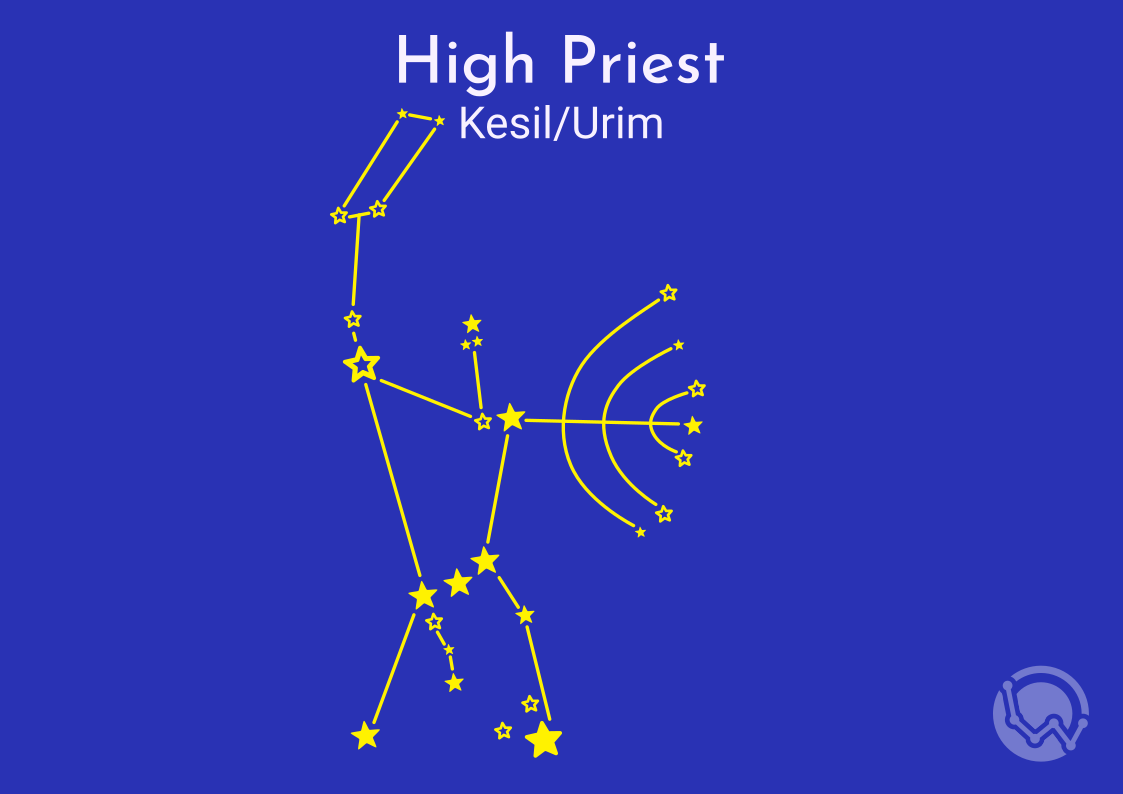
Did you know that there is a constellation depicting a High Priest? Ultimately, this constellation points to Yahushua.
One of two Hebrew names for this constellation is Kesil (כיסל). The other is Urim (אורים), meaning lights. The title Urim helps to identify this constellation with the High Priest. The High Priest wore a breastplate, and in it were two stones used for discerning YHWH’s will. One of these stones was called ‘urim.’
In the constellation, the High Priest holds the breastplate toward Heaven in his right hand. In his left hand, he holds the seven-branched menorah, a candlestick used in the Temple.
The stars prophesied Messiah’s everlasting priesthood to people like Job before these events manifested on Earth!
Typically, this constellation is called Orion. Orion is portrayed as a warrior. In Greek mythology, Orion is a giant hunter with a club.
We should call this constellation the High Priest or use one of the Hebrew names as Job did.
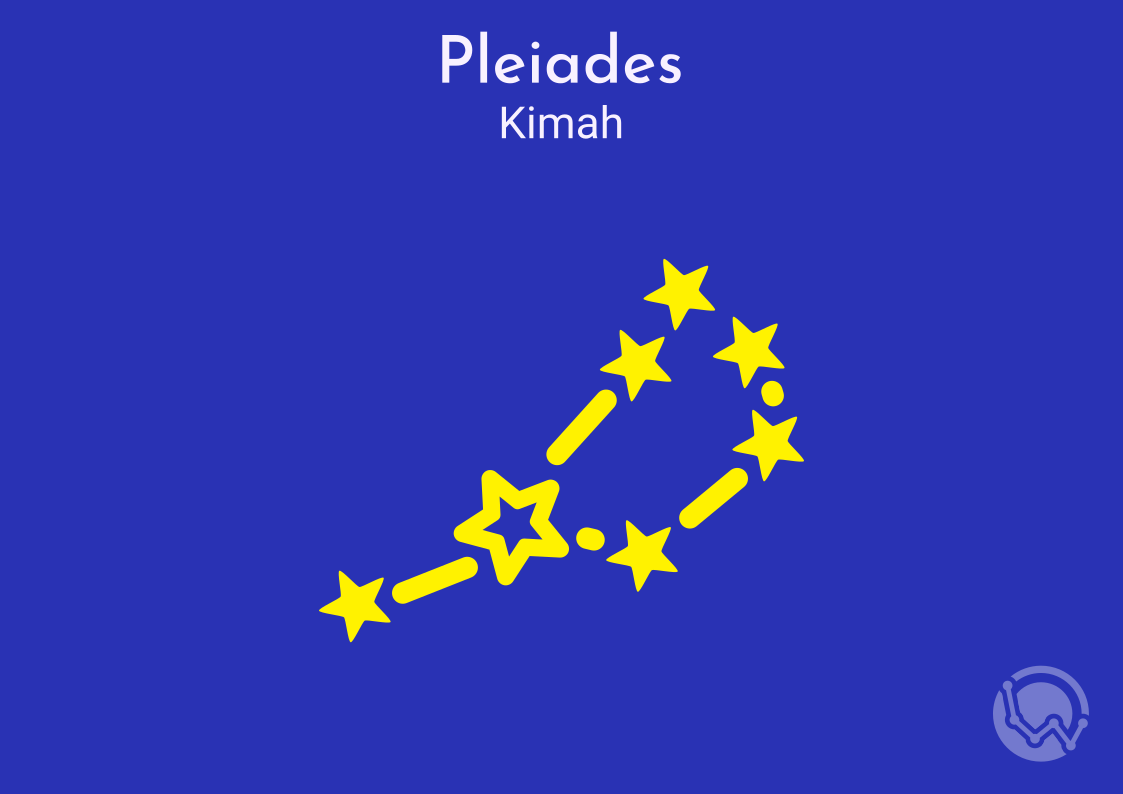
The Hebrew word for this star group is Kimah (כימה), meaning a heap or cluster. The word makes sense because this is a cluster of seven stars knit closely together. ⭐⭐⭐⭐⭐⭐⭐
The Pleiades is a part of a bigger constellation on the zodiac: the Bull. And it is actually quite easy to identify in the sky.
The Latin name “Pleiades” matches one of the Hebrew names. There are at least three Hebrew names for the Pleiades.
Learn More About Pleiades
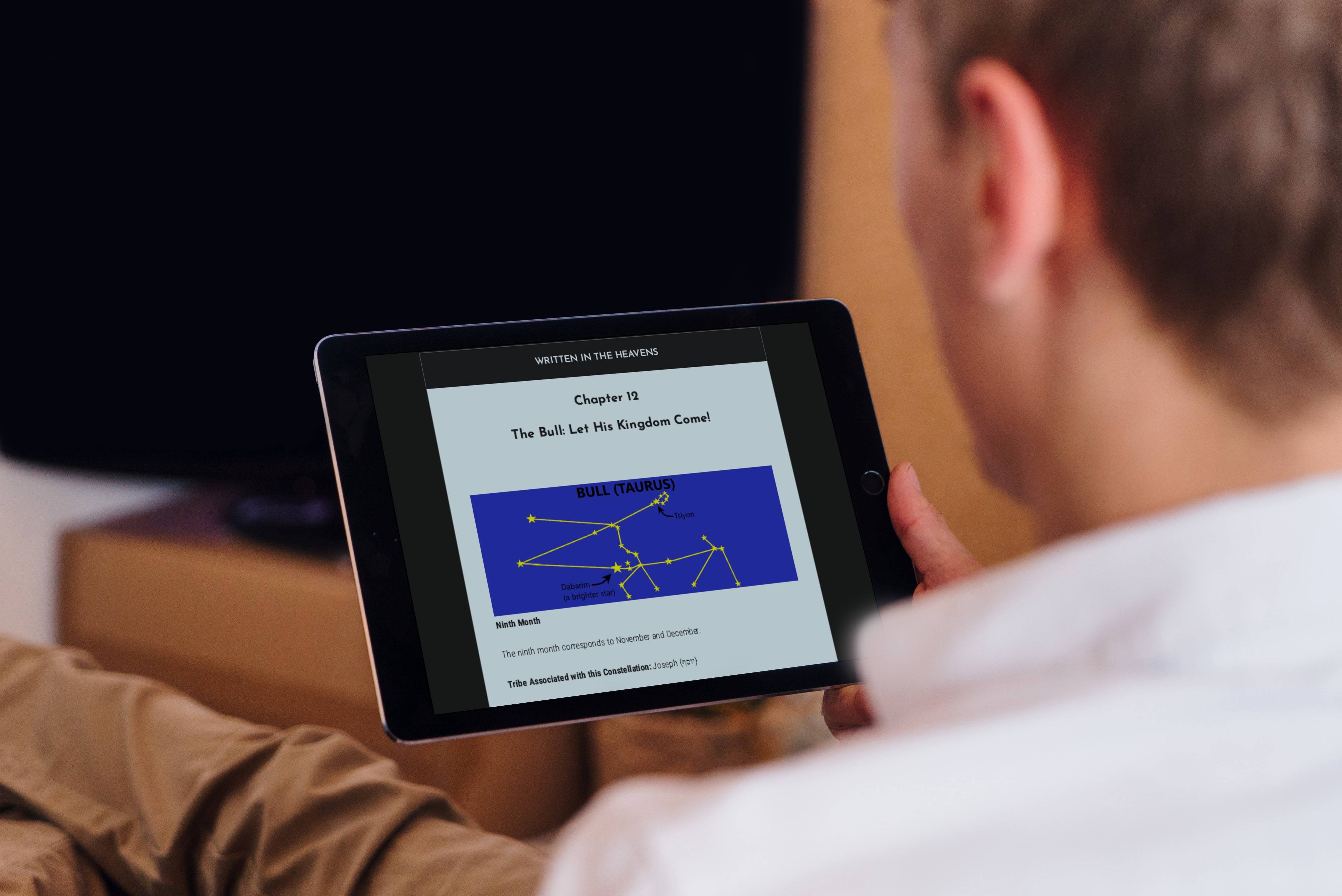
To learn the Hebrew names and the biblical meaning, you will want to read my book.
Written in the Heavens: Events on Earth Revealed in the Stars is available for an immediate download with a contribution of $15 towards the work of spreading the message of Yah’s word in the Heavens.
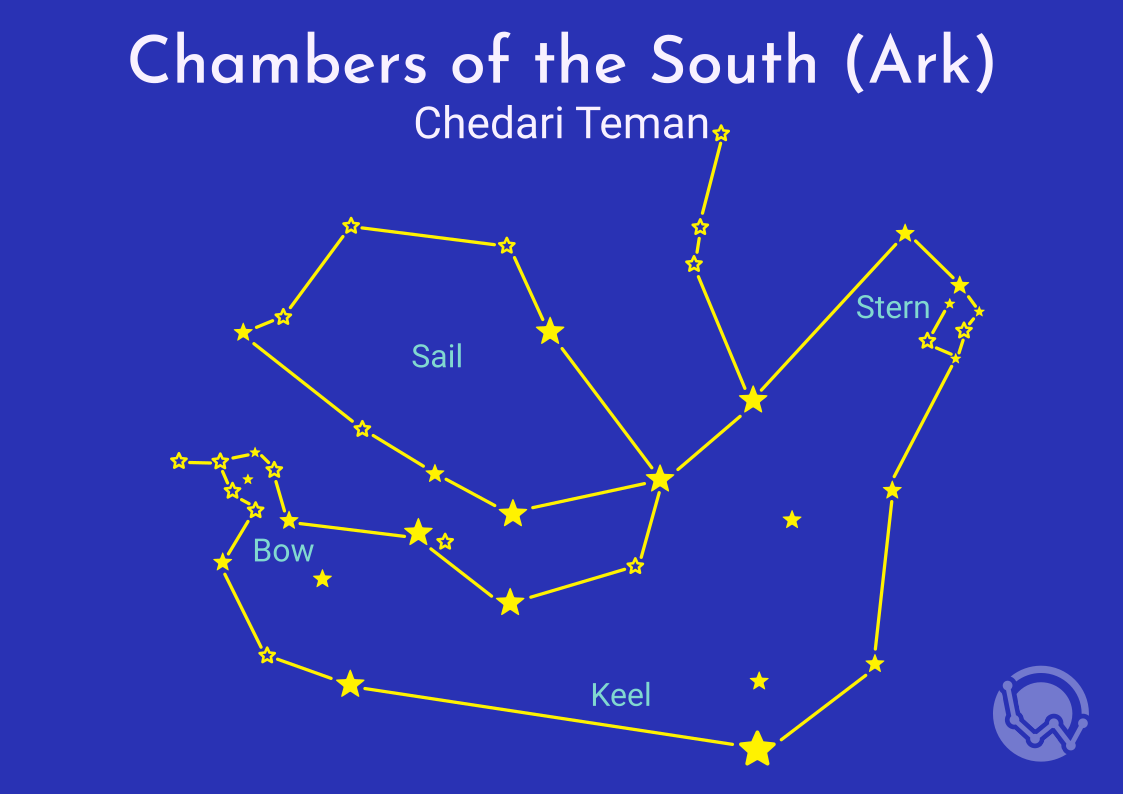
Job named a fourth constellation, and it is hidden in the text. The way Job 9:9 reads in the English, some may assume “the chambers of the south” refers to something completely different.
The Hebrew text along with knowledge of the Hebrew names for the constellations reveals that Job was listing a fourth constellation! After all, if he listed three constellations, it makes sense that what follows is part of the list.
The Hebrew words translated as the “chambers of the south” are Chedari and Teman (חדרי תמן). Chedari means chambers, rooms, or inner most parts, like a bridal chamber.
Teman means south, but it also refers to a specific location. Teman was a region in the ancient land of Edom.
Did you know Job was an Edomite? He was a descendant of Esau. Job was a king; he reigned in Botsrah, and Botsrah was a city likely within the region of Teman. (See Genesis 36:33 and the Testament of Job 1:4-5) Living in the region of Teman, the name for this constellation meant something to him.
It turns out that the constellation named Chedari Teman is a pictograph of a ship. 🚢This constellation is significant in two ways.
It prophesied salvation in the Ark during the Flood in Noah’s day.
It prophesies salvation in the bridal chambers in the End Days.
The first was fulfilled. The second is coming soon.
The Ark constellation is a significant sign for the End Days, and I hope to cover it in a future post.
So there you have it.
Job 9:9-10 “Who made Ash, Kesil, and Kimah, and the rooms of the south; who performs great and unsearchable deeds, and innumerable wonders.” (TS 2009)
The four constellations Job proclaimed are:
Big Dipper
High Priest
Pleiades
The Ark (Chambers of the South)
These are four special constellations YHWH placed in the sky. Identifying these signs brings deeper meaning to the written Word.
I hope this post was a blessing and brought clarity.
Let us direct our praise to YHWH Elohim, Maker of Ash, Kisel, Kimah, and Chedari Teman.
👉 As always, I value your thoughts as the reader. Share what stood out to you in the comments.
👉 If you would like to support my work, please consider becoming a paid subscriber.
Comments
Nothing yet. Say the first thing.
Sign in to join the conversation.