
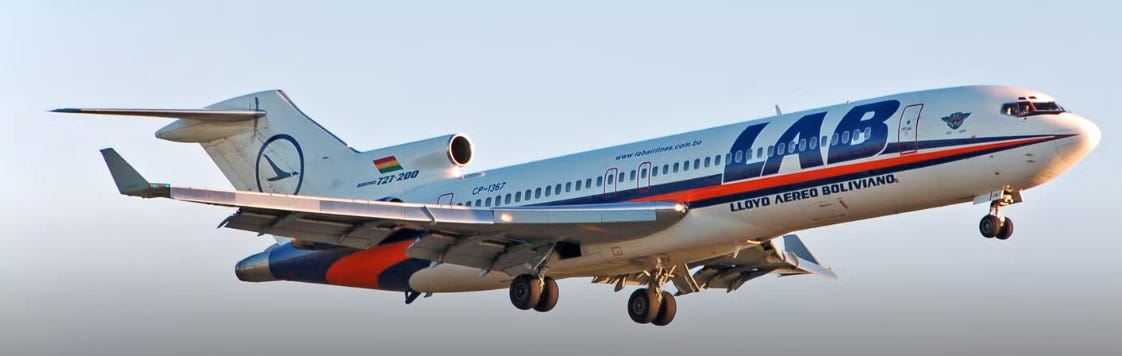
My plane to Bolivia was to leave at 7:30 that evening. I was the only passenger in the line at the Lloyd Aero Boliviano window, allowing for a quick check-in of the backpack I planned to live out of for the month-long trip. The absence of other flyers was disconcerting, though I shouldn’t have been surprised. When I’d come across the Lloyd Aero Boliviano flight on the web, I’d leaped at the incredibly cheap fare. It was only after I’d purchased my ticket that a savvy traveler friend told me that a string of mishaps and near-mishaps around South America had all but grounded the airline, leaving it teetering on the edge of suspension and insolvency. Now a pariah among carriers, with one of the worst safety records in the skies, Lloyd Aero Boliviana was practically giving tickets away.
Walking toward the departures gate, I suddenly wasn’t sure I wanted to go. This had been a trip I’d longed planned: Bolivia, Peru, Chile. If living in Mexico had enriched my American self, this was the next increment: inevitable, that I’d reach out into greater Latin America. I had other reasons for going, among them the fact that I was going to write about the trip.
I’d planned to travel around Bolivia first, beginning with the capital, La Paz. Then a month before my departure, 33 Bolivian protesters were shot and killed in the Plaza de Armas, in front of the capitol building, a block from the pension where I’d be staying. Army and police had attacked the protesters and each other. There were demonstrations and roadblocks throughout the country. The indigenous cocaleros union was protesting the US-backed government, and State Department travel advisories warned citizens against entering the country.
I took the advisories with a measure of skepticism. Among travelers on the ground, US travel advisories had little credibility and were often made fun of. In Mexico they often appeared after some random assault on a tourist on a remote Guerrero stretch of beach, or as a punitive response to some contretemps between Washington and the Mexican government. Sometimes the safest place to be was exactly where the State Department warned you not to go. You just needed to know your way around, take the normal precautions. The advisory gave big play to a report that some months earlier a European couple had been attacked by a local mob in southern Bolivia, triggered by rumors Europeans were seeking babies for their body parts.
Bolivia, I knew, had had more changes of government than any country on earth, the average regime lasting a year and a half. But if strikes or roadblocks prevented my traveling by road within the country, they would hobble my plans: after La Paz I’d plan to go to Cochabamba and Sucre in the south, then to Copacabana and Titicaca in the north, entering Peru from there. I decided to make the trip anyway, but in reverse, beginning in Chile, delaying my entry into Bolivia until last, in the hope that things would have calmed down. The plane would fly to Santa Cruz, a hub airport in southern Bolivia, where I’d change planes and fly over the Andes to Santiago, the capital of Chile.
The scant few of us gathered at the Lloyd Aero Boliviana departure gate were summoned by loudspeaker to a shuttle bus and driven through foggy drizzle to a remote corner of the landing field. Few of my fellow passengers look to be tourists. Some were short, dark indigenous Bolivian Aymara or Quechua perhaps, reminding me a little of Oaxaca’s Zapotecs; others, to judge by their garb and mien, looked to be middle-class Mexican or South American businessmen. There were a few families with babies wrapped in rebozos or shawls. A shabby little klatch of passengers we were. But what was there to dress up for when we were going to spend all night in flight to the poorest country in South America?
The plane loomed ahead in the mist, a huge Boeing 747 of uncertain vintage, parked alone beside a chain link fence at the farthest reaches of the airport, beyond the arc lights - as if Lufthansa and American Airlines and British Airways passengers were not to know that this flight took off from here at all. Hurrying across the airstrip in the rainy darkness, I felt as if I were boarding some remote Aeroflot flight in 1950s Tajikistan, or I’d blundered into Casablanca’s final scene with Bogey and Claude Rains.
I climbed on board and found my way to my seat. Oddly, they’d grouped the several dozen of us into one corner of the gigantic plane, along one side, near the front of economy class, leaving the rest of the plane, center and right, fore and aft, virtually empty. Was this good for the weight distribution? Of course as soon as the seat belt signs went off, everyone would migrate across the ocean of unsettled unoccupied seats and settle where they could stretch out and sleep. For now, I was sandwiched in between a corpulent, heavy-breathing man who looks to be European and smelled of drink, and an indigenous woman with her sleeping baby, swaddled in a colored shawl. Suddenly the idea that tiny, poor Bolivia would even have an intercontinental airline seem preposterous, suspect.
Riffling through the in-flight magazine while we waited for takeoff, I read a long editorial by the new president of Lloyd Aero Boliviano, a man with a German last name, offering, in effect, a mea culpa for Lloyd’s shaky flying record without actually owning up to it. He promised a better, safer airlines, a nuevo Lloyd Aero Boliviano, as he put it, with planned non-stop service between Bolivia and Los Angeles.
When the plane’s engines started up, passengers, unwilling to wait until they were airborne, began flooding the other sections of the plane. I joined the revolt and scrambled across the aisle to an empty middle row, a few seats behind the partition separating us from the deserted first-class section, where I could stretch out for the night.
As the 747 taxied down the runway, rain pelting the windows, a sudden desolation swept me. What was I doing out here? Was there no exit from this endless corridor of travel?
I gazed at the fuzzy green screen above me displaying the flight map that would track our voyage. The little plane icon, poised on Mexico City, pointed due south. Curacao, Iguazu, Antofagasta, Belo Horizonte. Names off childhood maps. We were flying to a different corner of the world! Then as the Lloyd Aero Boliviana rose, shuddering, into the air, I felt a rush of anticipation, mixed with fear.
Adapted from the travel narrative Mexican Days (Random House)
Comments
Nothing yet. Say the first thing.
Sign in to join the conversation.