
Memorable Movie Moments: The Third Man is considered the epitome of a noir film. This scene is all about the brilliance of the dialogue.
What to Do After You Finished Your Novel: From Editing to Agents to Self-Publishing: A brief overview of what to do after typing The End.
5 Resources for Writers: Good stuff to write better.
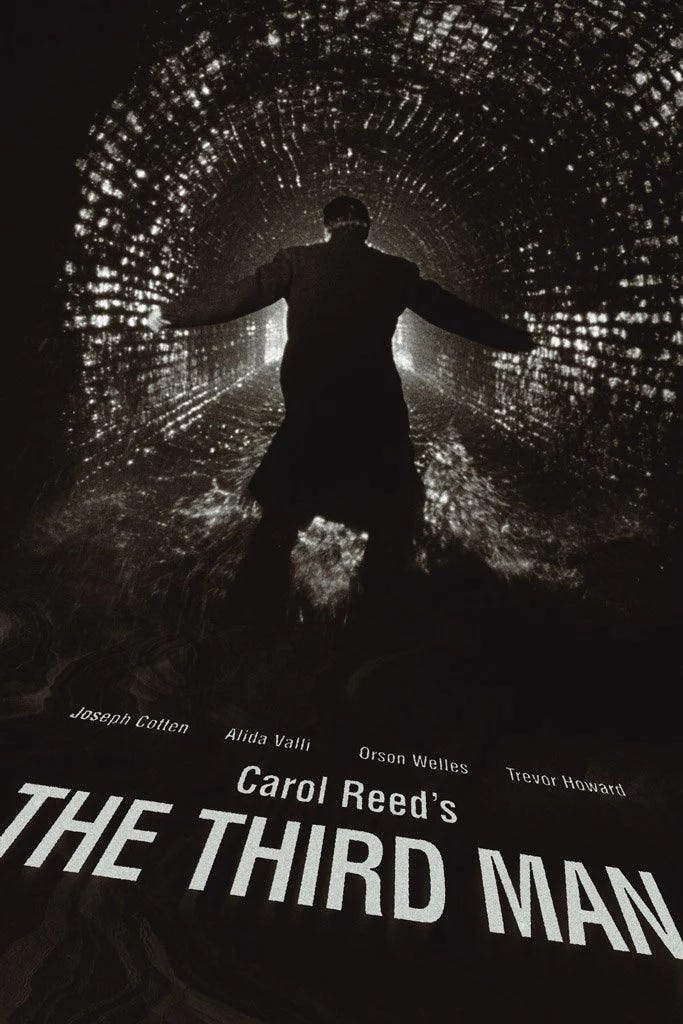
The Third Man (1949) is one of the best movies ever made and appears on dozens of lists of greatest films (with a 99% rating on Rotten Tomatoes). I mention its popularity among film aficionados only because so many viewers today are unfamiliar with the movie. However, this classic has been ripped off so many times that they know some of scenes from those lame filmmakers who copied from it. The last act chase through the sewers of Vienna has been stolen at least half a dozen times by lesser directors.
This scene features the villain, Harry Lime (Orson Welles) on a Ferris wheel in Vienna, delivering his justification for his evil acts to the hero, his former best friend Holly Martins (Joseph Cotten). Lime has been diluting the penicillin he sells on the Black Market, which has resulted in the deaths and agony of children at a hospital. When Martins sees the suffering children, he agrees to help the police capture Lime.
This entire speech is one of the most famous in movie history. Lime justifies killing, first based on the financial gain, telling Martins that people are just dots far below. Then on the philosophical basis: “The dead are better off dead.” And finally on a cultural basis: Chaos and struggle have produced great art. We only need to look at current politicians to see similar rhetoric.
Pay attention to Lime’s threat to kill Martins by shooting him and throwing him out, until Martins reveals the cops already know Lime is alive (he faked his death earlier). Lime knows the cops are closing in and most his crew are dead or will be arrested so he tries to recruit Martins, who he just threatened to kill. This is how you write dialogue for a charming and compelling villain.
Writer’s Notes about This Clip:
About the speech: This famous passage was actually written by Orson Welles. They needed another sentence for the timing in the scene, so Welles came up with this passage, which is an adaptation from a 1885 lecture by the artist James Abbott McNeill Whistler. When the movie came out, the Swiss informed Welles that is was the Germans, not the Swiss, who invented the cuckoo clock.
“‘You know what the fellow said—in Italy, for 30 years under the Borgias, they had warfare, terror, murder and bloodshed; but they produced Michelangelo, Leonardo da Vinci and the Renaissance. In Switzerland, they had brotherly love; they had 500 years of democracy and peace—and what did that produce? The cuckoo clock!’”
About being a compelling villain: Harry Lime was such a charming villain that even though he is murdered in the movie, people still wanted more of him. A radio show, The Adventures of Harry Lime, featured Orson Welles reprising his role, though as a younger, roguish conman, before he became the homicidal businessman from the movie. He was also the hero of a television spin-off starring Michael Rennie which ran for five seasons from 1959 to 1965. That’s what happens when you write a compelling villain. (The same thing happened with Hannibal Lector, the serial killer from The Silence of the Lambs, who went from villain to getting his own novel and then a TV series.)
About the ending: The ending of the movie is so good that it is often pointed out as an example of a perfect ending. However, the author of the screenplay, Graham Greene (one of the most famous novelists in the world at the time), had originally written a different, happier ending. Though Greene and director Carol Reed disagreed about the ending, Greene eventually conceded that Reed was right: “One of the very few major disputes between Carol Reed and myself concerned the ending, and he has been proved triumphantly right.” This same thing happened with the movie Chinatown. Screenwriter Robert Towne wrote a happier ending in which the villain is punished. But director Roman Polanski chose the darker ending. After years of anger over the choice, Towne finally admitted Polanski was right.
The first question you need to ask is, “Is my novel really finished?” Toward that end, I’ll present a Zen story from Kai Tsukimi’s A Cup of Zen:
A wealthy noble stopped at a roadside stall, watching as an artist painted calligraphy on silk. “I hear you are skilled,” the noble said. “Paint me something worthy of my hall.”
The artist nodded and took up his brush. With a single stroke, he began to paint a perfect circle. His hand was steady, his ink dark and rich. But just before he completed the shape, he lifted his brush.
The noble frowned. “It is unfinished.”
The artist set the silk aside. “Is it?”
The noble crossed his arms. “A circle must be closed.” A cart rumbled past on the road, its wooden wheel spinning, its edge blurred in motion. The noble’s gaze followed it. He turned back to the painting. The ink had dried. The gap remained. His fingers twitched as if wanting to finish it himself. The artist took a fresh piece of silk, dipped his brush—and began to draw another circle. Again, he did not finish.
The wind stirred the silk. The noble said nothing.
Traditionally, the whole idea of Zen fables, stories, or koans is not to explain them because meditating about them is the meaning. But I think of this tale whenever I am deciding whether my story, novel, or script is truly finished. There is always something more I can do to “close the circle.” Yet, in reality, the circle will never be closed because I will never reach perfection, I will only do the best that I can do given who I am right now. And right now is never perfect.
In a 1933 essay, French poet Paul Valéry made the famous statement that “art is never finished, only abandoned.” And so we abandon our works and move on the next work, which will also be an unclosed circle. Embrace it.
Author Susan Sontag once described every writer’s dilemma: “I am profoundly uncertain about how to write. I know what I love or what I like, because it’s a direct, passionate response. But when I write I’m very uncertain whether it’s good enough. That is, of course, the writer’s agony.” Every writer has grave doubts about his or her ability. Even successful and acclaimed writers wonder: Am I any good? Most of them secretly harbor a wish for some sort of supernatural (or AI) machine, the repository for the world’s greatest writing, an arbiter of its highest level of literary taste, in which you could deposit your manuscript and five minutes later it would spit the pages back out with GENIUS! or STINKS! stamped across it.
The difference between the novice and the professional writer is that the pro knows these doubts are, like stage fright for an actor, merely an occupational hazard. However, it is not condemned as a hazard to be overcome, but rather a companion that constantly challenges the writer to strive to become better. Without that fear and anxiety, we might settle for less than our best. Here are four rules to help you determine if what you’re writing is any good.
Before you can decide whether or not your writing is any good, you need to establish the standard against which you’re going to measure yourself. If you’re wondering if you’re as good as Shakespeare or Melville, the answer is, “Probably not.” But neither are some of our greatest writers. One of my favorite novels is Budd Schulberg’s What Makes Sammy Run? Is it as good as King Lear? No. But it is a brilliant, compelling work with memorable characters and thematic depth. It is doubtful that Schulberg said, “Either I write as well as Faulkner or I don’t write at all.” More likely, he might have said, “Either I write to the best of my ability or I don’t write at all.” (By the way, I would reread Schulberg over Faulkner any day.)
First, make a list of your favorite authors, the ones whose writing you most would like to emulate. If Tolstoy is one of them, then go for it; you might very well be the next Tolstoy. But if you’re writing genre fiction—mysteries, sci-fi, romances, etc.—then include at least three authors on that list who write within your genre. Keep stacks of works by these authors on your writing desk (you’ll see why in Rule #2 below).
Second, be honest with yourself. This needs to be a “living” list, filled with people you are currently reading. If you love Colleen Hoover, then put her on the list. Putting Charles Dickens on the list, if the last time you read his work was in high school, won’t help you. Who would you rush home to read?
Third, make an informal list of what exactly you like about these writers. If it’s plot, then write out a three-sentence synopsis of several of your favorite plots. If it’s style, mark passages in the books that exemplify that style. And so forth. This will become your writer’s bible, to which you can add new authors and works any time. Keeping this list in mind as you read your own work will be a helpful guide for making sure you including in your work the very characteristics that draw you to your favorite authors.
First, open your novel on your computer, partial or completed. Next, begin reading one of the authors on your Standard List. As soon as you come across something you like in their story, stop reading. Now begin to read your own manuscript. Can you recognize any differences? If so, specify them in writing. For example, your favorite author uses more poetic descriptive language. Or their dialogue is shorter and punchier.
Second, continue this process, going back and forth between your favorite authors and your own writing. It’s important that you don’t keep reading the books on your list all the way to the end. This is not an exercise for your reading enjoyment; it’s for your writing improvement. Read those authors only in small sections, only as a means of comparison with your own work.
Third, don’t take the list of differences as gospel. Perhaps you are developing a style that is different from those of your favorite writers. You may admire another writer’s descriptive language, but you have no desire to write like that. This, too, is valuable information that will help you gain confidence in your own unique writing skills. Decide which items on this list are ones you’d like to change, and which are merely examples of your own budding style.
There’s a rule of thumb in sitcom writing that you must have three laughs per page. Some TV critics might think that’s a rule more in omission than in practice, but it’s still a good idea to have such rules of thumb. Decide what your goal is, then read through your manuscript to see if you’ve lived up to that goal. For example, my goal is that I must find one “good moment” per page. That moment might be a metaphor, a descriptive phrase, a dialogue exchange, a shiny word. But if I can find one bright moment per page, I am pleased. If I find more, I’m delighted—and usually surprised.
The more you reread your work, the less enamored you are over each word. I often open my computer whenever I have a few free minutes and reread the pages, continually polishing them. After a while, I’m a much more objective critic and more easily separate the wheat from the chaff.
Nobel Laureate Jean-Paul Sartre once said, “Hell is other people.” While this may be true in one’s daily life, for writers, especially beginners, “Help is other people.” The good writer needs good critics. Most professional writers have other professional writers they give their work to for criticism. To do so is not just an acknowledgement of doubt in one’s ability, it is an announcement of desire to be a better writer.
First, you need to choose who this select group of critics will be (it’s better to have more than one for comparison’s sake). The best critics will be those who are also writers, usually in a class or in a private workshop. It’s fine to give your manuscript to non-writer loved ones, but there’s a downside. Because they aren’t also writers you tend to respect their opinions less. If they love it, you still have doubts. If they hate it (and are courageous enough to admit it), you resent the input. You smile, but you’re thinking, “What do they know about writing.” Either way, you’re putting a strain on your relationships. Give it to them only if you have other, more skilled critics to share with. That way you can appreciate your loved ones’ opinions for what they are: sincere efforts to help.
Local community colleges usually offer a variety of creative writing courses. If possible, contact the professor to ask if their particular class includes the critiquing of student manuscripts in a workshop atmosphere. If not, seek out a writer’s group that you might join. Don’t be afraid to shop around—sitting in for a couple sessions and then moving on if you don’t like it. It’s crucial that you respect the people in the workshop. Otherwise, you won’t follow their advice anyway.
Be sure to find out if the students read the manuscripts at home before being workshopped. Reading manuscripts aloud and getting cold feedback is mostly worthless in a classroom setting because the rest of the class has not had a chance to look at the words nor think about them. [However, it is an excellent practice for writers to read their work aloud to one person outside a classroom setting. This way the author actually hears weak writing, jumbled sentences, bad dialogue. When I’ve done this, I don’t even need any feedback. Just knowing there is an audience helps me find all the bad spots.]
Second, be realistic about such criticism. Even professionals disagree about the quality of manuscripts. I’ve had conflicting editorial advice about the same work from major publishing houses. I even had a novel rejected by one house, only to have the same house accept the same manuscript six months later when it was submitted to a different editor. Only you know what you are intending to accomplish; the critic is judging what they perceive. Sometimes even the best critics are wrong. However, if you start to get a lot of similar comments (“I don’t like the protagonist.”), then you should start taking it seriously.
As we discussed above, there is no such creature as the “final” draft. It is as mythological as the unicorn. Just when you think you’re done with a manuscript, you take another look at it and suddenly you’re scribbling notes on every page. However, there is a point at which every manuscript must be abandoned, sent out to publishers, and the next work begun. This is the final—and most difficult—step a writer takes. But it must be taken.
Once you’ve sent the manuscript out to the agent, magazine, or book publisher of your choice, don’t sit around waiting to see what will happen. Begin your next work as soon as possible. Not only will it distract you from the waiting—during which you’ll think about all the flaws in your manuscript—but all the techniques you’ve just learned and practiced in the completed manuscript are fresh in your mind and will make this next novel or script even better.
When you send your manuscript out, it’s as if that manuscript is going on a job interview for you. Imagine it sitting across the desk from the agent or editor. If it were you there instead of those pages, you would probably have taken a shower, put on nice clothes, and conducted yourself in a friendly but professional manner. The same is expected from your manuscript. Here’s what needs to be done:
Edit for grammar and spelling errors. Your manuscript needs to be relatively error-free. If an editor reads the first page and finds three errors, changes diminish that they will continue reading. They figure the writer isn’t serious. Remember: Agents have hundreds of manuscripts arriving. They’re looking for reasons to reject works so they don’t waste their time. Don’t give them any.
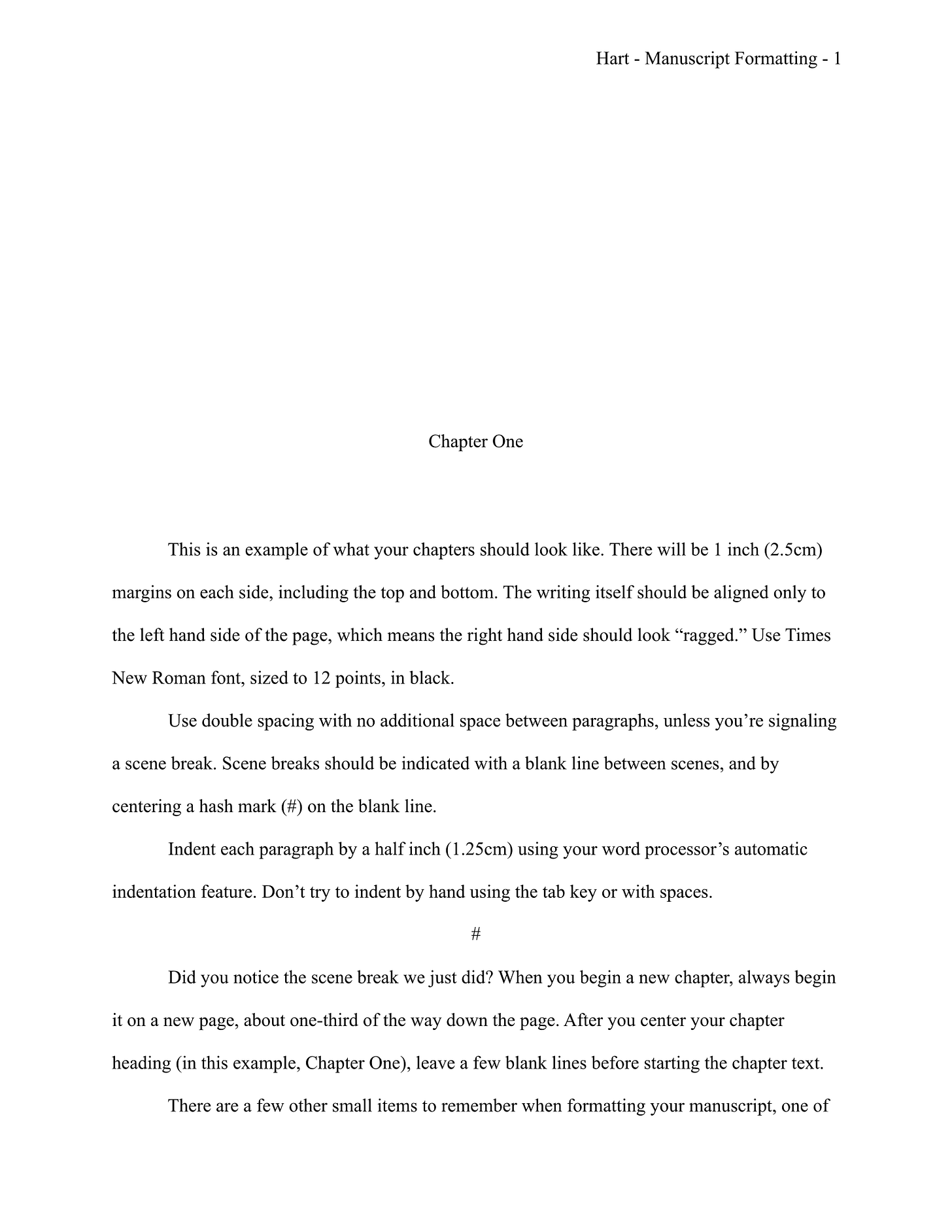
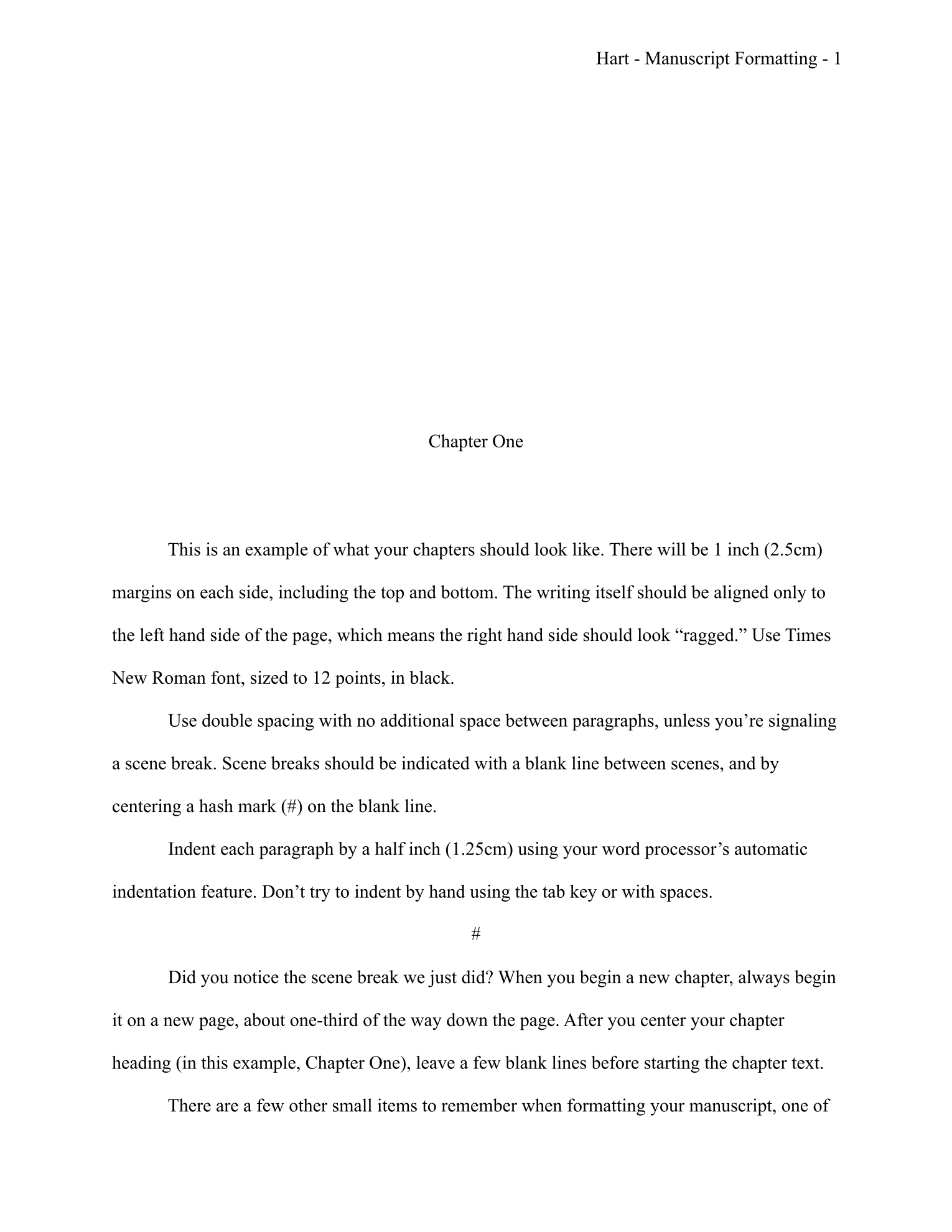
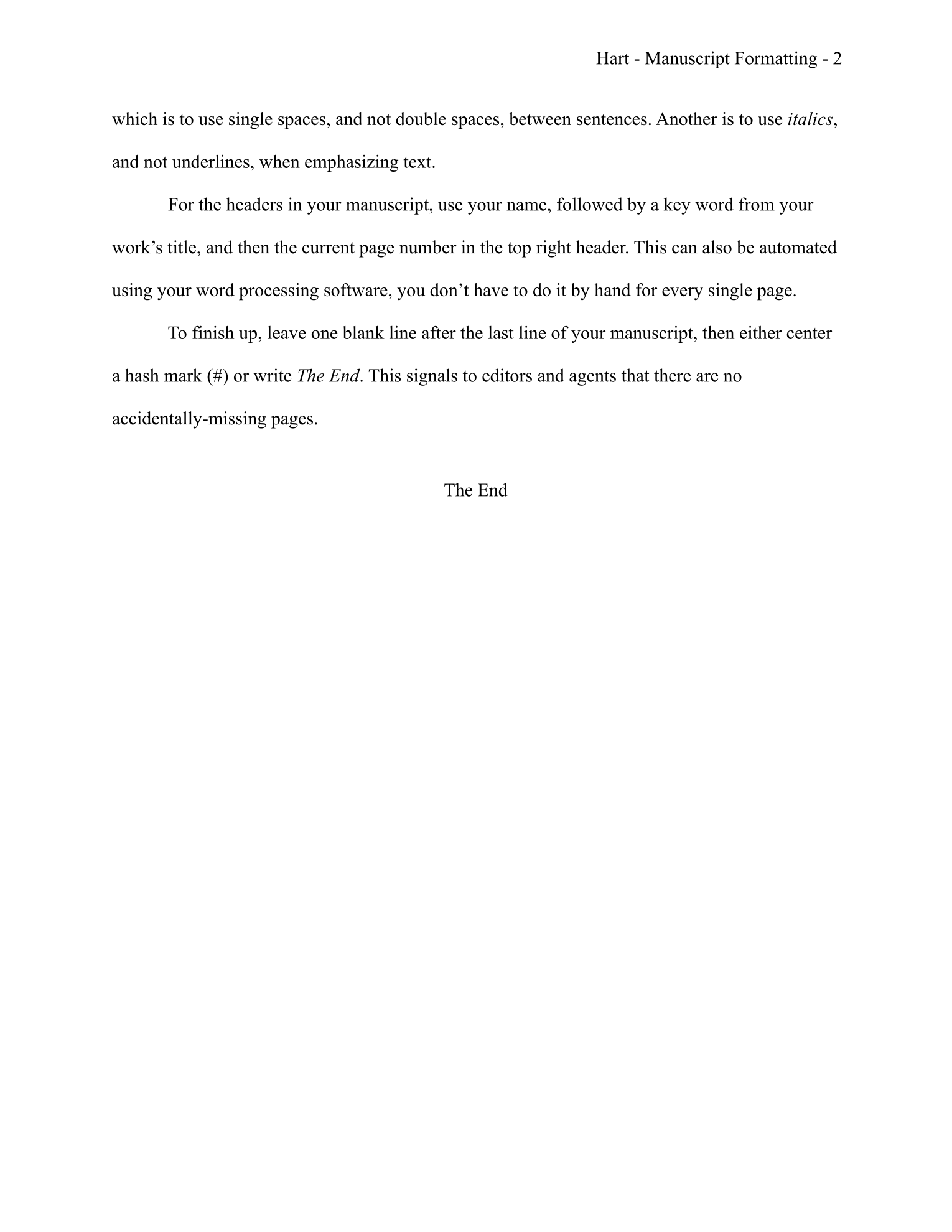
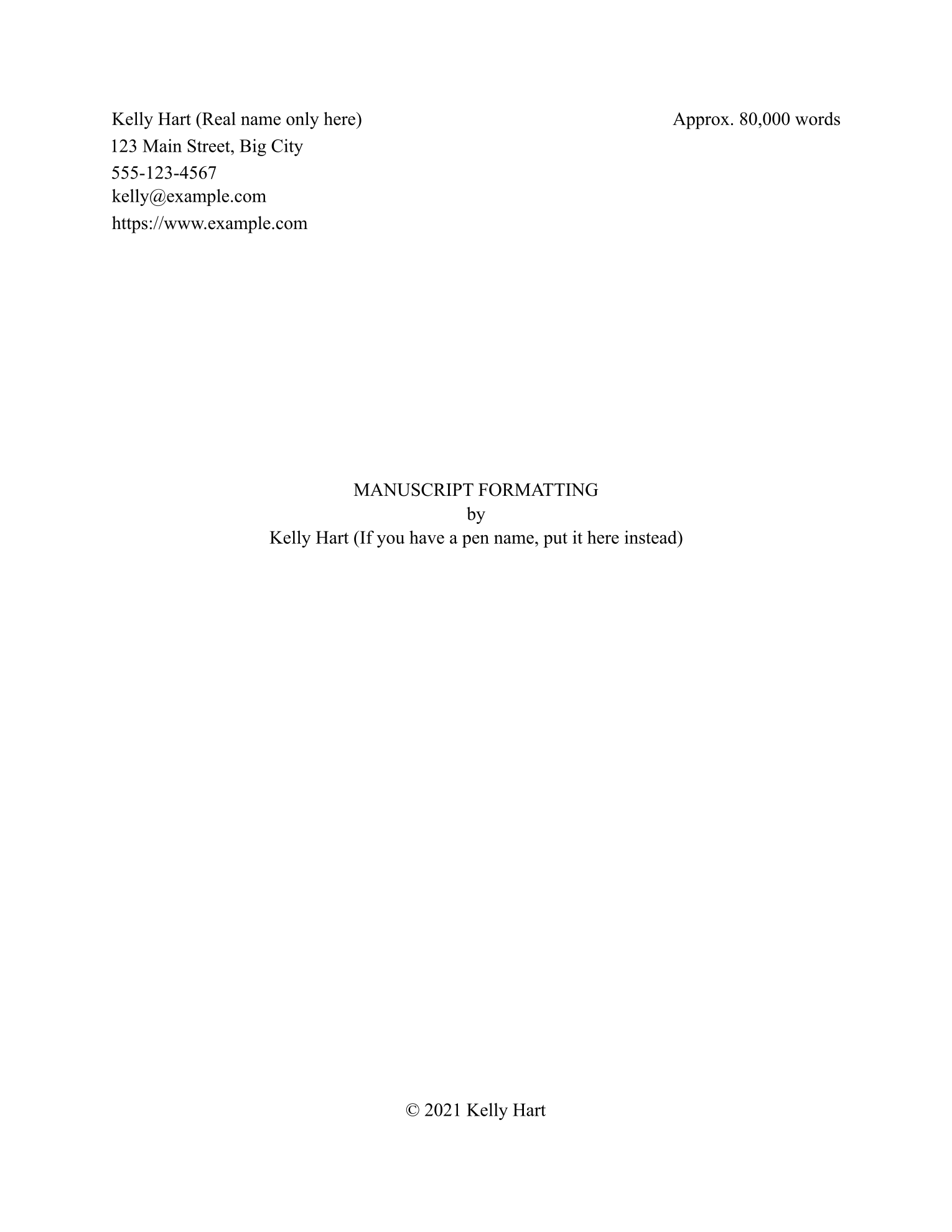
Format. There is a standard format for novels: Here are the details you should follow from Scribophile. (Ironically, there is an error in this otherwise good example: “accidentally-missing” should not be hyphenated because accidentally is an adverb. However, I see this error in many manuscripts, so beware.)
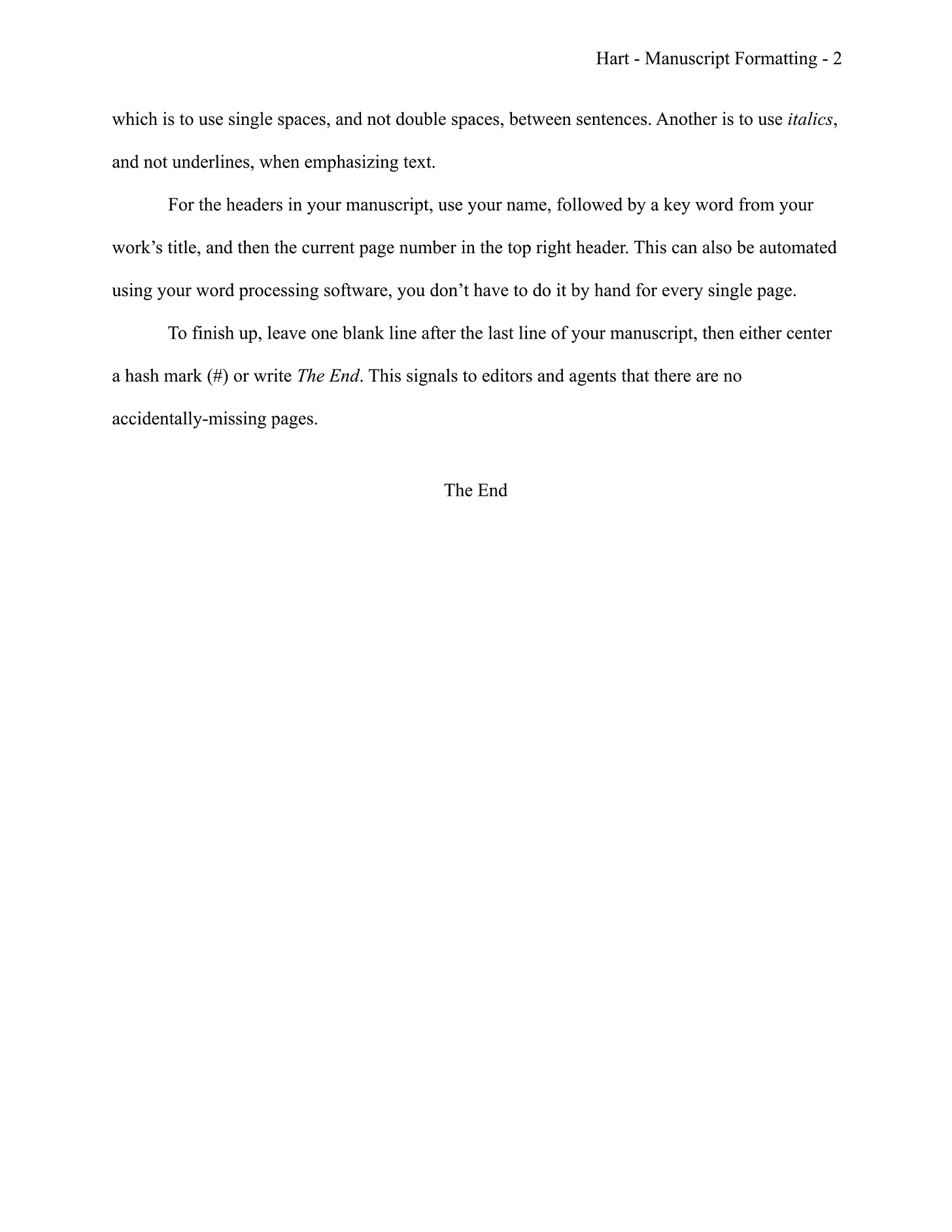
Titlepage. Just the title centered in the middle and your name, address, phone number, and email. Do not add any fancy designs or artwork or mock up of your own cover. This is the sign of an amateur. Here’s a sample titlepage from Scribophile.
About copyrighting. Beginning writers are often obsessed with the perceived threat that their great idea will be stolen while in manuscript form. The chances are negligible. However, for peace of mind, you can copyright your work. Go here for more information.
Most major publishers only accept material submitted by agents. You’ve probably already heard writers complain that it’s as hard to get an agent as it is a publisher. Don’t let that discourage you. There’s nothing easy about the writing business and if you just make a plan and follow it, no matter how much you get rejected, you are more likely to be successful.
First, compile a list of agents you want to represent you. The Poets & Writers Guide to Literary Agents and Reedsy offer lists of agents. Focus on those agents that represent your genre and that are willing to work with new writers. Then do your research. Go to the agency’s website and see what books they’ve sold and to which publishers. Order your list according to agents that have sold the most books in your genre to the most major publishers. Send query letters to all the agents on your list. Yes, you can query all of them simultaneously.
What should go in a cover letter? Not much. Introduce yourself, but don’t give your entire biography. No need to know where you went to college or that you love writing or that you think the book is the next Harry Potter series. Give only information that would be helpful in making a decision about your book. If you’re a college professor in physics and your novel is a thriller that deals with something involving physics, that’s relevant information. You’re an expert. If you’re a cop writing a mystery, that’s relevant. Most important, keep the bio brief (no more than five sentences).
Queries should include a brief synopsis. Again, keep it short and simple, focusing on the character descriptions and the plot conflicts. Writers often make the synopsis too long, sometimes breaking the entire novel down into chapter descriptions. Too much information. Keep it under a hundred words.
Some agents and editors want you to include a sample with the query. Usually, they’ll tell you how much to send. Don’t send more than they ask for. Honestly, they’ll probably know whether or not they want to read more after the first three pages.
It makes sense to try the traditional publishing route before publishing online. With traditional presses, you will get a money advance for your book. However, many writers choose to forgo the anxiety of seeking agents and traditional publishing to sell their novel online as an e-book. There are many platforms available, the most popular being Amazon. You’ll find more specific information at “How to Publish a Book For Free: The 7 Best Sites.”
Important: The e-book business changes rapidly, with new platforms arriving and disappearing. It’s crucial you do the necessary research before making this choice, or paying money to a company to help you publish. I am not endorsing any platform or company, just offering you information.
If you decide to post it on various sites publish it online yourself, remember that about 4 million books are published each year in the U.S., 3.5 million of them being self-published or e-books. That means you have a lot of competition for readers. You still need to edit your book for errors, create a cover, and do a lot of marketing.
You’ve probably read about the authors that posted their own books and sold hundreds of thousands of copies. And how traditional publishers took note, gave them huge advances, and published their novels under their imprint. Go online and read how they did that. You’ll find that first they spent money and time promoting their e-book. Make a detailed, realistic plan before you choose this option.
Comments
Nothing yet. Say the first thing.
Sign in to join the conversation.