
Great Movie Moment: Say Anything: The best teen rom-com ever made.
An Overview of What Act Two Must Do: The second act is the hardest part of any novel or screenplay. Here’s what needs to be included in Act Two to make it successful.
5 Resources for Writers: Good stuff for writers.
Say Anything has half a dozen memorable scenes, all of which I will probably post eventually. Written and directed by Cameron Crowe (Jerry Maguire, Fast Times at Ridgemont High), it is the best, most original teen romantic comedy every made. Their relationship is not just believable, but one you root for with a passion.
Probably the most famous scene, known even by those who have never seen the movie, is when Lloyd (John Cusack) tries to win back Diane (Ione Skye) while she’s trying to sleep. There is no dialogue, just the song playing. Notice how Lloyd isn’t sitting on the hood of his car with the boom box next to him. He’s standing, holding the box above his head. It’s an uncomfortable position, but that’s the point. It’s not just the song that conveys his emotion, it’s his stance, his serious expression, the time of night. Lloyd will go through physical hardship to win her back. It’s shown, not told.
No one who’s seen the scene can forget it. That’s good writing.
Desk drawers across America are filled with first acts of scripts by wannabe screenwriters. They enjoyed introducing the characters, plot, and conflicts, but now that those things have to be explored with more depth, they give up. Act Two is where the real writing ability is revealed. It requires more thought, technique, and perseverance than either of the other acts. Fortunately, we can show you just how to accomplish all that.
This is how writer-director Billy Wilder (Some Like It Hot) described the three acts of a screenplay: “Act One, get your hero up a tree; Act Two, throw stones at him; Act Three, get him down out of the tree.” What he means by “throwing stones” is that the hero must face obstacles that make the audience wonder whether or not he’ll be able to get down from the tree in one piece. That wonder creates suspense. The more we care about the hero, the greater the suspense. The bigger the obstacles in the way of him getting down, the greater the suspense. The better the reason for him getting down, the greater the suspense. Clearly, the main function of Act Two is to generate suspense.
Why?
Because Act Two is the toughest of the three acts to write. Those in the film industry often criticize scripts by referring to “the second act slump,” “the second act blahs,” or more directly, “the second act snooze.” The reason the second act is so difficult is because (1) it’s the longest act of the script (so more can go wrong) and (2) it has to payoff the promises made in Act One as well as make promises that will be paid off in Act Three (which means it has more moving parts—so more can go wrong).
Act One is fun for writers because you’re introducing characters and presenting plot conflicts. You’re engaging the audience by presenting interesting characters and a compelling plot hook. It’s like showing a man a photo of a beautiful woman and promising that you’re arranging a date for him with her. It’s like having guests to your house, showing them all the fresh ingredients and describing the delicious meal you are about to cook for them. It’s like watching a trailer for a movie filled with clips of romance and adventure.
Act Two is the promised date; Act Two is sitting down to the finished meal; Act Two is finally watching the movie. In other words, Act Two fulfills the promises made in Act One. Therefore, that date better be great; that meal better be delicious; that movie better be fantastic. If it isn’t, you’ve lost your audience because they no longer trust that the rest of the script will pay off on its promises.
Because of that, you no longer have the staples of Act One: cute meet scene, big action opening, introducing characters with witty dialogue and entertaining quirky habits. Because the audience doesn’t know the characters yet, they are easier to surprise. Oh, look, she has a pet iguana that crawled into bed with them. Cute. Oh, look, he quotes poetry when arresting someone. Quirky. Oh, look, his family was kidnapped by someone in an ice cream truck. Suspenseful.
But Act Two doesn’t have it easy. Act One is the first few weeks of giddy and passionate dating; Act Two is moving in together and figuring out who washes the dishes and cleans the toilet. That means in Act Two, seeing the iguana is no longer that cute, quoting poetry as you slap on the cuffs is no longer that quirky, seeing the ice cream truck trolling streets is no longer that suspenseful. The audience has seen it, so at this point they’re asking, “Now what have you got?”
One function of Act Two is taking the promises of Act One and either explaining them or complicating them.
Explaining: If in Act One we understand that Something Bad happened to the protagonist years ago while soldiering in Iraq, in Act Two we have to find out what that Something Bad was. And the explanation must have as much or greater impact on the audience as the suspense created by withholding that information. If it doesn’t have that impact, the audience will be let down and they will lose faith in the script’s ability to payoff on other promises. For example, someone at work tells you first thing in the morning that they have a serious secret about your boss but can’t tell you now. Every time you see this co-worker, they can’t talk now but in a furtive whisper promise to tell you later, after work. Then when work is over and you finally meet they say, “Your boss just bought a new car. The same model that I bought last week!” Really? That’s the “serious secret”? Lame. And so you won’t trust that person again when they say they have a worthwhile secret.
Flashbacks: Act Two is often where you’ll find flashbacks that try to dramatize the withheld secret. Too often these flashbacks are written more like journalism than compelling storytelling. That’s why so many times when you read or see flashbacks it’s clear that, not only aren’t they necessary, but they kill the momentum of the story. If you’re going to write a flashback, which takes us out of the current story that we are attached to, you must make that flashback as intense, compelling, and entertaining as the main story. Think of it as a short story or short film that has to stand on its own.
Complicating: Promises don’t always have to be explained, they can just be further complicated, thereby increasing the suspense and letting Act Three be responsible for the final payoff. For example, in Act One of Murphy’s Romance, James Garner and Sally Field’s characters meet and start a flirtatious May-December relationship. She’s trying to start over with her son after a bad break-up with her husband. The promise is that she will overcome her emotional guard in Act Two and let James Garner in. However, in Act Two her ex-husband—much younger, better looking, and filled with energetic charm—shows up. Complication! Does it pay off? The competition between the two men is both funny and touching, thereby increasing our appetite to find out how this will be resolved.
Act One has established what the stakes in the script are. If Sam doesn’t get win the money in the poker game, he won’t be able to pay back his bookie and might get seriously injured. Act Two’s job is to increase those stakes so it’s even more important that the protagonist successfully accomplish his goal. That will increase the suspense. In this case, what if Sam discovers that his daughter needs an operation to save her life and the only way he can afford it is to win at the poker game. But he must win more than he’s ever won before.
Increasing the stakes proportionately increases the suspense because, just as we’d gotten comfortable with the original stakes, we are shocked out of our comfort zone and back on the edge of our seats into caring again. But harder.
Act One has established what the goal is and what qualifications the protagonist has to accomplish his goal. If Sam, the gambler in the above example, discovers that two of the players in his poker game are cheating together, yet he can’t reveal it or they’ll kill him, how will he still win the money necessary for his daughter? His ability to win is severely decreased and now the suspense factor is greatly increased.
In Casino Royale, Act One establishes that the newly relaunched James Bond is rougher, tougher, and more ruthless than previous incarnations. It shows this in the opening scene in which he doggedly chases someone through a dangerous setting, and later when he shoots a traitorous British agent without any hesitation or remorse.
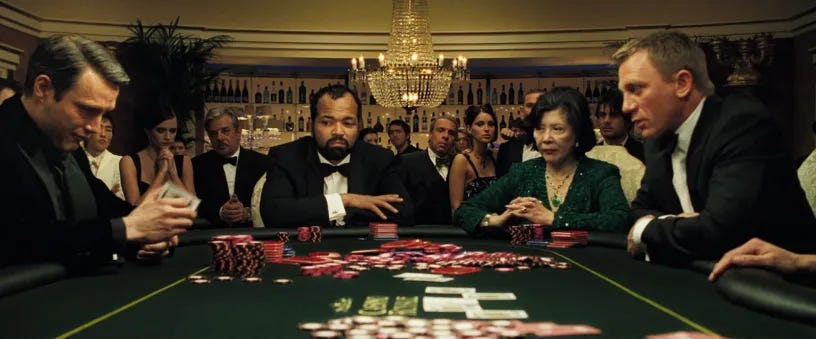
Then in Act Two, when he must play cards against the villain and win in order for his plan to work, two things occur to decrease his ability to win. First, in his arrogance, he misjudges his ability to see his opponent’s “tell” (sign that they are bluffing). Instead, he is suckered and loses all his government’s money. Second, he is poisoned and has to jump-start his own heart with electricity.
By decreasing a protagonist’s ability to accomplish his main goal, you are increasing the suspense. Now we wonder if he will ever succeed and how he will overcome his handicaps in order to succeed.
Act Two separates the wannabe writers from the real writers because the challenges are much greater. This is where writers get frustrated and doubt themselves. The secret is to not rush it. Think your ideas through. Don’t go with the first few notions. Push for more original ideas. And remember, whatever your choices, they should be entertaining.
3 Smart Screenwriting Lessons from the ‘Ted Lasso’ Season 4 Soft Reboot
Poet wins Eisteddfod Chair for second time for ‘exhilarating and tender’ work
‘Like a computer in my heart’: how AI poetry betrays our desire for human connection
Comments
Nothing yet. Say the first thing.
Sign in to join the conversation.