
This is Writing Quests’ Official Newsletter.
by John Corso
“The road to hell is paved with adverbs.” - Stephen King
Weasel words are words “weaseling” themselves into otherwise strong prose. They’re technically correct, but their inclusion is unnecessary and distracting. This can be problematic for three main reasons:
1 - demonstrates a lack of writing refinement
2 - adds unnecessary word count/ fatigues readers
3 - jeopardizes the story’s emotional punch
The good news is that by being aware of what they are, writers can exterminate them from their stories. Here, we’ll look at passive verbs (was + verb), adverbs, (-ly), “very,” vague qualifiers (somewhat), and ambiguous qualifiers (many).
Some examples and corrections:
Jane was running vs. Jan ran
The car was skidding vs. The car skid
She was very mad vs. She was livid
He was very tired vs. He was exhausted
Tina walked briskly vs. Tina strode
Michael said quietly vs. Michael whispered
The day was somewhat cold vs. The day was brisk
The sun was mostly covered vs. The sun was obscured
Some soldiers marched vs. A platoon of soldiers marched
A few cars hit each other vs. Three cars hit each other
Point 1 - Lack of writing refinement/ can look amateurish
This is the ego check no writer wants to hear, but needs to know. Weasel words are fine when writing for ourselves or for family/ friends. When authors want to break out into the larger literary world, there will be quality expectations. An author’s writing prowess is assessed within the first couple of paragraphs, if not sentences. Publications accept a finite amount of work for distribution and will choose the stronger writing options.
Point 2 - Adds unnecessary word count/ writer fatigue
When submitting a novel or a short story, the publisher will set a word limit. Most of the time, these boundaries are hard counts. Weasel words will add into that count, pushing out stronger story lines and/ or character development.
Weasel words make sure readers become tired sooner than later. Minimizing weasel words allows the reader to remain engaged in your story longer.
Point 3 - Jeopardize the emotional punch
Powerful scenes require deliberate words and descriptions. Well-constructed, compact sentences enhance strong emotions. Weasel words spread out sentences, diluting their emotional impact.
Putting it all together:
“The very mad killer pursued her. She was rapidly hurrying to hide behind many somewhat stacked boxes.”
Notice the use of very+adjective, adverb, passive verb, and vague language.
“The irate killer pursued her. She hurried to hide behind four stacked boxes.”
Which sentence offers the greater impact?
The second sentence simultaneously maintains a higher tension level while showcasing the author’s refined skill.
While the 17 words (first sentences) to 13 words (second sentences) seems trivial, this 4-word difference can add up to hundreds of unnecessary words over an extended story.
Keeping weasel words out of your writing will make your stories more efficient, more impactful, and keep your readers engaged longer. Take the time to practice being a weasel hunter.
This is our newest feature. We want to hear from you! Please leave a comment below.
What do you struggle with the most as a writer?
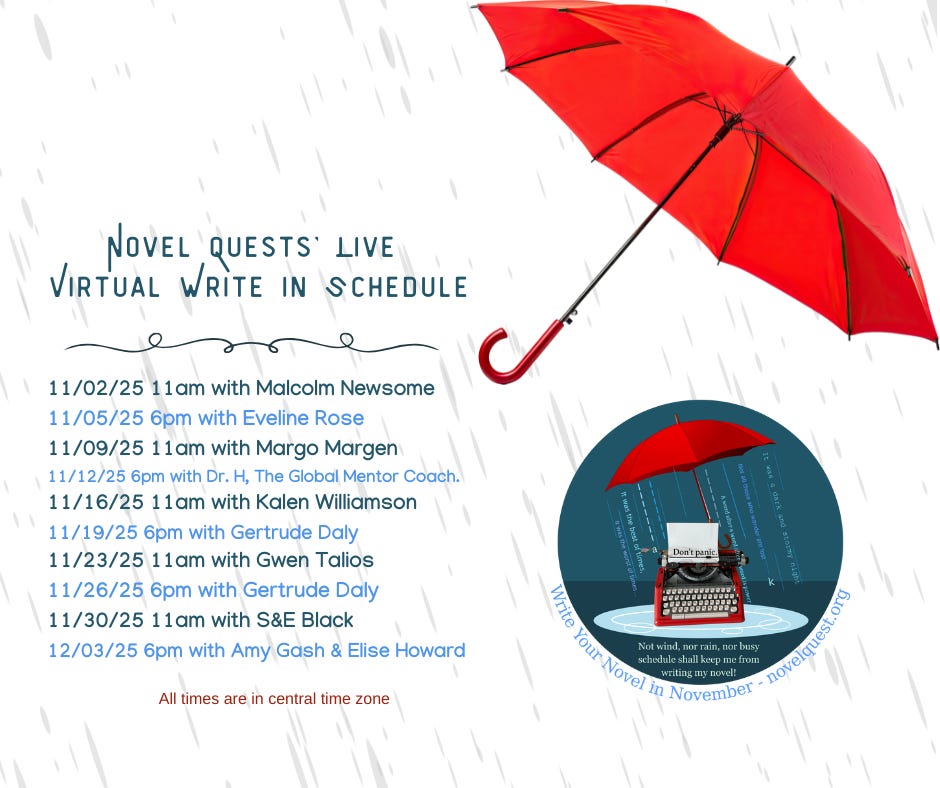
We had a full schedule of authors we are excited for you to meet. Check out our VODs on YouTube to watch their interviews.
We are seeking volunteers to help with the Questy development. In particular, it would be helpful to find individuals with skills/experience/interest in
php/Symphony dev
React web
UI and UX
We are on a journey to create a flexible writing progress tracker (Questy) that will have some nice features, including:
supporting common Quests (defined writing challenges)
supporting individual projects of different formats (novels, series, plays, short stories, etc)
supporting some community communication capabilities, beginning with buddies
supporting community/buddy progress tracking graphs (similar to what NaNo Faces provided when it was active).
You can read more about the project at GitHub (especially see our plans on our wiki).
Hi Writing Questers,
We just passed Valentine’s Day, and love is in the air. Perhaps all of these hearts inspired you to add a romantic subplot to your story. Here are some quick tips to get you started.
5 Quick Tips for Adding a Romantic Subplot
Your MC (main character) and their LI (love interest) should have opposite goals.
If your MC is trying to save the world from the antagonist, they need to fall in love with one of the antagonist’s minions.
Beware of dramatic irony
Sometimes it will work for you, sometimes it will work against you. If you’re adding a romantic subplot for mystery, then the identity of the LI as a minion needs to be a secret from the audience and the MC.
Make sure the tension adds to the story
Both your MC and LI need to be distracted from their goals while falling in love. Are they about to miss a critical deadline because they are busy mooning over their LI? Fun times.
Regulate the amount of steam according to the dictates of your genre. A few examples are:
Epic fantasy can be very spicy or not, according to your own personal taste
Cosy mystery = no spice
Thriller = medium spice
The subplot and main plot need to merge in a very dramatic way.
While subplots should only make up about ⅓ of your story, they do need to feed the story and merge at the climax.
This is a great place to reveal LI as a minion to our antagonist, shocking both reader and MC alike.
This is a great place for the LI to switch sides.
This is a great place for the MC to admit they made a mistake, and break up with the LI.
Subplots do not need a happily ever after.
With these tips you can really up your main plot with a some love juice! What’s not to love?
No posts
Comments
Nothing yet. Say the first thing.
Sign in to join the conversation.