
Good morning, WITDers. I’m super excited because after what feels like months of hubbub, today is a writing day for me. A real one, a long one, and very necessary one. Wish me luck.
Also, quickly, for those who don’t know, we’re in Chapter Seven of our 100 Days of Making & Writing practice, Making from Relationship. It’s always a good time to jump into this daily creative ritual, or jump back in! Today, we’re making and writing something from the student. Below you’ll find a short intro essay, then a detailed invitation to make and write at the end of the post.

One of my mentors, the poet and teacher Paul Matthews, has the most beautiful passage in his craft book, Sing Me the Creation, about teaching, which completely captures how I feel about it:
Maybe when we meet there seems to be nothing between us; yet if you give me your word I can reply with the next, collaborative, responding to questions asked, needs recognized, testing each other’s immediate joys and fears in the writing. That is how I started my work as a poet-teacher—with nothing almost, with simple human acts of language—until I became aware that through a word or a sentence shared in writing we could move into the presence of a communion greater than anything I had intended. At such moments it was no longer a classroom with me as teacher at the center. It became a “circle of truth, poetry and love….”
But before I was a writing teacher, I was an elementary and middle school teacher. And about fifteen years ago, at age thirty-nine, I stood in an eighth-grade Waldorf classroom in Minneapolis and lit a beeswax candle. I placed my hands over my heart to say morning verse with the same students I’d been teaching for eight years, since they were first-graders. They were just months from graduating and leaving the school forever, and I found myself, as I wrote in an essay published in Past Ten and included in the Past Ten anthology:
… gaping into the jaws of my own future, jaws yawning open and shut, mouthing the brutish question of whether I would ever return to my dream of writing.
I had taught these children through the loss of grandparents, through learning to read and write and struggling to multiply fractions and conjugate Spanish verbs and perform Shakespeare and knit socks. I had taught them everything I knew. And all the while they had been teaching me something I would need for the rest of my life: how to receive.
The relationship between teacher and student is one of the most mis-described relationships I can think of, because we almost always describe it in one direction only, with the teacher doing the giving and the student doing the receiving. But anyone who has taught anything ever, especially for any length of time, knows that the opposite is also deeply and immutably true: there is perhaps no more powerful way to learn and to grow than to teach, and this is only true because of the role of the students, whose questions and efforts remodel the teacher, one exchange at a time.
I have felt this in every teaching relationship I’ve ever been in. Students ask questions I’ve never even thought of, or they resist a text in such a way that I come to understand it differently. My students—and this includes those of you so generously sharing your work in this 100 Day practice—produce writing helps me rethink everything I thought I knew about the craft. I’ve actually written in depth about what it has meant to me—what it still very much means to me—to teach writing on Substack and in community, and these sentiments only deepen and become more true the longer I teach. That longer essay is here.
And my former Waldorf students—now in their thirties—gradually became some of my dearest friends. I wrote in that Past Ten essay about what happened when Jon and I got married in 2005:
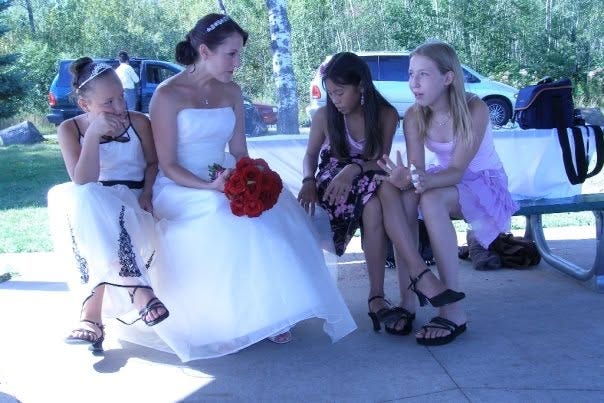
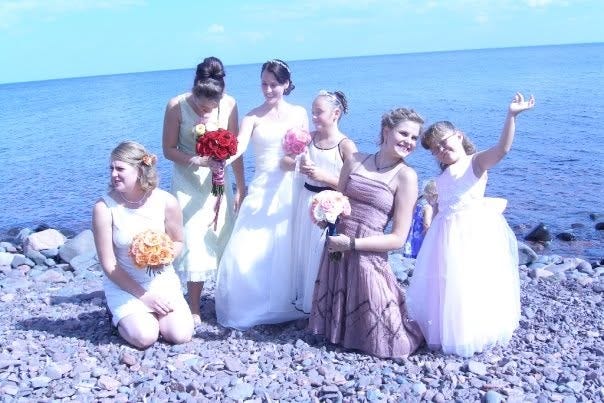
The school community, including my students and their parents, made up most of our wedding guests.
My students (fifth-graders at the time) came to my wedding. And then, in the most unexpected twist of all, last year, Max married Kaela, who was in my Waldorf class.
But—and this is super important—the teacher-student relationship needn’t be institutional to be formative. We teach each other constantly. A friend who shows us how to be brave in a conversation we’ve been avoiding. A child who teaches us something new and beautiful about patience. A colleague models an intriguing new way to solve a problem. A stranger does something offbeat or graceful or generous in public and helps us realize some part of ourself that’s longing to be expressed. Every time one person helps another grow toward something they couldn’t have reached alone, that’s a teacher-student dynamic that changes both people.
Today I’ll invite us to make something from a relational dynamic in which we taught something to someone else, and were changed by it, no matter how subtly.
Here’s a short video and a few words about the riches you’ll find here (and it’s a place to introduce yourselves, as well). With this Curriculum Index, you can check out all the things we have going on in our incredible archive of essays and writing exercises for any mood.
Right now, we’re smack in the middle of our 100 Days of Making & Writing Practice, Day 68 The Student! Remember, it doesn’t matter if you start on Day 1, Day 12, Day 20, or right now with Day 66. I call each ten-day section a chapter, and we are in the middle of chapter seven—Making from Relationship—but you can also explore the entire experience here in any order that suits your desire.
There is no right or wrong way to do this—every day is another chance to choose our own adventure. We’re just so, so glad you’re here!
Welcome, welcome!
Mark your calendars for our upcoming 100 Days of Making & Writing Community Zooms for us to come together, share snippets of the work, ask questions, and celebrate the creative synergy. I’ll send out Zoom links closer to the events—and you can always check the WITD calendar of events here, too, but, meanwhile, here are dates to mark:
Sept 3, 4 - 5 CDT
Sept 23, 10 - 11 CDT
Think of someone you taught something to—and, remember, teaching can take a million different forms. Have you ever taught a child to read, or helped guide a
Comments
Nothing yet. Say the first thing.
Sign in to join the conversation.