
Hemingway and Faulkner were dead of course, Woolf and Fitzgerald long gone. But Vonnegut, Updike, and Cheever were peaking in 1970, continuing the novelist dream. Literary lions, they roared, drank, went crazy, scrapped, bought country homes, and to the fan’s eye seemed to mostly sit around tiny tables at Parisian sidewalk cafes, smoking and shooting the shit. Listening to jazz.
In 1970 I’m a 15-year-old junior in suburban DC. Annie’s a 16-year-old senior in a San Francisco suburb. A continent apart, we share the same roster of heroes. We are reading the same books. It’s hard to believe, but culture had yet to fragment into tribal identities. All of our important teachers and professors, our peers, the book reviewers, and the style makers praised Updike and Baldwin, listened to Miles and Monk, caught the new Truffaut and admired Rauschenberg. Culture was still monolithic and thought to be a meritocracy. It would be close to a decade before the Eagles and Madonna, Spielberg and Lucas, and Bret Easton Ellis and Jay McInerney opened the door for facile, meretricious works to be labeled genius.
In 1970 Henry Miller — my personal hero — was winding down his life, holding salons at his porticoed home six blocks from a beach near Santa Monica. I completed Dashiell Hammett and moved onto Thomas Wolfe. Annie’s paragon, J.D. Salinger, had released his final public writing five years earlier. Next stop for Annie was Virginia Woolf, including all six volumes of her letters.
These were and are among our formative authors, as influential as Shakespeare and Austen and Dostoevsky would be in college. Then after college Bukowski, Beriault, Olds, Morrison, Portis, Calvino, and on and on.
We trained. Mostly by reading well. And suddenly in 1980, Annie and I were both ordained professional writers. That year my wife published her first novel a few days after her 26th birthday, and a daily newspaper printed my first story as a staff writer. A continent apart, we had shared the same exemplars and dreams, and hadn’t given up.
To me, with success might eventually come the glamor of Paris cafe society, the Algonquin Roundtable, and fireworks in the Hamptons with Gay Talese. Or the reverse glamor of the down-and-outs toughing it out in an blisteringly intense reality: Miller and Orwell in Paris and London, the Beats in Tangier, Exley and McGuane in the Keys. These were my visions.
Annie knew better. The child of a literary father, her family’s Marin County living room unveiled the drunken sloppiness, questionable morality, and sketchy brinksmanship that passed for salons of witty banter. The reality that irony and glamor prevent intimacy was exposed in her own house. And she could see that the average literary writer lived on hot dogs and Four Roses in shabby apartments. Glamor, no, Annie had no illusions. But respect and notice from the day’s literati? Yes, that was a substantial goal, and it required an East Coast stamp, from the New Yorker and the New York Times mainly. That was Annie’s vision.
Here our stories part. From the start, Annie was brave and I was chicken. If she was to be a famous writer, she must produce her first novel. As soon as material presented itself — her father’s brain tumor — the process began. Her father encouraged it, with the remark, “Why don’t we both record what happens to me?” His draft petered out quickly, as his cognition declined. Annie stuck with it, and her novel about a family in shock, titled Hard Laughter, put her on the map. And it would be hot dogs and Four Roses for a long time.
Me? I went for a steady income, and landed a reporting job at an upstate New York daily with an annual salary of $12,500, almost double what Annie lived on. Within a few years I was making $45,000 as a publisher for a chain, then back down to $25,000 as a reporter again, rising to nearly $40,000 for a large Jersey daily. I bought a house, supported a wife who was trying to make it in the New York art world, and figured I would get around to novels at some point.
From my first days in newspapers, forty years sped past before I took novel writing seriously. Meanwhile, Annie built her literary reputation with a series of novels, interrupting them with two remarkable nonfiction books, Operating Instructions and Bird by Bird, that brought her real fame and money. Her dream had come true. And there was proof of her acceptance into the literary tribe. Until she tired of it, she traveled as a regular on the writing retreat circuit, hobnobbing with the day’s literary dons as a made member. She was a single mother, so her little boy Sam came along. Her memories aren’t of witty repartee, but kind men and their wives helping out with Sam. Kurt Vonnegut, Peter Matthiessen, Frank McCourt, and Evan Connell were just guys entertaining her five-year-old.
When we met nearly ten years ago, I was completing my first book, a description of a small corner of spirituality, which I wrote as if by accident in homage to a former teacher. Annie had just finished her 17th book, all of them written at her own instigation and for no other reason than that she believed they weren’t already out there. If the writing retreat circuit could be called glamorous, she had left fame and glamor behind years before we met. No writing retreats, no hanging out with famous men. Annie liked staying home and participating in the lives of old friends, few of whom were writers, and her tightknit family. She corresponded by text with near-strangers, friends of friends who found their way to her, usually because they were dying or drowning in the wake of a nearby alcoholic, never about publishing. Our days gravitated around a quiet living room that engaged in little snark other than that aimed at the Trump regime. (We fell in love two months before the 2016 election.)
Early on, Annie tied a red Buddhist string around my right wrist and prayed aloud, “May a writer’s life come to you.” She knew my history — reporting and editing, publishing, corporate communications, PR, a dozen years of strategy and product management, landing finally in executive and spiritual coaching. And a steady complaint that I hadn’t yet chased my dream. Yes, a lot of writing in there, but a hack like me was filling in the blanks for others. By “a writer’s life” Annie meant writing for myself for once.
Like in everything else in life, you do what you can. If you can write persuasive sentences, you probably trained your eye on that skill, and might well be a writer. It’s what you can do. But just because I was confident I could write well didn’t mean I was courageous in life. That’s a whole other thing.
Annie showed her courage at 19, dropping out of college because it was getting in the way of her ambition. I showed my cowardice by settling for newspapering and a regular paycheck. Straitjacketed within a format that didn’t suit my drawl, the spark in my writing style went out. I revived it briefly — quit my job, got divorced, sold the house, rented a cabin in the woods, and taught myself fiction in 1988 and 1989 — and then snuffed it for a corporate career and magnificent paychecks in the Nineties and on.
Slowly, with Annie’s encouragement, I adopted the writer’s life. Over the first year of Covid I published my spiritual book and wrote a second, this one my own. That was Better Days: Tame Your Inner Critic, based on techniques I had refined with private clients over the prior few years. As soon as it was published, I started a third book, which turned into Good Writing: 36 Ways to Improve Your Sentences, co-authored by Annie. That one got me the imprimatur of a major publishing house and the cred of making it onto the New York Times bestseller list. No glamor arrived, and my daily life didn’t change: inner critic clients, gardening, watching TV with Annie, some exercise outdoors, and a little writing.
Oh, by the way, I wrote a novel that I got into shape this year and is being pitched by my agent as you read this. Too bad Gay Talese isn’t still around. Apparently I got into the game too late to taste the glamorous life of a novelist. And besides, it has been five months and no publisher has picked it up. Maybe it sucks.
Hemingway advised writers to state what is rather than what is not. Like all rules, this one deserves to be broken at times. Despite all my 15-year-old self’s hopes, writing turned out to not be a path to glamor. So why do I still do it, and why am I finally writing novels? That’s another essay.

CLICK HERE FOR MORE INFORMATION
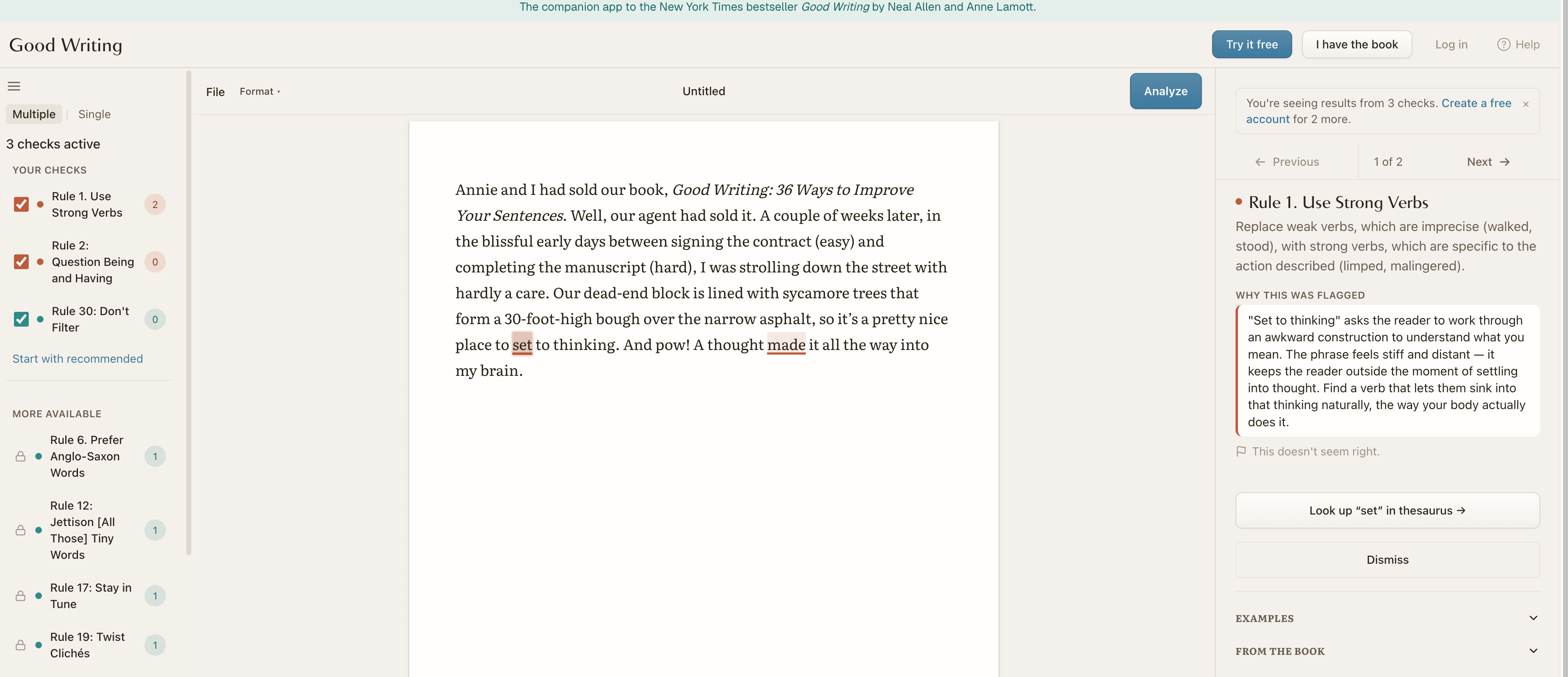
Hey kids, I’ve got an app that accompanies the book Good Writing: 36 Ways to Improve Your Sentences, co-authored by my wife, the fabulous Anne Lamott
No posts
Comments
Nothing yet. Say the first thing.
Sign in to join the conversation.