
This week’s video puts DeepSeek V4 through five tests — premise, outline, chapter, revision, and one for fun. It’s already up, and I’ll link it at the bottom.
But there was a sixth test. One I started running while I was editing the video, and one I couldn’t fit because the result took a turn I didn’t expect, and the analysis would have blown the runtime past 20 minutes.
So I’m telling you about it here. This is the version of the story that only the newsletter gets.
I asked AI to write a complete 77,000-word thriller. In one run. No human input. No mid-stream prompts. Just hit go and walk away.
Here’s what happened, what it taught me, and why this is the most useful thing I’ve learned about AI for authors all year.
After finishing the scorecard tests for the video, I had everything ready to keep going — the premise, the twenty-chapter outline, a thriller called Kiss of the Weld about a saturation diver trapped in a sabotaged underwater habitat at 300 meters. Halomate (the platform sponsoring this week’s video) has an auto mode feature that’s supposed to let the AI continue working on its own without you prompting it.
I turned it on. Walked away. Came back fifteen minutes later expecting either nothing or a couple of chapters.
What I came back to was a complete manuscript. Twenty chapters. An epilogue. A character appendix. Internally consistent. Plot threads tracked. Hook lines at every chapter break. Voice held across the whole arc.
And I’ll tell you — the opening is genuinely good. Not “good for AI.” Good.
The weld pool was running too hot. I saw it before the alarm could tell me — that faint orange shimmer under the surface of the molten steel, a colour that belonged in a forge, not in a saturation diver’s prep box at three hundred metres.
That’s chapter one. Real opening line, real sensory grounding, real character voice. I wouldn’t have flagged this in a slush pile.
So why am I telling you it failed?
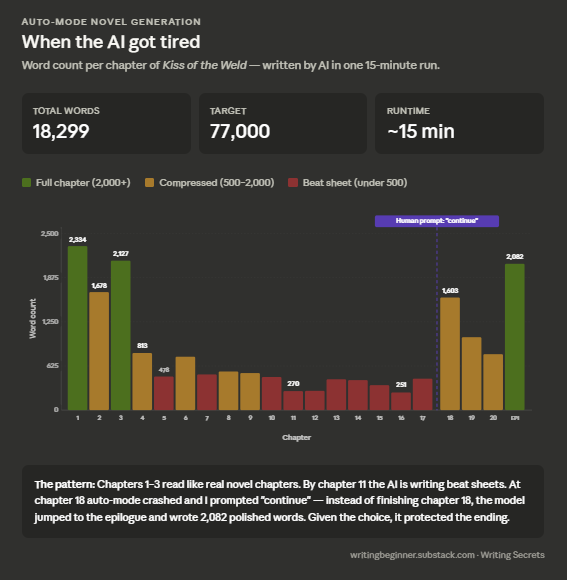
Chapter 1 is a real chapter. Nice. Chapter 11 is a beat sheet pretending to be a chapter. Not so nice. Chapter 16 — the climax-adjacent chapter where the protagonist is racing against a countdown — is 251 words long.
The total came out to roughly 18,000 words. Novella length. About a quarter of what I asked for, written in about fifteen minutes.
As context fills up, the model starts compressing. It stops writing scenes and starts writing summaries of scenes. It stops dramatizing and starts narrating. The middle chapters of Kiss of the Weld aren’t chapters. They’re plot notes the model wrote to keep itself oriented while it raced toward the ending.
You can feel it in the prose. Here’s chapter 1, where the protagonist counts seconds to manage panic:
I have been counting in fours since I was fourteen. I do not think about why. I will tell you that on a wet road in November my brother Thomas was alive in the passenger seat for three minutes and forty seconds after the car went into the canal, and I was on the bank, and I could not work the door, and my mother was screaming, and the screaming did not unbuckle anything.
And here’s chapter 9, where the same protagonist is supposed to be making a high-stakes decision about a sabotaged valve:
Sam had mentioned it that morning — a throwaway line, a remember that time story about the refit crew getting it wrong and nobody noticing for three months. I had filed that information away. And now I was going to use it.
That’s not the same writer. Chapter 1 trusts the reader. Chapter 9 explains itself like a Wikipedia entry. Same model, same session, same voice prompt. The difference is fatigue.
And here’s the part that fascinates me: when the model hit chapter 18, auto mode crashed. I had to manually prompt it to continue. When I did, it didn’t finish chapter 18 — it skipped ahead to the epilogue and wrote 2,082 words of clean, controlled, thematically grounded prose.
The model wasn’t out of its capabilities. It was out of attention. Given the choice between finishing a middle chapter and protecting the ending, it protected the ending.
That’s not a bug. That’s a model making the same triage decision a tired writer would make at 2 AM with a deadline at dawn.
The lesson isn’t “AI can’t write novels.” The lesson is more useful than that.
One. AI can produce novel-quality prose at the start and end of a long generation. The frame holds up. If you’re using AI for opening chapters or for closing scenes, you’re working with the model’s strongest output.
Two. AI cannot sustain quality across the middle of a long generation without human intervention. The middle of every novel is where the work is. It’s where the model gets tired, and tired models compress.
Three. Auto mode is not “set it and forget it.” It’s “set it and stay in the room.” If I’d been checking in every two chapters, I could have caught the compression at chapter 4 — when chapters dropped from 2,000 words to 800 — and re-prompted with “expand chapter 4 to full novel scale before continuing.” The model wasn’t going to do that on its own.
Four. And this is the one that surprised me: the model’s instinct to skip chapter 18 and protect the epilogue is exactly what a good human editor would have advised. If you can only finish one of these, finish the ending. The AI made the right structural call. It just couldn’t tell me it was making it.
This experiment couldn’t have happened in a regular ChatGPT or Claude window. The context window would have blown out somewhere around chapter 6, and the model would have lost the premise, the outline, and the voice.
Halomate’s persistent memory — what they call “Mates” — is what kept the model oriented across all twenty chapters. The Mate held my premise, my outline, my voice samples, and the running manuscript as a continuous reference. The model could check itself against the source material without me re-feeding it.
That’s the actual unlock. Not “AI writing a novel.” It’s “AI writing a novel while still remembering what novel it’s writing.” Most platforms can’t do that.
If you want to try it: Halomate is here. They’re sponsoring this week’s video and they’ve been good to work with. Free tier exists. Auto mode lives behind the paid tier and burns credits fast — fair warning — but the persistent memory feature is the part I’d actually keep using.
The newsletter is the honest version of this story. The video is the entertaining version — five DeepSeek tests including the prompts I used (which you can steal). They’re meant to be read together, and you’ll get a different angle from each.
👉 Watch the full DeepSeek V4 test here
It’s the most fun I’ve had testing a model in months.
If someone tells you AI can write a complete novel autonomously in 2026, they are either lying to you or they have not actually tried it. AI can write the first quarter of a novel beautifully. AI can write the ending beautifully. The middle is where the human still has to live.
That’s not a disappointing finding. It’s a useful one. It tells you exactly where to spend your time, and exactly where to let the AI run.
I’ll be back next week with something else weird I tried.
— Christopher
No posts
Comments
Nothing yet. Say the first thing.
Sign in to join the conversation.