

Claude Fable 5 is the most interesting thing to happen to book writers since Opus, and almost everything being written about it is aimed at coders and businesses.
Nobody is writing the author playbook.
So here it is. This issue stands on its own: ten copy-paste prompts that go beyond my FABLE Method one-pager, real audit data from a thriller I built live with Fable 5 this week, and the craft truths about how this model actually behaves with a manuscript in its hands.
If you want to watch the whole live build, the bodies, the bibles, the audit catching twelve structural problems before Chapter 2 existed, that’s in this week’s video:
[▶ WATCH: I Built a Thriller Live With Claude Fable 5]
But you don’t need the video for this issue to pay for itself. Let’s go.
Three facts worth knowing, because they change how you should work:
1. It’s a new tier, not just a new number. Fable 5 is the first model in Anthropic’s Mythos-class tier, which sits above Opus. There’s a sibling model, Claude Mythos 5, that shares the same underlying model and is available only to approved organizations; Fable 5 is the one you and I can use, with additional safety measures on dual-use capabilities. For fiction work, you are not missing anything: it’s the same brain. (Anthropic’s announcement is here if you want the official version.)
2. The headline capability for authors is long-context consistency. Earlier models could write a beautiful chapter. Fable 5 can hold a book: who knows what and when, which gun is on which mantel, whether Chapter 19 is still loyal to Chapter 3. That’s the difference between an AI that writes scenes and an AI that can be your continuity department.
3. It critiques best when critique is split from generation. Ask for a draft and a critique in the same breath and you get a polite critique of work it’s invested in. Ask in a separate message and you get an editor. This one behavior shapes half the prompts below.
I’ve been running Fable 5 hard on fiction since launch. These are practitioner observations, not spec-sheet claims, and every one of them changed how I write.
1. Never let it invent your premise. Ask any model to “give me a thriller premise” and you get the statistical average of the genre, because that’s literally what it is. Bring the seed yourself, then make Fable 5 attack it. The attack is where this model is shockingly good: it found the load-bearing flaw in my premise (a logistics problem I’d hand-waved) in its first response, and the fix it proposed became the engine of the whole book.
2. Voice before structure, always. If you outline first, every chapter inherits generic outline voice. Lock a 300-word voice sample first, codify it into five written rules, and paste those rules into every drafting session. Fable 5 holds a codified voice with unnerving fidelity; it cannot hold a voice you never defined.
3. Plot holes convert into plot devices, but only under interrogation. Live example from my build: the interrogation pass caught that my president hid a body in nine impossible minutes. Instead of patching it, the fix made the impossibility visible to a character: he asked for two minutes, took twelve, and the agent who counts everything logged the discrepancy. The plot hole became a clue. That’s what a separate-message interrogation buys you that “make it better” never will.
4. The bible is external memory, and files are the source of truth. Conversations drift, get long, get messy. A living story bible (cast sheets, world rules, timeline, beat map, promises register) updated after every chapter is what keeps a 400-page book coherent. Export locked chapters as files. The conversation is scaffolding; the files are the building.
5. Audit the design, not just the prose. The highest-leverage pass I ran all week wasn’t on the manuscript. It was on the bible itself, before chapters 2 through 18 existed. Single-purpose passes over the beat map and promises register caught twelve structural problems, including an entire act with no kills in a serial-killer thriller. Here’s the cost logic in one picture:
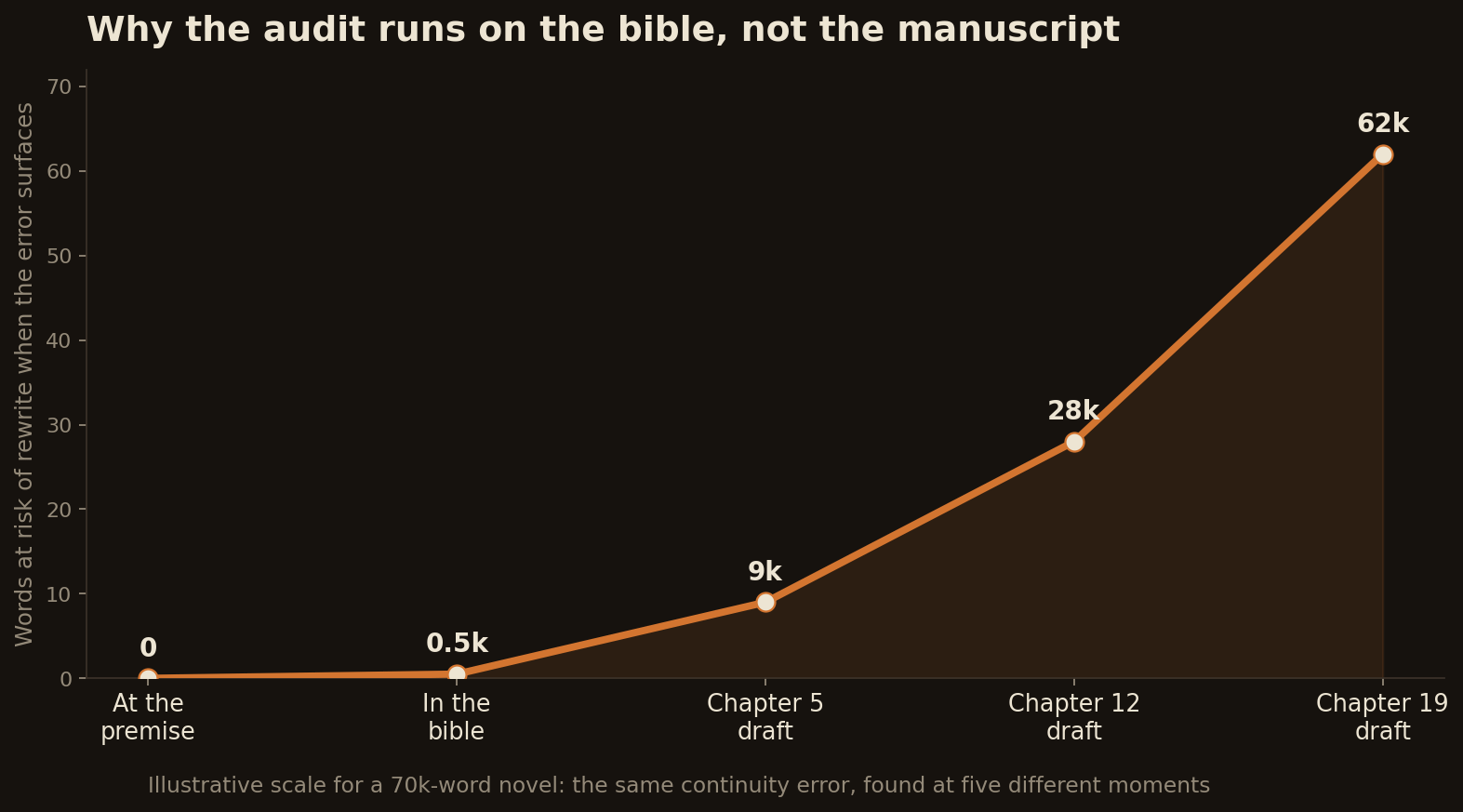
Same error, five different discovery dates, wildly different rewrite bills. Catch it in the book bible and it costs a sentence.
Everything below comes from one session: a suspense thriller called RED HOUSE, built stage by stage with the FABLE Method.
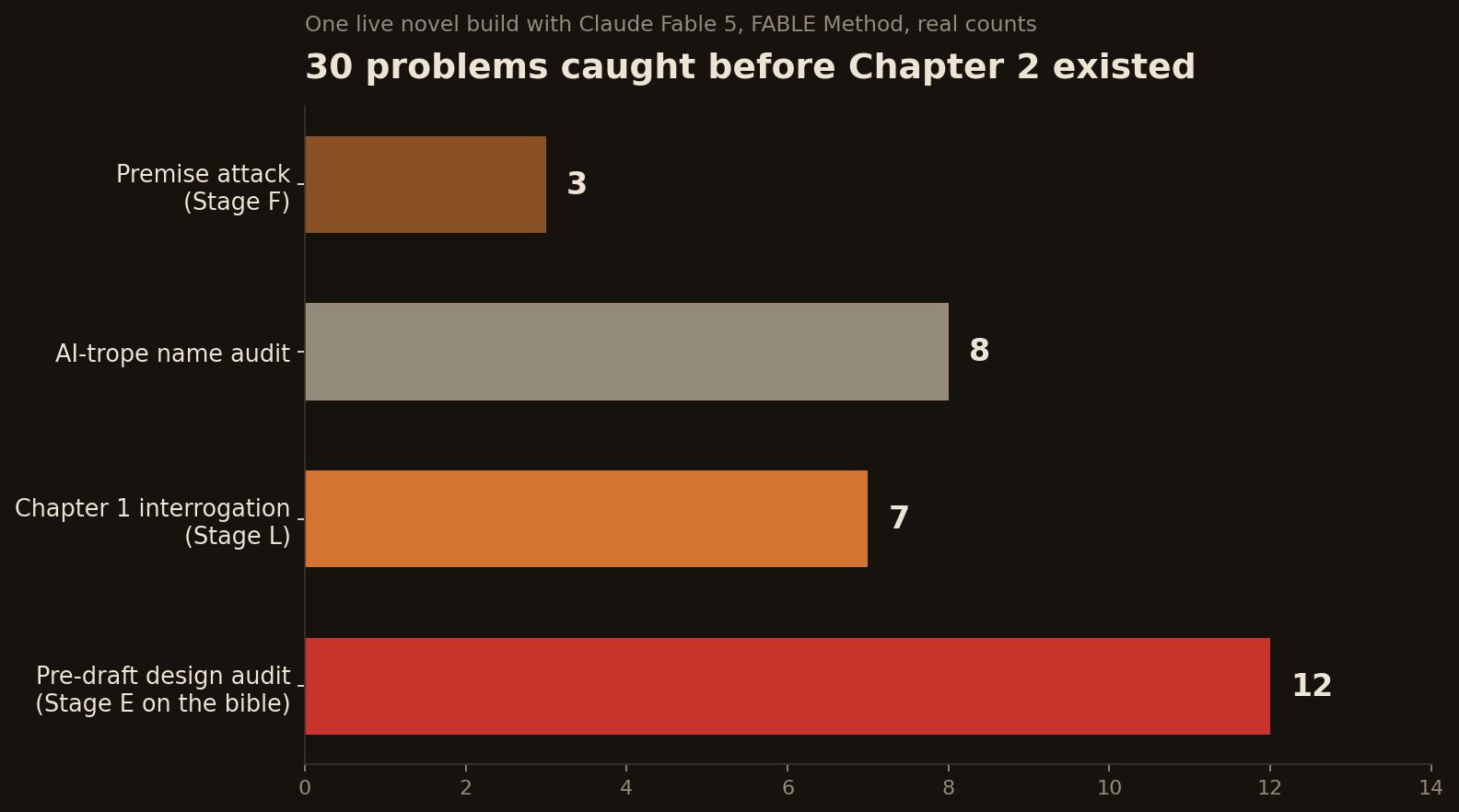
Thirty problems caught before Chapter 2 existed: three fatal premise assumptions, eight AI-trope character names (yes, the model audits its own naming clichés if you ask), seven chapter-level issues in interrogation, and twelve structural findings from the design audit.
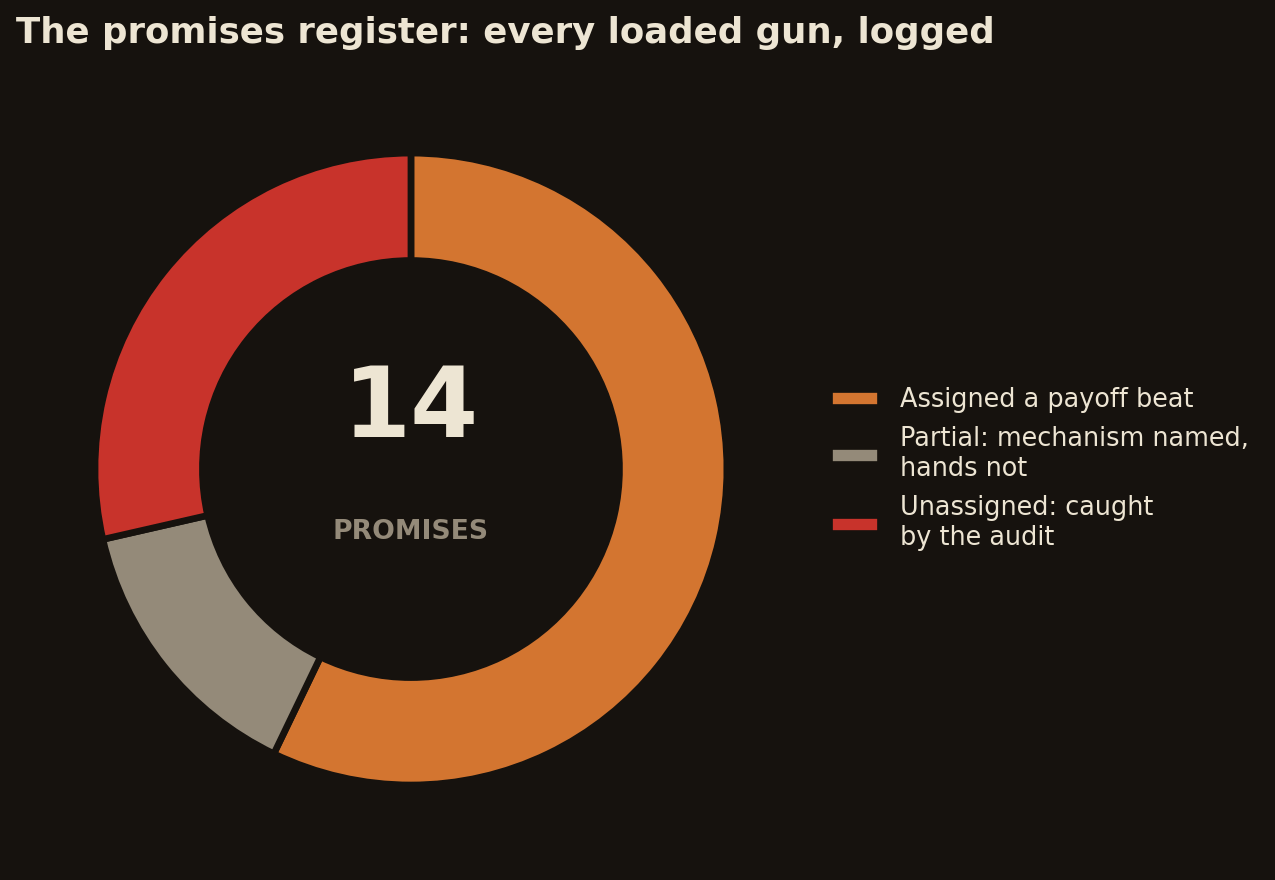
The promises register is the unsung hero: fourteen tracked setups, each one either assigned a payoff beat or flagged. Four unassigned promises surfaced in the audit, which are four broken-promise reader complaints that now never get written.
These extend the FABLE Method (Forge, Anchor, Build, Layer, Elevate). They work identically in Fable 5 and Mythos 5, with the same underlying model. Copy, paste, fill the brackets.
Act as three acquiring editors with different mandates: one literary
imprint, one commercial thriller list, one audio-first publisher.
Each reads this premise: [PREMISE]. Each gives the one reason they
would pass and the one change that would make them bid. Then merge
the three changes into a single sharper premise.
Here are my five voice rules: [RULES]. Here is Chapter [N]: [TEXT].
Score the chapter 1 to 10 against each rule separately, quote the
three worst-offending sentences per rule, and rewrite only those
sentences in compliance. Change nothing else.Full manuscript attached. Build a table of every setup that creates
reader expectation: object, line of dialogue, wound, or threat.
Columns: promise, chapter planted, payoff chapter or NONE, verdict
(paid, partial, broken). Do not fix anything yet. Flag the three
broken promises a reader is most likely to notice.You are a hostile fact-checker deposing this manuscript against the
attached bible. Find every contradiction in timeline, geography,
character knowledge (who knows what, and when they learned it), and
physical detail. Cite chapter and line for each. Rank by how likely
a careful reader is to catch it.Dialogue-only pass. List every line where a character states their
emotion or motive directly. For each, give a replacement that
conveys it through deflection, action, or silence. Mark the lines
where on-the-nose is actually correct and should stay.Scene transitions only. For every scene, quote the current first
and last lines. Flag scenes that enter before the interesting
moment or exit after it. Propose later entrances and earlier exits,
by sentence, without rewriting the middles.Chart the tension of this manuscript scene by scene on a 1 to 10
scale, as a table. Identify every lull longer than two scenes, then
tell me which lull is strategic (a held breath before a detonation)
and which is dead air. Suggest the cheapest possible detonation for
each dead lull.Interrogate the attached chapter, separate from drafting. Answer
only: the weakest moment and why, the sentence where the voice
slips, the paragraph a hostile editor cuts first, the strongest
line that must survive revision, and one structural risk this
chapter creates for later chapters.Compare this locked chapter to the attached bible. Output only: new
canon facts to add (names, times, geography, objects), promises to
add to the register, promises this chapter paid off, and any line
that contradicts existing canon. Format as a changelog I can paste
into the bible.You were trained on a million versions of this genre. Identify the
five most statistically predictable moments in the attached
chapter, the beats most models and most writers would default to,
and for each, propose the version one standard deviation stranger
that still honors the genre contract.Single-purpose pass for nonfiction: list every factual claim in the
attached chapters with its supporting evidence from my claims
bible. Columns: claim, chapter, evidence, strength (strong, thin,
missing). Do not soften any claims; flag the ones I cannot
currently defend.The method fits on one page. The setup that makes it survive a 400-page book takes sixty seconds:
Create a Claude Project (or the equivalent workspace in any AI).
Drop the bible and your five voice rules into Project Knowledge, so every new chat starts already knowing your book.
Run one chat per chapter. Fresh context, zero drift.
When a chapter locks, export the file. Files are the source of truth, not the conversation.
And a confession: I ran this week’s entire live build in one long chat, because I got excited. Which is exactly the failure this setup exists to prevent. Do as I say, not as I just did. The full setup, the live build, and the moment the audit caught my Act Three problem are all in the video:
Bookmark it, or better, paste the ten prompts into a note inside your book’s project so they’re one click away while you write. If you build something with them, reply and tell me what the audit caught; the best war story goes in a future issue.
And if you’re new here: the FABLE Method one-pager, the Claude AI Book Blueprint, and the full Claude Author Bundle live here: https://ko-fi.com/s/c38d7ba38d.
Write smarter. Build stronger books.
Christopher Writing Secrets
No posts
Comments
Nothing yet. Say the first thing.
Sign in to join the conversation.