
My mother was an investigative journalist for a short time—and I often listened to her phone interviews from the kitchen. She discovered remarkable things simply by staying curious. She asked open-ended questions. She wondered aloud. She wasn’t afraid of silence, and she often called people back because a conversation wasn’t finished after one interview.
I think that’s where I first learned that writers can’t really exist without curiosity, and to walk this earth without curiosity creates a dullness of the soul.
Children follow footprints into the woods. They sit in the backseat of their parents’ car asking why. Somewhere along the long drive of childhood, many adults begin believing they have to know everything before they begin. Writers begin believing they have to know exactly what their book is about before they write it, when in reality the book might be writing them.
The point isn’t to have the answer before we begin.
We return to curiosity and wonder. We follow the tracks first and discover what they mean later, and right in the middle maybe we take a different path.
Somewhere along the way, many of us trade curiosity for certainty. I have noticed, teaching for eighteen years, that writers reverse that process. We learn to ask beautiful questions again and again, until even the question becomes a different question.
When I was a child, I was endlessly confused by time. I couldn’t understand how my brother could be three years older than I was when his birthday came the day after mine, or how my grandmother could be so old and still be the youngest person in the room. I dreamt about the future, but the ghosts of the past often entered my bedroom at night, angry that I was living on their land. Who were they, from what tribe, and who really owns land, were early questions when those ghosts hovered outside my bedroom door.
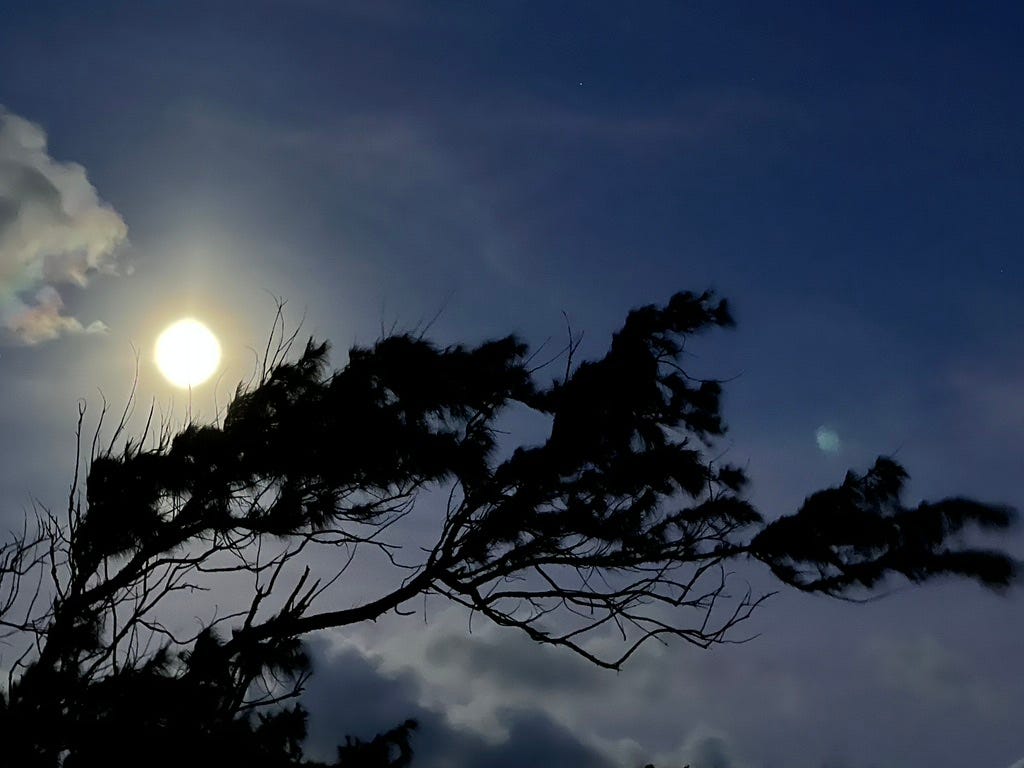
No matter how many times my teachers held up the earth, the moon, and the sun, I couldn’t understand how day and night happened differently all over the world. I remember asking my mother, Are we all looking at the same moon? How can it be full everywhere?
My father laughed when an early junior high IQ test suggested I tested at a genius level.
You’re the first genius with no common sense, he joked.
What he didn’t understand was that my questions weren’t practical—they were mystical. Perhaps no teacher had the answer I was seeking because I hadn’t yet found the right question.
I have heard countless stories from authors who were working on a book, and while writing the original concept of the book it turned into a different book.
Curiosity reminds us that we don’t always interpret what we’re seeing accurately. As memoir writers, we often discover the truth only after following the wrong trail for a while. Sometimes we return to the same story because, like my mother calling someone back, we realize the conversation isn’t finished.
Recently I was standing in a circle painted on my driveway, facing north. A dragonfly flew past me, circled back, then began circling me, each pass a little closer until it hovered inches from my face. Then it spotted a butterfly from our butterfly tree and shot away, catching it in the basket of its legs.
Later I watched another dragonfly carry off a large wasp.
I could have gone inside and Googled dragonflies, but I didn’t need information as much as I wanted to be in relationship.
My house sits on farmland beside Mark Zuckerberg’s property. Sometimes it feels like a National Geographic special—only nobody is narrating, only my curiosity.
I now know the cry of a cow giving birth versus the cry when a cow is stuck on a narrow ridge, terrified to back out. Cows are good at getting into situations and then screaming all night for help.
Recently, after filming cows in distress, I went to Mark Zuckerberg’s gate so someone could contact the rancher to help the cows. The man at the gate asked me how I knew the cows were in trouble.
I speak cow, I said.
But the truth is I’ve spent hours watching and listening to them.
These days curiosity often sends us to search engines before it sends us into the world. But sometimes the better answer is to enter into relationship with the living world, like Walt Whitman and Mary Oliver and Rachel Carson and Terry Tempest Williams.
And to enter into relationship with our memory.
I waited for the dragonfly to circle back, as curious about me as I was about him, after he devoured my beloved butterfly.
Information is knowing that dragonflies eat butterflies.
Curiosity is standing in a circle long enough to watch one chase a butterfly through the air and catch it in the basket of its legs.
This essay was in week three of The Hundred Acre Heart, a six week Literati Academy workshop. Writers taking this course will be featured soon in this Substack to share the beautiful essays and poems created in this course.
Laura Lentz is the Founder of Literati Academy and Writing and Red Lights, the author of STORYquest, the Writer, the Hero, the Journey and Freeing the Turkeys.
No posts
Comments
Nothing yet. Say the first thing.
Sign in to join the conversation.