
Hello Writers ❤️
You probably know that I have two Substacks. I write this one for an ‘audience’ of writers—like you. The other one, I write for people who I consider my readers. People who like to read the kinds of things I write about.
If I could change anything about Substack, I would provide an option to turn off the analytics, or at least hide them. If you’re not a Substack user yourself, what I mean is that when I log in, the very first thing I see, front and centre is a chart of my followers/subscribers/audience… my readers.
I think that this is unhelpful. Counterproductive, even. If you really want to develop as a writer, you need to let go of certain anxieties. You need practice. You need to develop your voice and figure out what you want to say. You need to put your work out there. You need to learn how to silence your inner critic, which is extra hard to do if you’re confronted with other people’s judgment every time you sit down to write.
This Write with Danica Substack has a pretty small following and that’s okay. I just write it because I love you and want to share what I know about the craft to anyone who is trying to do more of it themselves. I want to encourage you. For me, part of my vocation as a writer is to also nurture other writers. I have known this about myself for as long as I’ve known I’m a writer. The two things arrived as a package deal and I try to honour both.
My other Substack has a much larger audience and my feelings about the size of it are much more fraught. Let me show you something:
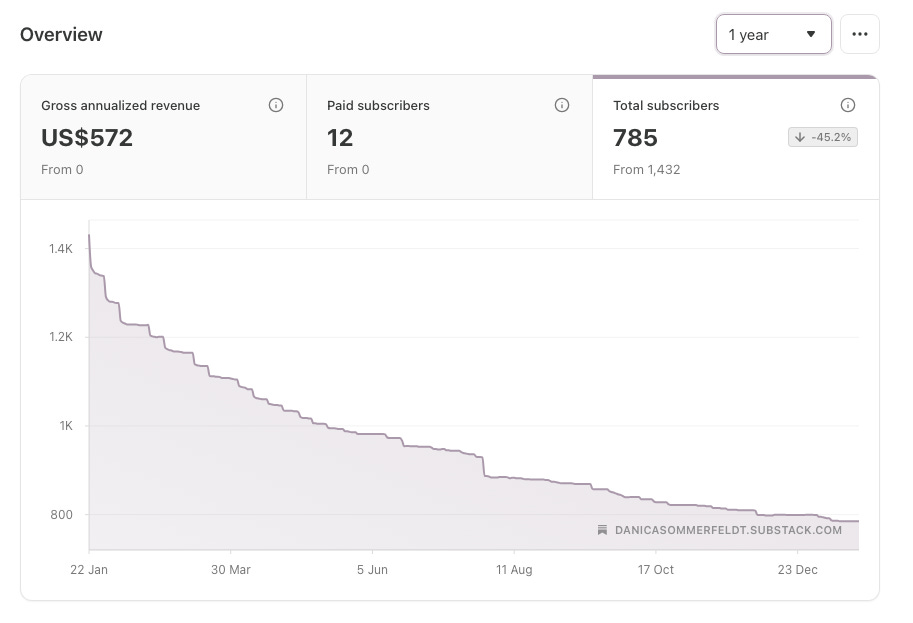
Every time I log in to my Substack to write another letter to my readers, the very first thing I see, before I even have a chance to start writing, is this visual evidence that my writing sucks. Or, at least, that is what I am tempted to think. I went from a readership of 1500 to less than 800 in one year. And every time I write, I lose a few more. Ugh. It feels like a little punch in the gut every time. And, it can tempt me into a state of fear, at times. I am approaching publishers these days, and publishes want to know these numbers… evidence that you show promise with readers, that you are worth their investment.
This chart doesn’t show the whole picture, either. I have gained a number of new readers as well. But the unsubscribes still out-pace the new subscribes, unfortunately. I harbour hope that the trend will slope upward again in time.
On the one hand, it difficult to face this evidence of rejection every single time I want to write to my readers. But on the other hand, I suppose it has built resilience in me because I keep coming back in spite of it. It is a testament to my own sense of writerly purpose. I will keep writing that Substack, I tell myself, even if my audience whittles all the way down to zero. And I know it won’t.
On the other hand—and this is actually my point today—I really love this chart. I tend to think of these declining numbers more in the sense of the focusing of a laser beam. When I started writing that other Substack a year ago, what I started with was my old bookstore’s email list. I began the project knowing that quite a few would not be interested in my writing at all. They signed up for updates from their local bookshop, which no longer exists. I knew ahead of time that there would be a lot of unsubscribing. I just had no idea what proportion of the list would disappear. You can see that the decline was more significant in the beginning and that it has tapered off over time. Which is excellent news! Because I’m getting closer to the truth of how many engaged readers I really have. You can even see a significant drop midway through the year, and that’s because last summer, I went into my subscriber list, ran some filters, then personally excised subscribers who had clearly never opened an email from me. I want actually readers, nut numbers.
So, this chart is oddly encouraging. It blows my mind that 700+ people read what I write. I don’t even know who most of them are. That is humbling and makes my heart feel so warm. As a writer who is inching closer to earning a living at my craft, I would rather have 500 subscribers who really like my work—who might be willing to buy a book if I ever manage to publish one, for example—than 5000 subscribers if that is an artificially inflated number.
The handful of new subscribers I gained last year who never knew the bookstore, are amazing to me. And, the fact that I went from 0 to 12 paid subscribers (even though the vast majority of my newsletters are free) is one of the most encouraging things that happened last year. Not only does those paid subscribers represent the first money I have ever earned for my writing (as opposed to writing work I do for clients) but the notion that there are people out in the world who think my work is good enough that I deserve to be compensated for it… well, I have shed more than a few tears of gratitude over that. It’s so deeply validating. So heartwarming.
I wanted to share this with you today writers, because I know that gaining readers for your work is so hard, and also validating (and necessary if you have any designs on publishing). Seeing stagnant growth or even a decline in interest in your work can be equally devastating. I want to remind you that the work of writing—developing your skills, developing your practice, committing the time and effort and heart to get the work done—all of that matters so much more. You’ll never find your readers at all if you don’t prioritize your writing.
There are all kinds of good reasons to have access to analytics. But, I would much rather think about these numbers when I choose to. And a lot of writers don’t want or need them at all. I don’t think it’s healthy for writers to be thinking about their audience all the time. Just focus on your work. The joy of creating. Discover your voice. Figure out what you think and what you want to write about. And practice. The numbers that count the most are the number of words you get out of your head and onto a page, and the number of hours you spend practicing.
You can do it.
xoxo Danica
No posts
Comments
Nothing yet. Say the first thing.
Sign in to join the conversation.