
A few days ago, I received this notification.
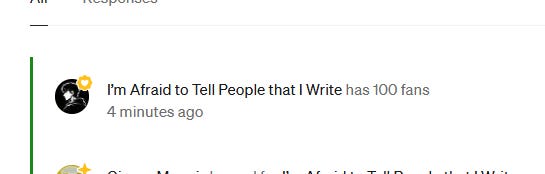
Every month, I have a few pieces that are widely read. The cherry on top is the positive comments I receive.



I’m living the life of a writer I once dreamed of. I wake up in the morning, I write. It makes people happy. And the loop has been repeating for years.
Through writing, I even managed to find my soulmate. And I ended up marrying her.
Not long ago, someone asked me if I had any secrets. I don’t know if the rule of always writing what your heart tells you is a secret. But I do know that writing is a science. It’s a specific form of connection with other human beings. It can be studied. Practiced. Understood. And taught.
This morning, I’m going to give you one of the things I’ve never shared. I had planned to release it as a bonus for my mastery. Then I figured I shouldn’t gatekeep some sauce.
Something that took me years to understand. The real reason why some writing manages to touch hearts and souls.

Most texts are… correct. Well written, clear, structured. Writers even run them through AI to check everything and produce texts that teachers would give an A to in school. They are well written. But forgettable.
They convey ideas, sometimes good ones, but they are flat. They disappear the moment you finish reading them. And the reason is simple: many writers write from ego. They write to impress, not to share. They write to prove, not to give. They write to take, when writing is about giving.
They fail to understand that they are writing words that serve only themselves and not their audience. You could give them any coaching, but as long as they don’t understand this, they will stay stuck. Because their starting position is wrong.
And don’t get me wrong, there’s nothing shameful about wanting to make money from your words. It just has to be a fair exchange. You can’t expect to get paid if you don’t give anything.
Why do you read something? Because you expect to find something in it. Why would you read something empty? It makes no sense.
The challenge of writing is the ability to turn your words into small treasures. Gold that your audience can touch, appreciate, handle, and use as they wish.
I love Spiderman. No matter what movie comes out. Even if I’m not a big fan of the new actor. I still watch. And I’m even happy to watch these new awful movies. It’s like I’m meeting an old friend again.
I’ve always admired Spiderman. His courage. His humanity. His intelligence. His resilience. I have a deep emotional bond with this character.
Stan Lee created something extraordinary. A character people attach to so deeply that no matter what film comes out next, massive crowds will show up. The movie could be terrible. Fans will judge the movie, not Spiderman. Because they know Spiderman is eternal.
Now imagine you want your audience to always come back. Imagine the possibility of creating that kind of bond. Imagine that after reading just one of your pieces, every time they see your name in their feed, they click. They’re even happy to see you again.
To reach that point, you need to create attachment. And to create attachment, you need to create emotion. This is not about literary talent. It’s a biological reaction.
Your reader is not just reading your text. While they do, their brain is constantly reacting. Some of the questions it asks:
Am I safe here?
Do I feel understood?
Do I feel seen?
Can this help me grow?
When the answer is yes, they open up.
And in that state of openness, a molecule comes into play: oxytocin.
It is often called the bonding hormone. The one released when you feel understood, safe, and connected. In a sincere conversation. In a moment of closeness. In a look that says, “I see who you are.” “I understand you.” Like a friend who listens and takes care of you. That’s why we always come back to the same people who make us feel good.
Writing can trigger that.
Many words send precise signals to the brain. They say: you can relax, you are safe here. When someone feels understood, they don’t just read you. They attach to you.
Words of proximity like “you” and “we” immediately reduce distance.
“People often feel this.”
becomes
“You’re probably feeling this right now. Most people just never admit it.”
Words of safety, like “there’s nothing wrong with you,” remove the fear of being judged.
“You lack discipline.”
becomes
“You don’t lack discipline. You lack a system strong enough to carry you when motivation disappears.”
Words of softness create a calming sensation.
“You need to try harder.”
becomes
“Effort isn’t your problem. You’ve been pouring it into things that don’t return it.”
Words of vulnerability open a real space.
“You must persist.”
becomes
“I kept going too. Not because I was strong, but because stopping would have cost me more.”
And finally, words of permission release pressure.
“You must act now.”
becomes
“Waiting won’t make this easier. It only makes the cost of starting higher.”
These words are not powerful because they are beautiful.
They are powerful because they create connection.
I kept these examples extremely simple. The real sauce is using the core of these formulas and dressing them elegantly with your literary talent and your poetry.
“Waiting won’t make this easier. It only makes the cost of starting higher.”
Would become for me
“Delay doesn’t solve the problem. It compounds the price of facing it.”
Most writers try to impress. To dictate. To position themselves as authority figures above their readers. They want to be precise, intelligent, academic. So they write things like:
“Optimizing your behavior requires better habit management.”
It’s clean. But it’s useless.
Because the brain doesn’t connect to complexity.
It connects to safety.
Simple words, placed with precision, will always beat complex ideas with no soul.
“You already know what you should do. And every day, I know it too. The hardest part is doing it when you don’t feel like it.”
People don’t follow writers. They follow how writers make them feel.
You’re not just building a text. You’re building a relationship, even a brief one.
You bring the reader closer. You create safety. You remove pressure. You make them feel seen. Understood. You’re not writing sentences. You’re shifting someone’s internal state. They move from resistance… to openness. And it’s in that state that connection happens.
You’re not speaking to their mind. You’re speaking to their heart. And the more you speak to their heart, the closer you get to their soul.
The tips I’m sharing with you today aren’t just tools to add to your writing arsenal. They’re also a defense mechanism to help you spot those who want to manipulate and take advantage of you.
How do you think gurus take control of people’s minds? Or manipulators in relationships? They use this exact technique. They identify one of your weaknesses. They make you feel understood. Seen. They make you feel like you’re in a safe space with them. When in reality, you’re surrounded by sharks excited by your gushing, bloody wound.
It’s easy to spot the pitfalls. Look for asymmetry. Are they asking for much more than they’re giving you? Your spider-sense should kick in.
Writing is not about transmitting ideas. It’s about influencing an internal state. A text can inform. Or it can connect. And that connection is not abstract. It is real. It is chemical. It is built on simple signals your reader feels, even if they can’t explain them.
Readers don’t come back for ideas.
They come back for how you made them feel.
If your words can do that, they won’t just be read.
They will be awaited.
You won’t need to ask yourself if you should post less because you’re afraid of losing readers. Instead, every notification will be welcomed. Because they know you are the writer who understands them. Who listens to them. Who makes them feel like they exist. Who puts words to emotions they don’t yet understand.
Then you’ll write more, and you’ll be happy to write abundantly for people who are happy to read you.
Take care and have a nice day.
If you want to go deeper
No posts
Comments
Nothing yet. Say the first thing.
Sign in to join the conversation.