
[Editor’s note: This is a repost with corrected copy, with apologies to the writer. Enjoy!]
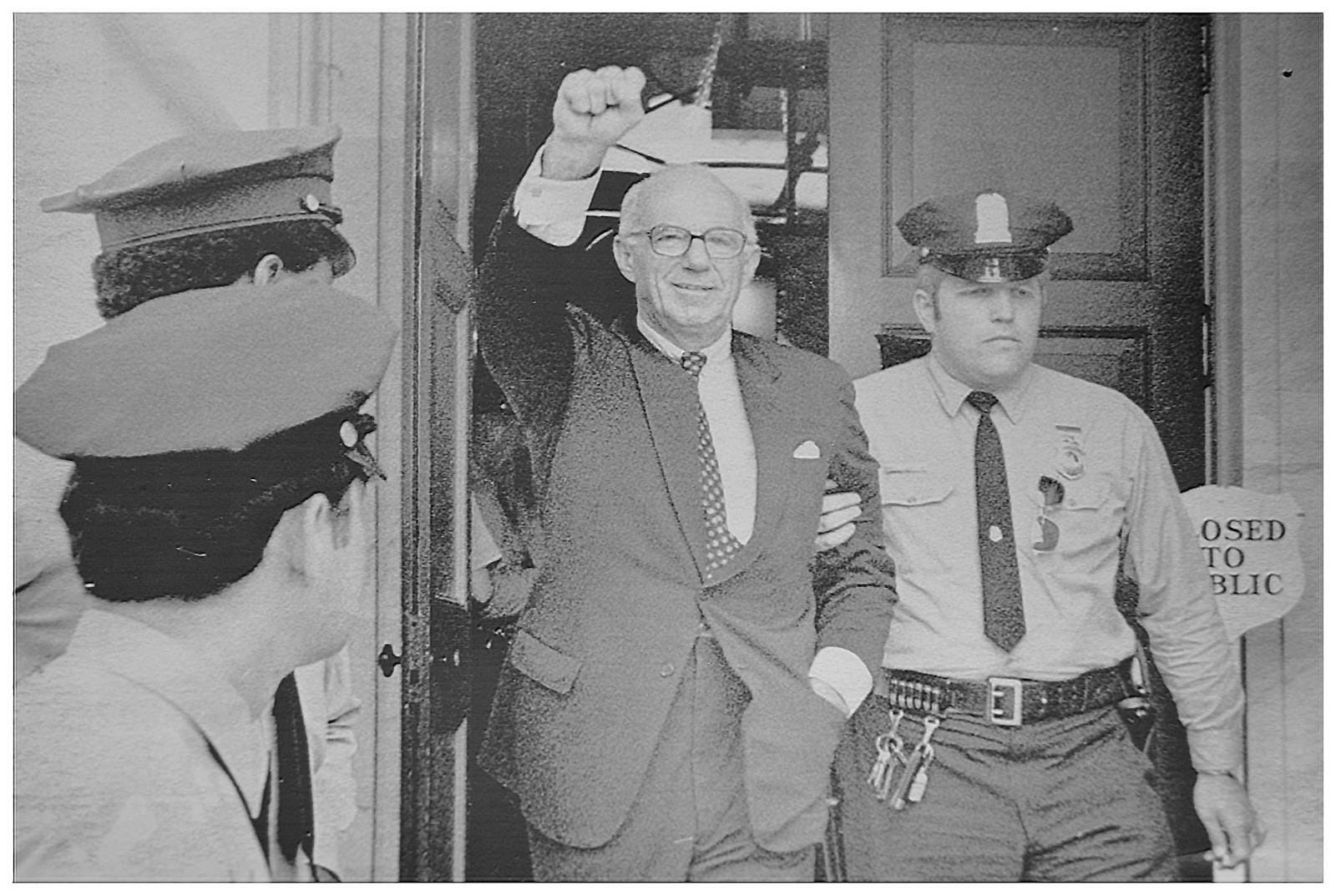
Dr. Spock Under Arrest at the U.S. Capitol, May 24, 1972
I like to say I slept with Dr. Spock.
There were six of us jammed into a two-man cell in the D.C. slammer on the night of May 24, 1972.
There was George Wald, Harvard biochemist, cell biologist, and Nobel Laureate in Medicine. There was Bronson Clark, head of the American Friends Service Committee. There was Joe Papp, creator of New York’s Public Theater and Shakespeare in the Park. There was Dr. Jack Geiger, a leader in creating community health centers, a civil rights activist, and cofounder of Physicians for Social Responsibility and Physicians for Human Rights, groups that would later be awarded Nobel Peace Prizes. There was Dr. Spock. And there was me, David Rubin, a young instructor in English at Boston University.
Earlier that day, our group of signers had delivered a Petition for the Redress of Grievances to Congress, a right specified in the language of the First Amendment to the U.S. Constitution, “… the right of the people peaceably to assemble, and to petition the Government for a redress of grievances.” We said we would wait in the halls of Congress until we had a response to our grievances, which read in part,
[The President and the executive branch] have spent the taxes, emotions, and resources of the people on mass murder and destruction as American society and its public services decay. They have brought unrest to our cities and institutions, defiled the flag with American and Indochinese blood, and brought shame upon our country.
Then-Representative Gerald Ford, Republican of Michigan and Minority House Leader, left the floor of the House and came out into the hallway, where he patiently explained that it would take some time to receive a response to our petition, and that it would be wise for us to disperse. We thought otherwise, and continued to sit outside the House chamber until 94 of us were arrested by the Capitol Police for unlawful assembly, and transported to the D.C. jail.
We didn’t get to choose our cellmates, and yet here I was thrown into a jail cell together with Dr. Spock. It seemed so improbable, and yet there’s a wing of quantum theory that says anything that can happen will happen. Five years earlier, on Oct. 16, 1967, I had attended a draft card turn-in ceremony at the Arlington Street Church in Boston, where I dropped my draft card on a church offering plate held out to me by Dr. Spock.
* * *
In 1961, about to be drafted, I instead joined a federal reserve army unit, the 94th Infantry Division, and did 6 months active duty in basic and advanced infantry training at Ft. Dix, then remained on active reserve status for five and one-half years until my discharge in 1967, attending weekly drills and annual 2 week summer training.
In the mid-60’s, with the Vietnam War ramping up, I fully expected to be recalled to active duty as the buildup for the Vietnam War gained momentum and the draft quotas for young men kept rising. I was already married with three young children and at the beginning of an academic career, but the more I learned about America’s role in the Vietnam War, the more my opposition to the war grew.
I watched TV news coverage of American troops committing war crimes in Vietnam. I attended teach-ins, and participated in the sanctuary movement at Boston area churches and universities that offered support for active-duty GI’s who were refusing orders to Vietnam. I read Howard Zinn, Noam Chomsky, I. F. Stone, Jonathan Schell’s The Village of Ben Suc, and listened to Wayne Morse’s lonely voice of opposition to the war on the Senate floor. All of these strengthened my resolve to refuse a call-up order, knowing it would mean prison time, and knowing too that it would cause my young family great hardship. But to my surprise no call-up order came.
In the fall of 1967, just after I received my discharge papers, I came across A Call to Resist Illegitimate Authority, published in The New York Review of Books. As I read it, I knew I had found a forceful document that expressed my own scattered thoughts in a clear and compelling call to action that began,
An ever growing number of young American men are finding that the American war in Vietnam so outrages their deepest moral and religious sense that they cannot contribute to it in any way. We share their moral outrage.
Even though I had completed my military service, I wanted to stand in solidarity with the thousands of young men who were part of the growing draft resistance movement. Legally, I was still required to carry my Selective Service card on my person, and thus I could use it to register my opposition to the war and my support for the young draft resisters who had gathered at the Arlington Street Church that day.
And that’s how my draft card came into Dr. Spock’s hands. Spock was one of the leading figures in RESIST, an organization dedicated to further draft resistance and other forms of resistance to the Vietnam War. Dr. Spock, Michael Ferber, Yale Chaplain William Sloan Coffin, Marcus Raskin, and Mitchell Goodman, were all busy gathering draft cards at the Arlington Street Church that day. Across the country similar draft resistance gatherings were held.
On Oct. 20, 1967, my draft card along with about 1,000 others was brought to the steps of the Justice Department in Washington by Dr. Spock and other RESIST leaders . These draft cards were presented to Justice Dept. officials who were not eager to receive what amounted to a mass act of civil disobedience and resistance to America’s prosecution of the war in Vietnam.
The following year, in what came to be known as the Spock Trial, Dr Spock and the other four men were indicted on federal felony charges of “conspiracy to counsel, aid, and abet young men in violating the Selective Service Act by resisting the military draft.” They were tried in federal court in Boston, and all except Raskin (father of Jaime Raskin) were found guilty by an all-male jury and sentenced to 5 years in prison and a $5,000.00 fine. Their convictions were set aside when a federal appeals court found serious judicial error in the judge’s coercive instructions to the jury and other violations of the defendants’ First Amendment protections.
* * *
Once the door clanged shut on the six of us pressed flesh on flesh in that two-man cell, we found ourselves staring in wonder at two naked steel slabs, one stacked above the other, intended, it seemed, for sleep. Spock immediately volunteered to sleep on the filthy cell floor. Though my only contact with him had been that anonymous moment when I dropped my draft card among many others on his offering plate, though he knew me not at all, I blurted out, “No! Dr. Spock must have one of the slabs! I will sleep on the floor!” as though my saying so had solved some elusive algebraic word problem involving six bodies and two steel slabs. Everyone laughed. Me too.
I won’t lie to you: Nobody slept that night. All along the cell block we stood banging on the bars, shouting encouragement to our comrades, known but unseen. David Amram led us in song,
If we had some hammers,
We’d bust clean out of this joint,
We’d sing Redress of Grievance,
All over this land…
The women in our protest had been herded into another cellblock elsewhere in the jail. We couldn’t hear them, but we knew they were singing out too. We knew they were raising a righteous ruckus, beating the steel bars of their cells into plowshares. Marlo Thomas, Grace Paley, Gloria Steinem, Lucy Lippard, Judy Collins, Jean Humez, Francine DuPlessis Gray… and dozens more. (See the full list of signers below.)
Though our bowels hardened at the sight of the naked steel commode at the back of the cell, built to be unbreakable and unmovable in the event of a prisoner riot, still we clamored to be fed. Finally at about 4:30 AM, a prisoner trustee wheeled a cart along the cellblock, handing out wannabe sandwiches: a sliver of U.S.D.A. surplus American cheese and a slice of spoiled bologna between two green-dotted slices of Wonder Bread.
Came morning, our cell doors opened all at once and we were ferried to our arraignment, filing into a courtroom of the Superior District Court of the District of Columbia, disheveled and a little less defiant than we had been in the halls of Congress.
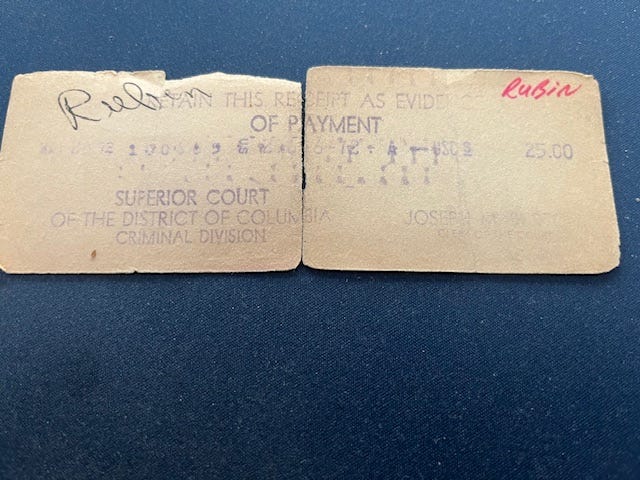
The judge offered us a choice: we could plead guilty to misdemeanor charges, pay a $25.00 fine, and walk free, with our arrest records expunged after one year if we stayed out of trouble; or we could plead innocent, go to trial, almost certainly be found guilty, and face a 30 day jail sentence and a more substantial fine.
Our lawyers urged us to cop a plea. We talked among ourselves, but not for long. Returning to the courtroom, we all pled Nolo Contendere. No one chose more jail time.
Out on the street, blinking in the light of day, I breathed in the springtime air as though taking my first infant breath. For a moment I thought of all those prisoners, unrepresented, unprivileged, not famous but not infamous either, many held for crimes no more serious than ours, left behind in that hellhole of a city jail. Not me. I was sprung. It had been too easy.
SPOCK! Thou shouldst be living at this hour: AMERICA hath need of thee! You who dispensed common sense medical advice that calmed anxious, sometimes overwhelmed young parents, your reassuring voice rising from the pages of a well-thumbed paperback version of your baby book. You who stood with the child questioning authority, and with the adult resisting authority when it lapsed into illegitimacy, or tyranny by another name. You who counseled sanity against the madness of nuclear war. You who put your life on the line to bring an end to the expense of spirit in a waste of shame that was America in Vietnam.
* * *
That was then. Today we face a mind-numbing assault on all the foundations of American democracy, where essential government services are deliberately undermined, where dehumanizing policies are cruelly enforced, where corrupt leaders ransack the public treasury, where a vainglorious lout sits in the White House, and where even the most modest opposition is brutally crushed. It’s the plan. They call it “flooding the zone,” a sports metaphor run amok, where we are forced to fight on so many fronts at once that we exhaust and enfeeble ourselves into submission.
Or so they would have it. But in fact resistance is rising everywhere, and it takes many forms. It’s in the streets, in the courts, in local and state government responses to the invasions of federal forces as directed by the president. Everyday hardworking people, citizens and non-citizens alike, are finding their lives and livelihoods disrupted by destructive policies emanating from this White House, as in Trump-directed ICE assaults on local communities, and his illegal tariff wars. We have had enough.
Writers have always given voice to the oppressed, have called out injustice, exposed corruption and mocked the pretensions of those in power, often at their peril. It is no different today
Writers sometimes lament the loneliness of their craft, the solitude and individuality it requires. But that’s not always the way: sometimes writers work in teams or become participants in literary movements, sharing their work in cafes or hospitable bookshops, or, when necessary, underground, as in the former Soviet Union’s samizdat movement, and in Vaclav Havel’s Czechoslovakia.
Writers for Democratic Action offers a chance for writers to work together, where the work of many writers can be amplified into a multitude of voices of resistance. Think of Bruce Springsteen writing his anthem, Minneapolis, so that we could all join in singing homage to the courage of those who took to the streets of that embattled city. Think of the collective drafters of A Call to Resist Illegitimate Authority and A Petition for Redress of Grievances: we may not know them by name, but we can look back on those written documents as essential expressions of resistance to the Vietnam War.
I’m grateful to WDA for giving me a chance to look back on that earlier time, and hope my reflections on a night in jail with Dr. Spock will further inspire new forms of resistance that we so need today.

To see the full documents, A Call to Resist Illegitimate Authority and A Petition for Redress of Grievances, please go the following websites:
https://online.salempress.com/articleDetails.do?articleName=DDVW_0035&activationcode=bluegoldwidget
https://www.nybooks.com/articles/1972/06/15/petition-for-redress-of-grievances/
Brief bio: David Rubin taught English and Humanities courses at Boston University and the College of Public and Community Service at the University of Massachusetts-Boston. He has published op-eds, short fiction, and memoir pieces. He is 88 years old and lives with his wife, Eleanor, at a continuing care community south of Boston. Both continue as activists in these times of great need.
Comments
Nothing yet. Say the first thing.
Sign in to join the conversation.