
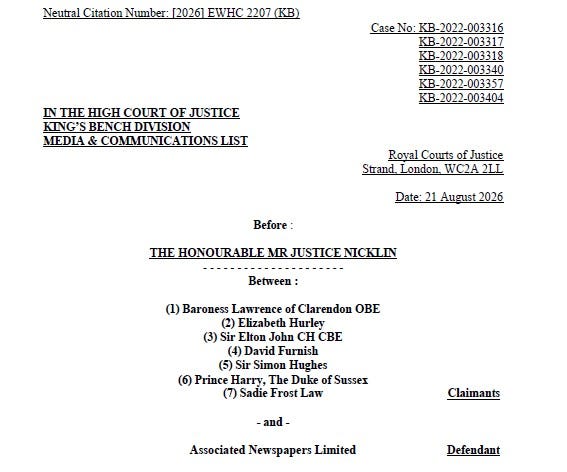
Prince Harry was on a quest to “slay dragons” during his series of legal fights against the British tabloids. He’d been on a winning streak until he picked a fight with his tabloid nemesis, the Daily Mail.
On July 7, Prince Harry and the six other plaintiffs lost all 97 of their claims in their unlawful information gathering case against the publisher of the Daily Mail.
As the losers in a civil case, Harry and the others would have to pay at least part of the publisher’s legal bills. Associated Newspapers put those costs at approximately £34.5 million (I’m doubling for a rough Canadian amount, so CAD$70 million).
Justice Nicklin warned the plaintiffs that he’d issue a ruling regarding the costs issue and any needed interim payment in mid August. The 44-page judgment landed on Friday, August 21. It is an expensive and, at time, brutal rebuke to Prince Harry and his fellow plaintiffs. (The judgment and press summary are both written in clear, readable language.)
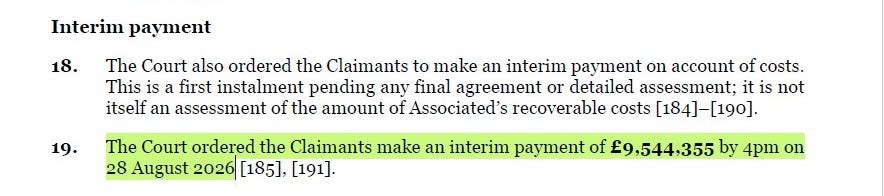
The claimants have to make an interim payment of £9,544,355 by 4 p.m. on August 28, 2026.
That’s roughly CAD$20 million.
For an interim payment.
Due in a week.
As the judge wrote:
“I accept Associated’s central submission. This was not simply a case in which serious allegations were made and failed. Nor was it merely a hard-fought piece of litigation in which, after a lengthy trial, the Court preferred the evidence and submissions of one side over the other. The claims, and the manner in which they were brought, pleaded, pursued, maintained and publicly advanced, involved a combination of circumstances and conduct which took the litigation outside the ordinary and reasonable conduct of civil proceedings.”
The big interim bill is because of another of Justice Nickin’s decisions. Rather than assessing costs on a “standard basis,” by which Associated would recover only “reasonably incurred” costs (which years ago the judge had estimated to be perhaps CAD$10- or $15 million for each side), the judge took another, rarer route and instead awarded costs on an “indemnity basis” because the plaintiffs’ litigation was “well outside the norm.” Ominously, while there is still to be discussion as to the final amount of the publisher’s costs to be paid by the other side, Nicklin has “decided not to impose a ceiling on Associated’s recoverable costs.”
The plaintiff’s insurance policies, which total around £16 million or CAD$32 million, will cover that interim amount. But those funds are unlikely to be enough to pay the final tally. Also unclear is how much they owe to their own legal team or whether others are financing those costs.
The judge was scathing in his analysis of where the plaintiffs went wrong:
“Several features are important. They include: the speculative and substantially inferential character of the claims at their origin; the exceptional breadth of the pleaded case; the gravity of the allegations made against a large number of named individuals; the pursuit over an extended period, and up to and including closing submissions, of serious allegations of wrongdoing, including allegations amounting to criminal conduct; the pursuit of allegations which, in material respects, lacked a proper evidential foundation or were irreconcilable with contemporaneous documents; the failure voluntarily to withdraw serious allegations which could no longer properly be maintained; the deployment and continued reliance upon the Burrows material … and the public presentation of allegations of serious criminality and impropriety which were not ultimately established.”
Harry’s problems began from how they framed their case. As Nicklin stated in July, their “original pleaded allegation of widespread and habitual UIG [unlawful information gathering] as ‘exceptionally wide; indeed, it could hardly be wider.’ That was not an incidental feature of the pleading. It was a deliberate forensic choice.” [the judge’s own italics]
And the judge saw their case as highly speculative: “With limited exceptions, the claims were substantially inferential and, in some areas, exclusively so…. That was a high-risk strategy. Once disclosure, case management rulings and witness statements exposed the limits of the evidence, the Claimants were required to reassess whether the allegations could properly be maintained. They did not do so.”
He also attacked the fact that “not a single allegation of serious wrongdoing was voluntarily withdrawn by the Claimants,” even when they were no longer pursuing those allegations in court. “The allegations of UIG against those individuals were not withdrawn, were not acknowledged to have fallen away, and were not accompanied by any explanation or apology. That matters. Serious allegations of criminality or grave impropriety cannot properly be left hanging over individuals in that way.”
Even how the claimants publicized their case came in for withering criticism:
“The press release launching the claims used highly charged language. It referred to abhorrent criminal activity, crimes, and terrible and reprehensible covert acts. It placed at the forefront allegations based substantially on Mr Burrows, including bugging and live-call interception, at a time when the Claimants’ camp knew of serious problems with his evidence and his cooperation.”
Still, Nicklin does offer some good news for Harry and his other plaintiffs, writing, “I accept that no Claimant has been found dishonest. I accept that the Claimants had genuine concerns about how private information about them had appeared in Associated’s newspapers.”
That may be a cold consolation as Prince Harry and his other claimants look at their bank accounts and prepare to write some rather massive cheques.
Thanks for reading WRITE ROYALTY by Patricia Treble! This post is public so feel free to share it.
Comments
Nothing yet. Say the first thing.
Sign in to join the conversation.