
To be an analog person in a digital world is to live with intentionality while surrounded by automatons. I heard a line in a documentary short on, of all things, analog journaling, that writing a journal entry by hand with a pencil and paper was a method to slow down. The narrator stated handwritten writing forced him to slow down and think through his thoughts before committing them to paper. His typing speed was much faster than his handwriting speed, making typing feel like he was just throwing out as many words as he could instead of choosing his words with intention. Another thing the narrator mentioned that really resonated with me, as I often say the same thing about a typewriter, was that writing thoughts down on a piece of paper using a pencil took his thoughts from the ephemeral void and brought them to life in a carbon-based reality. Typing thoughts onto a computer screen took one etherial thing and just transferred it to another etherial thing. They never get the chance to truly exist.
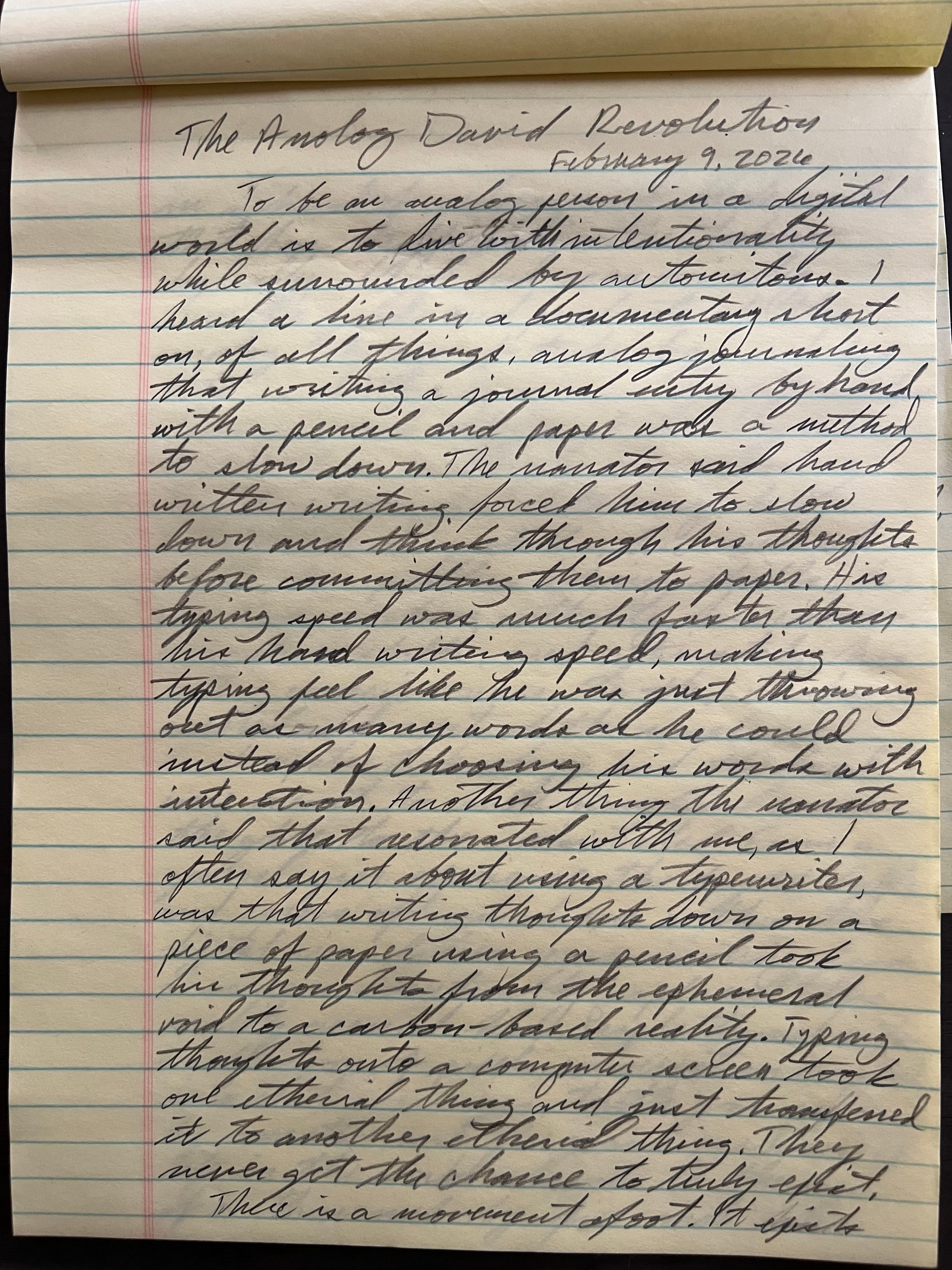
There is a movement afoot. It exists in a kind of underground black market that traffics in the technologically illegal and economically unviable goods and products of the analog. The age of technology and big data is berthing a new age of machine learning and artificial intelligence. Mankind is willingly surrendering his freedom, his autonomy, his critical thinking skills, his research skills, his problem-solving skills, his decision-making authority, his communication skills, and, ultimately, his entire consciousness to those who created and control the machine.
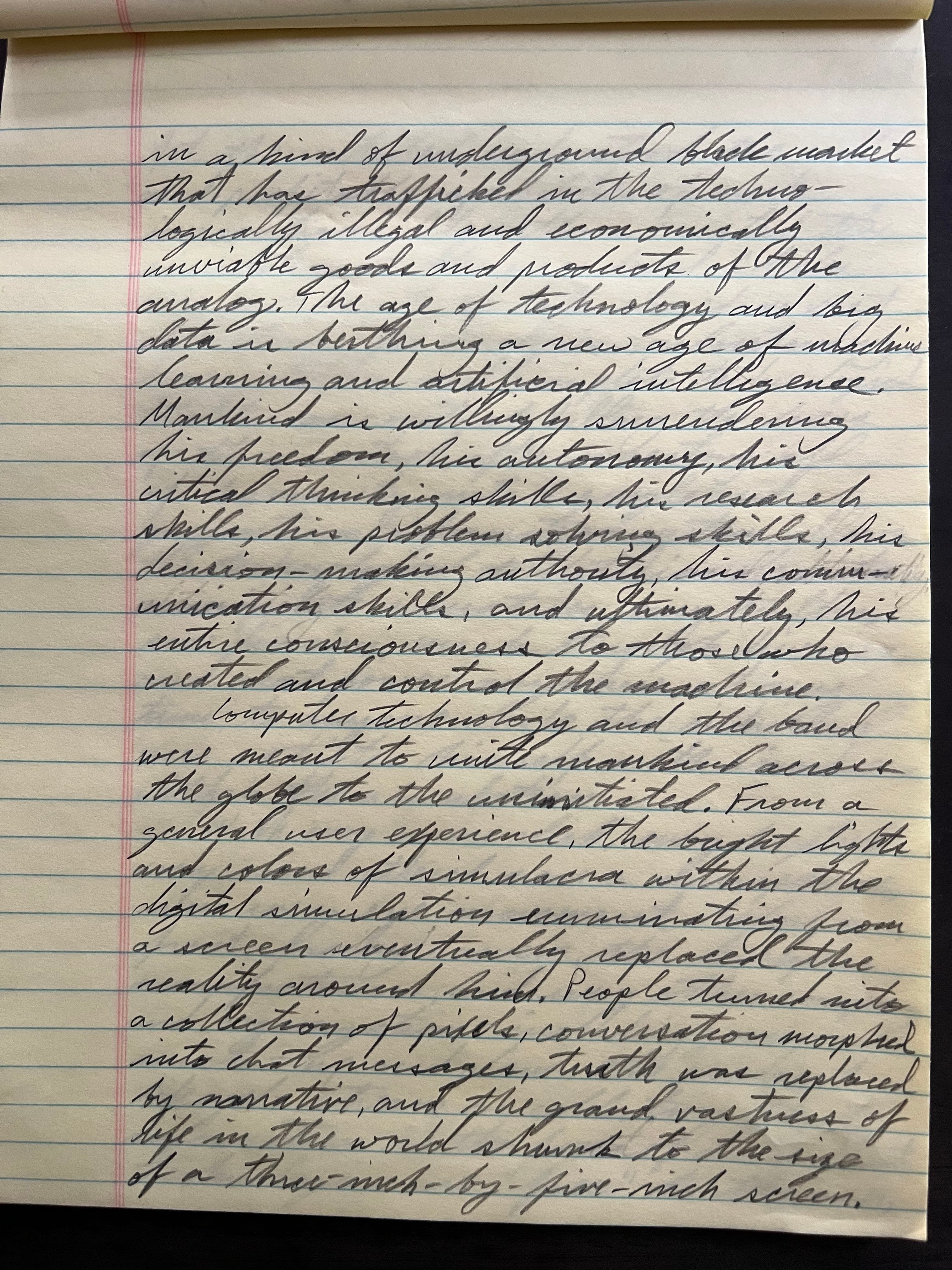
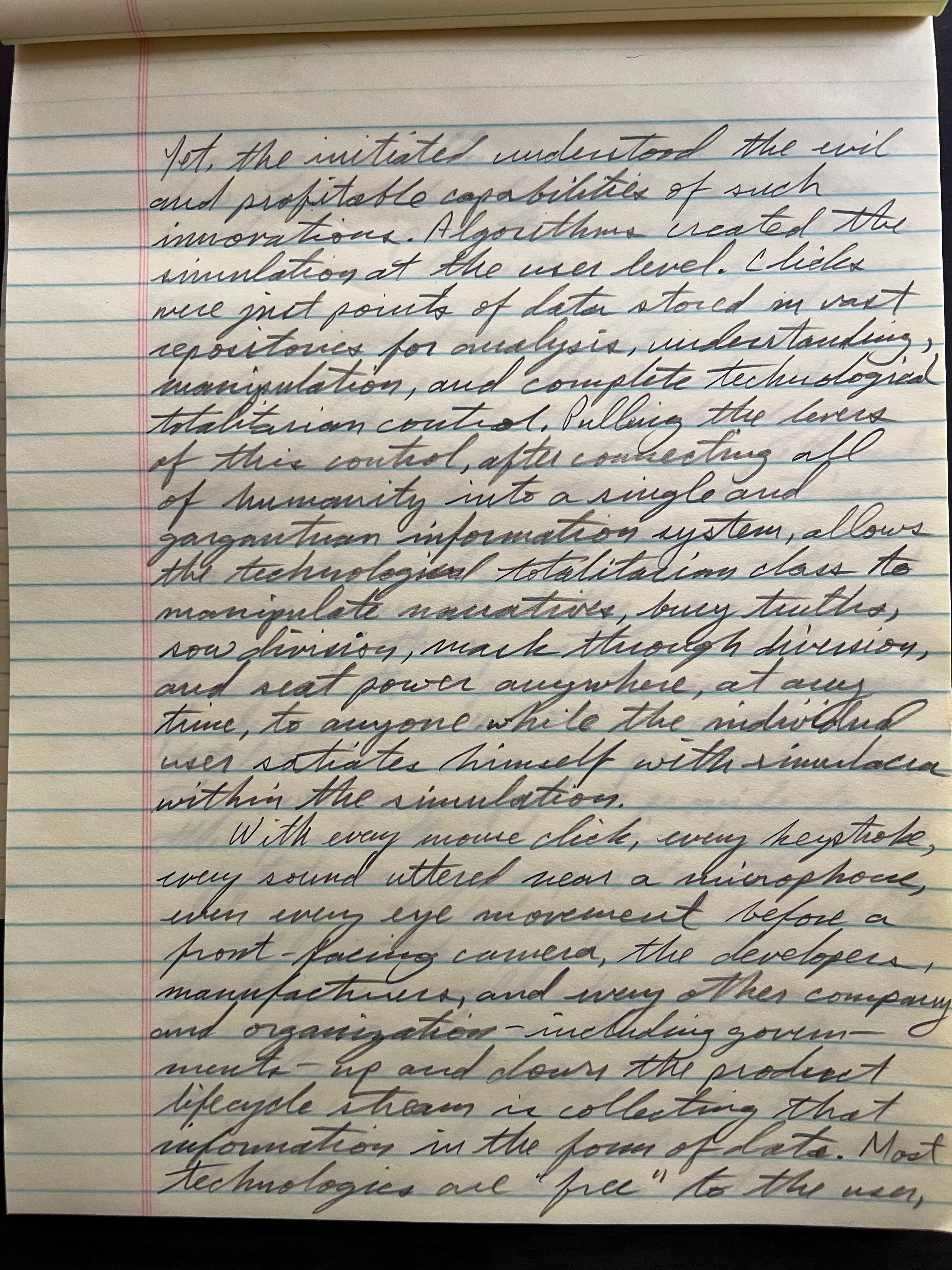
Computer technology and the baud were meant to unite mankind across the globe; at least, to the uninitiated. From a general user experience, the bright lights and colors of simulacra within the digital simulation emanating from a screen eventually replaced the reality around him. People turned into a collection of pixels, conversation morphed into chat messages, truth was replaced by narrative, and the grand vastness of life in the world shrunk to the size of a three-inch-by-five-inch screen. Yet the initiated understood the evil and profitable capabilities of such innovations. Algorithms created the simulation at the user level. Clicks were just points of data stored in vast repositories for analysis, understanding, manipulation, and complete technological totalitarian control. Pulling the levers of this control, after connecting all of humanity into a single and gargantuan information system, allows the technological totalitarian class to manipulate narratives, bury truths, sow division, mask through diversion, and seat power anywhere, at any time, to anyone, while the individual user satiates himself with the simulacra within the simulation.
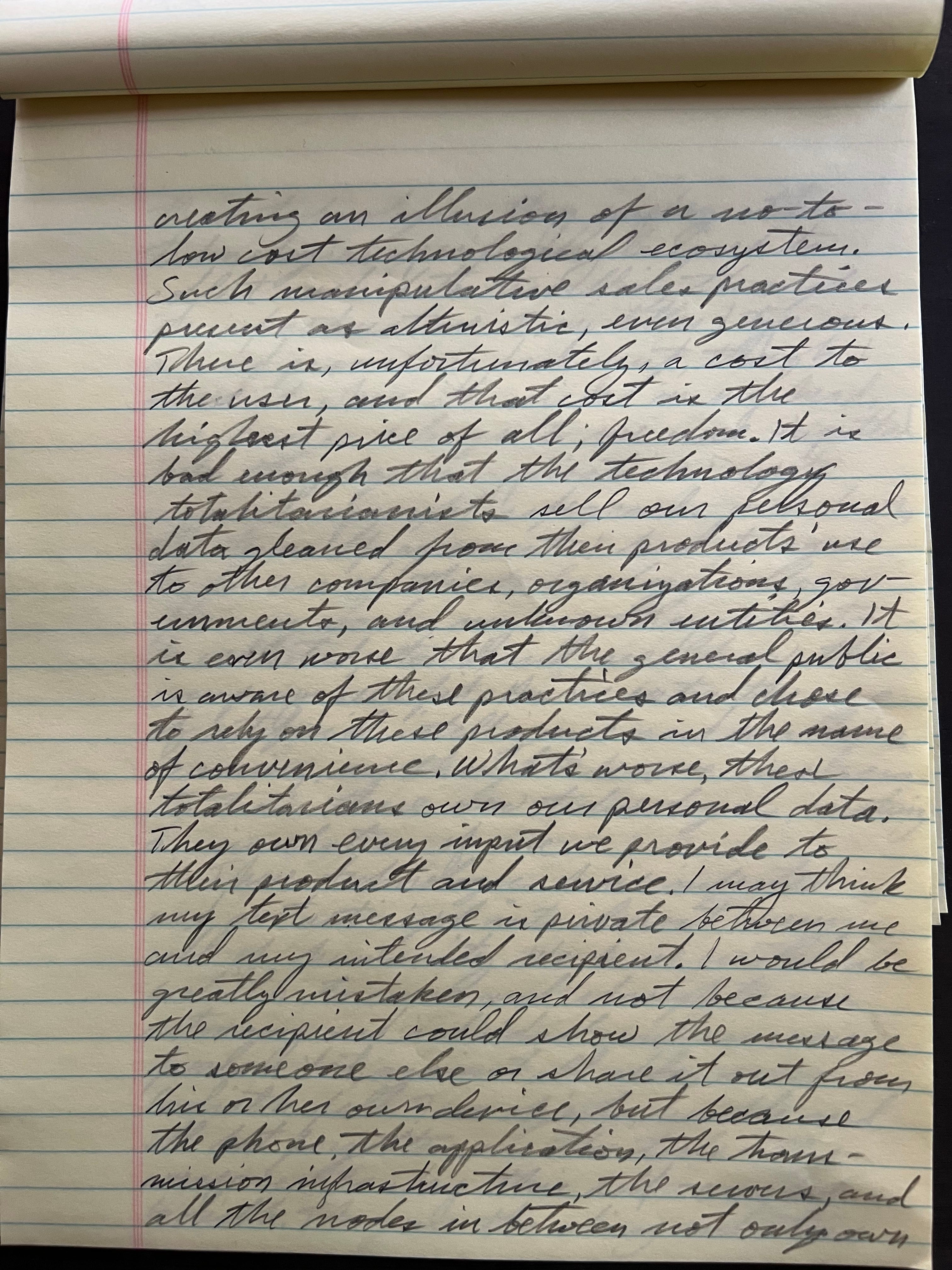
With every mouse click, every keystroke, every sound uttered near a microphone, even every eye movement before a front-facing camera, the developers, manufacturers, and every other company and organization -- including governments -- up and down the product lifecycle stream is collecting that information in the form of data. Most technologies are “free” to the user, creating an illusion of a no-to-low cost technological ecosystem. Such manipulative sales practices present as altruistic, even generous. There is, unfortunately, a cost to the user, and that cost is the highest price of all; freedom. If the product is free, you are the product. It is bad enough that the technology totalitarians sell our personal data gleaned from their products’ use to other companies, organizations, governments, and unknown entities. It is even worse that the general public is aware of these practices and still choose to rely on these products in the name of convenience. What is worse still, these totalitarians own our personal data. They own every input we provide to their product and\or service. I may think my text message is private between me and my intended recipient. I would be greatly mistaken, and not because the recipient may show the message to someone else or share it out from his or her own device, but because the phone, the application, the transmission infrastructure, the servers, and all the nodes in between not only own those technologies, they employ additional technologies specifically designed to collect such data travelling through their infrastructure. Every letter I type in a word processing document, though I owned it when it resided in my head, no longer belongs to me once inputted into the program application. Despite supposed copyright safeguards and laws, the terms of agreement I had to acquiesce to for use of the technology allows for my words, my very thoughts, to be collected, stored, and used how the company sees fit. As we enter the age of artificial intelligence and machine learning, my thoughts become the simulacra, training these new technologies, creating a simulation of me.
These technologies have infected and metastasized into almost every cell of humanity. We have created Goliath to come and slaughter our autonomy and individual freedom of consciousness. Yet, against all odds, even Goliath fell. Two objects, humble and all but forgotten, are the tools -- the weapons -- to slay this self-created Goliath. They are the sling and stone of humanity’s salvation. They are the pencil and paper.
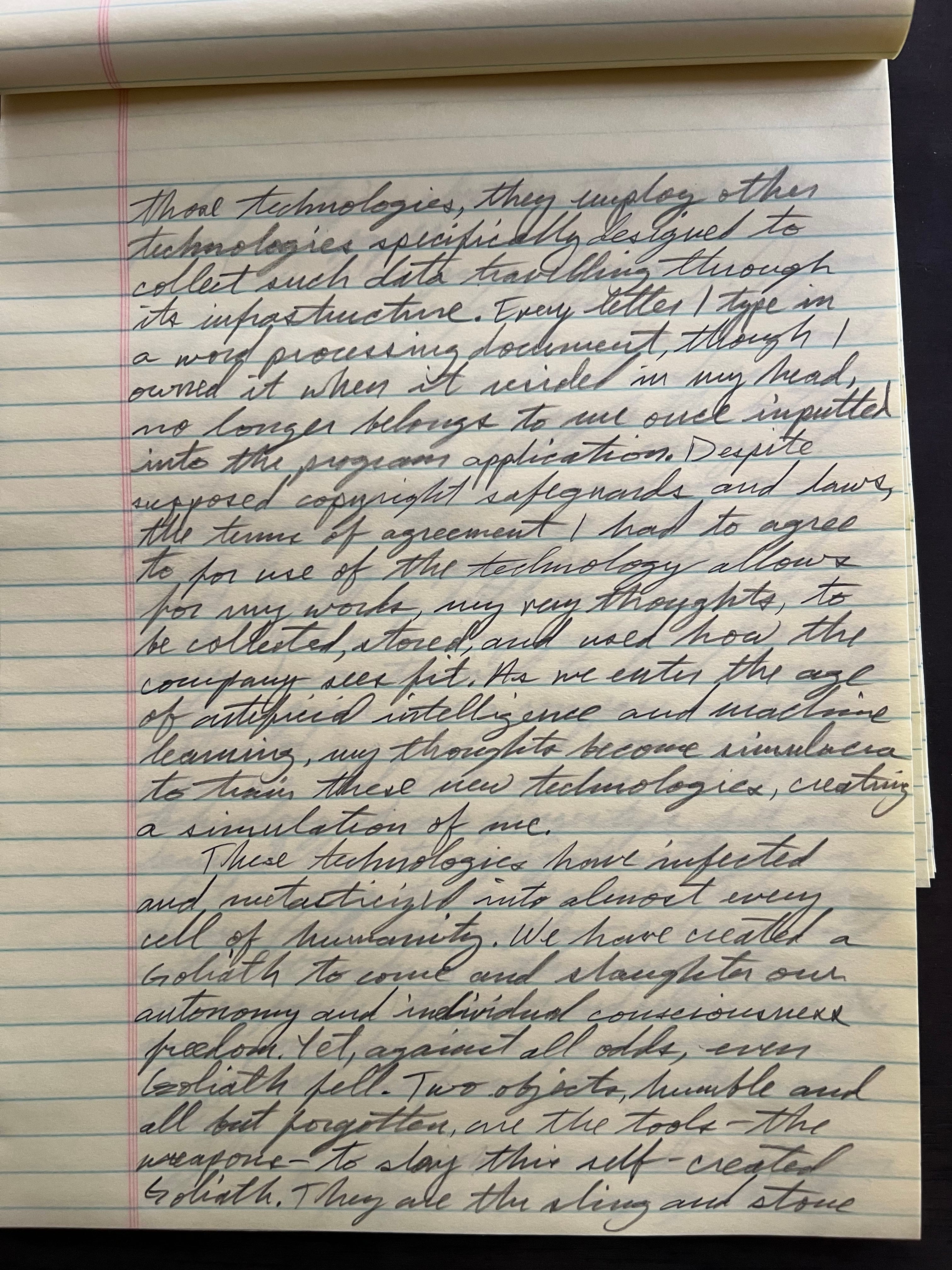
I can hear your laughs, and I can imagine your headshakes in disbelief and hubris-filled under estimation just as David must have heard and seen as he made his way through the battle lines to face his Godless enemy. Yet, just as I do while scrawling my pencil across this piece of paper, all it took was a practiced flick of the wrist, fueled by faith and determination, to do what was impossible. In my Army career, I was trained to land navigate with a paper map, a lensatic compass, a plastic protractor, a pencil, and some scratch paper. We had state-of-the-art GPS technology at our fingertips, but we learned how to navigate with minimalist analog tools because technology always fails. Problem solving and critical thinking with analog tools never fails. The paper and pencil are the most powerful tools mankind has to preserve itself and bring its salvation.
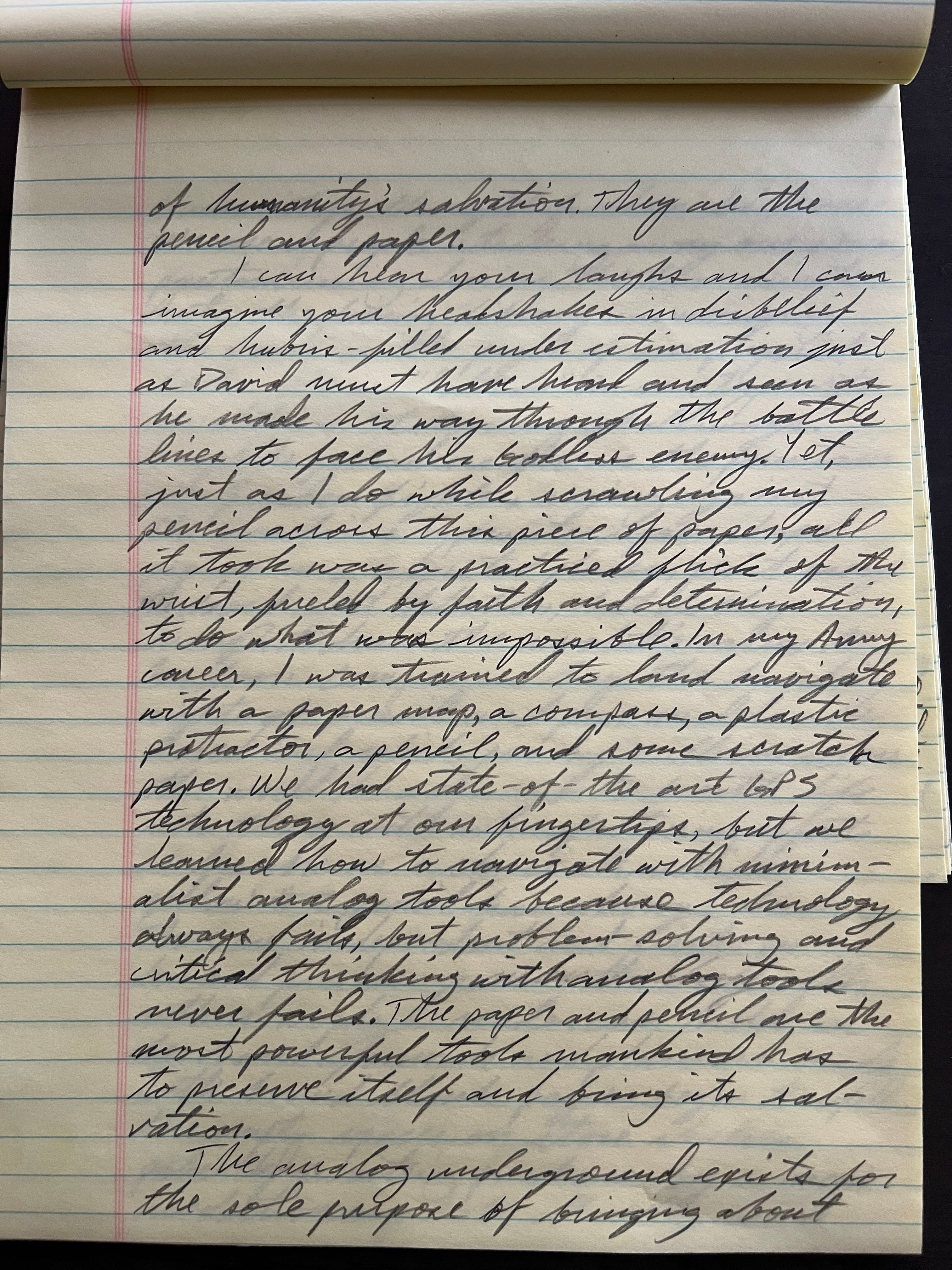
The analog underground exists for the sole purpose of bringing about humanity’s thought-freedom deliverance. We are a people stashing away our soma, pantomiming during the two-minutes hate, the living library memorizing the words on the pages of our physical books. We are “Poltean” in our typewriter revolution. Stationary scallywags. Graphite grenadiers. We are the fountain pen freedom fighters raging against the machine. Typewriter repair shops pop up in unexpected places, quiet enough to avoid overt attention, but clacky enough to draw the revolutionaries to her doors. Companies buy the branding rights of pencil and pen models once loved and relied upon by millions across the world decades ago to breathe life into them with manufacturing efforts as humble as a classic American yellow #2 pencil has always been. There are independent and print-on-demand presses gracing the world with authors’ words a reader can hold in her hand. Journals and planners made with bounded blank pages begin to refill the empty spaces on store shelves, patiently awaiting purchase by a new revolutionary. Like all underground movements saving humanity, progress is slow, membership is small, but the actions are mighty.
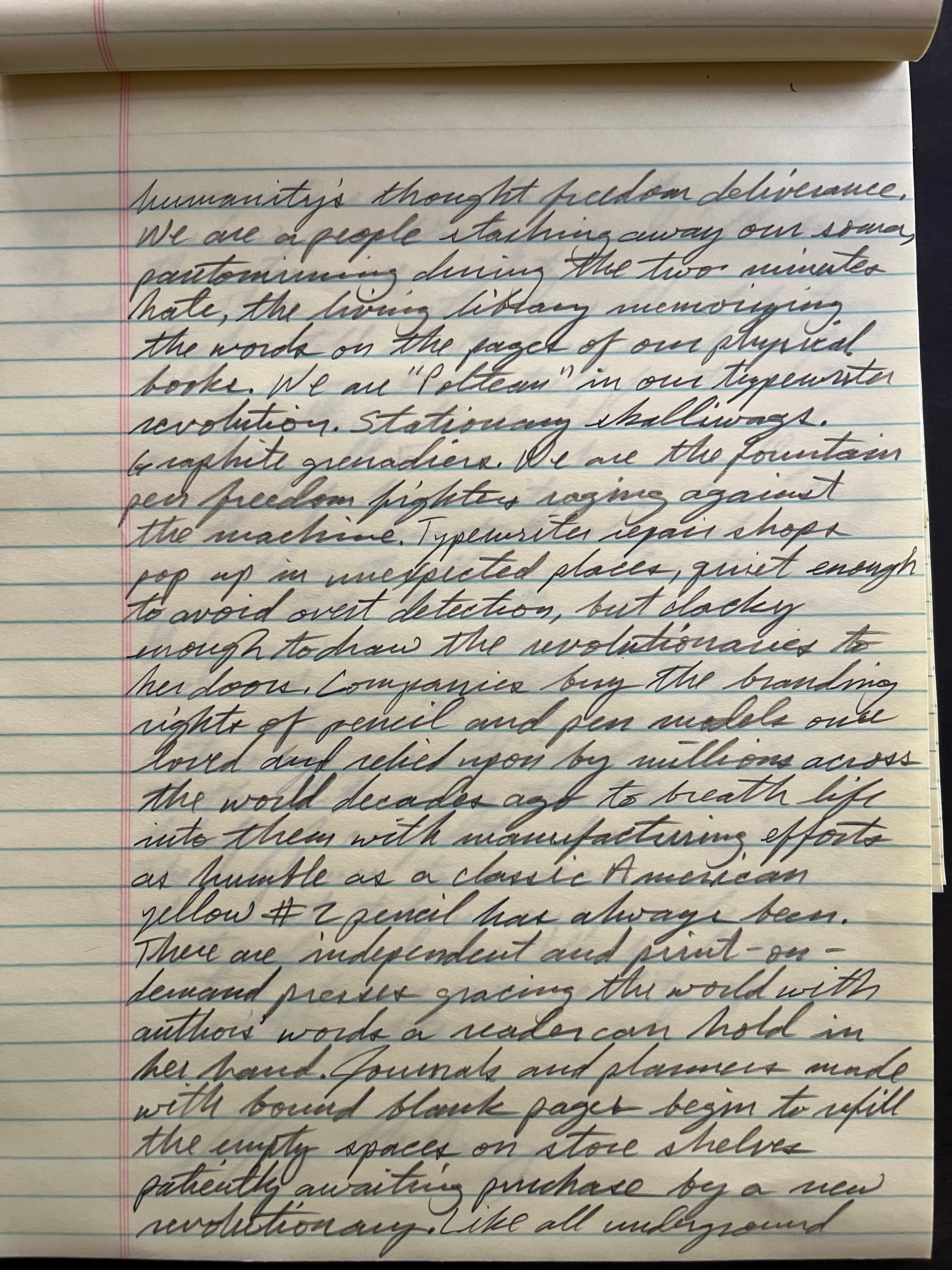
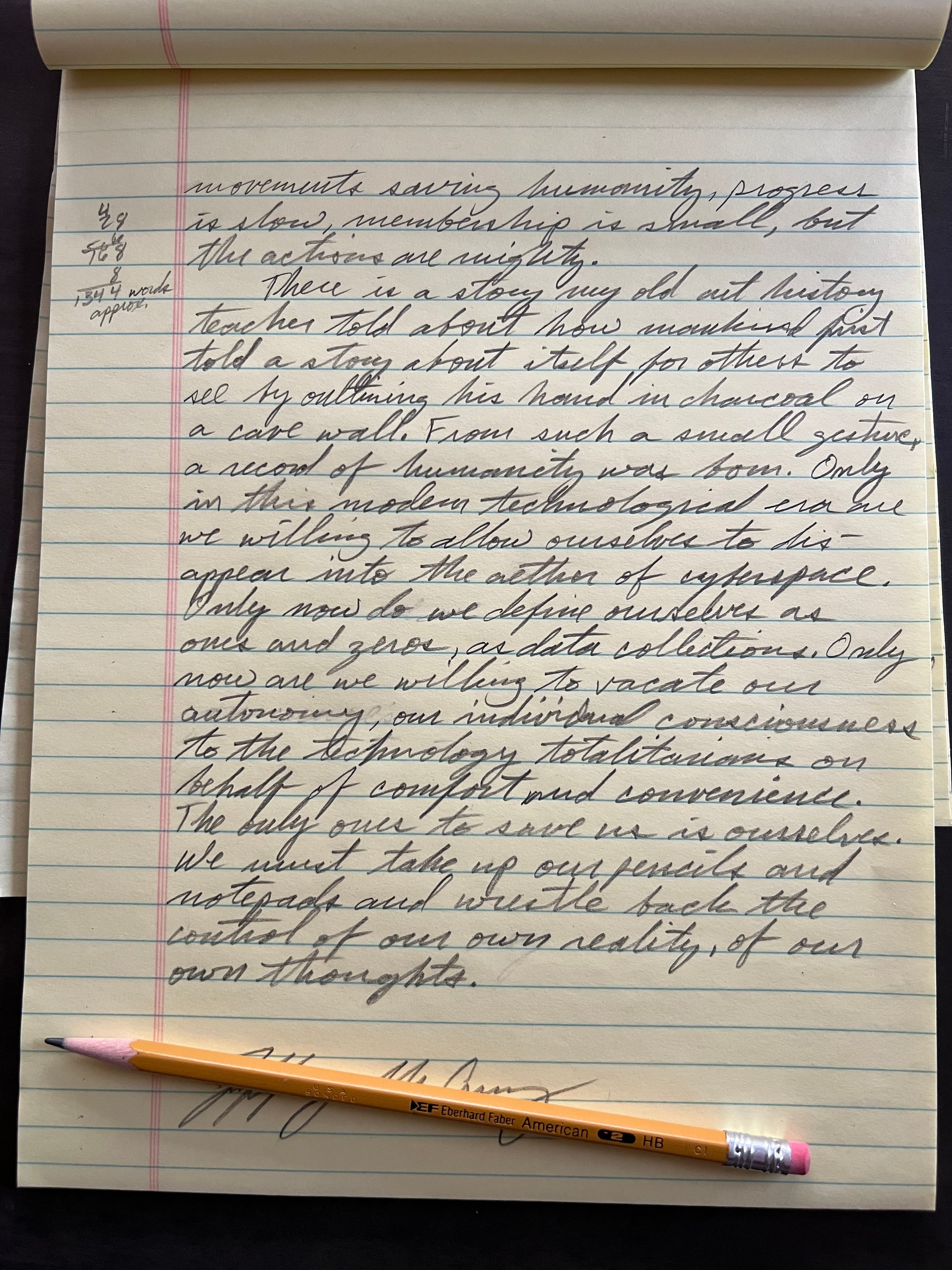
There is a story my old art history teacher told about how mankind first told a story about itself for others to see by outlining his hand in charcoal on a cave wall. From such a small gesture, a record of humanity was born. Only in this modern technological era are we willing to allow ourselves to disappear into the ether of cyberspace. Only now do we define ourselves as ones and zeros, as data collections. Only now are we willing to vacate our autonomy, our individual consciousness, to the technology totalitarians on behalf of comfort and convenience. We must take up our pencils and notepads and wrestle back the control of our own reality, of our own thoughts.
No posts
Comments
Nothing yet. Say the first thing.
Sign in to join the conversation.