
Start Here | Micro Mondays | 10-Min LWS | 3 Things | Writing Workshops | Paid Subs
Welcome! The live conversation is always free to attend. Paid subscribers receive access to the replay, craft packet, writing prompt, and bonus materials. Until August 8, 2026, this post will be free for all subscribers. Learn more here.
“3 Things: Short Prose Talks” is a one-hour conversation where short prose authors talk about writing and the creative process. Each guest shares three things: a selection of short prose, a writing tip, and a writing prompt. Thank you to Vince Puzick, Dana VonAllmen, susanna suchak, Maj-le Tate Bridges, Aisha Piracha, and everyone else who joined us live.
Dinty W Moore and I began by talking about Brevity, the flash nonfiction journal he founded almost thirty years ago nearly by accident, and how curiosity—both his own and the writers he published—shaped his career. We talked about how his idea of a “brief” essay evolved and changed over the years, and how a pantoum-inspired prompt led to his 183-word piece “There Was a Time in My Life When I Knew.” If you’re familiar with Dinty’s highly anthologized essay, “Son of Mr. Green Jeans,” he shares how it started out as a conventional essay he almost abandoned before discovering its abecedarian shape. We also talked titles (always my favorite thing to talk about), revision, trusting the reader, and what it looks like to keep adapting a creative life after thirty years of teaching and editing.
Dinty W Moore is the author of the memoirs Between Panic & Desire and To Hell With It (University of Nebraska Press, 2010), and the writing guides Crafting the Personal Essay and The Mindful Writer (Wisdom Publications, 2016), among numerous other books. He has published essays and stories in Harper’s, The New York Times Magazine, Georgia Review, Kenyon Review, Ploughshares, Short Reads, and elsewhere. Dinty is the founding editor of Brevity, a journal of flash nonfiction, and has taught nonfiction writing for more than 30 years, in workshops across the United States as well as in Ireland, Scotland, Spain, Switzerland, Portugal, France, and Italy.
Dinty’s website: dintywmoore.com. You can reach him through the contact form on his website.
Upcoming: “Power Your Memoir with Mystery: How Curiosity Fuels Craft”
September 4, 2026, 3:00–4:15 pm ET, CraftTalks. Register here.
How Brevity began in 1996 as an experiment [07:44]
Why championing new and emerging writers was part of Brevity’s—and Dinty’s—mission from the very first issue [05:37]
The three most valuable pieces of “real estate” in any piece of prose [24:18]
The inspiration behind “There Was a Time in My Life When I Knew” [16:41]
The inspiration behind “In Tuscany, with Covid” [26:27]
The years-long, meandering revision process that turned “Son of Mr. Green Jeans” into a braided abecedarian [30:36]
Why a small word count can be freeing rather than limiting when writing about the hardest or biggest material in your life [38:57]
Why curiosity on the page matters more than certainty [41:44]
Writerly insecurity [43:22]
The foundation for being a writer (spoiler: you don’t need an MFA) [46:03]
What Dinty’s creative life looks like now [54:57]
“Curiosity is essential.” — Dinty W. Moore
Brevity recently marked its 25th anniversary in 2020 with The Best of Brevity, an anthology co-edited by Dinty and Zoë Bossiere, gathering two decades of the flash nonfiction.
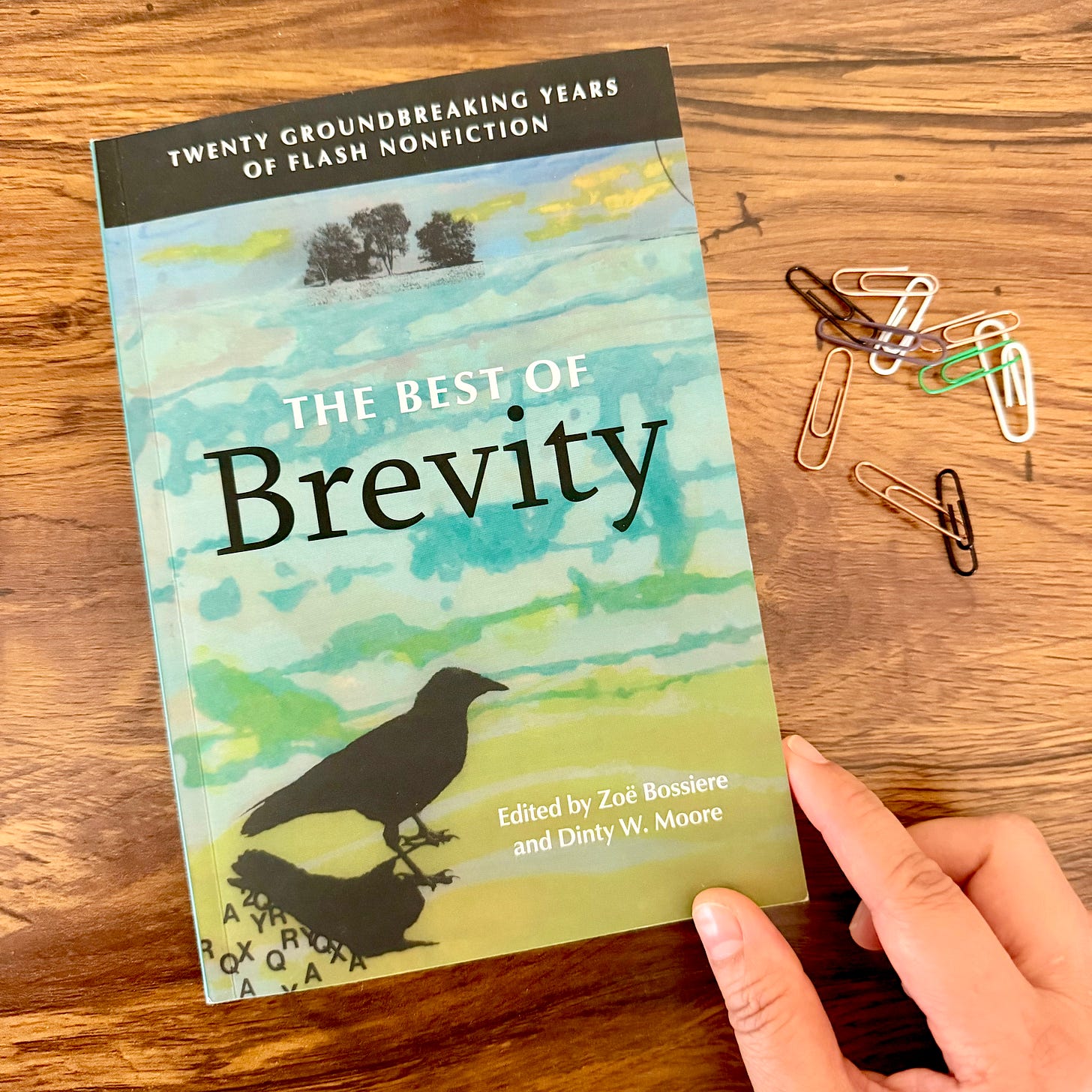
Purchase your copy from any of these booksellers (some include affiliate links) or at a bookstore near you:
Download Dinty’s 3 Things Craft Packet (which includes a selection of Dinty’s work and additional advice on writing short), along with his writing prompt and writing tip:
Excerpts © Dinty W. Moore. Shared with Darien Gee and Writer-ish by permission of the author. Please do not distribute or share these excerpts without permission.
Every inch of my neighborhood, every broken fence, every slab of crooked sidewalk that might shoot me over the handlebars of my black Schwinn bike. The slamming of car doors up and down the block as our fathers grudged off to work. That if there was something wrong with my family, then there was something wrong with me.
Minnows in bait shop bathtubs, night crawlers in ancient refrigerators, the glassy eyes of a floating carp. Turtles on branches. The drumming of the one-legged man’s crutch on the swaying wooden dock.
At night, in the summer, when windows were thrown open, you could walk by people’s houses, unseen, and you could hear things. Radios, televisions, women washing dishes. The sins of the fathers. The barking of dogs.
If a child was wailing, it was best not to hear.
Minnows, night crawlers, glassy-eyed carp.
My black Schwinn bike.
The sound of car doors, slamming. Children, wailing. Angry drop hammers at the Erie Foundry, two blocks away. Steel on furious steel.
Every broken family, every broken fence.
Every fault in the sidewalk, every fault in me.
Word count: 183
Rain bathes the medieval town. Bricks glimmer less orange than red.
Jackdaws swoop from roof to spire.
You stand lonely in your open window, but the long street is empty.
They tell you to isolate but they don’t tell you what that means.
The walled town of Boccaccio.
You are more out of time than you ever imagined possible.
Soon it will be too dark to see the castle.
In Tuscany, they don’t salt the bread.
Word count: 76
The following four “entries” are excerpted from “Son of Mr. Green Jeans: An Essay on Fatherhood, Alphabetically Arranged” (originally published in Issue 63 of Crazyhorse, 2003, reprinted in Harper’s Magazine, January 2004).
In Dublin, Ireland, a team of geneticists is conducting a study to determine the origins of the Irish people. By analyzing segments of DNA from residents across different parts of the Irish countryside, then comparing this DNA with corresponding DNA segments from people elsewhere in Europe, the investigators hope to determine the derivation of Ireland’s true forefathers.
Word count: 57
My own Irish forefather was a newspaperman, owned a nightclub, ran for mayor, and smuggled rum in a speedboat during Prohibition. He smoked, drank, ate nothing but red meat, and died of a heart attack in 1938.
His one son, my father, was a teenager when my grandfather died. I never learned more than the barest details about my grandfather from my father, despite my persistent questions. Other relatives tell me that the relationship had been strained.
My father was a skinny, asthmatic, and eager-to-please little boy, not the tough guy his father had wanted. My dad lost his mother at age three, and later developed a severe stuttering problem, perhaps as a result of his father’s disapproval. My father’s adult vocabulary was outstanding, due to his need for alternate words when faltering over hard consonants like B or D.
The stuttering grew worse over the years, with one exception: after downing a few whiskeys, my father could sing like an angel. His Irish tenor became legend in local taverns, and by the time I entered the scene my father was spending every evening visiting the bars. Most nights he would stumble back drunk around midnight; some nights he was so drunk he would stumble through a neighbor’s back door, thinking he was home.
As a boy, I coped with the family’s embarrassment by staying glued to the television — shows like Father Knows Bestand Leave it to Beaver were my favorites. I desperately wanted someone like Hugh Beaumont to be my father, or maybe Robert Young.
Hugh Brannum, though, would have been my first choice. Brannum played Mr. Green Jeans on Captain Kangaroo, and I remember him as being kind, funny, and extremely reliable.
Word count: 285
What is Camille Paglia’s view on the need for fathers?
Why did Hugh Beaumont hate kids?
Who played Mr. Green Jeans on Captain Kangaroo?
Who would you rather have as your father: Hugh Beaumont, Hugh Brannum, a wolf, or an emperor penguin?
Word count: 31
Similar to the “Beaver died in Vietnam” rumor of the 1960s and ‘70s, during the late 1990s, Internet chatrooms and discussion lists repeatedly recycled the news that the actor who played Mr. Green Jeans was the father of musician Frank Zappa. But in fact, Hugh Brannum had only one son, and he was neither Frank Zappa nor this author.
Sometimes, though, he still wonders what it might have been like.
Word count: 63
In the end, it all comes down to loving the mechanics of a sentence and the beauty of a word. All the great ideas in the universe won’t help if you don’t adore fiddling around with how language changes when you alter pattern, rhythm, sound, and choice.
If through some mystical wrinkle in time, you could transport back many decades to observe your ten-year-old self from across the room, what would you see? (Not what would you feel, but what would you see.) Make sure the ten-year-old you are observing is busy with a task. You aren’t describing a photograph, you are describing a character—you, way back then—alive and in the middle of an action. What are you wearing, saying, what does your mouth look like, what is in your pockets, where are you, what’s in the back of your mind (then), what’s on the floor around you?
“You don’t need an MFA ... If you read a lot of good books, you’re going to have everything you need in front of you.” — Dinty W. Moore
Comments
Nothing yet. Say the first thing.
Sign in to join the conversation.