
“The essayist, unlike the novelist, the poet, and the playwrights, must be content in his self-imposed role of second-class citizen. A writer who has his sights trained on the Nobel Prize or other earthly triumphs had best write a novel, a poem, or a play, and leave the essayist to ramble about, content with living a free life and enjoying the satisfactions of a somewhat undisciplined existence.” E.B White
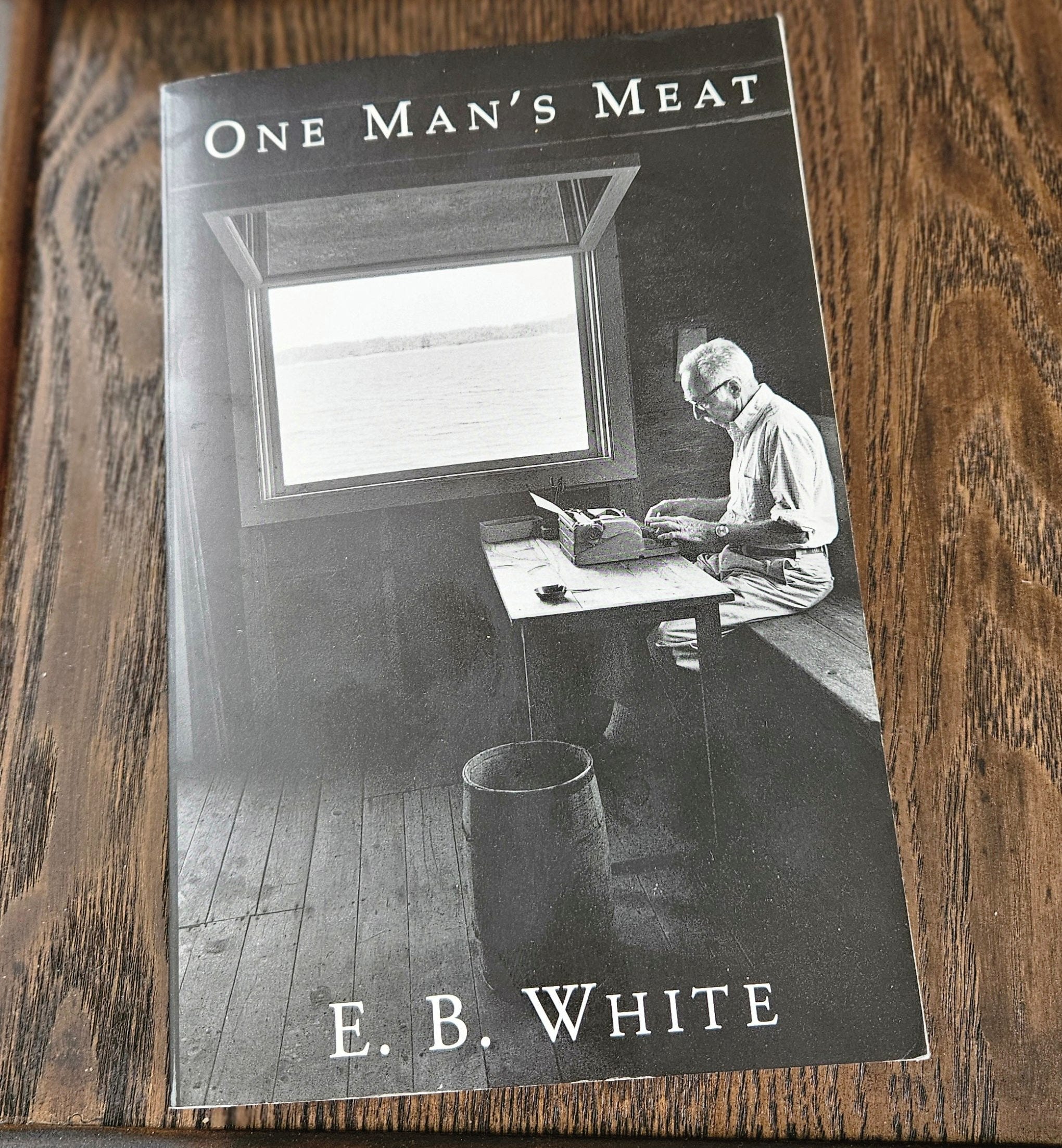
E.B meant himself, of course, since his essays tended to be first-person friendly, as if you had come upon him as he was thinking about where he had been, what had happened, who he had seen, and what it might mean to him when he has a chance to think about it some more.
He pondered. He took his time. He shook his readers loose of any preconceived ideas of what they were about to read. Nearly always a surprise. Something to think about. And it rested easy, as if, of course.
To prepare for this essay I’ve been reading “One Man’s Meat”, White’s book of published essays over a period from July 1938 to June 1943. All but three of the essays appeared in Harper’s, where he wrote a monthly column over that period during which Hitler’s war was brewing and then roared full force into Europe. As he writes about the joys and woes and quirks of a bucolic life on his farm, Europe’s plight looms and he can’t ignore it. Still, there’s a gentleness, a regret, a sorrow rather than rage. He’s still pondering.
In the Foreword, Roger Angell, White’s stepson and a fine writer in his own right, wrote this:
White’s passionate essays on world government sounded idealistic and simplistic even in their time—he was not a pundit by nature—but we can honor him for, then and now, it his clear conviction (no one was ever clearer on the written page) that he is qualified to think about freedom, all on his own, and to address his reader as one citizen to another about such urgent business. Who among us can be certain that when another time as vivid and dangerous sweeps us up we will find an E. B. White somewhere, to talk to us in these quiet and compelling tones?
I paid attention. Throughout the book, especially in later columns when the war becomes reality, White says what he thinks other writers should be doing during those volatile times, when the inclination might be to stay away from pontificating about a war that feels too foreign and too far away to be relevant.
He writes these thoughts in patches, here and there, not as afterthoughts but as soft warnings. As duties. Because he believes writers have duties.
In a free country it is the duty of writers to pay no attention to duty. Only under a dictatorship is literature expected to exhibit an harmonious design or an inspirational tone. A despot doesn’t fear eloquent writers preaching freedom—he fears a drunken poet who may crack a joke that will take hold. His gravest concern is lest gaiety, or truth in sheep’s clothing, somewhere gain a foothold, lest joy in some unguarded moment be unconfined. I honestly don’t believe that a humorist should take the veil today; he should wear his bells night and day, and squeeze the uttermost jape, even though he may feel that he should be writing a strong letter to the Herald Tribune. (January, 1939)
In July 1940 he wrote:
I confess to a disturbed stomach. I feel sick when I find anyone adjusting his mind to the new tyranny that is succeeding abroad. Because of its fundamental strictures, fascism does not seem to me to admit of any compromise or any rationalizations, and I resent the patronizing air of persons who find in my plain belief in freedom a sign of immaturity. If it is boyish to believe that a human being should live free, then I’ll gladly arrest my development and let the rest of the world grow up…
In that same piece, called “Freedom”, he writes:
Being myself a knight of the goose quill, I am under no misapprehension about “winning people”; but I am inordinately proud these days of the quill, for it has shown itself, historically, to be the hypodermic that inoculates men and keeps the germ of freedom always in circulation, so that there are individuals in every time, in ever land who are the carriers, the Typhoid Marys, capable of infecting others by mere contact and example. These persons are feared by every tyrant—who shows his fear by burning the books and destroying the individuals. A writer goes about his task today with the extra satisfaction that comes from knowing that he will be the first to have his head lopped off—even before the political dandies. In my own case this is a double satisfaction, for if freedom were denied me by force of earthy circumstance, I am the same as dead and would infinitely prefer to go into fascism without my head than with it, having no use for it anymore and not wishing to be saddled with so heavy an incumbrance.
In “A Winter Diary”, a column published in January 1941, he breaks from a story about rubber plants and manure and tells us about the incoming news coverage. In that last paragraph, he sees us. He knows us:
I have been listening to Hendrik van Loon broadcast the news lately, in Mr. Swing’s pace. He is a good news man, for he sounds as though the fighting and the destruction wearied and disgusted him. He wanders in the ruins; and probably because he is a historian and a geographer and has a broader sense of time and space than most, he sounds discouraged and grieved at the repetition of ancient movements of peoples and armies on the globe, yet firm in his belief in the ultimate triumph of the free man. I have liked his reports on the day’s events because he has made them seem like part of a whole, not like an isolated moment in time. Many newscasters, it seems to me, have developed a cheerful bedside manner, and when they mention a mechanized division it sounds as though they had it right there in the studio and were scratching it behind the ears.
One of the phenomena of the war is the news coverage. In a sense the American people are a bit overtrained on this strange concentrated diet. Body and mind adjust to almost any kind of stimulus; we compensate physically for the news, just as we do for the speed of a motor car in which we are riding, until at last it seems as though the car is not in motion at all, as though there is no news, not really.
In the very next column, for February 1941, as he writes from a beach cottage in Florida, far from his home in Maine, White takes on racism in a piece that must have startled the readers of his day—even those in the north who might wholeheartedly agree but weren’t ready to confront it with such blatant honesty.
There are two moving picture theaters in the town to which my key is attached by a bridge. In one of them, colored people are allowed in the balcony. In the other, colored people are not allowed at all. I saw a patriotic newsreel the other day that ended with a picture of the American flag blowing in the breeze, and the words, One Nation Indivisible, with Liberty and Justice for All. Everybody clapped, but I decided I could not clap for liberty and justice (for all) while I was in a theater from which negroes have been barred And I felt there were too many people in the world who think liberty and justice for all means liberty and justice for themselves and their friends. I sat there wondering what would happen to me if I were to jump up and say in a loud voice: “If you folks like liberty and justice for all so much, why do you keep negroes from this theater?” I am sure it would have surprised everybody very much and it is the kind of thing I dream of doing but never do. If I had done it I suppose the management would have taken me by the arm and marched me out of the theater, on the grounds that it is disturbing the peace to speak up for liberty just as the feature is coming on. When a man is in the South he must do as the Southerners do; but although I am willing to call my wife '“sugar” I am not willing to call a colored person a nigger.
Earlier in the same piece he makes fun of Florida oranges, to which the words “color added” must be included, since Florida oranges aren’t really orange like California oranges and have to be died in order to live up to their name. He brings it up again here:
I have to laugh when I think about the sheer inconsistency of the Southern attitude about color: the Negro barred from the movie house because of color, the orange with “color added” for its ultimate triumph. Some of the cities in this part of the state have fête days to commemorate the past and advertise the future, and in my mind I have been designing a float that I would like to enter into the parades. It would contain a beautiful Negro woman riding with the other bathing beauties, [her sash] stamped with the magical words, Color Added.
In the very next paragraph he slips in a tiny unrelated vignette, because even in America, many months before Pearl Harbor, the haunt of the war in Europe was ever-present.
In the cottage next door is a lady who is an ardent isolationist and who keeps running in and out with pamphlets, books, and marked-up newspapers, hoping to convince me that America should mind its own business. She tracks sand in, as well as ideas, and I have to sweep up after her two or three times a day.
I saved the passages below for last because they’re so universal it’s scary. They hit me hard, as I would only have to change the names or the times or the locations to see us there. Our hopes, our fears, our guesses for the future, our need to call out the frightening rise of out-of-control dictators leading us into fascism—and the more dangerous need: not to feel anything at all.
(December 1941)
As I write, this is the third day of the war. That is, for most of us it is. There’s one lady I know who has it worked out that we have been at war for some years now. She is an inveterate radio listener, and whenever she hears static she thinks it’s Germans, communicating with their local spies. Life has been a vivid thing for her, and war a reality for a long while. The latest attack on Pearl Harbor was just an incident. At that I suspect she is nearer right than most of us. It is better to hear messages in static than to hear no messages in anything: think of the people who have listened to the rumbling and crackling of National Socialism for the past six to eight years without detecting any ominous sound.
And this one, written just after the attack on Pearl Harbor. (Paging Chuck Schumer, et al.)
America has been at a real disadvantage in relation to the axis. In this country we are used to the queer notion that any sort of sporting contest must be governed by a set of rules. We think that the football can’t be kicked off until after the whistle is blown. We believe the prize fighter can’t be socked until he has come out of his corner. We think the fox hunter must tip his hat to the M.F.H before he can gallop off after a fox. In this crazy land of ours a tennis player doesn’t serve until his opponent is ready. Ever since trouble began inside Germany, years ago, we have hung tight to our sportsmanship, our code of honor, our book of rules, quite incapable of comprehending any other sort of approach to life. Not all the denial by Herr Hitler, not the plain statement in his book that the way to get an advantage was to seize it, not the deeds themselves as the little countries were struck down, one by one, made much of a dent in our characters. So it was quite to be expected that America grew purple and pink with rage and fury when the Japanese struck us without warning. There are still, on this third day, people who seem to feel that a universal referee will step in and call a penalty.
The book ends with an essay called “Cold Weather”, written in January 1943, almost a year after Pearl Harbor. It’s a rambling, clever piece covering a lot of pastoral territory, mostly about winter, with, surprisingly, no mention of the war or the war effort here in America. But in an essay before that, written in October 1942, called “Bond Rally”, he describes a fund raiser in Bangor, with an appearance by Dorothy Lamour, two war heroes who had been injured but are too choked up to talk about it, a young Jewish violinist, and a negro singing group. It’s the last chapter of the book where the war plays a starring role.
Here, for a Nazi, was assembled in one hall all that was contemptible and stupid—a patriotic gathering without strict control from a central leader, a formless group negligently dressed, a group shamelessly lured there by a pretty girl for bait, a Jew in an honored position as an artist, Negroes singing through their rich non-Aryan throats, and the whole affair lacking the official seal of the Ministry of Propaganda—a sprawling, goofy American occasion, shapeless as an old hat.
When I started this piece I thought I would be pulling out E. B White’s advice to writers, and I may still do that down the road, because of course it’s so good, but when I came across his thoughts on dictators and fascism, so startling and pertinent 85 years later, I had to go there.
I think about his audience at that time, long before the internet, and wonder how many might have read these and shared them. While Harper’s Magazine, a monthly, was elite and prestigious, circulation numbers had to have been pretty low. It wasn’t like Will Rogers, who wrote a syndicated newspaper column with nationwide delivery to cities and every little burg across the country, making him a national treasure because millions of people had access to him. Did White care? It doesn’t appear so. He wrote as if the world was his, as if of course everyone would want to read whatever he came up with—on surly cows or quirky neighbors or monsters laying pillage across the sea.
And here he is. His book of essays, the one I’m quoting here, is still in print 85 years later, relatable even now. So maybe he knew what he was doing.

I’m here for the long haul, but in order to be seen and heard I need subscribers, both free and paid. Or you can support my work by tipping any amount at any time at Ko-Fi or at Paypal. Thank you!
If you would prefer to remain on the free list, you’re always welcome and you’re included in everything. Please share any of my pieces with those who might want to join our community. It all helps.

Comments
Nothing yet. Say the first thing.
Sign in to join the conversation.