
Hey Friends! Hope everyone is staying warm and getting ready for Christmas. Nothing spoils the season like frenzied, last-minute shopping. Just to be helpful, let me remind you that the best gifts are books—gifts your loved ones spend a lot of time with and remember long after they’ve finished reading.
2025 has been a tumultuous year for writers, but the bottom line is, book sales are improving, author income is increasing, indie bookstores are growing, and there are many new opportunities writers can take advantage of to propel their careers. On our podcast in 2025, the two most commonly discussed topics were Amazon and AI, both of which are going to play large but changing roles for writers in the days to come. Stay informed!

Last time I mentioned how excited I was to be going on a cruise through uncharted waters (for me), the Eastern Caribbean with Holland America. Lara and I will both be teaching, as will Betsey Kulakowski, author of the award-winning Veritas Codex series, plus one of the best agents in the business, Katharine Sands, who has sold many books for many people (including me). Katharine has committed to not only speak but to meet individually with anyone in our group who wants to do so. Katharine wrote the article on “Querial Killers” in the last newsletter and she follows up this time with “How an Agent Reads Your First Page.” We’ll also have onboard classes and small or private meetings with attendees for a total of over 20 hours of instruction—but only while the boat is at sea. I know when we’re in port you’ll want to get off and look around. But when we’re on the water, we’ll be doing everything we can to make your writing dreams a reality.
Click here to see the entire itinerary. Then register and come join us! Payment is due not due in full till next year, but you can reserve a room now while we still have space available.
AND NEVER FORGET:
WRITERCON RETREAT July 15-19, 2026
We are returning to Canebrake Resort for a five-day writing retreat next year. The Retreat gives us more time to work on your individual manuscript in a workshop setting. Hoping for some feedback on your work-in-progress? This is where you get it. Plus you’re in one of the most gorgeous, inspirational settings on earth. Click here for more details.
WRITERCON CONFERENCE Sept 4-7, 2026
And of course, the conference will return. This is the Big WriterCon event. This year we had almost 300 people attending. More than 60 speakers. More than 100 breakout sessions. And next year, we will have even more. Some of you did not get the great WriterCon video shot and edited by my son Ralph Bernhardt, so I posted it above again. I felt like he captured the spirit of the conference.
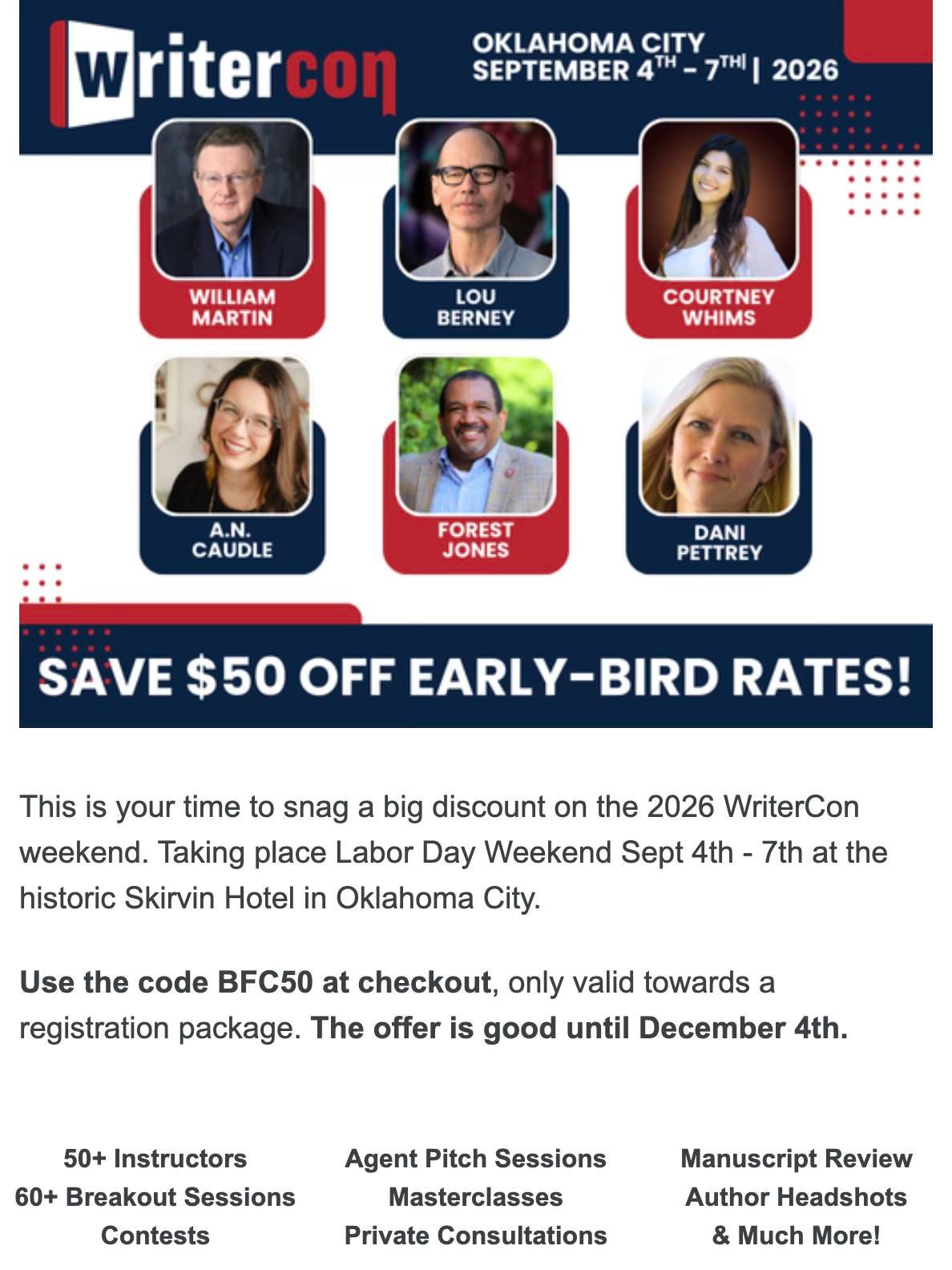
Just to convince you that you need to join us, I’m extending our Black Friday sale to those subscribing to this newsletter (so ignore the part about expiring December 4.) From now till Christmas, you can use this discount code to save yourself $50. So what are you waiting for? Click here for more information.

When agents read the first page, we are reading diagnostically. We are deconstructing the pitch, the story, and the writer. We read to find reasons to keep reading long before we are ready to represent the writer.
Page One is about you being in charge of the page and taking your reader into your imagination, your world, your story. It is the place where a writer shows the sparks that set off the alchemy of agency interest. Pitching to Page One is how the agent understands what is on offer.
It is not that this is the only aspect of your work anyone will pay attention to—it is the place where a writer shows the energy that will carry a whole book. The first page must work the way your query does: it has a job to do, and you are building a case for reader interest.
Your reader has not yet had the chance to become involved with the character’s journey and why we want to take it with them. You want to show a story arc here—one that takes place in a fascinating world, rich with colorful characters and situations.
PitchCraft® and the Place–Person–Pivot Formula
PitchCraft® is the writing you do about your writing. It is the speaking you do about your writing. And these are needed tools. From Pitch to Page One, writers need to know that their pitch has much more work to do than to query an agent—the very first “elevator pitch” will take many forms, morphing into brand and mission statements, used for community and platform building.
For both query letters and first pages, I have a PitchCraft® formula: Place – Person – Pivot.
These are the first reader takeaways. These are the elements the reader needs to become oriented, invested, and immersed in a story—any story.
Place
Where do you take me? What is the story universe?
Establish time, place, and tone fast. You, as author, know the scope and theme. We don’t. We need to be oriented—to feel we have entered a world that is alive, vivid, and specific. For memoir, this means the reader must know where they are and when. For fiction, it means the setting must signal mood and meaning—an invitation into your created world.
Your first lines are the entryway. They are not the time for abstract reflection, theme, or commentary. Start with the story. Ground us. Make it visual, sensual, and specific.
Person
Who do I meet, and why do I care about their story?
We need to know whom we are following, what is distinctive or human or fascinating about them. When you introduce a character or narrator, define them fast—remember, you have watched the movie at the keyboard, but we have not. I don’t know if your hero is thirty or sixty, gay or straight, human or alien, or a poodle. Without that visual or emotional anchor, the story isn’t as engaging as it might be.
Readers follow people, not ideas. Even the most elegant prose cannot compensate for a lack of emotional identification. Give us a sense of voice—tone, perspective, and sensibility.
Pivot
How do I enter the story at a lively, dramatic, interesting place?
This is the moment something changes. It could be the point where the ordinary becomes extraordinary, where the reader is dropped into motion. It could be your personal story—when something extraordinary, catastrophic, or magical happens. It needs to be dynamic.
The pivot is what propels your narrative and signals that something is at stake. It’s the moment we, the readers, come into the story just in time to see something start the story in motion.
What Not to Do
Writers sometimes forget that the first page is not the time to lead with theme words—redemption, transformation, self-discovery. Theme words are the enemy of immersion. Theme is what we understand later, not what we are told at the top.
Don’t begin with the nadir because you assume we’ll be wowed by the shift in later chapters—we may never get there. Don’t introduce a dull version of your protagonist just to set up their later brilliance. Start with something alive.
Don’t overload us with backstory or commentary. Backstory kills momentum. Commentary distances the reader. Keep us in the present action.
Don’t forget that your first page is the place to prove you can tell a story, not explain it.
What Agents Look For
When reading, agents ask: Where am I? Who am I with? Why does it matter?
We want immediacy. We want to feel that we’ve been taken somewhere new. We want to hear a voice that is confident enough to lead us through. We want to feel we are in capable hands.
We are also thinking beyond the page: Is there a definable audience? Is this voice and story transportive, distinctive, or saleable? Can I imagine an editor championing it? Can I imagine readers buying it?
The first page is where we begin to form that impression.
How Page One Relates to Platform
When we read, we’re not just responding to words—we’re assessing potential. Agents look for authors who understand the importance of platform, who can define their ideal intended audience and demonstrate a path to reach them.
As an author, you must be an impassioned ambassador for your book. The springboard through which you do this is your platform. It defines your ideal audience and provides a blueprint for getting to those readers.
First pages are connected to this idea—they introduce not only a story but a sensibility, a worldview, and an audience relationship.
Publishing is an emotional business. Sharing words is passionate work. Agenting, by contrast, is the diagnostic side of that passion. It is midwifery. When I read a first page, I am looking for the pulse—the heartbeat of the story.
I want to feel that I would be a strong choice for the writer—not just that the writer is publishable, but that I am the right choice to shepherd the book to fruition.
For me, Page One is the writer’s calling card. It tells me not only about the story but also about the writer’s instincts—their sense of craft, timing, and connection.
Remember: the agent is listening for clear, core points about why the book will appeal to an audience. All backstory and process should be put aside. Focus instead on immediately interesting the reader in why you, why now, why this book.
What Works on Page One
The most successful first pages orient, engage, and propel. They give a sense of place, introduce a person we care about, and pivot us into motion. They demonstrate control of voice and timing. They offer texture and tension.
Readers must feel that each line drives the story forward and that each paragraph builds toward revelation, discovery, or change. The energy must rise.
From First Writes to Last Rights, client representation is about working with writers at many stages of creation and in many formats—whether this leads to traditional publishing, self-publishing, or digital media.
The same applies to the writing itself: from first word to first page, you are always inviting someone into your world.
As a writer, you are not simply putting words on paper—you are creating an experience. That begins the moment an agent reads your first line.
Think of your first page as your performance. Hone it the way you would a pitch. Know that it is both an introduction and an invitation.
Remember your three essential markers—Place, Person, Pivot.
Orient, engage, and propel.
Let us feel what changes—and why we should follow.
That’s how an agent reads the first page.
Penguin Random House Initiates a KPop Line
You probably knew this was coming. PRH is collaborating with Netflix to publish “fan-forward” titles about KPop Demon Hunters for children and adults.
New nonfiction publisher: Full Set
A new publisher has launched headed by the former head of Amazon Publishing Europe. Full Set will target current affairs and business titles. They’re also publishing a weekly newsletter, Reading In, which will provide insights into book publishing.
New agent: Brian King at Metamorphosis
Brian King is open to YA and adult fantasy and romantasy. He has many years of experience at Barnes & Noble.
New agency: The Alicia Brooks Literary Agency
Brooks, a former literary agent for Jean V. Naggar Literary, is open to a wide range of fiction and nonfiction.
New agency: Starling Literary
Jemiscoe Chambers-Black and others have founded Starling Literary, representing children’s authors as well as adult fiction and nonfiction.
The WriterCon Facebook Page
For more breaking news from the publishing world, join our Facebook group! Doesn’t cost a thing and guarantees you’ll know about important matters that affect writers when they happen. My favorite part of the page, though, is seeing how many WriterCon writers are successfully publishing and marketing their books. Click Here to Join.
We just celebrated our 200th episode!!! We brought back two of our first interviewees way back when, Will Thomas (Barker & Llewelyn Victorian mysteries) and Julia Thomas (The Kennedy Girl). Plus we discuss the latest news and share craft tips from Marty Ludlum (At First I Was Afraid). Click here to listen.
Till next time, keep writing, and remember—you cannot fail if you refuse to quit.
William Bernhardt
willbern@gmail.com
www.writercon.com
No posts
Comments
Nothing yet. Say the first thing.
Sign in to join the conversation.