
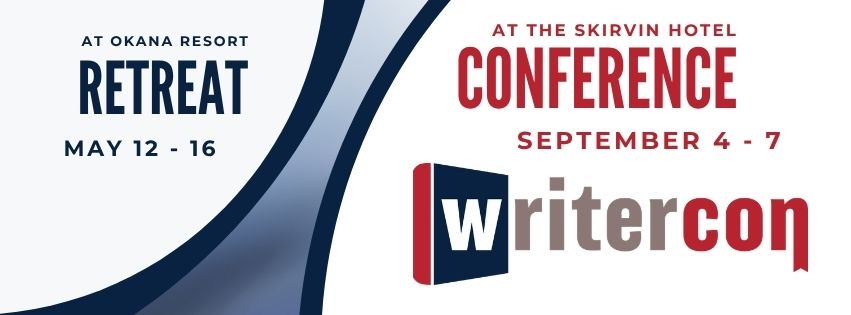
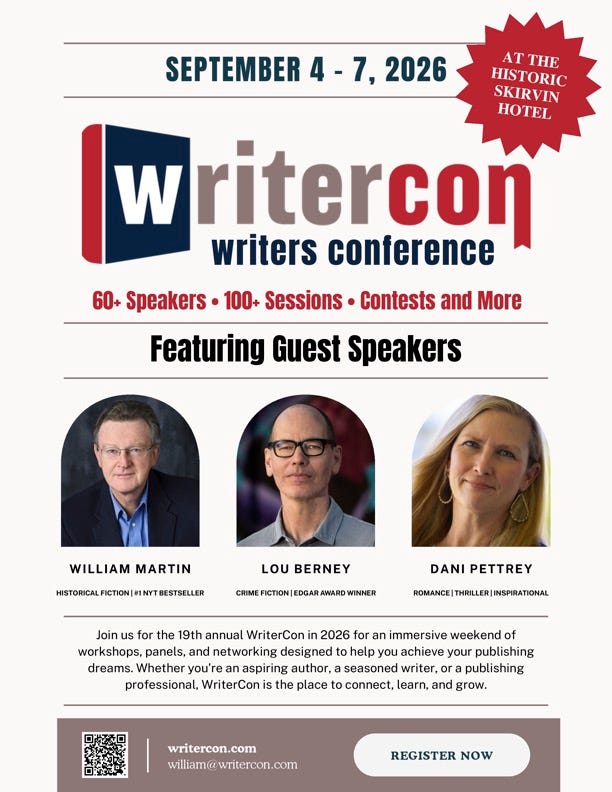
WriterCon is only one month away! Registrations are still open (though that could change) and we would love to have you join us! It’s Sept 4-7 in Oklahoma City at the historic Hilton Skirvin Hotel. The schedule is now posted to our website. I think we’re covering every kind of writing there is. The other day I realized, Wait! We don’t have a songwriter! So I found one and now we do (and a great one)! We have agents covering virtually every kind of writing and we have the latest on all that’s happening in the publishing world that writers need to know about.
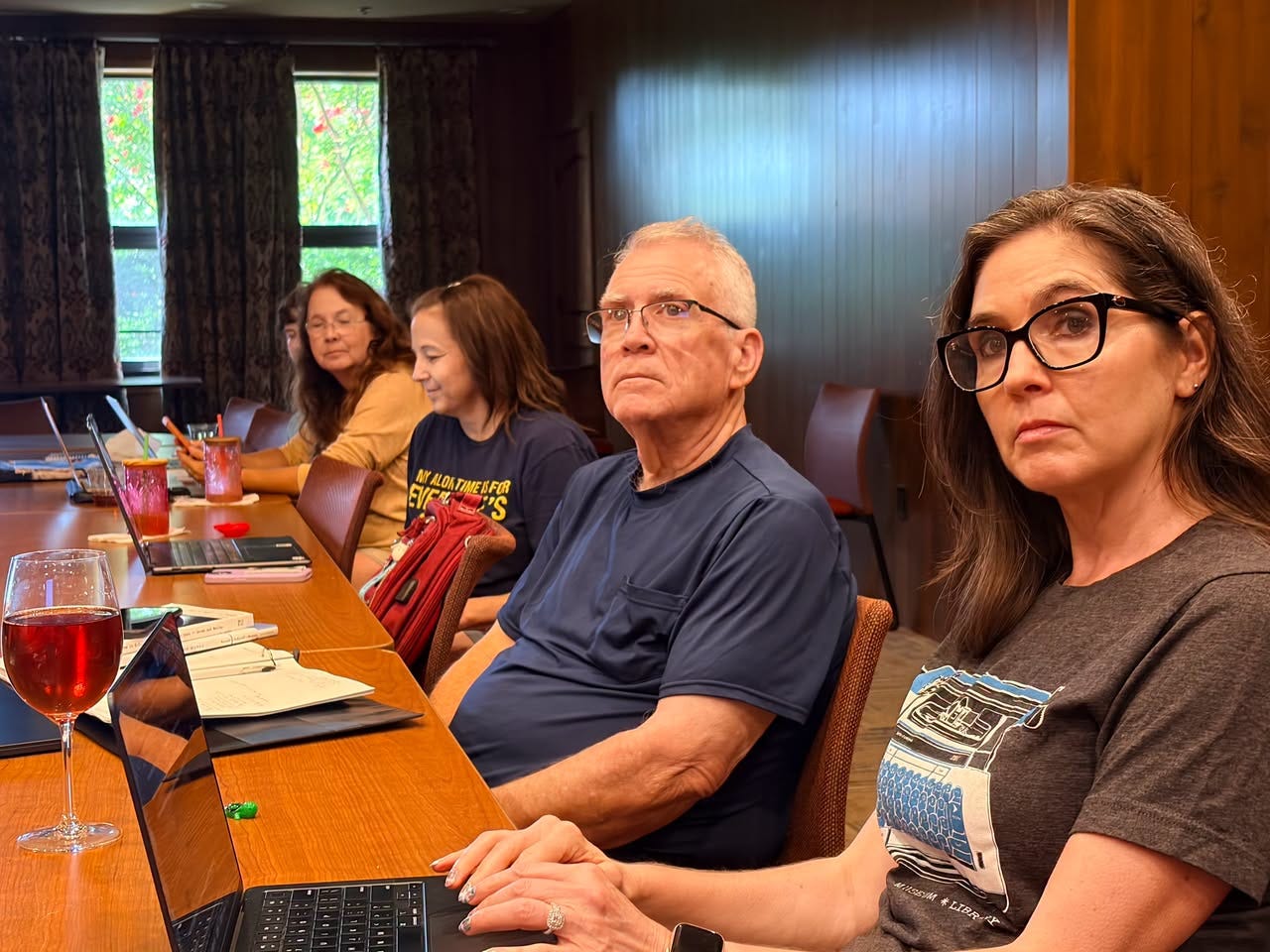
We just finished the WriterCon Retreat at Canebrake and it was a delight. I love getting to work one-on-one with writers, having a chance to read and comment on their work. That’s when I feel most useful. Our group this year was off-the-charts talented. I hope they all show up at WriterCon, because they have what it takes to succeed in the weird and wonderful writing world.
I’d like to see you there, too!
More than 100 breakout sessions. Superstar presenters covering every aspect of writing. Contests, manuscript reviews, private consultations! Pitching at no additional charge. Informal roundtables where you can ask anything! Here are a few of the headliners:
I should mention that even though our watchwords are “education” and “opportunity”—we do occasionally have fun. This year we’re adding a nighttime Singo! for those who just don’t want to sleep. With Jesse Ulrich as DJ, it should be a blast. Also WriterCon Jeopardy (I host that one, natch), WriterCon Karaoke, Pitchapalooza, and much more.
This is one of the biggest and best conferences in the country. Ok, I’m a little biased, but that doesn’t mean I’m wrong. And this is definitely the warmest, friendliest conference, designed to give you exactly what you need to boost your career. Click here for more information.
BETSEY KULAKOWSKI is an author (and a WriterCon grad) with more than a dozen published books, including her “Veritas Codex” series that explores the world’s wildest unsolved mysteries. She’ll speak at WriterCon this year, but in the meantime, she’s offering an invaluable article about how to protect yourself.
Writing a book is one of the most emotionally charged achievements a person can pursue. You pour your heart and soul into a dream and bring it to fruition. If you’re lucky, your book will be published. It’s an achievement that represents years of work, identity and hope. That’s exactly why scammers target authors—and they are getting good at it.
If you’re like me, on any given day, you can open up your email and see an email from someone who identifies themselves as a book club sponsor, or a marketing expert. At first they extol the virtues of your book, praise your skill as an author, regurgitate your blurb and tell you how stories like yours caught their attention.
Then it comes, the back-handed compliment that leads to the problem you didn’t know you had. Your book doesn’t have enough reviews, or you should be hitting a best-seller list, or whatever. But the good news is, they have a solution! Maybe its access to 4,000 readers in their book club, or their ability to create a marketing plan that will earn you the income you deserve and promise to get your book in front of all the right people. They don’t provide details or guarantee success, but they’d be happy to book a call with you to see what they can do. Just don’t wait! Their schedule is filling up.
Sounds too good to be true, right?
According to the Authors Guild, scams targeting writers are increasing rapidly—and becoming more sophisticated, especially with the rise of AI-powered impersonation and marketing schemes.
This isn’t just spam. It’s a carefully crafted ploy to exploit the ambitions of authors. They’re playing on our vulnerabilities and imposter syndrome, and sadly, it works.
The most common scams currently targeting authors include:
1. “Marketing Magic” Scam – The email begins with high praise for your book, while they regurgitate your own book blurb and say how amazing it is that you wrote this book. But, there’s a problem. Your book doesn’t have enough reviews or its not properly aligned with the market for maximum exposure. But they have a solution that will get your book in front of thousands of readers, or help you align it with your target audience. They don’t even mention the fees, which I guarantee will come out eventually if you engage with them. The best they can deliver are bots, fake followers, and fake reviews. Once they have your money, they could simply disappear, giving you nothing. But here’s the reality check, real marketing professionals don’t cold-email unknown authors with guaranteed results.
2. Fake Publishers & Vanity Press Traps – These are among the most damaging scams because they look legitimate. They have a professional website, staff (with AI generated headshots), and fake testimonials from their satisfied customers, using real authors identities. One recent investigation uncovered global networks of fake publishing companies using cloned branding and virtual offices to lure authors into paying for publishing packages. Here’s the reality check, real publishers make money from selling books, not charging authors up front. You should never have to pay to get your book published.
3. The Bestseller & Hollywood Promise – the emails promise they can make your book a bestseller or get it in front of industry experts who will see the film potential of your work. No legitimate company can deliver that kind of success. These scams rely on urgency and ego. They’ll tell you it’s a limited time offer, and that you’ve been selected from thousands of authors. These are classic manipulation techniques.
4. The Bookstore Bulk Order Scam – someone emails you claiming to represent a major retailer (Barnes & Noble, Books-A-Million, etc.) and they want to place a large order to put your book in their storefront. Here’s the catch—you have to pay for printing and shipping. Spoiler alert: Bookstores don’t work that way.
5. Impersonation Scams (Authors, Agents, Producers) – you get an email from a famous author (I got one from “Dean Koontz”—I feel so special!), film producer or literary agents. They praise your work and seek to build rapport. They want to connect with you. They might ask some questions about your writing journey or your book. (It’s always one book, never “books” which offends me because I have dozens.) Eventually, they’ll start asking for money, maybe offering a service in return. This is increasingly common, and often AI assisted.
6. Click on the Link for More – this is common throughout the world, not just in publishing. Fake links are often fake versions of legitimate websites (with subtle differences in the web address), and if you click on them, they’ll direct you to a cloned website where scammers can download viruses, keyloggers or ransomware into your system, while stealing your confidential information, like banking log in, credit card numbers and social security information. They can use this information to steal your identity and open new accounts and take out loans in your name, leaving your vulnerable to financial ruin. The Federal Trade Commission reports that, in the U.S., every 4.9 seconds someone becomes a victim of identity theft. In 2025, there were over 6.4 million reported cases of identity theft, with financial losses near $13 billion.
So, why do these scams work? They don’t succeed because authors are careless. They succeed because there engineered to work around human psychology. They exploit your hopes, they offer validation of your efforts. They often come with a sense of urgency in the hope that you’ll leap before you look, and they give you just enough information to entice you to reply for more details. They hope that by getting you to engage, they can build rapport and earn your trust by finding out what your specific pain points are, and offering (falsely so) a solution to solve all your problems.
There are red flags in every email scam I’ve seen come through my inbox (and straight into my junk folder). Here are the most common:
· Unsolicited offers that sound too good to be true,
· Upfront fees for publishing or marketing that aren’t clearly defined in the initial contact,
· Guarantees of sales, rankings or film adaptions without details,
· Pressure to act quickly
· Vague, unverifiable credentials
· Gmail/Yahoo/AOL email accounts instead of a professional domain
· Misspelling of the company name, or omission of a company name all together
· Grammar patterns which suggests the author might not be a native English speaker (or even human for that matter). AI has a certain cadence and pattern that can be detected if you’ve trained yourself to recognize it.
So how do you protect yourself? First off, you have to recognize you are a target. You don’t have to like it, but you have to know that they are trying to play you—and for them, this is a game. They win when you click on a link, or respond to their offer.
Approach emails without emotional attachment, because that’s where they’ll try to get you. They play on your emotions. Instead, approach every email with suspicion. You may be wrong, but its better to be safe than sorry.
Verify everything—look up the company independently (without clicking on a link). Check with others in the writing community for complaints, not just testimonials. Confirm identities through official websites.
NEVER click on a website or link provided in an email. Those can take you to websites where viruses can be downloaded into your computer and your information can be uploaded into theirs.
Follow the money. Ask:
· How do they make their money?
· Is it from selling books—or charging authors?
Never pay under pressure. Scammers rely on urgency. Legitimate professionals will always give you:
· time to review contracts,
· ask questions, and
· seek legal advice.
Work with professionals you know and trust. Talk to other authors and those in your writing community. Meet them at writing events such as conferences—like WriterCon—and writer’s club meetings. Ask your fellow authors for recommendations. Ask where they found their resource. Ask how much they paid? How they paid? Then, do your own due diligence. Vet them to make sure they are a good fit for what you need.
Scams thrive in isolation. Communities expose them quickly, so your writing community is one of your best defenses.
Never hesitate to hit that “block” button whether it’s on social media, or your inbox. It’s not rude. It’s protecting yourself and your author business.
Serious professionals get paid when your book succeeds. If their business model depends on your payment instead of your success, you’re not their partner, you’re their revenue stream. There’s a big difference between paying for a service and paying for a promise. Friends, don’t fall for it.
Agent Opportunities
Jessica Kasmer-Jacobs has founded a new agency, Blueprint Literary, to represent Jewish, Israeli, Arab-Israeli, and Palestinian authors. Learn more.
Publisher Opportunities
Harlequin launches Romantasy Imprint “MoonFire”
According to the Harlequin press release, “MoonFire will publish a wide range of romantasy and paranormal, cosy, and dark fantasy romance, designed to be both accessible and commercially appealing. It will publish books that respond to voracious reader demand for relationship-driven, emotionally satisfying stories with page-turning plots and varied spice levels, so readers can find exactly the kind of romantasy they love.” Learn more.
New Imprint from Springer Nature
Nature Books will publish work under the established scientific brand Nature. Books will focus on academics, policymakers, and funders. Learn more.
More News Worth Knowing
Amazon is Turning BookTok in Hit TV
She Blew $44,000 Promoting Her Book—Don’t Make the Same Mistake
The Anthropic Settlement is Finalized!
The WriterCon Facebook Page
For more breaking news from the publishing world, join our free Facebook group! Doesn’t cost a thing and guarantees you’ll know about important book news when it breaks. My favorite part, though, is seeing WriterCon writers share valuable information and experience about successfully publishing and marketing their books. Click Here to Join.
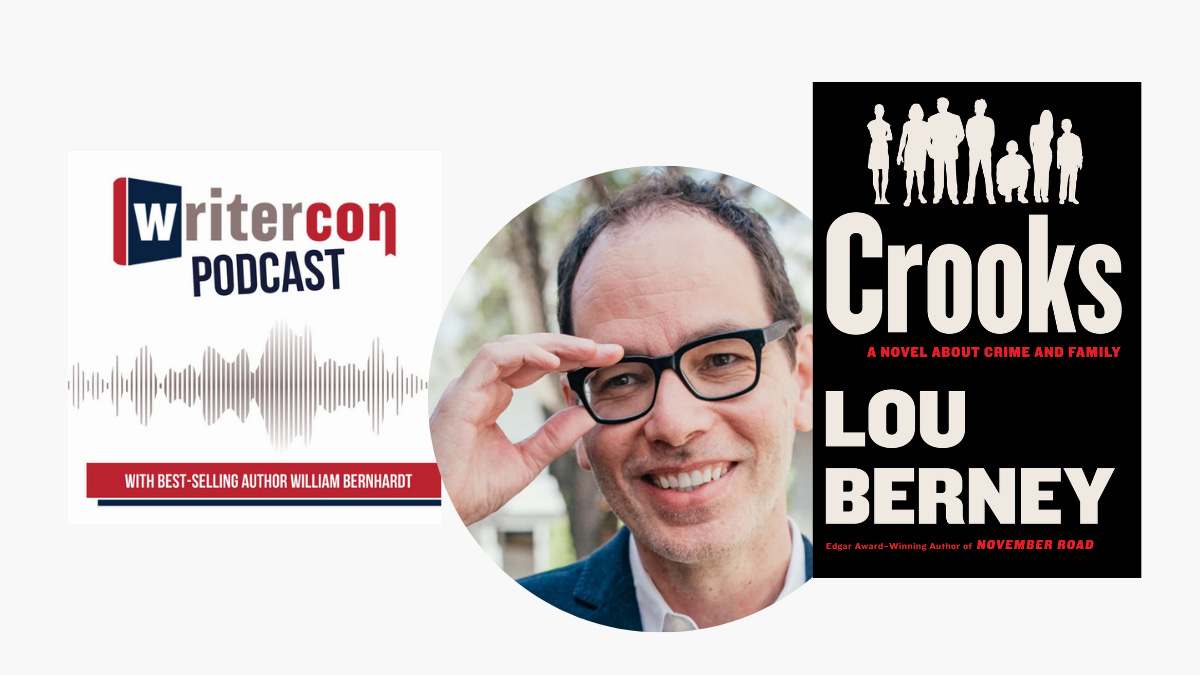
Just to give everyone a taste of WriterCon before it happens, we interviewed William Martin, author of December ‘41, The Lincoln Letter, and many other bestselling historical fiction novels, last month. This time it’s Lou Berney, our Friday keynote. Lou is one of the best crime writers in the world. He won the Edgar Award, which should be enough for anyone, but he’s also won the Hammett, Steel Dagger, Anthony, Barry, and Macavity awards, plus he’s a four-time finalist for the L.A. Times Book Prize. I think you’ll find this is one of the most illuminating (and unusual) author interviews you’ve heard! Click here to listen!
Till next time, keep writing, and remember—you cannot fail if you refuse to quit.
William Bernhardt
willbern@gmail.com
www.writercon.com
No posts
Comments
Nothing yet. Say the first thing.
Sign in to join the conversation.