
So much of my writing process is letting the book play like a movie in my head before I ever write a single word. I talk to myself in voice recordings too, listing potential plot holes, magic system conundrums, and overarching multiverse lore tie-ins.
My overactive imagination led me to seek a degree in scriptwriting, and while I do enjoy the occasional script, I realized my true passion would always be books and even more so bringing the active writing I learned in scriptwriting to the fiction world.
Then I learned a couple years back that my ability to play out my book in my head was not…normal. That apparently it’s called ‘hyperphantasia’ and not everyone has the capability. Hyperphantasia has also been linked to those with anxiety, obsessive–compulsive disorder, major depressive disorder, and bipolar disorder (wikipedia). While I don’t have the latter, I do have the first three, and I thought that was so incredibly interesting.
For so long, my mental health and neurodivergence felt like a burden, but if it’s what gave me hyperphantasia, then I want to give younger me a big hug. The ability to see my scenes has driven 95% of my multiverse. It’s even directly affected my writing style, especially after I finished my college degree. I found myself drawn to active, present tense writing, and even more so with a first person POV.
I’d been competing in flash fiction competitions (and even won a few which was cool), leaning into writing that focused heavily on ‘show don’t tell’; writing that’s not really meant to be binged but where every word on the page is very precise. You must tell a story with a complete beginning, middle, and end within 1,000 words. Every word chosen is for a reason, and there can be a lot of in between line context involved in understanding the story.
Reedsy.com actually did a better job of putting it into words:
The form [flash fiction] is unique in that, rather than focusing on plot or character development, it focuses on movement: each sentence (or even word) peels back a layer and progresses the story.
One of the most famous pieces of flash fiction is actually only six words long:
For sale: baby shoes, never worn.
Written by Earnest Hemmingway. I remember studying this sentence for three, hour-long classes in school. One sentence—a thousand variations of story. Did the baby grow old? Did it not? Was it simply that the shoes were an extra pair? The wrong size? That one sentence has the capability of telling an entire narrative without another word, and it creates deep conversation.
With books, I’m able to take my micro pieces of story and provide greater context, but my style leans toward creating conversation and opening the door to many meanings, not just one. That’s experimental in and of itself.
A great example is the Wrathos magic system. It’s the same system across all my books, but different realms have different names for things based on their culture. Some realms also have access to different facets of the magic while others don’t.
Some readers prefer to be told exactly how a magic works; others have enjoyed discovering it with each of my books I’ve written. Magic is malleable in my multiverse, and it’s incredibly emotionally driven. It acts almost like its own character, and it takes on the traits that the characters using it have. Not all Death magic is bad, for example, but in the hands of Mogaell Winloc (For Mist and Tar/For Blood and Flame), it goes awry.
That’s not to say there isn’t any standard of structure or no rules. There definitely is, and those too will be revealed over time. But I love seeing readers debate the similarities, for example, of Infusion from Alchemight and Bonds from Fates of Mirror/Shard Daughters.
Or even better: how the Threads of Fate look behind the ‘veil’ very similar to chemight, and Rayze being able to manipulate threads is very similar to golem strings. It’s created this stimulating dynamic between readers of how they perceive the magic among Wrathos can be used and how it can’t—when in reality, I’m the only one who truly knows (for now) hehehehehehehehehehehehe!
Hyperphantasia adds another layer to this. I loved this article from David Robson at The Creativity Workshop:
Such intense and detailed imaginations are thought to reflect a condition known as hyperphantasia, and it may not be nearly as rare as we once thought, with as many as one in 30 people reporting incredibly vivid mind’s eyes.
Just consider the experiences of Mats Holm, a Norwegian hyperphantasic living in Stockholm. “I can essentially zoom out and see the entire city around me, and I can fly around inside that map of it,” Holm tells me. “I have a second space in my mind where I can create any location.”
This once neglected form of neurodiversity is now a topic of scientific study, which could lead to insights into everything from creative inspiration to mental illnesses such as post-traumatic stress disorder and psychosis.
Theirs is a very different experience from most. It’s extremely immersive, and their imagery affects them emotionally.
I think my hyperphantasia is the reason why I glommed onto flash fiction so hard in college. Six little words. A grand story. It allowed me to disappear into my head and create whatever narrative I wanted.
This is making me miss writing flash fiction. Side poll:
Scriptwriting adds an additional, third layer to my writing style. In scripts, you typically divide things up by scenes—just like books have chapters—and each scene gets a setting (unless the overarching setting remains unchanged). Then the rest is almost always dialogue and a mix of very brief but critical character calls like this page from the film, Ocean’s 11:
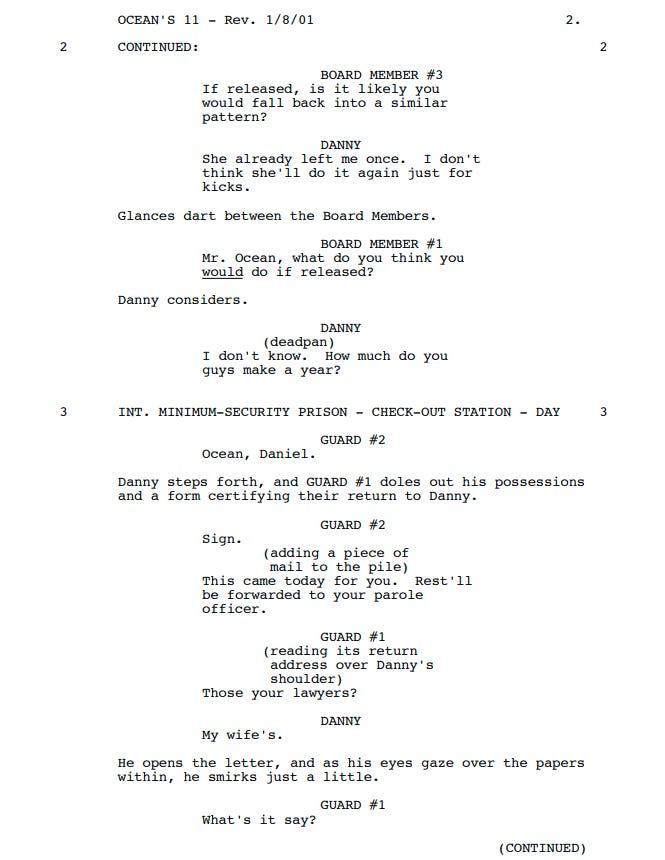
Because a lot of my ‘teaching’ moments were in this format, when it came to writing books again after college (I’ve been writing books since I was a wee child), my style evolved to a more ‘lean’ structure. My Alchemight Duology was written before a lot of that was instilled in me. The first drafts were at least. Which is also why you may notice a big difference between Alchemight and Fates.
Shard Daughters is very action-oriented, so I’ve found myself leaning on my scriptwriting background even more. Setting, I believe, has never been a strong suit of mine because of this. As you can see from this page, setting is a line, if that. In a book, that doesn’t cut it, right? You need more of a visual. But with my hyperphantasia, sometimes it’s a struggle to know if what I’ve put on the page is enough—because to me, I could see it with one word.
That’s where feedback comes in before publication, and I’m grateful to have fellow creatives who spend their spare time offering me such feedback. Doesn’t mean I’m perfect at it, but it’s something I’m working on.

Writing this way has it’s strengths and weaknesses, just like anything else. When I sat down and asked myself what article I wanted to write for the new year, I decided on this because I think it provides great context to my books.
It’s always interesting to me when I have conversations with readers about this, because I’ve found that most times if they don’t have that visualization power (which is totally okay!), they can struggle with my work. The exact opposite was happening with readers who did have hyperphantasia. They were seeing the scenes almost exactly as I was, which was and always will be insanely cool to me.
Reading is subjective. We all know this. The author writing the story is their own cocktail of style from whether or not they’re neurodivergent to the kind of POV they prefer and what kind of upbringing they had. My brain doesn’t work the same as everyone else’s, so I can’t expect my work to resonate the same with every single reader.
When I was a debut author, that was a hard thing to come to terms with. I was new to the space, and I definitely didn’t understand who I was as an author, just that I had a big dream. Now, I invest more time in learning about the differences in mindset and psychology between every person—particularly myself. Because the more I understand me, the better I can understand who will most resonate with my stories.
Learning about hyperphantasia, understanding my neurodivergence, and being open about that with you now will be hugely helpful in deciphering that.
My first years as an author had a lot of stumbling. I’m endlessly proud of both the Alchemight Duology and the Fates of Mirror trilogy, but I’m sure if you’ve read them, you can probably see how…torn I was. They’re me, but they’re two sides of me.
I’m still, with the Shard Daughters series, trying to understand how to properly merge all sides of my author voice. It will take time and more books before I can wholeheartedly say I’m a ‘master at my craft’. I’ll never pretend to be perfect or even the best writer out there, but I will always strive to find my way.
The Shard Daughters series is certainly the first step in learning to merge my two halves. The Shard and The Serpent is lean and mean in its writing, brutally clear—something I definitely took away from flash fiction and scriptwriting. It doesn’t beat around the bush, and it moves fast. If you skim, you will be endlessly confused. It’s heavily show don’t tell, even while being in first person which is often known to have a more internal feel.
I’m clearly still finding my way in the internal department. I feel I was able to give so much emotion to my Alchemight duology, and granted, that duet ended up burning me out and putting me in a somewhat dangerous mental health spiral—but it’s still some of my favorite character development I’ve ever done.
With The Shard and The Kraken, my next release and the sequel to The Shard and The Serpent, my goal is to try even harder at marrying my author voice. Every book is about aiming higher. Not for perfection, as my OCD heart would so desire, but to know I can put the physical copy on my stack of published novels with a sense of pride.
The plot I’ve devised for The Shard and The Kraken will be just as brutal (honestly more so) as book one, but I’m also trying my hand at creating slower moments, instilling more purpose in allowing my writing to ‘breathe’. My style can often veer poetic in nature—so it’s a very fine balance of juggling active, action-packed plot versus emotional, lyrical character cores.
I love having conversations about writing style with my readers and fellow authors, because it helps me align who my books are for. That’s not to say that if you don’t have hyperphantasia, don’t enjoy show don’t tell, and could care less about lyrical writing that you won’t enjoy my books—but it’s a good indicator that you might not, and that’s also okay.
I came to terms with the fact my books are not ‘everyone’ books after I released For Mist and Tar. I like to experiment, play with structure, and take big risks with my story mechanics. Sometimes it pays off, and other times it gets dog-eared as something I should archive for the foreseeable future.
Writing, for me, has always been about connecting. Feeling less alone in the world. Finding inner peace through fictional characters. Just choosing to be okay knowing I rarely felt normal but that maybe not being normal was the very thing that would allow me to have a readership.
Will I ever be a big name author on billboards with huge agented deals and mass market appeal? To be so for real with you, I don’t know. If that happened, of course I’d be jumping for joy, because more exposure means sharing my work with more of the world. But it’s not something I’m directly chasing after either.
My goal is mostly just to find readers, and if you’re reading this, then that means you are one.
I would so love to know if we relate on anything I mentioned from the hyperphantasia to the love of scripts and flash fiction. I have a funny feeling a lot of us will share a love for those, and it’s so cool to know that the bridge that let us find each other was my work.
If there’s anything I want from 2026, it’s continuing to find you. I can’t wait to tell you more about The Shard and The Kraken, but for now, I hope to see you in the comments:
Comments
Nothing yet. Say the first thing.
Sign in to join the conversation.