
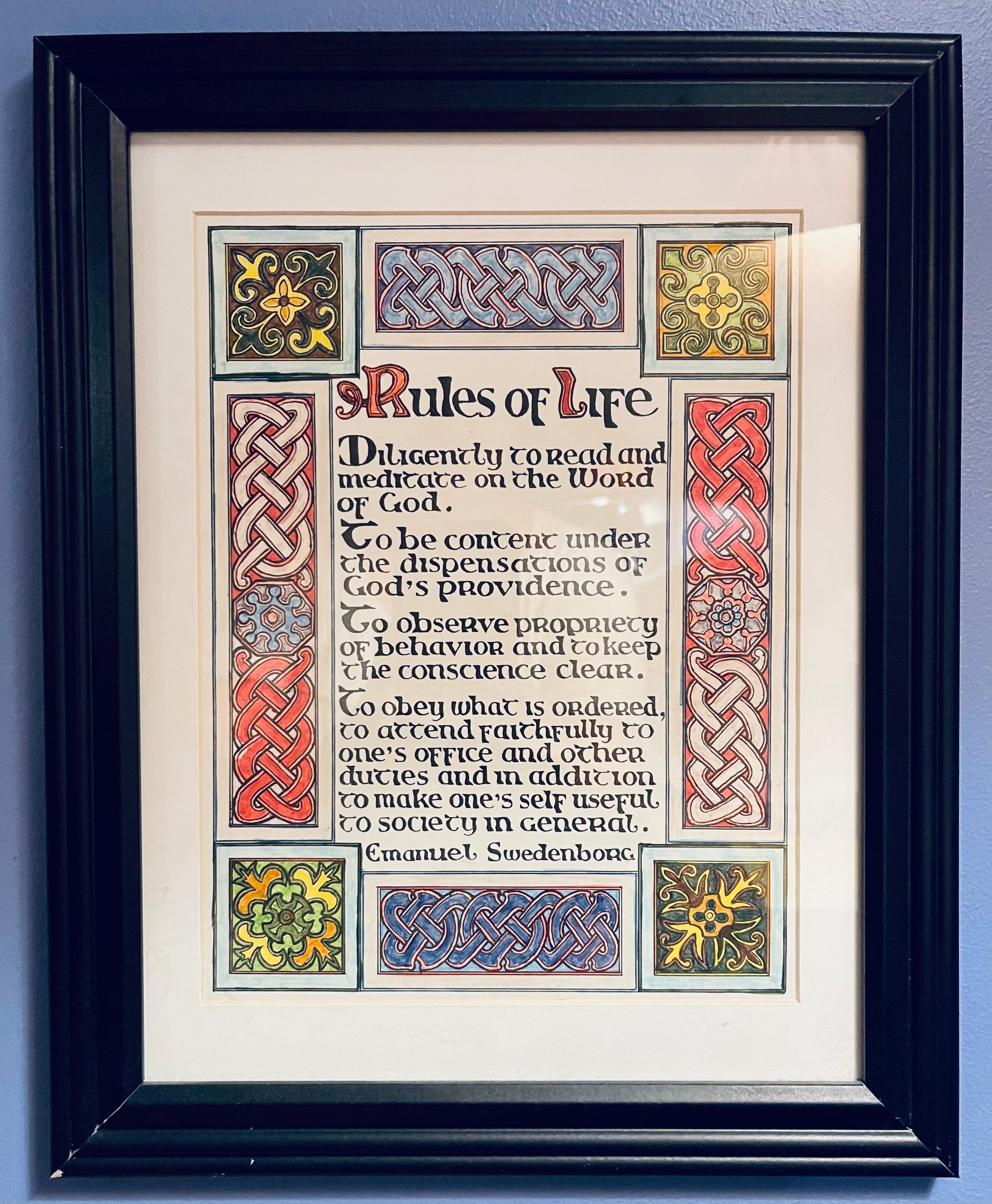
For my next installment, I’m taking you to a different part of my room — right next to my bed, by my bedside table.
This is Swedenborg’s Rules of Life. I purchased it many years ago on a visit to Bryn Athyn — it was actually a coloring page, and I colored in the designs myself and framed it. I’ve had it in my workspace, in my room, for probably over a decade now. I like keeping it close.
There’s some debate I’ve heard over the years about whether these were actually Swedenborg’s rules of life. He certainly didn’t publish and distribute them, saying, “Everybody, keep this by your bedside.” But I believe he had them sketched somewhere in his writings — so they were rules for him, at least for a time. Perhaps they shifted over his lifetime. There are four of them, and I’ll read each one to you and talk about it a bit.
This is what I mentioned in my last video, and I’ve spoken about it again recently. There’s a very literal meaning here — read your scripture, read your Bible every day, meditate on what Word of God is coming through that scripture, on the inner sense.
But if we consider the Word of God as speaking in many forms, I’d suggest you can diligently read and meditate on the Word of God by observing nature, by observing life, by considering and meditating on what word — what meaning — is coming through. This was essential to Swedenborg’s life and certainly his spiritual life. He spent time deep in the scriptures, and that was what he brought to the world through all of his writings about the inner sense — the deeper meaning of the scriptural story.
I resonate with this one — finding contentment wherever we happen to be along this journey of life, trusting that providence is moving through us in this moment, in this experience. And finding some contentment — not passivity, not “this is just what God is doing and I have no power or control.” Obviously that’s not true. God gave us agency, the ability to think and act and imagine.
So to trust in the dispensations of Divine providence is to trust where we are, and to trust our inner faculties — our inspirations, our dreams, our visions — and to carry them out, to act with the trust that providence is in us and with us, helping us move toward heaven.
This has been so helpful, so important to me, especially when I reflect on falling into loops of self-condemnation, fear, depression, anxiety — that whole experience of not trusting, of not having that trust. But Swedenborg wrote this as a rule: to be content under the dispensations of Divine providence, to trust where we are and the resources at our disposal. It feels very significant and important, and it has comforted me to have this in my space, to be reminded of it.
So much of the spiritual life we reflect on as this deeply inner process — and a lot of it is. But it’s equally relevant to our relationships, to how we act in the world and with each other. When we get caught up in cycles of isolation and separation, that often brings out the worst in us, and we cause harm to people. I’m sure if you sit quietly for a minute, you can think of moments when you’ve caused harm, or been part of a system where harm was at play.
I love that this is the third one, because I think every day reflecting on where I’ve caused harm, where I can bring repair, where I can offer forgiveness, where I can offer restoration, where I can repent and change — that’s really speaking to the necessity of humility along the way. Just knowing that in these physical forms, oh my gosh, we’re going to bump up against each other. Part of this rule of life is recognizing that and doing something about it — keeping the conscience clear not by being perfect and somehow avoiding harm, because that’s not a possibility, but by acknowledging that it will happen and making it right.
We all have a role to play. In Swedenborg’s time, those roles were quite clear; he was the surveyor of mines, and he had particular tasks within the government at different times. Those roles were very clear, and it’s great to know what your role is and to be able to perform it.
I’d say right now, in the world, roles are getting very mixed up and challenged. It’s not always clear — just because it’s our role, sometimes we need to question it and wonder if this is the role we’re meant to play. Sometimes in my ministry I’ve had a very particular role that I’ve taken great pride in fulfilling. As I am now off in this new territory, building something new, I’m having to listen to the role that God is giving me, and it’s not always clear what it means to fulfill it.
This fourth rule — as much as we need to be conscientious of how we fulfill our role — is also just a reminder that we’re part of something larger. We’re not just here for ourselves, and we likely do have a very important role to play in society at large. I’m a mother — that’s a very important role. I’m a citizen of this country — that’s an important role. I’m a member of my community, and I’m a minister in the Swedenborgian Church of North America, and I take that role seriously in how I’m called to support my colleagues in this community and help it grow.
So those are Swedenborg’s Rules of Life. They’re on my altar, in my altar space. I wonder if they’re in yours — I’m sure I’m not the only one who purchased this in Bryn Athyn one day, decades ago. If you have this on your wall, I’d love to see a picture, and maybe hear something about how Swedenborg’s Rules of Life have informed your life.
Take care, friends.
Follow this link if you’d like to print a copy of your own Rules of Life from the New Church Vineyard!
Share images and stories from your altar in the comments!
I’d love to see what spaces you are creating❤️
Comments
Nothing yet. Say the first thing.
Sign in to join the conversation.