
Six new open sourced projects from current fellows.
DIY Self Driving Lab by Dale
Building autonomous experimentation at homeBenchmate by Natalie
Seven AI agents debate each other in an Elo tournament to surface the hypothesis most worth testingPinakes Telegram Bot by Julia
Text message an AI research assistant for reviews across 11M+ papersCVMD by Sameer
a $50 Arduino box and a browser tab that measures how well your brain actually performs against your wearable’s readiness scoreStapler by Akhil
A BioScience MCP server to keep up with literature updates over timebioJARVIS by Vivek
an agent-first bioinformatics infrastructure
by Dale Herzog
Self-driving labs, where software designs, runs, and learns from experiments in a closed loop, have always lived inside large institutions. Dale’s project asks what it takes for *one person* to build one: the operating software, the custom instruments, and the mechatronic fundamentals underneath.
Why it matters: The real bottleneck in personal lab automation is the mechatronics. Reliable motion, actuation, sensing, and disciplined testing are what let a model’s proposed experiment actually run.
By pairing custom software with custom-built instruments, the project owns the full stack and produces a reusable roadmap others can follow.
Project Links
by Natalie Chen
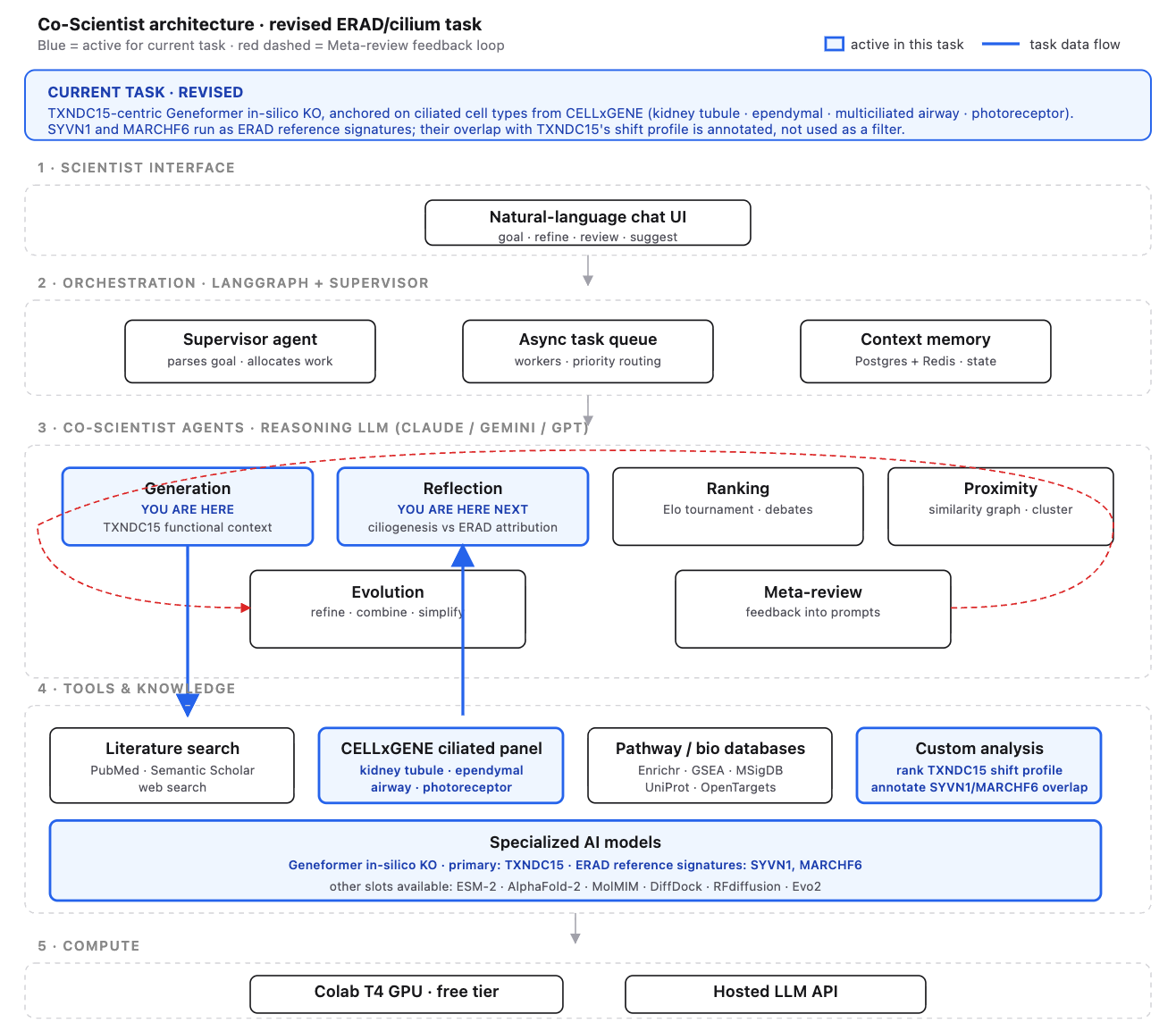
The hard part of research is deciding *which* hypothesis is worth testing. Benchmate is an open-source co-scientist where seven LangGraph agents propose hypotheses and fight it out in a pairwise Elo tournament.
The seven agents include: Generation, Reflection, Ranking, Proximity, Evolution, Meta-review, Supervisor. Winners evolve from the tournament and generate Geneformer Colab notebooks to perturb any gene you choose. Inspired by Google’s AI Co-scientist paper in Nature.
Why it matters: The hypotheses are grounded in real evidence. Agents inject cached Geneformer perturbation data and PubMed results directly into their prompts. It’s also cost-engineered: routing reasoning to Claude Sonnet 4.6 and throughput to Haiku 4.5 cuts an 8-iteration loop from ~$2.50 to ~$0.90 with no measurable quality loss.
Project Links
by Julia Gross
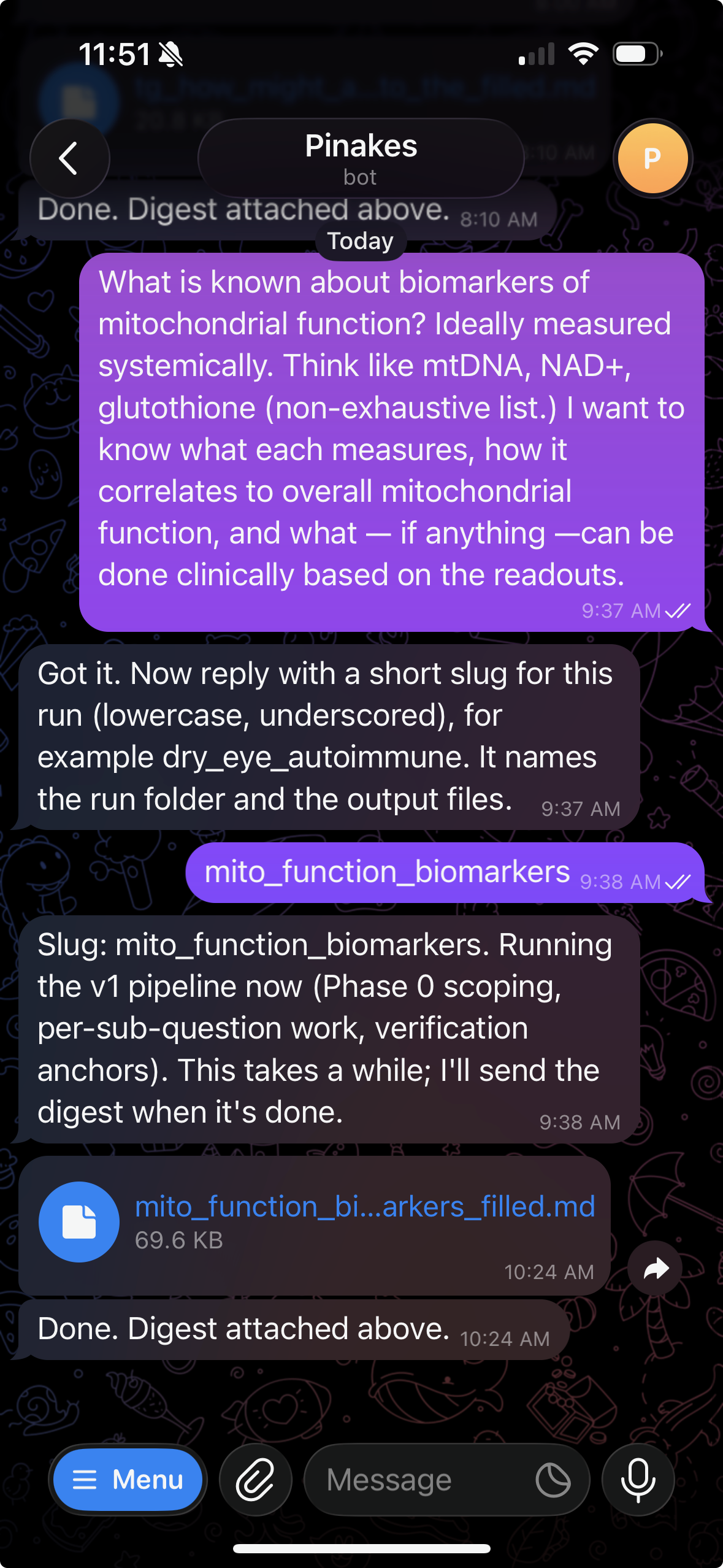
Julia started by hand-patching deterministic citation lookup into the paperclip orchestration pipeline. The Paperclip team shipped the same feature and happily obsoleted her work. So she redirected to the missing layer for a Telegram bot that lets you drive the whole research-digest pipeline from chat.
Why it matters: the pipeline turns a research question into a citation-anchored evidence digest across 11M+ papers, but launching it meant CLI flags and prompt files. Pinakes puts that behind a message.
Project Links
By Sameer Shah
Do the “readiness” scores our wearables hand us every morning actually correspond to how well our brains perform? CVMD measures cognitive performance directly through reaction time and checks it against the biometric story. This update explore a web app that complements the Arduino device. Same reaction-time tests, now in a browser.
Why it matters: the main exploration right now is measuring cognitive readiness through variability is the response data, not speed of reaction-time. The reaction time spread moved 242% across impairment states vs. just 76% for average reaction time.
Project links
by Akhil Devarasetty
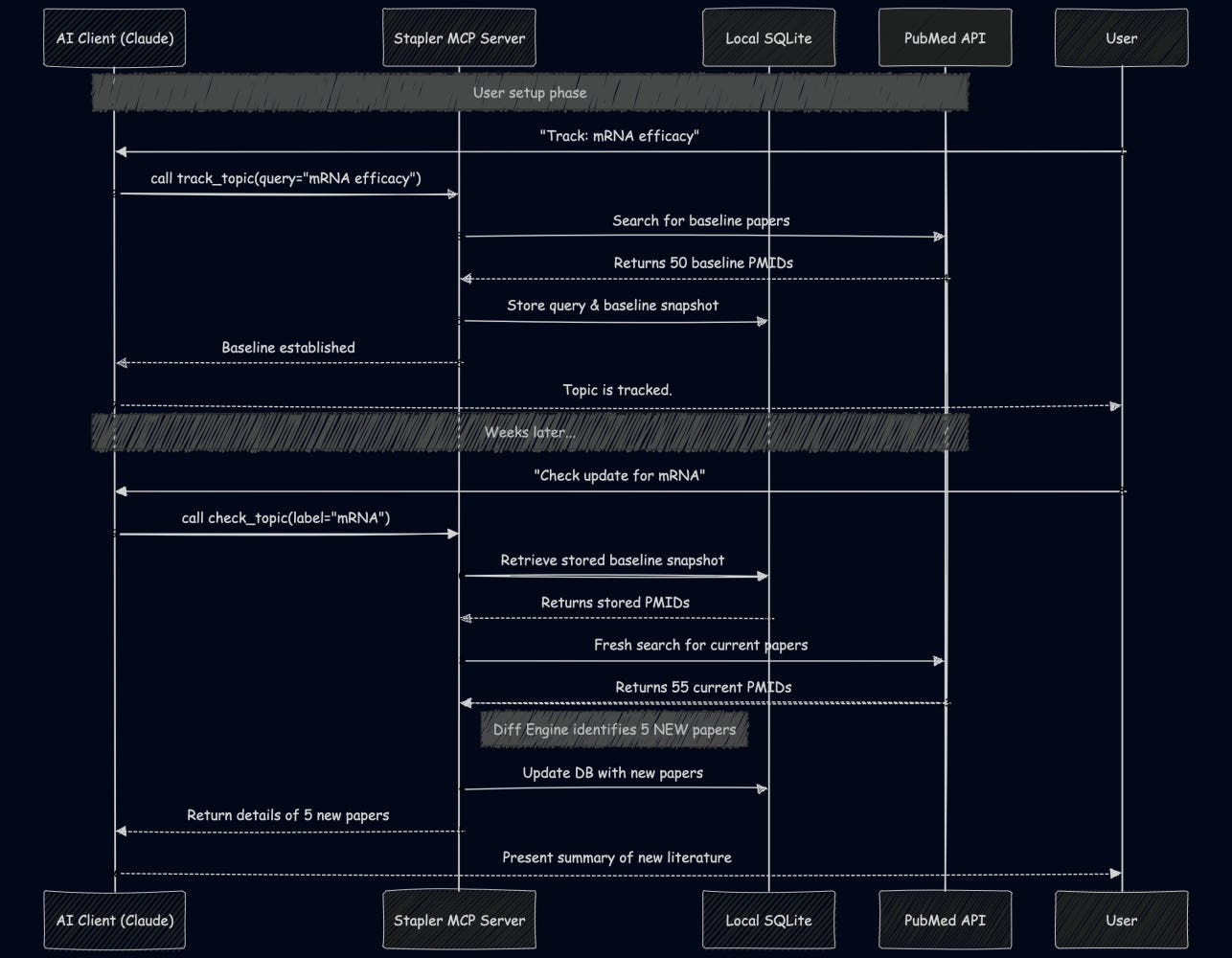
A systematic review is obsolete the moment you finish it. Stapler fixes that. It’s a local BioScience MCP server that unifies PubMed, NCBI Gene, ClinicalTrials.gov, and RAG over your own PDFs behind one interface — and its SQLite engine snapshots the topics you care about and diffs new PubMed literature over time, turning a one-time search into a living review.
Why it matters: literature never stops moving, and re-running searches by hand doesn’t scale. Stapler keeps the review current automatically, runs entirely on your machine (private by default, with a llama.cpp bridge for fully local models), and drops straight into Claude Desktop, VS Code, and Cursor.
Project Links
by Vivek Ramaswamy
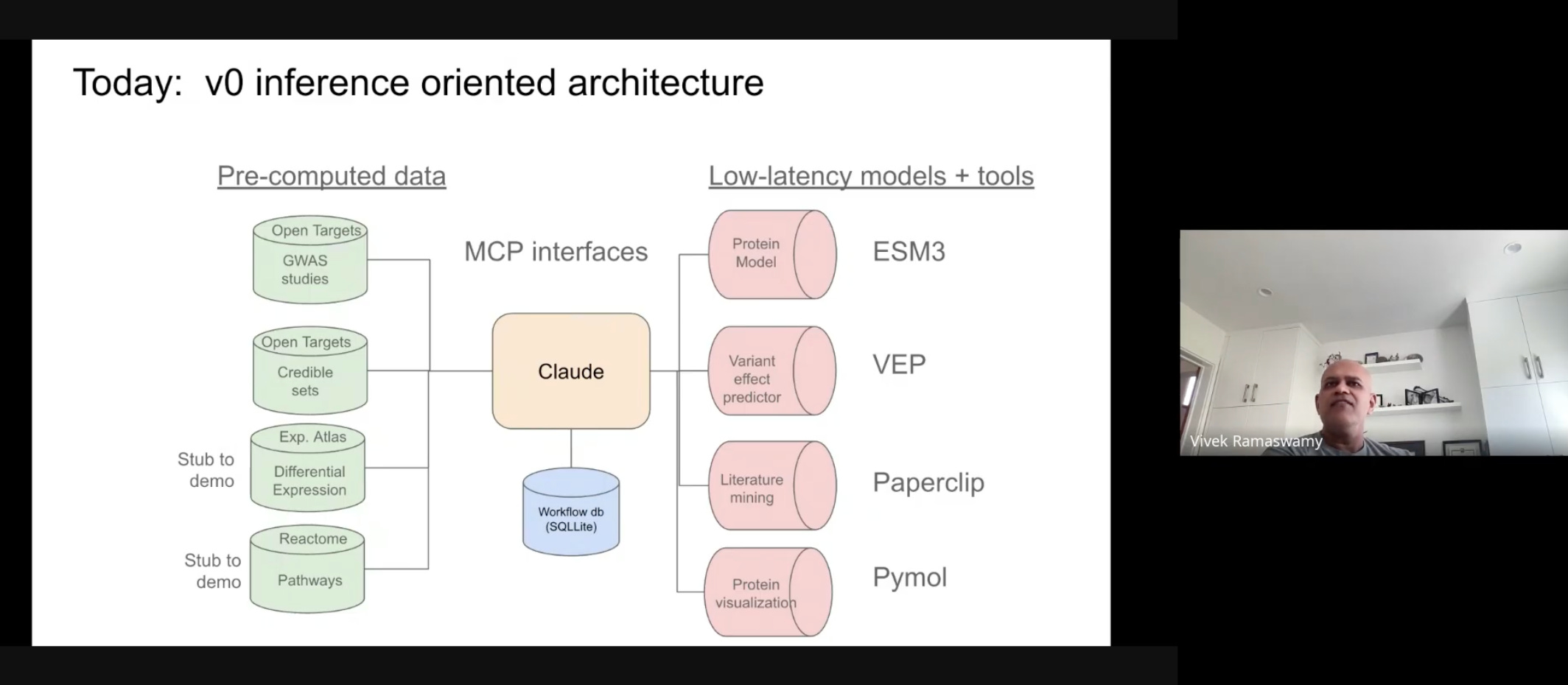
AI agents can finally explore hypothesis space at the scale the combinatorics demand but our bioinformatics tooling was designed for a human asking one question at a time. JARVIS for Bio v0 is an inference-oriented architecture that rebuilds that plumbing for agents, and proves it on a real problem: reasoning from an AMD GWAS hit to a mechanistic hypothesis across levels of biological organization, with full provenance on every claim.
Why it matters: The core move is separating writing from reading. Heavy compute (protein folding, indexing, enrichment) happens once in batch, ahead of time, so the agent only does fast schema-typed reads at hypothesis time. The payoff: the same six-gene AMD analysis takes ~30 hours by hand vs. ~4 minutes warm (~430× faster), with reasoning now 87% of runtime and retrieval negligible.
Project links
Follow for new builds every 2 weeks.
Worldwide Studios is an education nonprofit on a mission to help anyone build anything. We host 100 day fellowships, like this AI for Science fellowship, for people to explore the latest tools through ambitious projects. Learn more here.
No posts
Comments
Nothing yet. Say the first thing.
Sign in to join the conversation.