
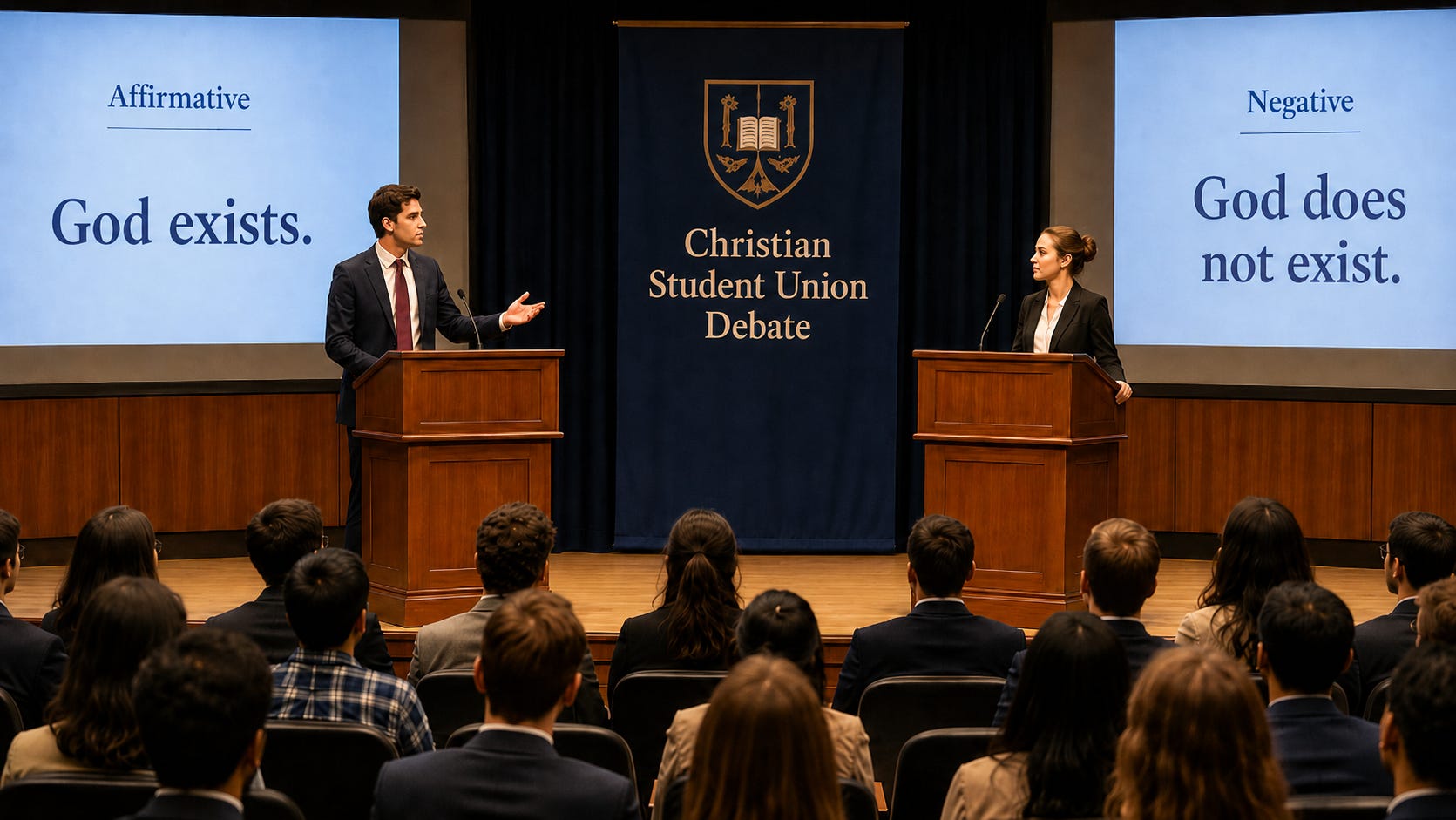
I recently had the privilege of reviewing the volume Debating God’s Existence: Believers and Skeptics in Friendly Conversation, edited by Andrew Drinkard. The centerpiece of the book is a debate between well-known atheist Dan Barker and Christian philosopher Adam Lloyd Johnson. In the debate, Johnson defends a form of mere theism—that is, the claim that God exists. In support of this proposition, Johnson presents three familiar arguments for God’s existence: a first-cause argument, a design argument, and a moral argument.
By way of rebuttal, Barker offers several reasons agnostics and atheists have reason to doubt that God exists. One of those reasons is the apparent lack of evidence. He states:
If God exists, why are we debating his existence? Why are we falling back on words and abductive reasoning?...Does he need philosophers to come up with arguments for his existence? This doesn’t disprove the arguments, but it does show that this being is kind of hiding himself…this debate itself is an argument for the lack of evidence.¹
Put another way, Barker is essentially arguing that if God really existed, and He wanted us to know it, His existence would be sufficiently evident that we would not need philosophical arguments to establish it. Indeed, Barker goes further, suggesting that the very fact that we are debating God’s existence is itself evidence for a lack of evidence.²
Ironically, when I hear such claims, I am reminded of the late atheist journalist Christopher Hitchens. Hitchens was a master rhetorician and was well known for his unflinching attacks on his theistic opponents in debate. One common debate tactic he employed was to respond to a claim about God by asking something like, “Do you claim to know the mind of God?” The point was not lost on the audience: How can a mere human being claim to know what God did or would do? But do you see the irony? When one claims that God, should He exist, should have created a universe in which arguments for His existence are unnecessary, one is making an assumption about what God would or would not do. It is at least possible that God has created a world in which arguments are one means by which people might seek after Him.
And as a matter of fact, this is entirely consistent with what the Apostle Paul famously told the philosophers in Athens about God:
The God who made the world and everything in it, being Lord of heaven and earth, does not live in temples made by man, nor is he served by human hands, as though he needed anything, since he himself gives to all mankind life and breath and everything. And he made from one man every nation of mankind to live on all the face of the earth, having determined allotted periods and the boundaries of their dwelling place, that they should seek God, in the hope that they might feel their way toward him and find him.³
Here, Paul informs the philosophers that God has ordered human history in such a way that people might seek Him.⁴ The further significance of these verses should not be missed. As the late Bible commentator Albert Barnes explains:
The design of thus placing them on the earth...was, that they should contemplate his wisdom in his works, and thus come to a knowledge of his existence and character. All nations, though living in different regions and climates, have thus the opportunity of becoming acquainted with God...⁵
When someone sincerely considers some of the various arguments offered through the centuries for the existence of God, they are, at the very least, engaging in the kind of reflection Paul describes—seeking after God and reflecting upon what He has revealed through His works. As Barnes explains, such reflection can lead a person to “come to a knowledge of his existence and character.” Philosophical arguments, then, can be understood as one means by which a person might seek after God and come to recognize something of His existence and character.⁶
So, where does this leave us? Barker’s objection is that if God exists and wants us to know Him, His existence should be obvious enough that we would have no need for philosophical arguments. But this objection assumes that we know how God would choose to make Himself known. We have no good reason to think that God could not use arguments, among other means, to draw people toward Himself. Indeed, Paul tells us that God has ordered human history in such a way that people might “seek God, in the hope that they might feel their way toward him and find him.” Philosophical reflection upon God’s works can reasonably be understood as one way of doing precisely that.
But there is an even more fundamental problem with Barker’s objection. The fact that people offer arguments for God’s existence does not mean that people need those arguments in order to believe in God. People come to believe in God for a variety of reasons, including religious experience, testimony, conscience, reflection upon the natural world, and what they understand to be God’s personal revelation. Philosophical arguments can provide important reasons for belief and can be invaluable in defending that belief, but they are not prerequisites for it. Johnson needs arguments because he is debating an atheist philosopher. That does not mean that God needs philosophers in order to make Himself known.
Perhaps, then, Barker’s question is not quite the right one: “Does God need philosophers to come up with arguments for his existence?” No, God does not need philosophers to establish His existence. But neither does the existence of philosophical arguments count against Him. Arguments for God’s existence are not evidence that God is “hiding Himself.” They are simply one of the ways in which human beings can seek after God, discover what they believe to be true about Him, and articulate and defend that belief. Perhaps the better question, then, is why we should assume that arguments for God’s existence are not one way in which people can seek after Him.
Notes
1. Andrew Drinkard, ed., Debating God’s Existence: Believers and Skeptics in Friendly Conversation, 25.
2. The Bible itself claims that God has made His existence and certain attributes plainly evident through creation (Rom. 1:18–23). Paul nevertheless explains that people can suppress this truth rather than acknowledge God. For the purposes of this article, however, I will focus on the narrower claim that philosophical arguments can be one means by which people seek after God, and that this is entirely consistent with the God revealed in the Bible.
3. Acts 17:24-27, ESV.
4. Deuteronomy 4:29; 1 Chronicles 16:11; Psalm 27:8; Jeremiah 29:13; Matthew 7:7–8; and Hebrews 11:6.
5. Albert Barnes, Barnes’ Notes on the Bible, commentary on Acts 17:27, available at Bible Hub, “Acts 17:27 Commentaries.”
6. This is especially relevant when one considers some of the philosophical arguments for God’s existence that seek to establish not merely that God exists, but something about His nature or character. For example, certain forms of the moral argument aim to ground objective moral values and duties in the existence of a morally perfect God.
— Chad A. Gross is an elementary school teacher, co-host of the Apologetics315 Podcast, and contributor to the Apologetics Study Bible for Students. He holds a Certificate in Apologetics from Biola University and writes at Truthbomb Apologetics. Chad and his wife, Danielle, are the parents of two daughters, Emma and Lily.
I’m happy to announce that I’ve just released my first standalone book, Worldview Essentials: Christian Answers to Today’s Cultural Questions.
The book collects 10 articles that have appeared in The Worldview Bulletin and elsewhere and provides analysis and answers from the perspective of the Christian worldview. Topics include:
• scientific evidence for God and the possibility of miracles
• God’s omnipotence and omniscience
• human dignity and the image of God
• love, sexuality, and the Christian understanding of marriage
• gender ideology and its claims about human identity
• helping children develop their identity in Christ
• the meaning of genuine happiness
• Christianity and the occult.
The chapters are concise, readable, and informative, and provide biblical, theological, and philosophical clarity on some of today’s most pressing issues.
Every purchase benefits The Worldview Bulletin and I’d be grateful for any reviews on Amazon. They help the book reach more people.
As a thank-you to paid subscribers, you’ll receive a free copy of the book. I’ll send a post shortly explaining how to get it. (If you’re not a subscriber, you can become one here.)

Digital and print copies are available at Amazon. I hope you’ll find the book helpful and encouraging!
[in partnership with]


Do you have an educational institution, ministry, book, course, conference, or product you’d like to promote to 8,169 Worldview Bulletin readers? Click here to learn how. We’re currently booking for September-October.
Comments
Nothing yet. Say the first thing.
Sign in to join the conversation.