
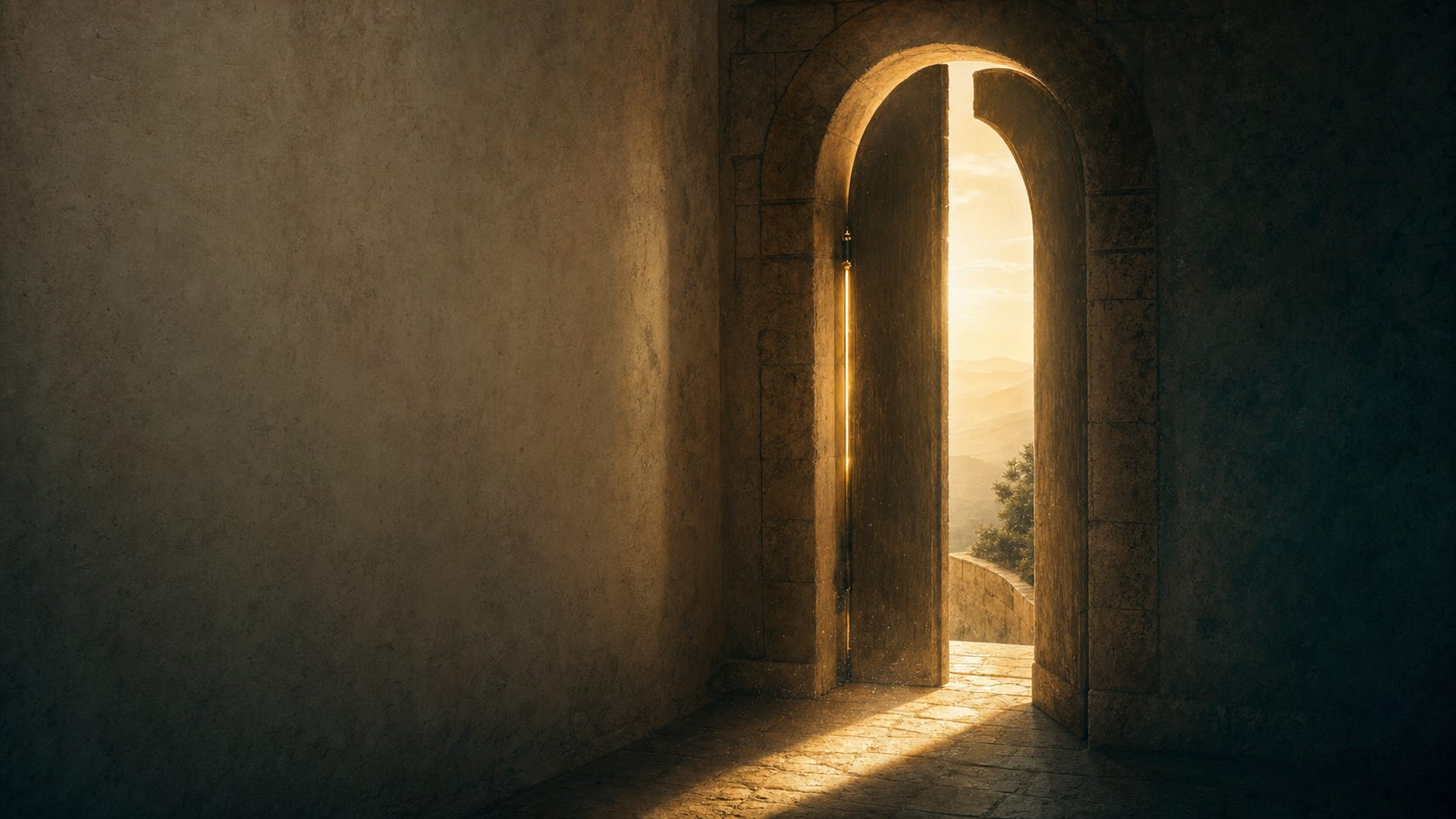
We tend to think of words as containers, small vessels for meaning that allow us to move through the world with some measure of shared understanding. A word gives shape to what might otherwise remain too large, too fluid, or too intimate to hold. Chair. River. Grief. Home. Each one gathers experience into a form the mind can touch.
Some words carry more than definition. They reinforce a pattern. They return us to an assumption so often that the assumption begins to feel less like language and more like reality itself. A word repeated long enough can become a room, and if we live inside that room for years, we may stop noticing the walls.
Most of us know this in the body before we know it in the mind. We know how certain words tighten the chest before thought has fully formed. We know how an old phrase can lower the ceiling of a day. We know the strange authority of a sentence we have heard too many times, especially when it begins speaking from inside us in a voice we mistake for our own.
This is true of the words a culture gives us. Successful. Productive. Realistic. Normal. It is true of the words handed down through family, school, religion, politics, and all the unseen systems that teach us where to stand. Difficult. Gifted. Broken. Chosen. Lost. It is especially true of the words we speak inwardly when no one else can hear.
Some words lower the ceiling. Some words widen the room. Every so often, a word arrives that does something stranger. It asks us to stand close enough to possibility that the old sentence begins to loosen its grip.
For me, one of those words is UPLifT.
I do not experience UPLifT as a slogan or a clever arrangement of letters. It feels closer to a structure, a small architecture of ascent, a word with a set of rooms inside it. The longer I have sat with it, the more I have understood that its power is not only in the larger pillars it holds, but in the small word resting at its center.
If.
The sacred if of possibility.
A society is shaped by its laws and institutions, but it is also shaped by the words it repeats until no one remembers they were once choices. Words gather in the atmosphere of a family, a nation, a workplace, a church, or a classroom until everyone inside that field begins breathing them as if they were simply the air.
Realistic can become a leash. Normal can become a gate. Productive can become a measure of worth so complete that rest begins to feel like theft. Broken can become a name someone answers to long after the wound itself has changed shape.
This is how language works when it settles beneath awareness. It stops sounding like language and becomes architecture. A person moves through the rooms it has built and calls the floor truth because it has always been beneath their feet.
A child called difficult may spend years trying to become easy. A dream called unrealistic may be buried before it has had time to become wise. A person called too much may learn to enter every room by first making themselves smaller. The word becomes a field around them, and after a while, the field begins to feel like personality.
Many of the most powerful words we carry were given to us by people who thought they were helping. They were trying to protect us from disappointment, prepare us for the world, or hand us the map they had been handed. Intention matters, but it does not erase effect. A map can still keep us from seeing the door.
The words we say to ourselves may be the most repeated teachings we ever receive. “I always do this.” “I never get it right.” “I am too late.” “I am not enough.” “No one really sees me.” After a while, these sentences stop arriving as thoughts. They arrive as posture, breath, and the small closing of the body before the day has even asked its first question.
The shoulders know what the mind has rehearsed. The throat knows what the heart has been afraid to say. The chest knows when a familiar sentence has entered the room.
This is where care is required, because I do not trust language that tries to paste brightness over pain. I do not trust words used as varnish. A sentence that bypasses grief does not heal the wound. It teaches the wound to speak from farther away.
UPLifT, at least as I understand it, asks for something more honest. It invites us to listen differently to the word, to the wound, and to the field around both. It does not require us to deny shadow, confusion, fear, or the difficulty of being human. It asks whether another sentence might also be true.
At the center of that invitation is if.
There is a world of difference between “I am broken” and “What if I am healing?” The first sentence closes around the self like a verdict. The second leaves a window open in the room where pain has been speaking alone.
There is also a world of difference between “I failed” and “What if this is information?” One leaves the body braced for judgment. The other allows the event to remain in motion long enough to become a teacher. “It is impossible” builds a different room than “What if there is a door I have not seen yet?”
The sacred if does not pretend the wall is absent. It refuses to grant the wall authority over the entire architecture. That is the grace of it. If does not coerce. It does not drag the soul toward a conclusion it is not ready to inhabit. It does not shame the frightened part of us for needing time.
If waits at the threshold. It is small, patient, and easily overlooked, yet the room changes when it enters. “What if I am not finished?” has a different resonance than “This is who I am.” “What if the story is larger than the part I can see?” gives the mind one inch of space, and sometimes one inch is where transformation begins.
The longer I have sat with UPLifT, the less it has felt like a word pointing upward in the ordinary sense. It is not an escape from the human condition. It is not an attempt to rise above grief, confusion, fear, or shadow as if those things were embarrassments to be transcended before we are worthy of love. It is closer to remembrance.
Unity is the recognition that separation is not the deepest truth, even when it is the loudest experience. Presence is the return to the moment before the mind has turned it into evidence for an old story. Love is the organizing force of care, the movement that asks what wants to be healed before it asks who is right.
Then comes if, the hinge that keeps the whole structure from becoming rigid. It is the place where possibility remains alive because no one has tried to turn it into certainty too soon.
Transformation, in this model, is not something we force onto the self. It begins to happen when the field has been tended long enough for a different sentence to become believable in the body. The mind can agree with a new sentence in an afternoon. The body may need years before it trusts the room has actually changed.
It would be easy to read UPLifT as a sequence, as if we begin with Unity, proceed to Presence, pass through Love and if, and arrive at Transformation at the end of a clean road. Living systems rarely move that way. They spiral, return, and reveal the same pattern at different scales.
UPLifT behaves more like a fractal than a ladder. Each part contains the shape of the whole. A single moment of Presence can restore the felt sense of Unity. A word spoken from Love can change the frequency of a room. The sacred if can reopen the place where certainty has hardened into defense. Transformation can reveal a deeper Unity that had been hidden beneath conflict.
This is why a word can matter. The letters themselves are not the point. The arrangement matters because it gives consciousness a pattern it can return to, a note in the field, a remembered key, a threshold the soul recognizes before the mind has finished explaining why.
The same word can arrive with different frequencies. “I forgive you” can be spoken from freedom, superiority, exhaustion, or the desire to end a conversation that has become too costly to continue. “I am fine” can mean peace, grief, avoidance, or a request to be asked again with more care. “I love you” can open a room or close one, depending on the field from which it is spoken.
The work, then, is not only to choose better words. The work is to become honest about the state of consciousness speaking through them.
This is where UPLifT keeps returning me to humility. It does not let me hide behind beautiful language. It asks whether the word carries Unity or separation, whether it was spoken from Presence or from the old machinery of defense, whether Love is actually present or only being used as a costume for control.
Then it offers the hinge again. What if I could pause? What if I could listen before defending? What if the sentence I am about to speak is true, but not yet loving? What if the sentence I have spoken to myself for years was never the whole story?
For one day, listen for the word or sentence that lowers you. Do not fight it, shame it, or rush to replace it with something polished and false. Just hear it. Notice when it arrives. Notice the body’s response. Notice whether the breath becomes shallow, whether the throat closes, or whether the room inside you narrows.
Then ask one careful question: What word would UPLifT this inner conversation?
The question is not asking for flattery. It is not asking for decoration. It is not asking you to deny the pain beneath the old sentence. It is asking what word would make the conversation truer, kinder, and more alive.
Maybe the word is healing. Maybe it is beginning. Maybe it is enough. Maybe it is listen. Maybe it is forgive. Maybe it is simply if.
Perhaps this is why certain words find us when we are ready. They do not arrive with a complete map. They do not explain everything. They do not settle the mystery into something small enough to manage. They open the next room.
UPLifT does not command me to rise. It reminds me to return to Unity, to Presence, to Love, to the sacred if, and to the possibility that transformation may already be moving beneath the surface of the sentence I have been repeating.
Maybe that is the real power of a word. It reinforces the world we are willing to keep meeting.
Reply if you feel moved to. What is one word that has shaped your life, either by lifting you or limiting you?
I am collecting doorways.
No posts
Comments
Nothing yet. Say the first thing.
Sign in to join the conversation.