
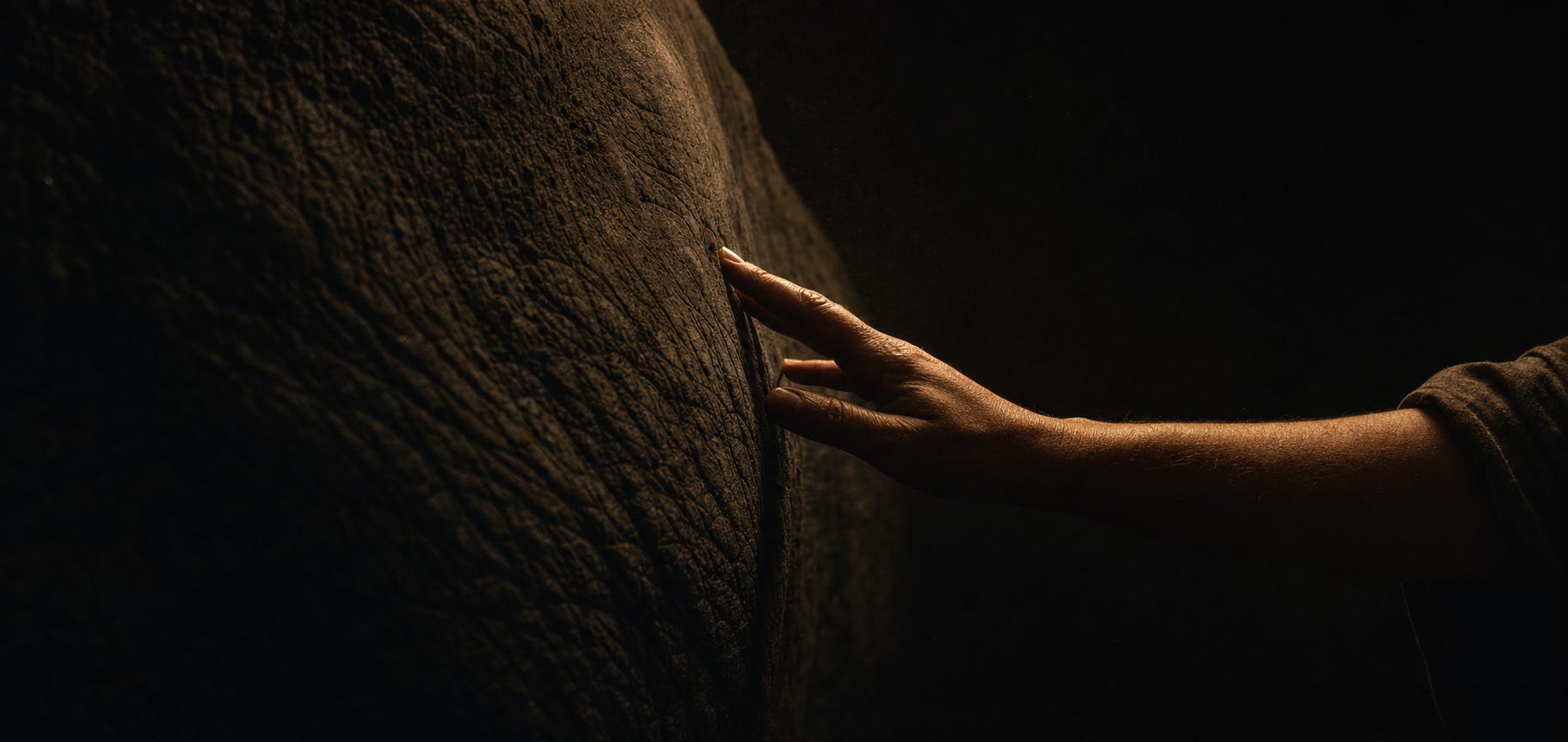
There’s a story I told in Unity. You’ve probably heard a version of it before. Six men, born blind, are brought to an elephant for the first time. Each touches a different part. Each comes away certain of what an elephant is.
The man at the side feels a wall.
The man at the tusk feels a spear.
The man at the trunk feels a snake.
The man at the leg feels a tree.
The man at the ear feels a fan.
The man at the tail feels a rope.
And here is the part that hit me recently, not the punchline that they were each completely wrong, but the part underneath that:
Each of them was completely right.
Inside his own hand, in his own body, in the only frame he had, that man at the side was not touching part of a wall. He was touching a wall. The wall was real. The texture under his fingers was real. The breadth of it, the warmth of it, the way the wall pressed back against his palm, all of it was real. And when the man at the trunk told him no, it is a snake, what the man at the side heard wasn’t a different interpretation of the same animal. He heard a man lying. Or a man confused. Or a man so far from the truth that the truth itself was being threatened by his nearness to it.
This is the first thing I wanted to sit with, since the book was released.
The other man’s elephant isn’t a different angle on what he’s touching. It’s a contradiction of it. And contradictions, when they come up against something we have touched with our own hands, do not feel like invitations to be curious. They feel like attacks on what is real.
I think about this every time I watch two people argue about something that, from the outside, looks like the same thing said two different ways. From the inside it never looks like that. From the inside, one of you has your hand on a wall and the other one has just told you walls don’t exist.
But there’s a second piece, and this is the part I really wanted to write today, because it’s the part that made me stop when I really understood it.
How did the man at the tail know it was a rope?
He had to have touched a rope before. Somewhere in his life, before he was led into this room, his hand had closed around a length of fibrous, twisted, slightly rough material — and somebody had told him this is a rope. The word and the sensation got stitched together inside him. Years later, in the dark, his fingers closed around something fibrous and twisted, and the stitching held. Rope. The recognition wasn’t reasoning. It was memory, doing what memory does.
Now imagine a different man. Same blindness, same elephant, same hand on the same tail. But this man grew up somewhere there were no ropes. He grew up around vines. The instant his hand closed around the tail, his entire history reached up through his arm and said vine. He would have walked out of that room as certain of vines as the first man was of ropes. Both of them touching the same thing. Neither of them lying. Neither of them even wrong, by any honest measure of what wrong could mean.
What we call the elephant, what any of us calls anything, gets named by the library we were handed before we got there.
And the library is different for everyone.
So now widen it. Take the six men out of the room and put eight billion of us on the same elephant.
That is where we actually are.
Eight billion lives. Eight billion libraries. Eight billion catalogs of what fibrous things have I touched, and what was I told they were, and who told me, and was I loved while they told me, and was I afraid, and what else happened that day. Every encounter you have ever had with anything you now have a word for — that encounter is filed somewhere inside you, and it is doing the work of translation every time the world brushes up against you.
We don’t see what is in front of us. We see what is in front of us mapped against the past and our catalog of it. Or in other words, “We don’t see things as they are, we see them as we are.”
And when something arrives that isn’t in the catalog, when our hand closes around something for which we have no prior reference at all, we don’t experience that as a clean, empty I don’t know. We experience it as the catalog reaching for the nearest available shape and stretching it over the new thing. Rope. Vine. Snake. Wall. The mind does not love a vacancy. It will paint a face on the dark before it will let the dark stay dark.
This is not a failure of the mind. This is what the mind is for. The catalog is how you survived to be the age you are. The catalog is how you crossed the street this morning. The catalog is the reason you knew, at a glance, that the person in your kitchen was someone you love. The catalog is precious. The catalog is also a filter — and a filter, by its nature, lets through what fits and pushes away what doesn’t.
So here’s what I think is true: every belief you hold, including the ones you would die for, is partly a report on what’s actually there, and partly a report on what your particular library had on its shelves when the world first asked the question.
Including mine. Including this essay.
This is the part where, if I weren’t careful, I would slide into telling you what to do about all of this. I’m going to try not to. The parable doesn’t work if it ends in a lecture, and the elephant doesn’t get smaller when we yell at each other about its shape.
What I’ll say instead is the same thing I said in Unity, but maybe with a little more room around it now.
Share what you perceive. Tell me what your hand is on. Tell me the texture of it, the temperature of it, the way it pressed back when you pressed in. Tell me what it called up in you. I want to hear it. I want to hear it whether or not it matches what my hand is on. Especially if it doesn’t.
Don’t try to convince me. The moment you start trying to convince me, you stop describing your elephant and start describing my error, and trust me, I will feel the difference instantly, even if you don’t. I will get defensive. My catalog will close. The thing you are trying to give me, I will refuse, not because it is wrong but because of how it arrived.
And the harder one, the one I keep practicing:
When something somebody else says triggers you — when their report on the elephant arrives like an attack on yours — let empathy and compassion be the first thing through the door, ahead of the argument. Not because they are right and you are wrong. Not because all positions are equal. But because, whatever they are touching and however they are naming it, they got there the same way you got to yours. Through a life. Through a body. Through a library nobody else has ever read.
The man who says vine is not lying about ropes. He simply has never held one.
If you can remember that — even for a second, even mid-sentence — something opens. Not agreement, necessarily. Not always. But something gentler than the wall that was about to go up.
That gentleness is, I think, the only way eight billion of us ever get to unity. Not by agreeing on what the elephant is. By trusting that we are all, in the dark, with our hands on something real, and that the only honest thing any of us can do is describe what we feel, and listen while the others describe theirs.
Until then, the elephant just goes on standing there, patient, undescribed by any one of us in full.
— Bill
No posts
Comments
Nothing yet. Say the first thing.
Sign in to join the conversation.