
Following a visit to the Breguet Manufacture organized as part of the GMT Watch Safari, participants discovered the exceptional craftsmanship of its artisans and watchmakers while sharing the passion of its CEO, Gregory Kissling, who personally presented the collections. From this immersive experience came a multimedia editorial project developed by Breguet, GMT, and WorldTempus, centered on the Tradition collection. Through the complementary perspectives of Emmanuel Breguet, historian and descendant of Abraham-Louis Breguet, and Gregory Kissling, the collection emerges as the most accomplished expression of the Maison's living heritage. Here is a selection of articles to further explore this collection, where tradition and innovation come together to keep Breguet's history alive.
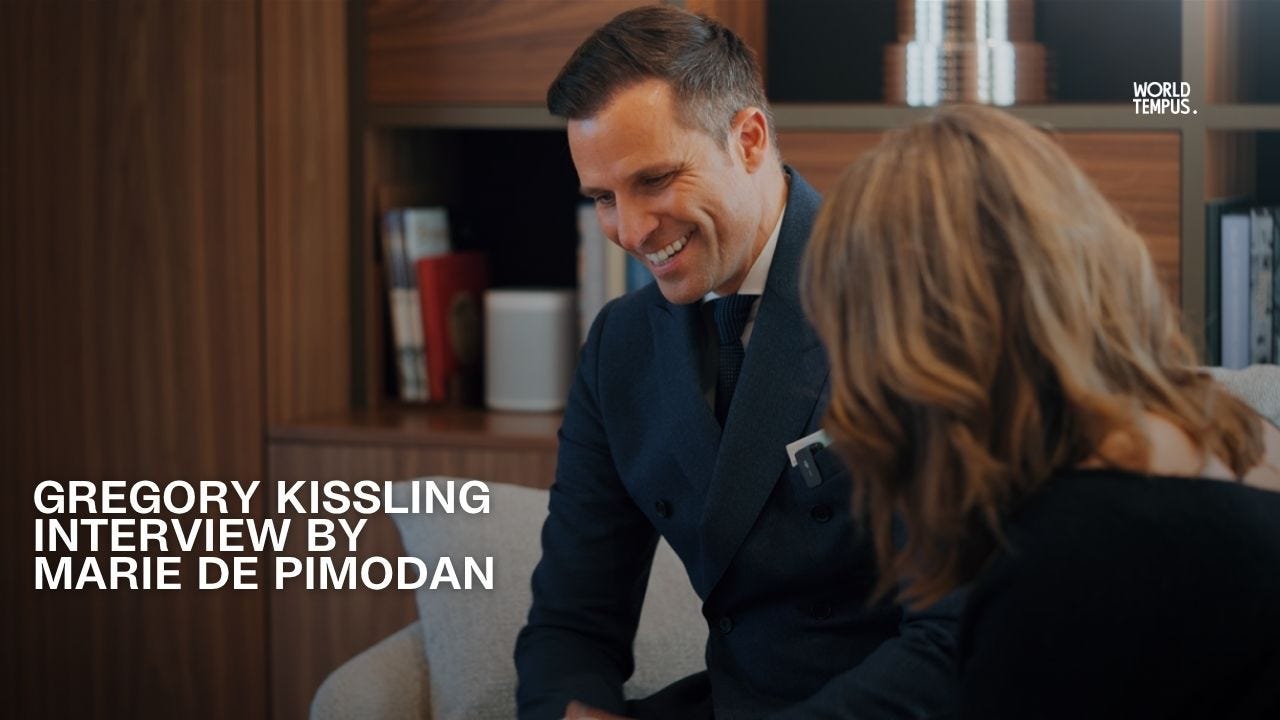
Breguet has expanded its Tradition collection with six new models, reinforcing a concept that has stood apart in contemporary watchmaking for two decades. According to CEO Gregory Kissling, these additions represent the next step in the evolution of one of the brand’s most defining lines, one that fuses métiers d’art, mechanical inventiveness, and the intellectual legacy of Abraham-Louis Breguet.
The Tradition story began in 2005, and it reached a notable turning point in 2025 with Reference 7035, a limited edition created to mark Breguet’s 250th anniversary. That watch broke new ground as the first Tradition model to feature Breguet numerals, pairing guilloché work with enamel artistry in a way the collection had not previously attempted.
This year’s releases build directly on that foundation. Traditional decorative crafts take center stage, and two models stand out for their fumé dials, which shift gradually from green to black in a finish that mirrors the dark treatment applied to the movements beneath them.
Despite these aesthetic refinements, the new watches remain firmly grounded in Abraham-Louis Breguet’s original thinking. Their case architecture recalls his subscription watches, while several of his key inventions, among them the Breguet balance spring and the pare-chute shock-protection system, are woven into the design. Modern materials such as silicon and platinum allow these centuries-old ideas to function within a present-day mechanical context, bridging two very different eras of watchmaking without diminishing either.
Twenty years after its launch, Tradition still manages to hold heritage and innovation in balance, a task that is harder than it sounds for a collection this long-lived. It looks backward without feeling dated, and forward without abandoning its roots. As Kissling puts it, the collection is a “legacy in motion” — and each new generation of references seems to bring it closer to permanent icon status within Breguet’s broader catalogue.
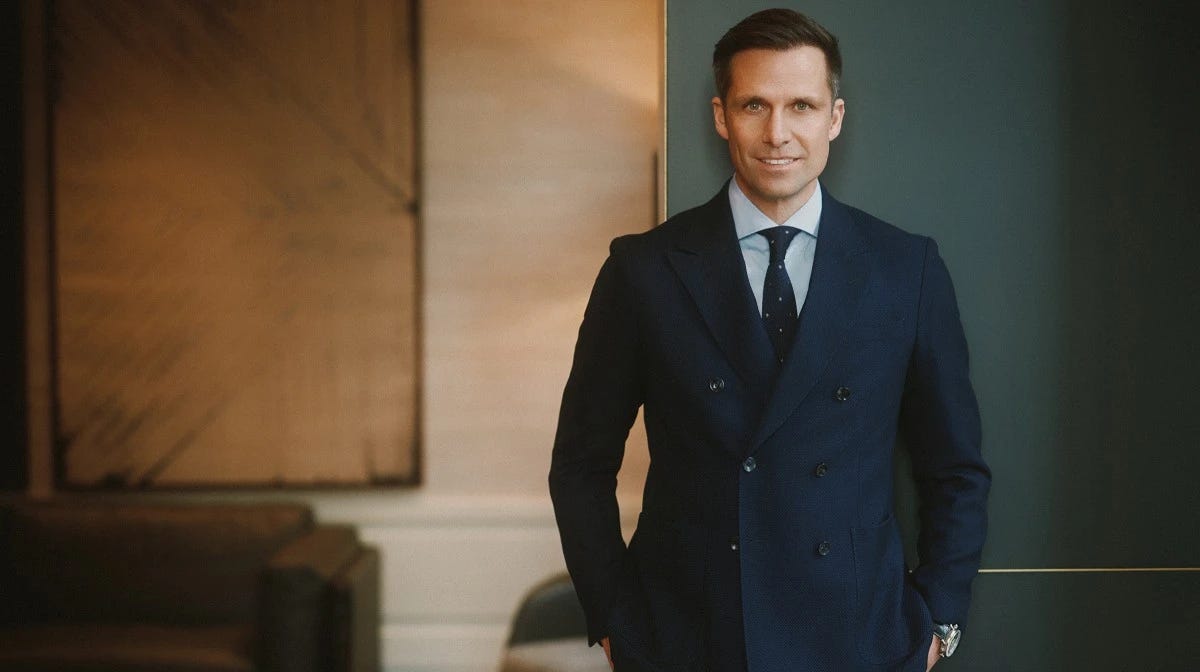
Twenty years after its debut, Breguet’s Tradition collection is undergoing a refresh, with six new models bringing together Grand Feu enamel, guilloché decoration, and colored movement components. CEO Gregory Kissling explains that the starting point was not the anniversary itself but the 7035 model launched last year, a limited edition marking Breguet’s 250th anniversary. That watch, one of the first in the line to carry Breguet Arabic numerals, signaled a shift toward the collection’s next phase.
Guilloché work runs throughout the new references, appearing on dials as well as on components such as the barrel cover and oscillating weight, where sunburst patterns catch the light. Enamel plays an equally prominent role. Dials are built from three to five layers of Grand Feu enamel, each fired at nearly 800 degrees Celsius, with the two Tradition GMT models pushing the technique further through a smoked gradient running from green to black, echoing the movement’s PVD coating.
Technically, the pieces remain anchored in Abraham-Louis Breguet’s inventions. Kissling points to fourteen of his innovations present across the line, including the silicon-made Breguet balance spring, the pare-chute shock absorber, and design cues borrowed from the perpetuelle watch of 1780. Some models also feature platinum oscillating weights, a nod to Breguet’s early adoption of the metal.
Asked whether a collection launched in 2005 can still feel contemporary, Kissling points to the Tact watch of 1799 as its true inspiration, a timepiece meant to be felt rather than read. Reflecting on where Tradition stands today, he offers a candid assessment: « Cette collection a tous les atouts pour devenir une icône majeure de la maison. » Whether two decades is long enough to earn that status, he says, remains to be seen.
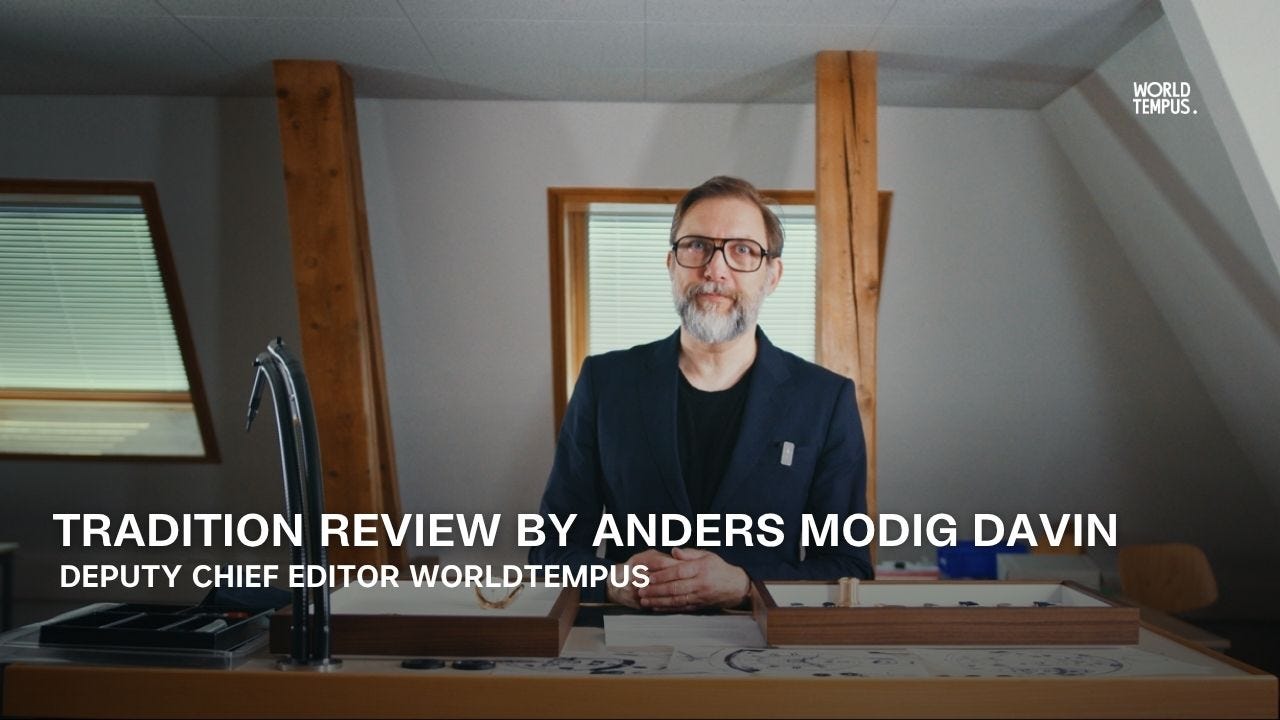
Breguet marks the 21st anniversary of its Tradition collection with six new references introduced in spring 2026, each reflecting the line’s ongoing dialogue between retrograde displays, GMT functions, and Grand Feu enamel work, all while staying tied to eighteenth-century horological roots.
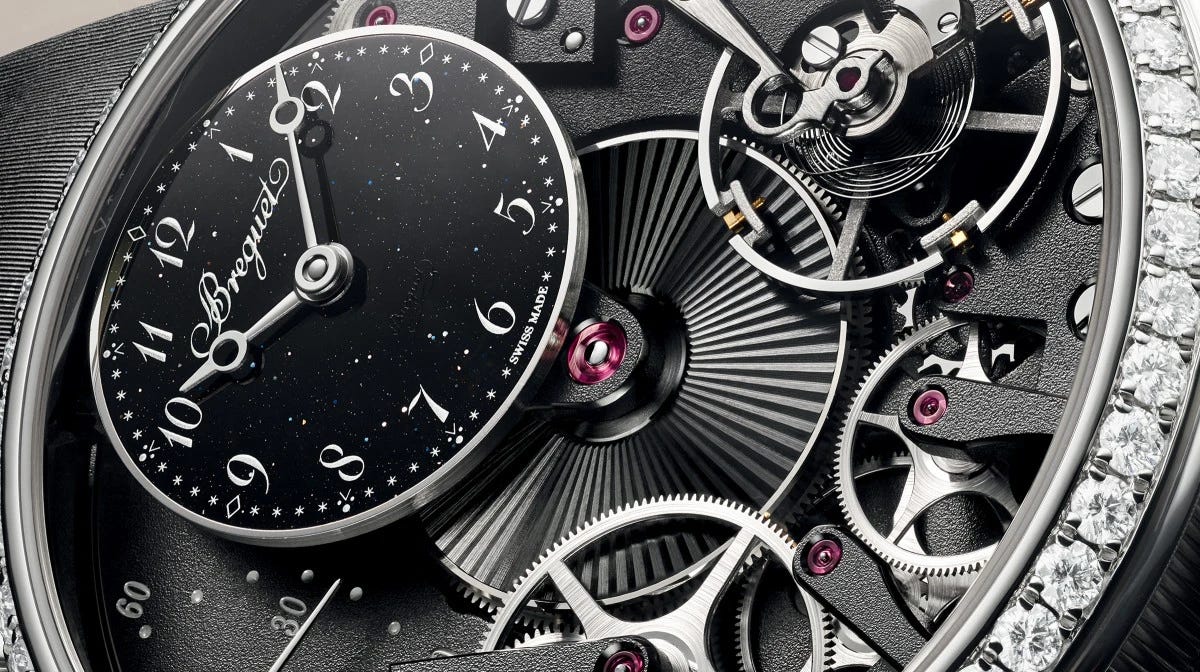
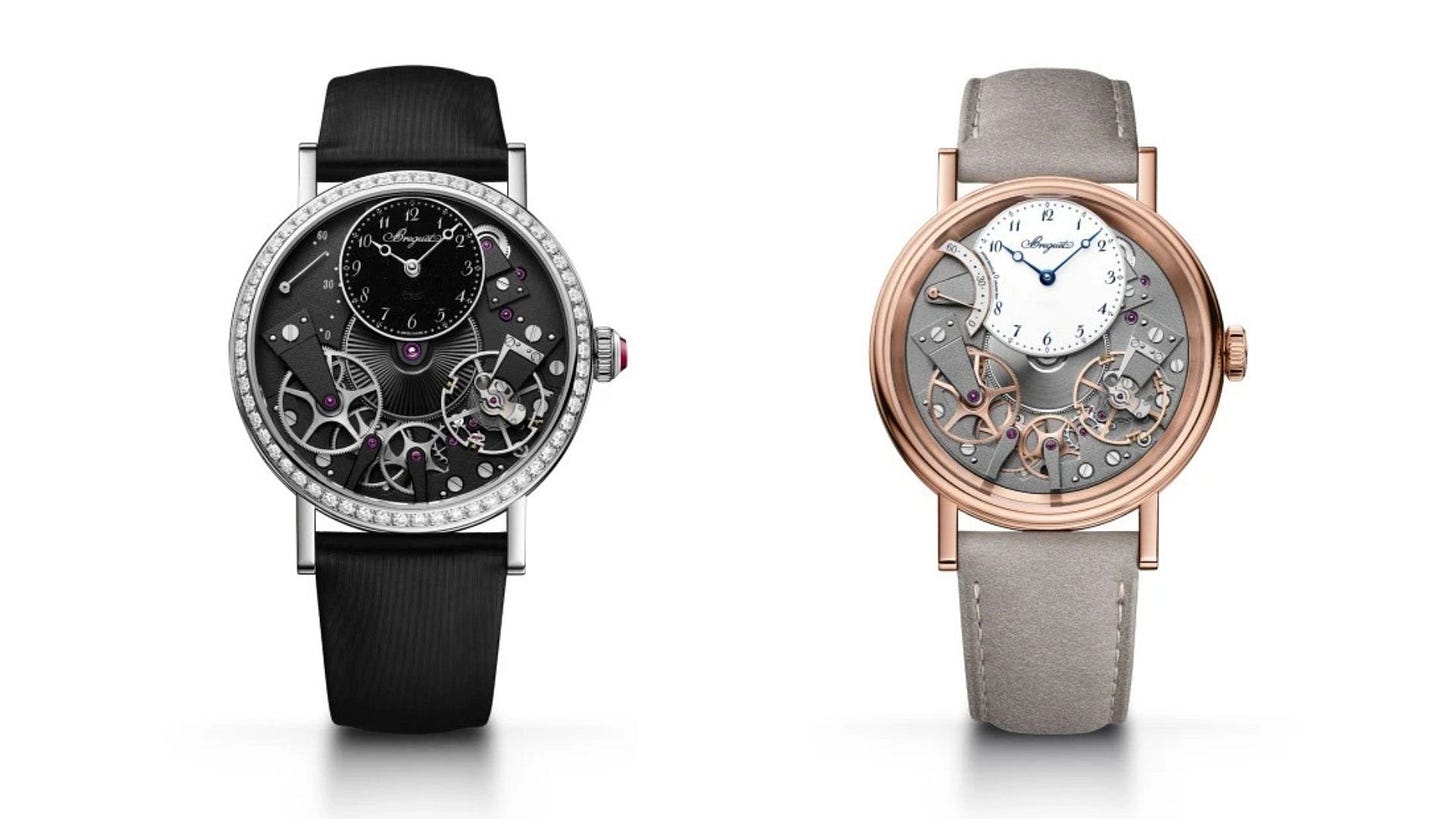
Four of the six watches feature a retrograde seconds display. Two share reference 7037: one crafted in white gold with a Grand Feu enamel dial, the other in platinum with the same enamel technique applied to a black dial instead. A third variation, reference 7097, is presented in rose gold, lending it a softer, more classical character than its siblings. The fourth retrograde model takes a different path altogether, pairing a smaller aventurine dial with a diamond-set bezel for a distinctly more ornate finish.
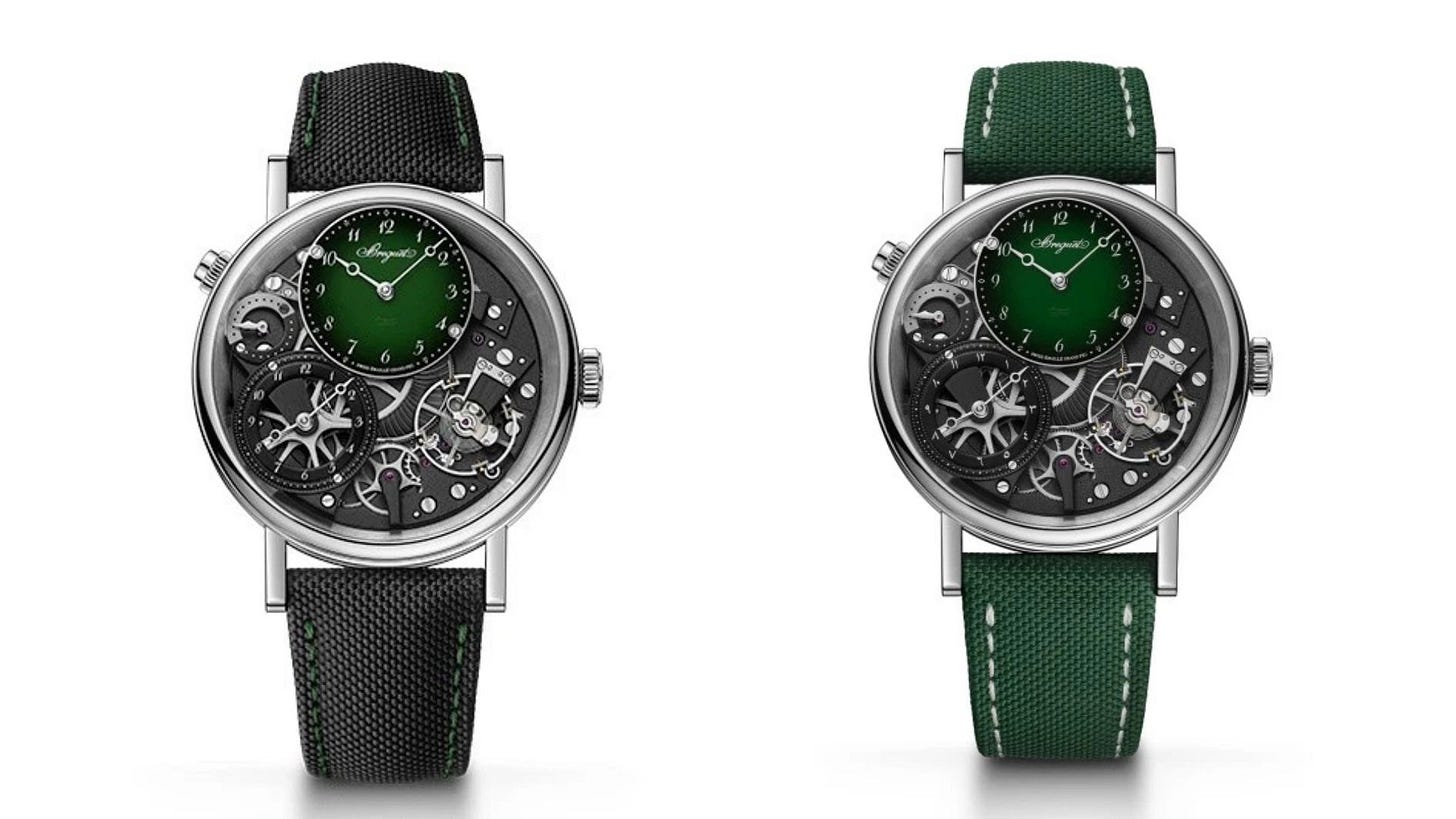
The remaining two references are GMT models, and here the enamel work reaches its most technically demanding form. Both display a dégradé, or fumé, effect achieved through Grand Feu enamel, a process that calls for between four and six separate firings at temperatures around 800 degrees. Buyers can choose between two numeral styles for these dials: Arabic numerals originally designed by Abraham-Louis Breguet himself around 1770, or oriental numerals, which lend the piece a somewhat different visual character.
Taken together, the six watches illustrate how Breguet continues to draw on historical inventions while adapting them through present-day manufacturing methods. The retrograde models lean into variety, offering distinct material and dial choices within a shared architecture, while the GMT pieces push enameling technique to its limits. More than two decades after its creation, the Tradition collection still finds room to grow, proving that a concept rooted in the past can keep producing genuinely new expressions of haute horlogerie.
A recent visit to Breguet’s manufacture in the Vallée de Joux revealed how the brand’s new Tradition references bring together design, movement architecture, and artisanal skill in a single, coherent statement.
Tactility emerges as the defining quality of these watches. The coin-edged case, the mirror-polished lugs with their soft curves, the smooth enamel dial, the finely grained bridges, the box-shaped sapphire crystal, and the knurled crown all invite touch as much as sight. Even the hidden six o’clock signature carries a practical purpose, since engraving a smooth enamel surface is difficult enough that the mark also authenticates the piece as genuinely Breguet. This attention to tactile detail is often traced to the late nineteenth century, yet the watchmaking approach pioneered by Abraham-Louis Breguet suggests the idea took hold in this field roughly a hundred years earlier.
Mechanically, the retrograde seconds and GMT calibers are open-worked, offer a fifty-hour power reserve, and combine robustness with visual refinement. One striking detail appears on the white gold retrograde model, where entire bridges are given a blue tone through Atomic Layer Deposition, a modern process applied to an effect traditionally achieved by heating small screws. Beneath these updates, the technical foundation remains closely tied to Breguet’s own inventions from two and a half centuries ago, among them the pare-chute shock absorber and the balance spring, now produced in silicon.
Decoratively, guilloché appears with unusual restraint, limited to spiral or sunburst patterns on the barrel cover rather than the dial itself. The dials instead showcase Grand Feu enamel in white or black, and, on the Tradition GMT 7067, a green-to-black gradient never before attempted on this collection. Each dial is fired repeatedly and finished with a discreet Breguet signature, making every piece distinct.

Emmanuel Breguet, the Manufacture’s Director of Patrimony and a direct descendant of Abraham-Louis Breguet, recently discussed how his ancestor’s ideas continue to inform the brand’s contemporary output, particularly the Tradition collection. Trained as a historian, he describes his own relationship with time as one built on continuity rather than anxiety, noting that his professional life consists of moving between past and present to draw comparisons. As he puts it, “Ultimately, being a historian means being a professional of time.”
At the center of the conversation is the Tact watch, introduced by Breguet in 1799. At a time when people read time visually or, through repeating mechanisms, audibly, Breguet devised a third option: a tactile system using an arrow and small beads along the case edge. Beneath its cover lies a small subdial at twelve o’clock set within an open-worked movement, a layout that directly inspired the architecture of today’s Tradition watches. A second historical reference point is the Perpétuelle of 1780, whose rotor shape reappears in the new collection’s oscillating weight, though Emmanuel Breguet is careful to note that the Tact remains the dominant influence.
Asked why so many of his ancestor’s inventions, from the tourbillon to the pare-chute system, have endured for over two centuries, he points to a combination of genius and restraint. Abraham-Louis Breguet treated function and beauty as inseparable, stripping away ornamentation while introducing techniques such as guilloché, which served decorative and practical purposes alike. This deliberate simplicity, requiring him to rebuild watchmaking conventions from the ground up, is what Emmanuel Breguet believes explains the lasting relevance of his ancestor’s work, describing him as a rare figure whose creations still function largely unchanged after two hundred years.
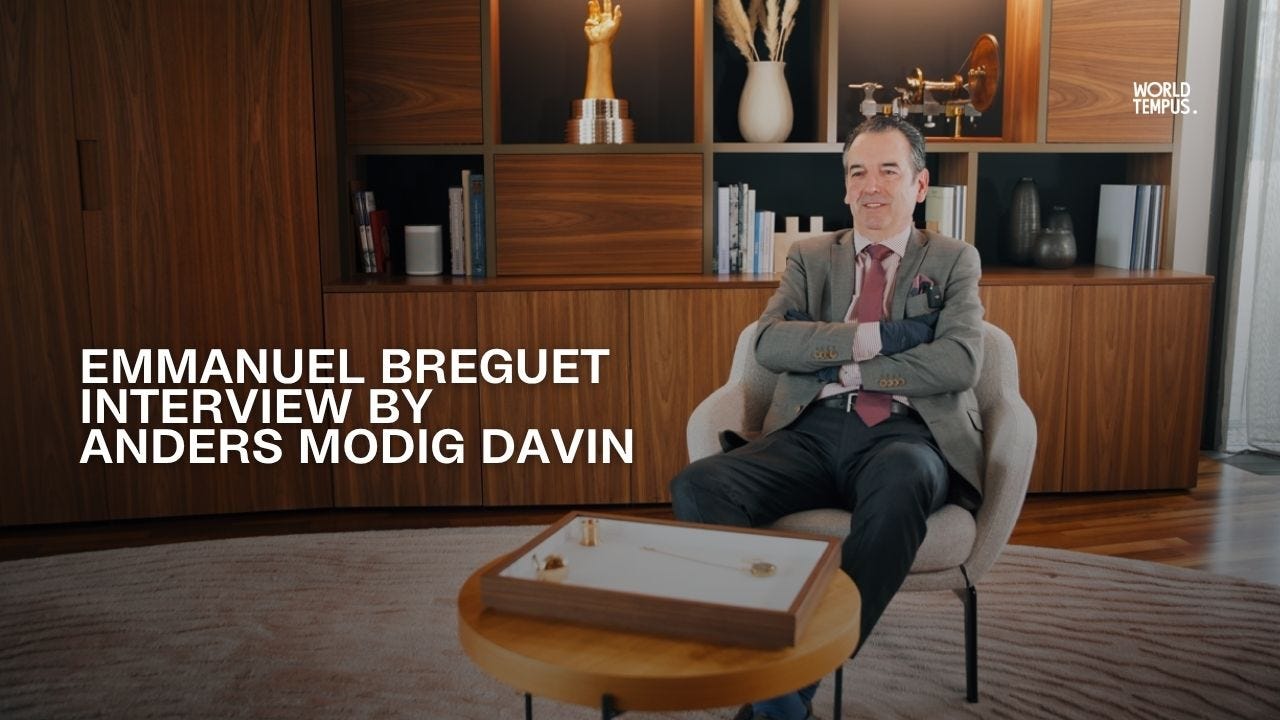
More than two hundred years after his most important inventions, Abraham-Louis Breguet continues to influence how modern watches are conceived. His descendant, historian Emmanuel Breguet, argues that this staying power comes not only from technical skill but from a design sensibility that treated beauty, function, and simplicity as parts of a single idea rather than competing priorities.
“Time itself is one thing; measuring it is another.” Emmanuel Breguet returns to this distinction often, and it helps explain what made his ancestor’s approach so unusual. Abraham-Louis Breguet did not simply refine how time was measured; he reconsidered how people experienced it altogether.
The tact watch of 1799 illustrates this shift clearly. At a moment when time could already be read by sight or heard through repeating mechanisms, Breguet introduced a third option built around touch. Tactile markers set into the case allowed a wearer to sense the time discreetly, without opening or even glancing at the watch. Beyond its mechanical cleverness, the piece reflects an early and unusually sophisticated idea about how a person should interact with an object, one that still informs the brand’s work today.
Emmanuel Breguet also points to design restraint as central to his ancestor’s legacy. Working against a period when ornamentation was expected, Breguet stripped away excess in favor of clarity, a philosophy visible in his use of guilloché decoration, which was prized both for its refinement and for its practical ability to cut down glare. This pairing of elegance with usefulness, rare among watchmakers of any era, is what the historian believes has allowed these ideas to survive intact for so long. As he puts it, “Breguet is a rare, truly exceptional case,” a judgment few inventors could claim after two centuries.
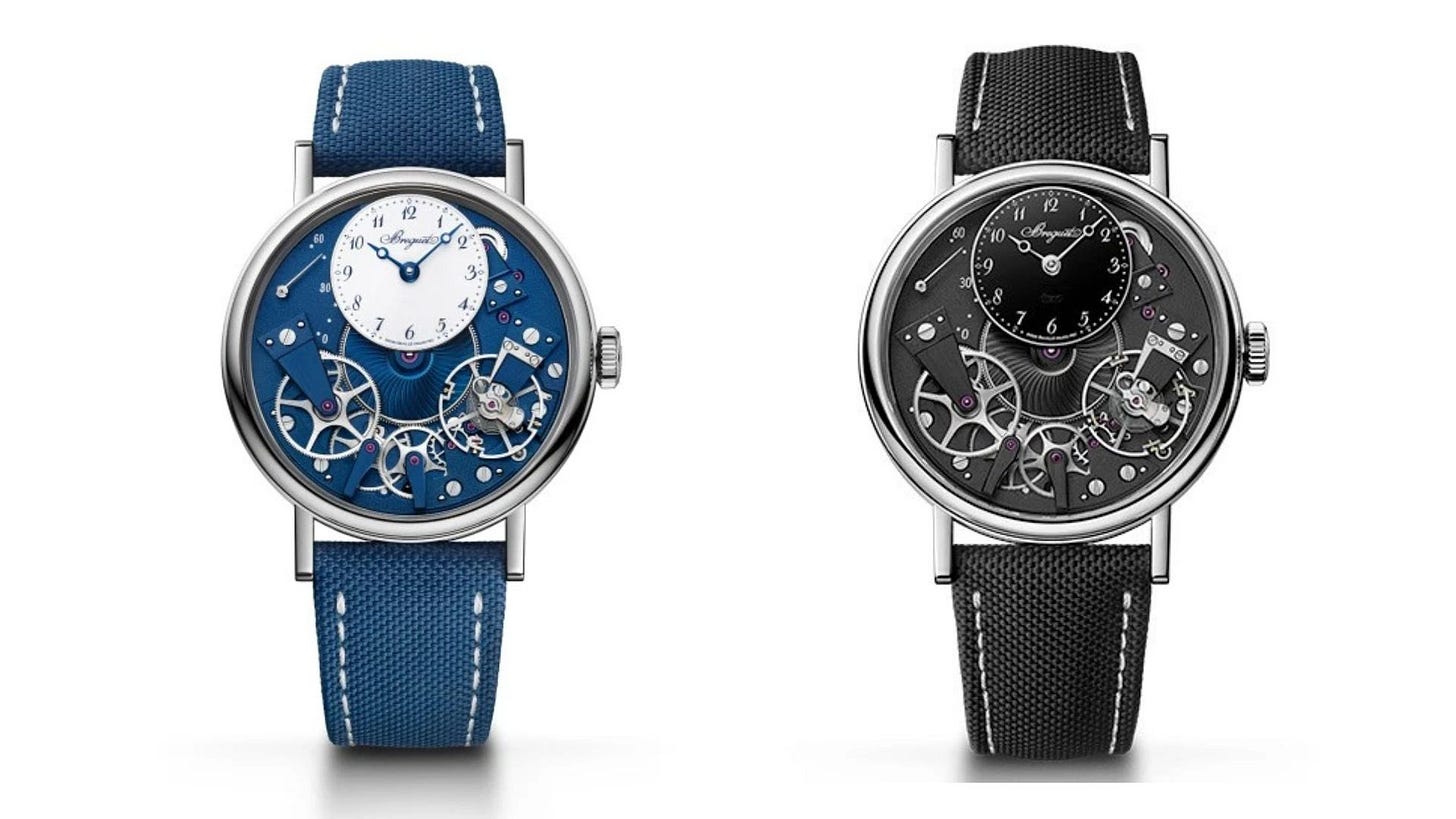
The four Seconde Rétrograde models show how a shared design language can produce distinct personalities depending on case size, material, and dial treatment. The 7037 comes in a 38mm case, offered in either white gold with a white Grand Feu enamel dial or platinum paired with a black enamel version, both fitted with rubber straps and pin buckles. The 7097 takes a slightly larger, 40mm rose gold case and white Grand Feu enamel dial, finished with a calfskin leather strap for a warmer, more classical feel. The 7038 stands apart with its 37mm rhodium-plated white gold case and a black aventurine glass dial, complemented by a black satin-finished fabric strap with a diamond-set gold pin buckle. All three references rely on the same 505 SR self-winding caliber, a 50-hour power reserve, and Breguet’s signature retrograde seconds indication, beating at 21,600 vibrations per hour.
The two Tradition GMT 7067 references push the collection into more technical territory. Both are housed in a 40mm platinum case and driven by the manual-winding 507DRF caliber, offering an identical power reserve while adding a second time zone with day/night indication, complications absent from the retrograde pieces. Their green Grand Feu enamel dials, paired with platinum and rubber straps, set them apart from the rest of the lineup, while the two variants themselves differ only in numeral style, Arabic or oriental, a nod to a choice Abraham-Louis Breguet made centuries earlier. Across all six watches, Breguet applies a consistent mechanical and decorative approach to pieces ranging from understated to striking, without straying from what defines the Tradition line.
No posts
Comments
Nothing yet. Say the first thing.
Sign in to join the conversation.