
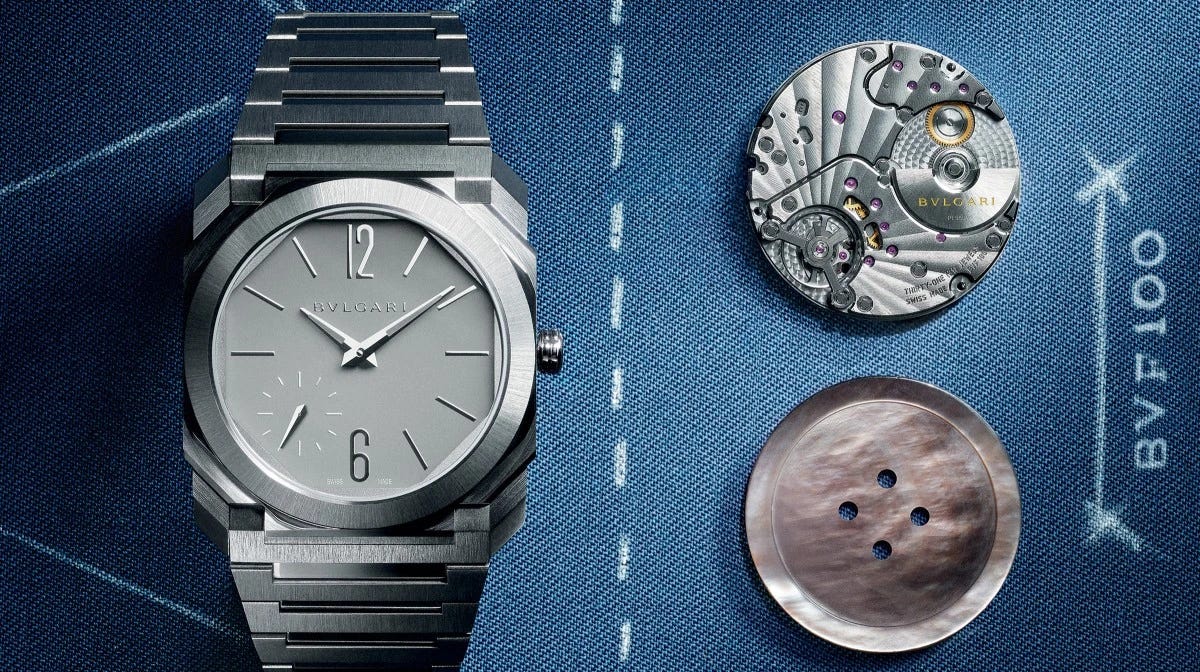
Icons are rarely recognized the moment they appear. In watchmaking, they earn their place through technical ambition, design coherence, and the kind of staying power that only time can confirm. When the Bvlgari Octo Finissimo debuted at Baselworld in 2014, it arrived as something genuinely unfamiliar: an architectural, razor-thin sports watch rooted in Roman geometry and filtered through the legacy of Gérald Genta. It was sharp, strange, and unlike anything else on the market.
What followed was more than a series of world records. Each ultra-thin achievement reinforced a design identity that remained instantly legible across a crowded room, the true measure of horological longevity. Benoît Colson, Geneva Head of the Watches Department at Sotheby’s, traces the real shift to 2017: “When first seeing it, my immediate reaction was that this watch had a bright future, as it was bringing something new to the watchmaking landscape.”
That novelty, however, had to earn emotional weight. Dubai-based collector Katia Jundi describes a gradual conversion: “My relationship with the Bvlgari Octo Finissimo definitely wasn’t love at first sight and I actually think that says a lot about the watch. It grew on me.” Swiss art director and former watch designer Sara Sandmeier points to the architecture as the source of its durability: “immediately recognizable, yet never overpowering. There is space for the wearer to inhabit it, to project their own personality.”
The 37mm version unveiled at Watches and Wonders 2026 marks a new chapter. For Jundi, it resolved a longstanding tension: “It finally made the watch accessible without compromising its DNA.” Colson notes that mid-size versions have historically secured a model’s place in history, pointing to the Nautilus and Royal Oak as precedents. Whether the Octo Finissimo ultimately reaches the cultural weight of horology’s most storied references remains open, but the foundation, every expert agrees, is solidly in place.
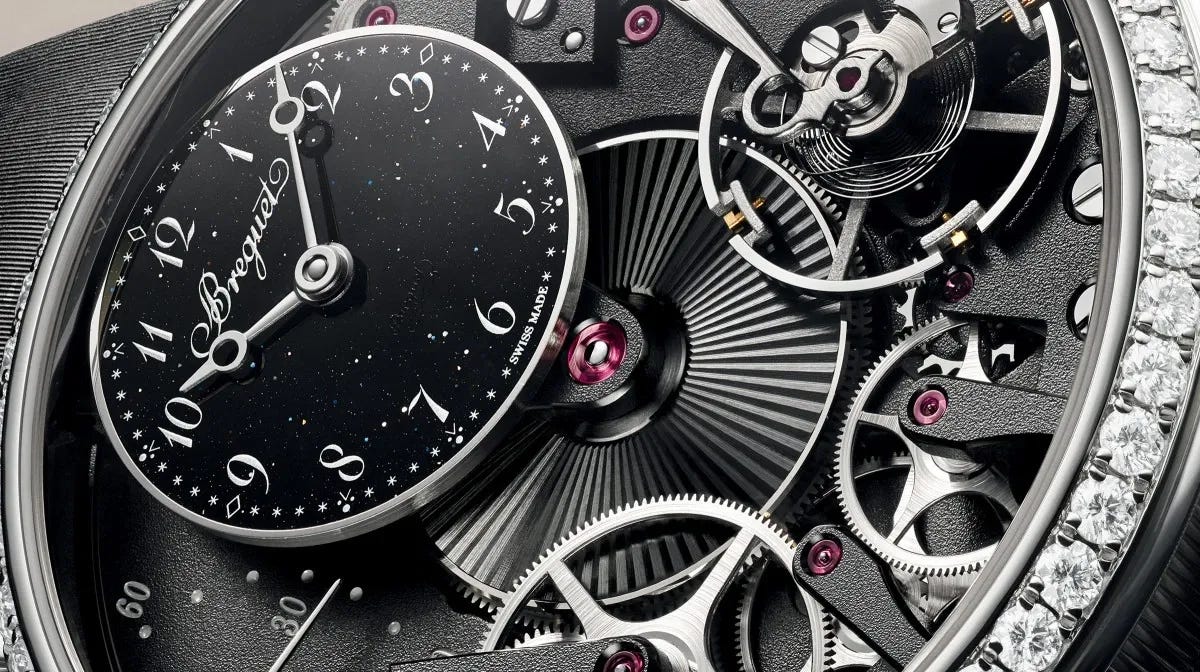
A visit to the Breguet manufacture in the Vallée de Joux is not easily forgotten. Spending several days across its workshops, each carrying centuries of accumulated knowledge, provides a rare perspective on what the new Tradition collection truly represents across three dimensions: design, movement architecture, and artisanal mastery.
If one word were to capture the collection’s aesthetic, it would be tactility. The coined case edge, mirror-polished lugs, smooth enamel dial, finely grained bridges and knurled crown all contribute to an object that invites touch as much as admiration. Even the discreet signature at 6 o’clock serves a dual purpose, functioning as both an aesthetic detail and an authentication mark. In an increasingly digital world, physical texture has regained its appeal, and Breguet’s history suggests this sensibility stretches back to Abraham-Louis Breguet himself, some 250 years ago.
On the movement side, both the retrograde seconds and GMT calibers offer 50-hour power reserves within open-worked architectures. A notable detail appears in the white gold retrograde model, where entire bridges are blued using Atomic Layer Deposition, a modern technique applied to a traditionally small-scale process. Core inventions such as the pare-chute shock absorber and the silicon balance spring connect the new collection directly to its founder’s legacy.
The decorative work is equally considered. Guilloché, elevated to an art form by Abraham-Louis Breguet as early as 1786, now appears more discreetly on barrel covers in spiral or sunburst patterns. Grand Feu enamel dials in white, black, and a first-ever green-to-black gradient on the GMT model complete the picture, each one unique by nature of the firing process that produces it.
Long dismissed as a relic of another era, the pocket watch is making a genuine comeback. In 2026, unique creations and contemporary reinterpretations have prompted some of the industry’s leading maisons to revisit this historic format with fresh ambition. Here are five pieces that particularly stood out.
Patek Philippe opens the list with its Flamenco pocket watch, part of the 2026 Rare Handcrafts collection. Combining grand feu enamel, hand engraving, and marquetry, each piece demands hundreds of hours of work. The colors appear to radiate from within, while the dancer seems suspended mid-movement. At this level of execution, the object crosses from watchmaking into art.
The Audemars Piguet x Swatch Royal Pop pocket watch is a collaboration few would have predicted. In its Otto Rosso version, the brightly colored case reframes the iconic Royal Oak octagon as a fashion object, making the pocket watch appealing to a generation that has never worn one.
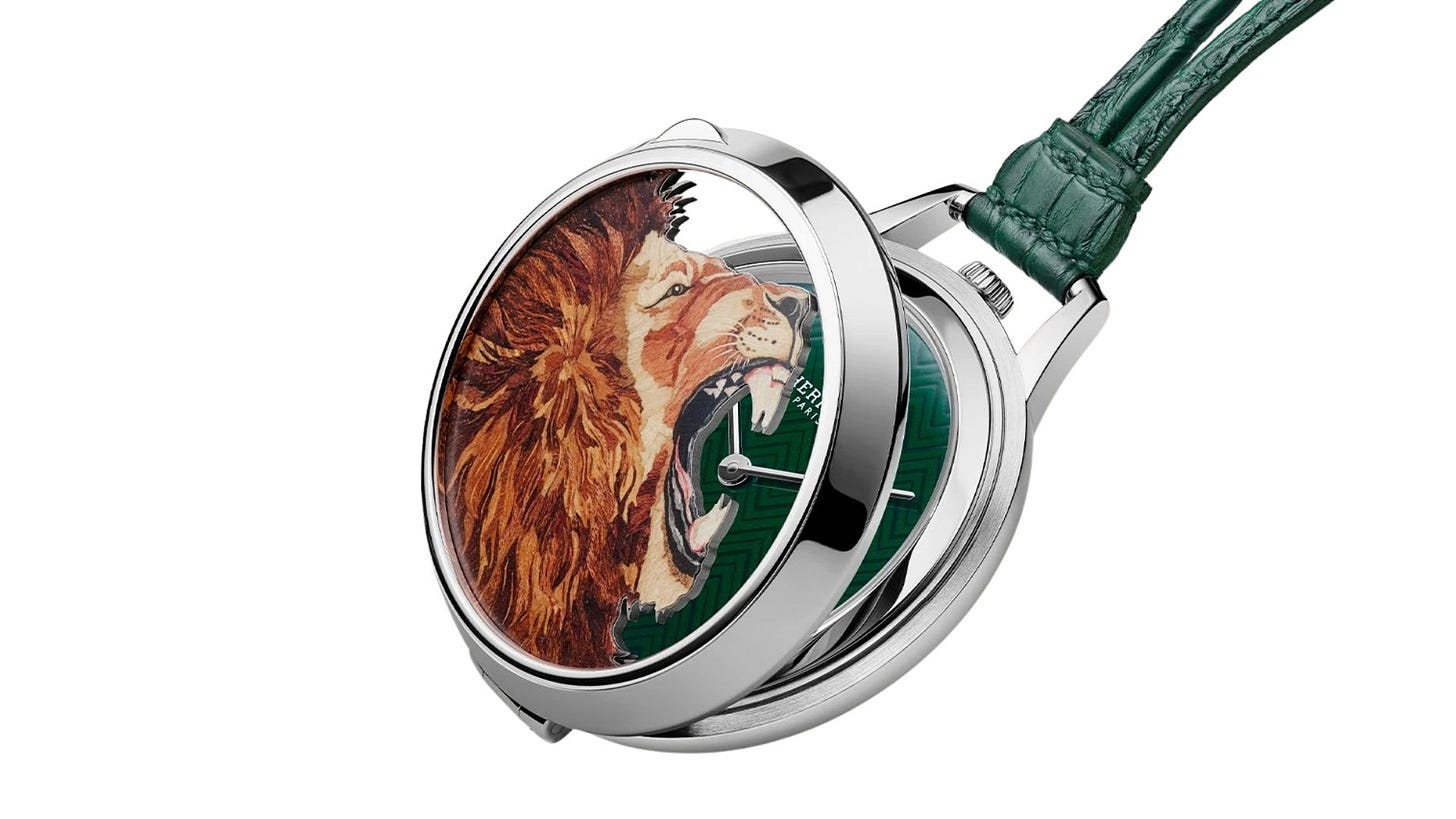
Hermès takes a different approach with the Slim d’Hermès Pocket Roaaaaar. A feline motif by British artist Alice Shirley spreads across the dial, while the savonette cover is rendered in wood marquetry using ten different varieties. Humor, craft, and color coexist without compromise — this is the kind of watch you take out of your pocket simply because you want others to see it.
The Jaeger-LeCoultre Memovox Travel Clock by Marc Newson occupies a category of its own. Strictly speaking not a pocket watch, its compact dimensions allow it to fit comfortably in the palm of a hand. A 12-day power reserve, iconic alarm function, and Marc Newson’s sculptural silhouette make it a compelling travel companion that transcends categories.
Finally, Audemars Piguet’s 150 Heritage pocket watch celebrates a century and a half of expertise through pure mechanical ambition. Its platinum case houses the new Caliber 1150, incorporating over 47 functions including 30 complications. Produced in only two examples, it represents a level of complexity that very few timepieces in the world can match.
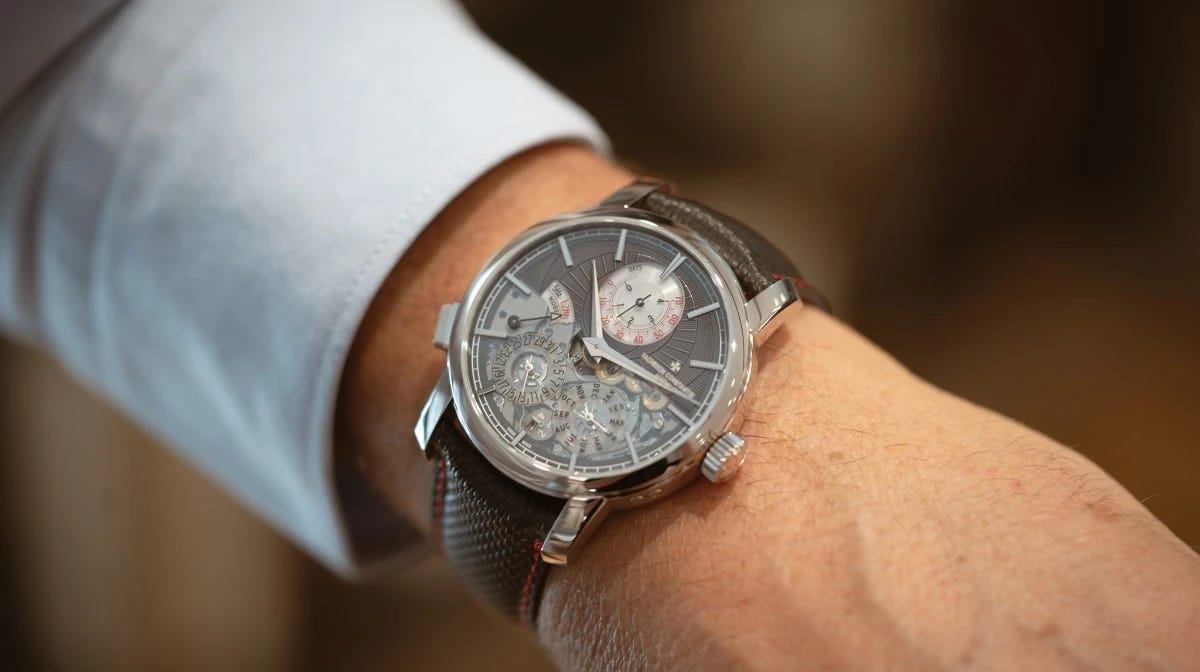
When Vacheron Constantin introduced the Twin Beat in 2019, it had the restraint not to describe it as a revolution. Yet the concept marked a genuine step forward in the pursuit of longer power reserves. Seven years later, an optimized limited edition pushes the idea even further.
The principle is straightforward. When worn, the watch runs at 5 Hz, ensuring strong accuracy but limiting autonomy to around four days. When set aside, the owner can reduce the frequency to 1.2 Hz, the lowest rate at which precision can still be maintained. The original caliber offered 65 days of power reserve at this pace. The 2026 version extends that figure to 70.
Pairing this architecture with a perpetual calendar was the second stroke of ingenuity. A perpetual calendar only functions as intended while running. Once stopped, it requires a full reset of day, date, month, year, and moon phases, defeating the purpose of a complication designed to need no manual correction until 2100.
To reach 70 days, Vacheron Constantin retained its three-differential architecture and paid particular attention to the perpetual calendar’s jumping displays, which are energy-intensive by nature. The manufacture refined a system requiring four times less torque than conventional instantaneous-jump mechanisms. The balance wheel used in standby mode is fitted with a hairspring developed exclusively for this frequency, measuring just 0.015 mm in thickness, considerably thinner than a human hair.
Housed in a 42 mm platinum case and retaining the pusher at 8 o’clock for switching between frequencies, the 2026 Traditionnelle Twin Beat Perpetual Calendar will be produced in a very limited number of examples.
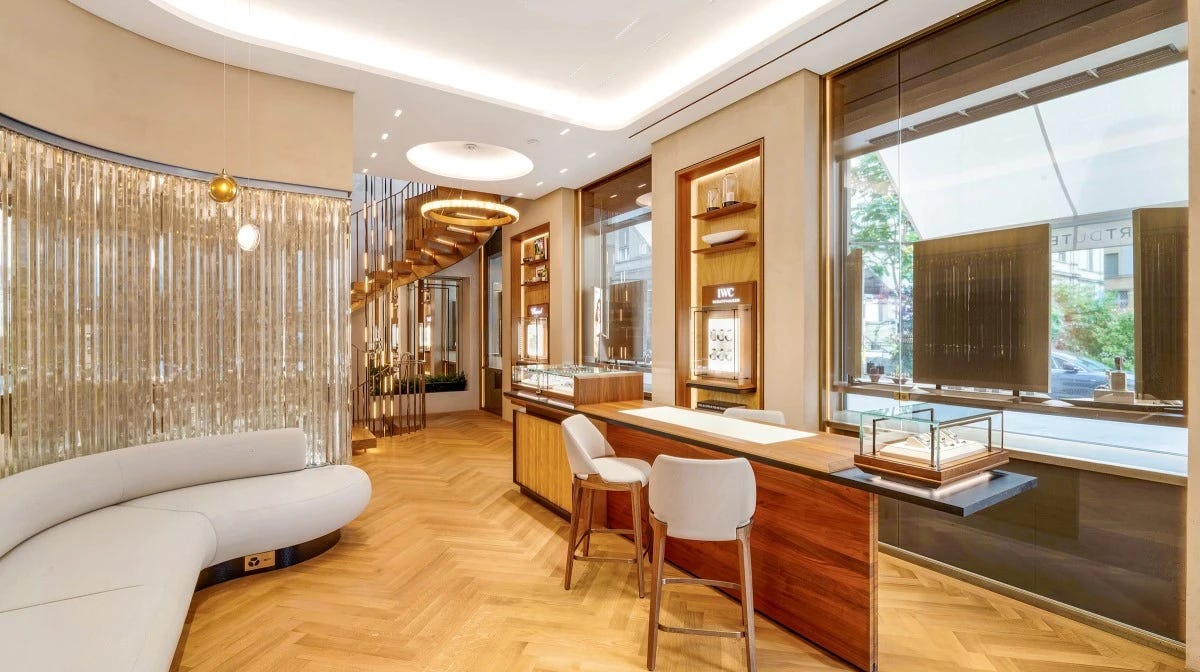
At a time when independent retailers are closing their doors and brands are tightening control over their own distribution, Cédric Schiess chose to open a watch boutique in Biel. The timing may seem counterintuitive, but the young founder, a trained watchmaker and Gen Z entrepreneur, believes he holds a distinct set of advantages.
The first is professional: he understands the watches he sells from the inside out. The second is generational. Born within the cohort that will shape the next wave of collectors, Schiess naturally speaks their language and meets them where they are, including on Instagram and through the boutique’s own podcast, “Lumen Society.” For more experienced clients, his technical background provides immediate credibility.
“In large retail stores with constant traffic, it’s impossible to dedicate enough time to every client. It’s something I always noticed and wanted to change,” he explains. The 220-square-metre Art du Temps boutique, which opened in July 2024 after eighteen months of careful preparation, was designed with that ambition in mind. The third floor, once Schiess’s personal apartment, now hosts private events while preserving the feeling of being at home. “It’s quite common for clients to stop by briefly and end up spending three hours talking with us over coffee,” he says.
That attentiveness extends beyond the boutique. Schiess recalls “a couple who bought their wedding rings from us. We paid attention to where they were going on their honeymoon and contacted the hotel to arrange a special dinner for them, simply to make them happy.” Rooted in Biel, Art du Temps is already thinking about what comes next.
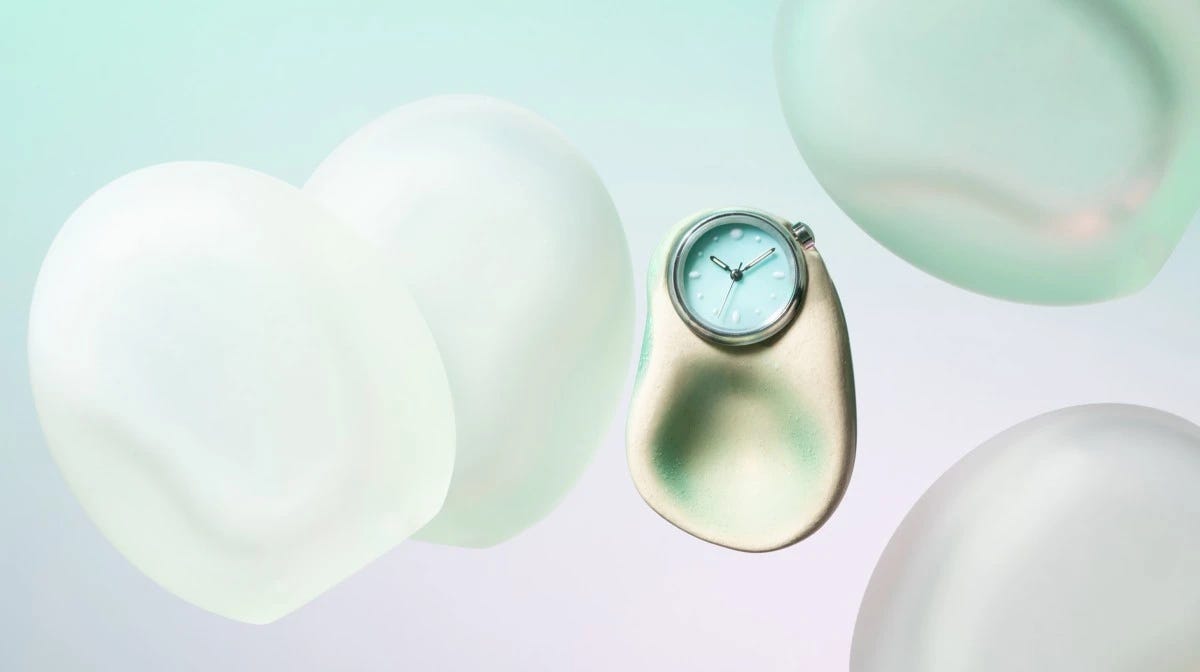
Each year, the Geneva University of Art and Design (HEAD) presents the final projects of its Master’s programme in Watch Design. The 2026 cohort stands out for its originality, and three projects in particular caught our attention.
The first comes from Iris Grondein, who is on the autism spectrum and lives with ADHD. Her relationship with time can become a source of overwhelming anxiety, making traditional watch formats largely meaningless. She needed an object she could physically interact with to gain a sense of control, so she created one herself. The result, entitled À fleur de peau, sits closer to a pocket watch than a wristwatch, using resin, ceramic, and oak wood for their softness, with a calm color palette far removed from traditional watchmaking tones. Jury member Yvan Arpa praised “a superb presentation, a magnificent object and a radiant personality.” Score: 5.5 out of 6.
Léa Maniscalco’s La Désirée draws inspiration from the world of wine, a field central to her family. The watch measures 37.5 mm in diameter, referencing the 37.5 cl bottle format, with three rehaut variations representing white, red, and rosé wines. Housed in a steel case with a Sellita-based movement, the concept is accessible and market-ready. Score: 5 out of 6.
The third project, by Mikael Correia, is a sociological statement. His watch-bracelet fits closely against the skin and can temporarily imprint a message on the wearer’s epidermis, probing the boundary between brand identity and the physical mark luxury objects leave on the body. Rigorous anthropological research underpins a deliberately provocative proposal. Score: 5.5 out of 6.

Now in its third edition, the GMT Watch Safari returns at the end of October for five days of exclusive manufacture visits in the heart of the Swiss watchmaking world. A few spots remain available.
From Monday October 26 to Friday October 30, participants will visit nine prestigious addresses: Audemars Piguet, Bvlgari, De Bethune, Frederique Constant, Mauron Musy, Laurent Ferrier, Longines, Panerai, and Roger Dubuis. The program also includes the opening cocktail party of the Grand Prix d’Horlogerie de Genève and a behind-the-scenes look at the launch of the AKHOR brand. The route travels from Geneva to the Jura mountains via Neuchâtel, aboard a luxury minibus through some of Switzerland’s most scenic landscapes. GMT handles the full itinerary, including accommodation in 4-star city-center hotels, transfers, visits, and meals.
Past participants have been enthusiastic. “I learned so much about the industry; it was really fascinating,” says Robert from the USA. Hugues from Switzerland describes it as “a unique experience,” adding: “I can’t wait for next year!” Peter, also from Switzerland, sums it up simply: “It was an incredible week and we had a lot of fun discovering the behind-the-scenes world of our great Swiss watch Manufactures.”
Spots can be reserved at watch-safari.ch or by emailing brice.lechevalier@gmtpublishing.com.
No posts
Comments
Nothing yet. Say the first thing.
Sign in to join the conversation.