
Abraham-Louis Breguet earned his place in horological history through inventions like the tourbillon and the minute repeater gong, but George Daniels titled his book on the watchmaker “The Art of Breguet” for a reason: aesthetics mattered to Breguet as much as mechanics did. Guilloché engraving, blued screws, distinctive hands, and the numerals he designed himself all remain signatures of the modern brand. Less discussed, though, is his attachment to enamel, most visible in the Souscription watch of the 1790s, where a single hand against pure white enamel achieved both simplicity and legibility, a combination revived last year in the Classique Souscription 2025.
Centuries after craftsmen in Georgia first developed the technique, enameling remains stubbornly manual, resistant to the automation that has reshaped much of watchmaking. Layers of enamel powder are fired repeatedly at temperatures above 800 degrees Celsius, with failure lurking at every stage: insufficient heat leaves the surface without its glass-like finish, excess heat destroys the enamel outright, and cooling too quickly can shatter a piece that survived firing. Rejection rates above 50% are not unusual among makers who work with the material.
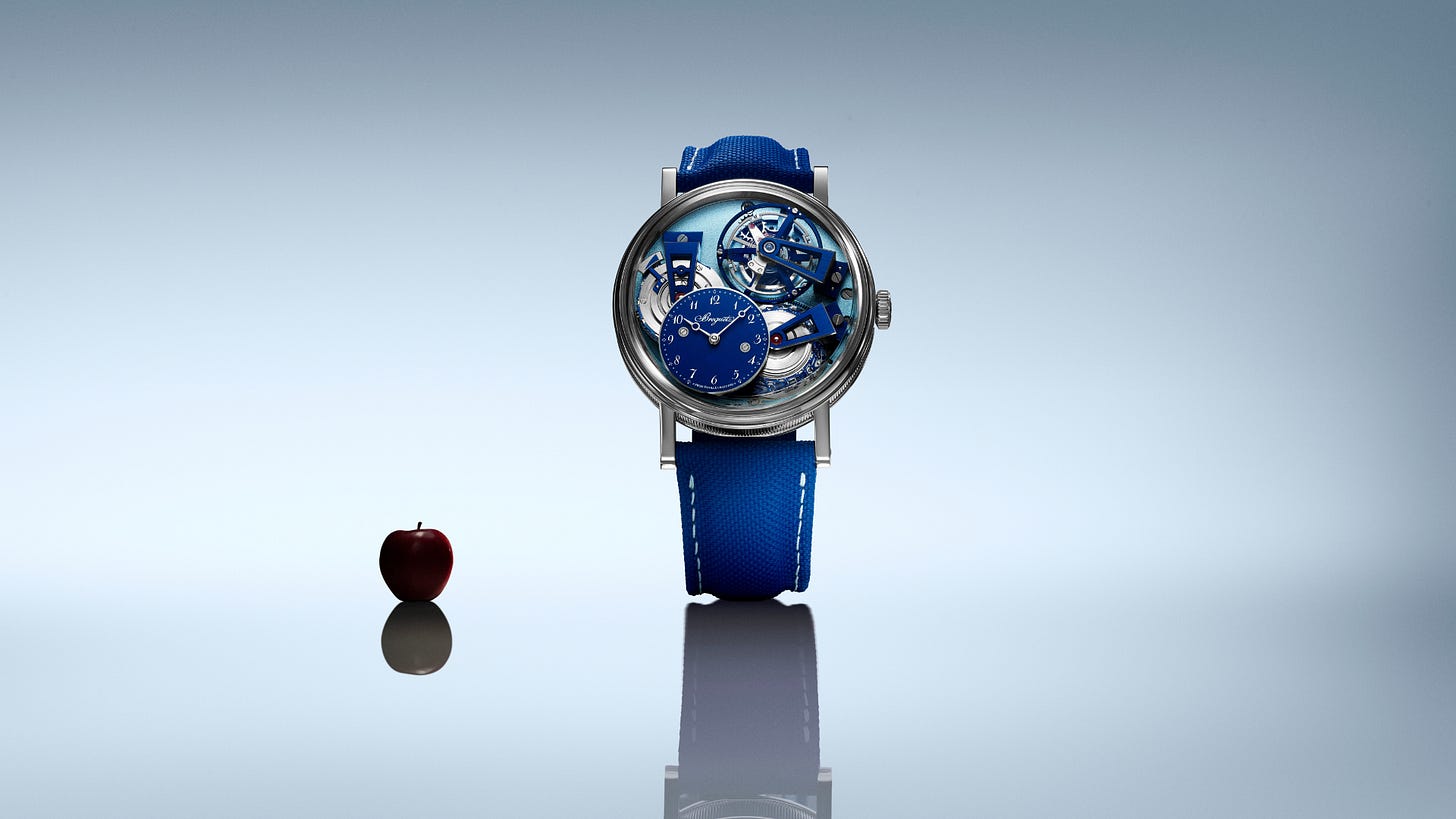
Breguet’s current tourbillon collection carries this tradition forward across several references. The Classique Tourbillon Extra Plat (Reference 5367) pairs black or white enamel with Breguet numerals and blued hands, while the Tradition Tourbillon 7047 uses a Lapis Blue enamel dial to match its fuse and chain movement. The Classique Tourbillon 3358 adds hand-engraved guilloché beneath red or blue grand feu enamel.
Marking 225 years since Breguet patented the tourbillon in 1801, four new references arrived this summer, including the £206,100 Classique Tourbillon Sidereal 7255. Its aventurine enamel dial evokes a night sky, paired with a flying tourbillon suspended using the “mysterious” technique, a first for the brand.
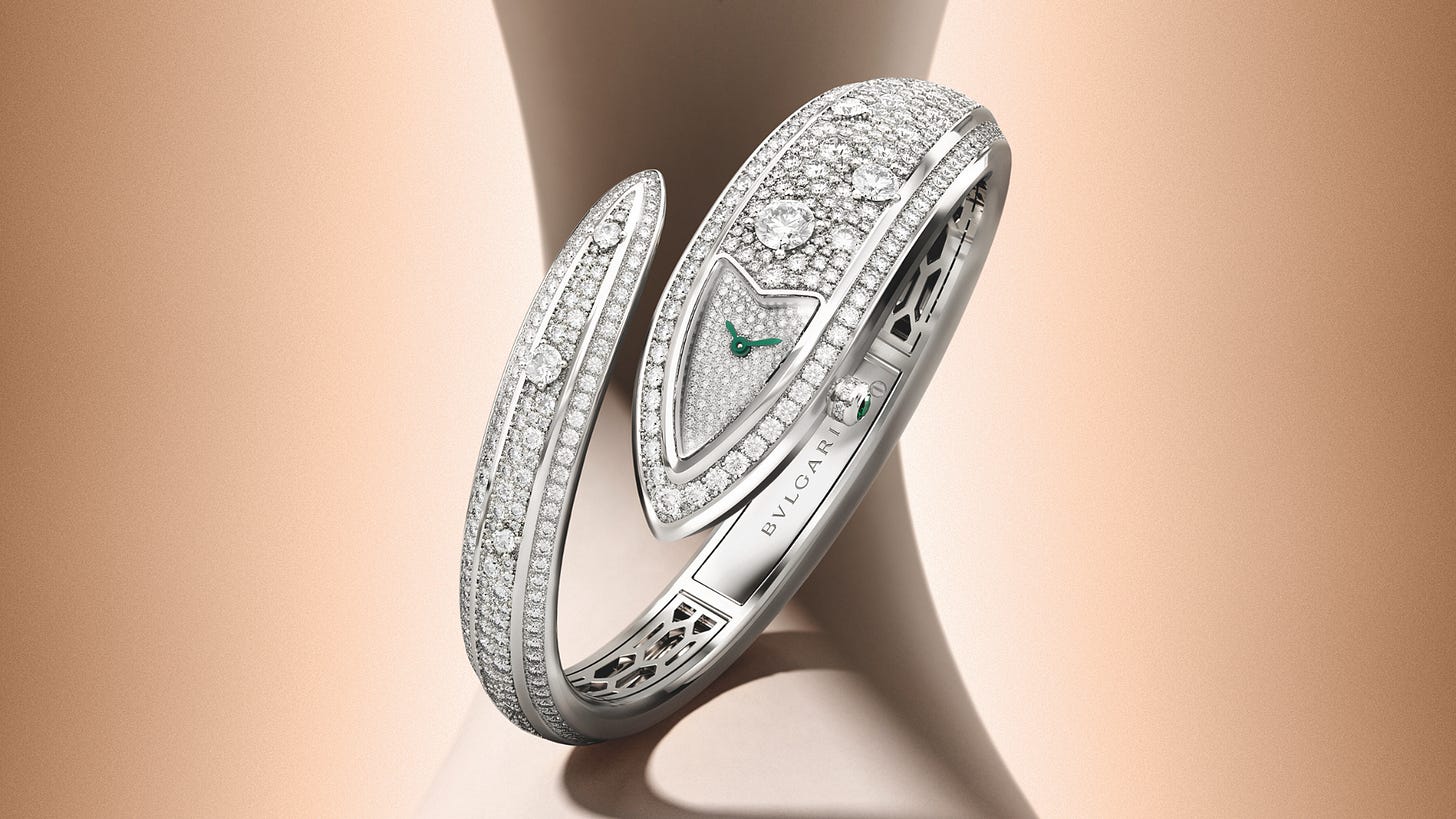
Bvlgari’s Serpenti has reinvented itself many times since the collection first appeared in the mid-20th century, tracing back to a gold tubogas watch from 1948. The 2024 launch of Serpenti Aeterna marked one of its most radical shifts yet, stripping the snake motif down to a more abstract, sculptural form. Fabrizio Buonamassa Stigliani, Bvlgari’s product creation executive director, describes the line as something closer to an idea than an object: “More than a creation, the Serpenti Aeterna is, fundamentally, a concept,” he said.
This year brings two new quartz-powered additions that push that concept in opposite directions. The first leans fully into Bvlgari’s gem-setting expertise, combining rubellite, amethyst, topaz, emerald, citrine, sapphire, tanzanite, pink and paraíba tourmaline, tsavorite, and peridot across 122 stones cut as rounds, brilliants, princesses, pears, and ovals. Realizing the design in rose gold took roughly 225 hours in total, including 185 hours devoted to gem selection and preparation alone. The finished 24mm curved case carries 5 carats of round brilliant diamonds alongside 13 carats of colored stones, with an entirely pavé-set dial and a stylized reptilian head reinforcing the design’s graphic presence. Openworked hexagonal scales along the bracelet let light pass through the stones, creating shifting effects of transparency.
The second model takes a quieter approach, marking the first time Serpenti Aeterna has appeared in yellow gold. Paired with a white mother-of-pearl dial, the 24mm case features a crown set with 11 round brilliant-cut diamonds and a bracelet carrying 68 more, totaling over half a carat. Designed with stacking in mind, it works equally well as a standalone piece or combined with other Bvlgari bracelets. Together, the two versions capture Serpenti Aeterna’s range: one built for maximalist brilliance, the other for understated, everyday wear.

Ralph Lauren has given its Polo Bear mascot a campus-inspired makeover, marking the first time the character appears dressed in a distinctly preppy, collegiate wardrobe within a watch. The 3D-printed bear takes center stage on a cream-colored dial, framed by a railroad minute track and oversized Arabic numerals, a graphic treatment sized to match the character’s outsized presence.
The bear’s outfit rewards close inspection: two-tone brogues, baggy jeans, a brown suit jacket, and a yellow cable-knit sweater, the same sweater found elsewhere in this year’s Ralph Lauren collection. A necktie and round, wire-rimmed spectacles complete the layered look associated with Ivy League style. The strap reinforces that heritage angle further, styled after the regimental stripe, a pattern with roots in British military regiments of the late 1800s that later became a fixture of preppy dressing. Its lining uses Alsavel, an exclusive calf leather, though the watch can also be fitted with a plain calf strap or an exotic alligator strap for a more understated option.
This is not Ralph Lauren’s first Polo Bear watch. The brand introduced its debut timepiece in 2009, with the first Polo Bear model arriving in 2017 to mark the company’s 50th anniversary. The new campus edition extends that lineage while pushing the mascot’s wardrobe further than before.
Beneath the dial sits Ralph Lauren’s own RL200 caliber, built from a reworked Sellita base movement. It runs at 4 Hz, or 28,800 vibrations per hour, and offers roughly 50 hours of power reserve. As with other Polo Bear models, the crown sits at 2 o’clock rather than the more typical 3 o’clock position, a small but consistent signature across the line.
With this release, Ralph Lauren continues doing what has defined the brand for decades: translating its preppy, collegiate universe directly onto a watch dial, using character and detail rather than complications to tell that story.
Since 2000, Bvlgari has built an integrated Swiss production capable of manufacturing every component of its most advanced movements in-house, a technical foundation the brand pairs with its longstanding Italian jewelry heritage. Four current timepieces illustrate that combination, each built around a different pillar of the maison’s watchmaking identity.
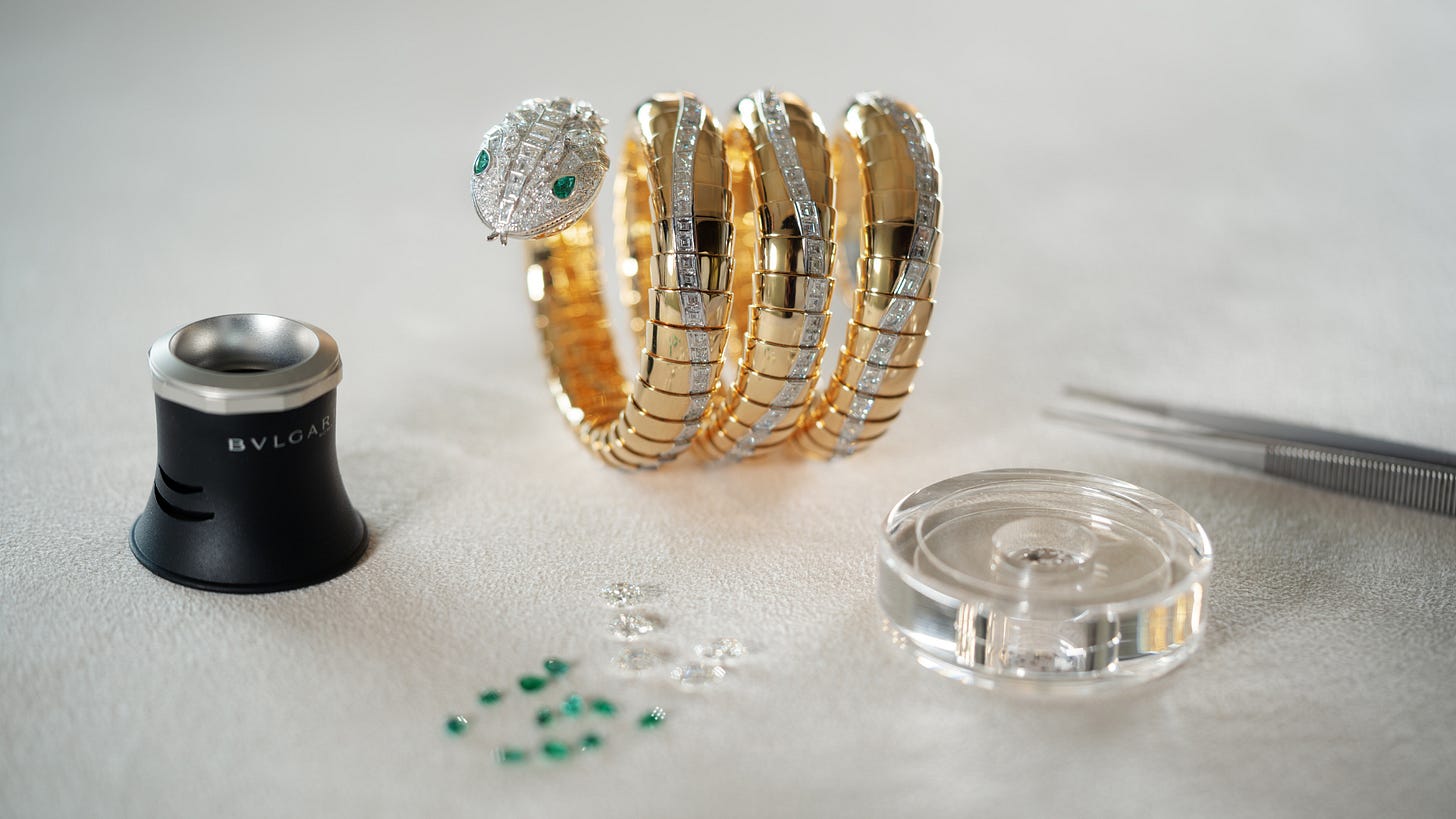
Miniaturization defines the Serpenti Misteriosi Dragone Secret Watch, a piece tracing back to the original 1948 Serpenti and its Tubogas bracelet, later immortalized when Elizabeth Taylor wore the design in Cleopatra. Here, yellow gold carries roughly 30.54 carats of diamonds, mostly baguette-cut, with marquise stones on the serpent’s head and two emerald eyes completing the design. Hidden inside the snake’s mouth is the manual Picolissimo caliber, BVL 100, a 102-part movement measuring just 12mm across and 2.5mm thick, currently the smallest round movement available.
Elegance takes shape in the Diva’s Dream Minute Repeater, its 37mm white gold case fully paved with round brilliant-cut diamonds and a baguette-set bezel. The dial and chime-activating charm reproduce the Caracalla mosaic pattern, originally designed for Rome’s Baths of Caracalla nearly 1,800 years ago. Its manually wound BVL 362 movement, at 3.12mm, ranks as the thinnest minute repeater caliber on the market, with gongs fixed directly to the case so the whole structure functions as a resonance chamber.
Architecture governs the Octo Finissimo Tourbillon Chrono, built around the 3.5mm BVL 388, the world’s thinnest automatic chronograph tourbillon movement. Its open-worked dial reveals a deliberately symmetrical layout, with subdials at 3 and 9 balanced by a barrel at 12 and the tourbillon cage at 6.
Sound anchors La Sinfonia Della Meccanica Octo Roma Carillon Tourbillon, whose 44mm platinum case houses a titanium middle case blued through atomic layer deposition. The open-worked BVL 428 carillon minute repeater uses three hammers and gongs, while acoustic gills and honeycomb-shaped micro-holes on the caseback amplify resonance, turning the case itself into an instrument.

Geneva Watch Days was never meant to happen the way it did. Planned for a 2020 debut, the event faced a pandemic that had already sidelined Watches and Wonders and every other traditional trade fair. Rather than cancel, its eight founding brands, Breitling, Bvlgari, De Bethune, Girard-Perregaux, H. Moser & Cie., MB&F, Ulysse Nardin, and Urwerk, pushed ahead with a decentralized, open-air format championed by Bvlgari CEO Jean-Christophe Babin.
The real model behind that decision came not from Geneva’s own canceled show but from Dubai Watch Week, an event the Seddiqi family has hosted since 2015. Dubai never chased Watches and Wonders’ attendance numbers; in 2019, roughly 9,000 visitors attended Dubai Watch Week compared to about 23,000 at Watches and Wonders. What Dubai offered instead was scale suited to conversation: CEOs, watchmakers, collectors, and journalists meeting without the rigid choreography of a conventional trade show.
Geneva Watch Days borrowed that same philosophy, and it appealed naturally to independent brands, which still make up the bulk of its now 69 exhibitors. A handful belong to larger groups, including Frédérique Constant and Alpina under Citizen Group, Bvlgari and Zenith under LVMH, and De Bethune under The 1916 Company, but independence remains the event’s defining trait. It has stayed free, open to the public since 2021, and spread across hotels throughout the city, just as it was at launch.
Growth, though, is testing that founding intimacy. Attendance in 2026 is expected to top 15,000, including around 2,000 industry professionals, pushing hotels to their limits as they host back-to-back meetings in spaces never built for exhibitions. Geneva Watch Days has effectively become a professional trade show while still resisting that label. Even so, exhibitors describe it as complementary rather than competitive with Watches and Wonders, a sign that Geneva, whatever form its events take, remains the industry’s center of gravity.
Some watches are defined less by their dial than by what wraps around the wrist. This selection focuses on that idea, precious bracelets elaborate enough to stand on their own merit, set aside from sports watches and high jewelry pieces where the case takes a back seat.
Patek Philippe’s Golden Ellipse 5738/1R reworks the familiar dressy silhouette with a bracelet built from 363 parts, including 300 oval links arranged in rows of eight and woven rather than simply meshed, giving it an almost fabric-like quality. The generous spacing between links keeps it breathable despite its heft.
Cartier’s Privé Tank Normale takes a different route, pairing a compact 32 x 25mm platinum case with a seven-link platinum bracelet inspired by pieces Cartier London produced in the 1930s. The full platinum construction, down to the clasp, makes this a notably heavy watch, exactly the weight many platinum buyers seek out.
Rolex’s 1908 Settimo extends the brand’s thin dress automatic line into unexpectedly precious territory. Its seven-link yellow gold bracelet uses the brand’s Crownclasp system, an invisible closure opened via a small crown, echoing the design language of the President and Flat Jubilee bracelets while remaining untapered along its full length.
Chopard’s L’Heure du Diamant pairs an intricately latticed caseband with a white gold roll bracelet, one link per row, a construction more commonly seen on sports watches but reworked here with heavy polishing that ties visually into the dial’s ribbed texture.
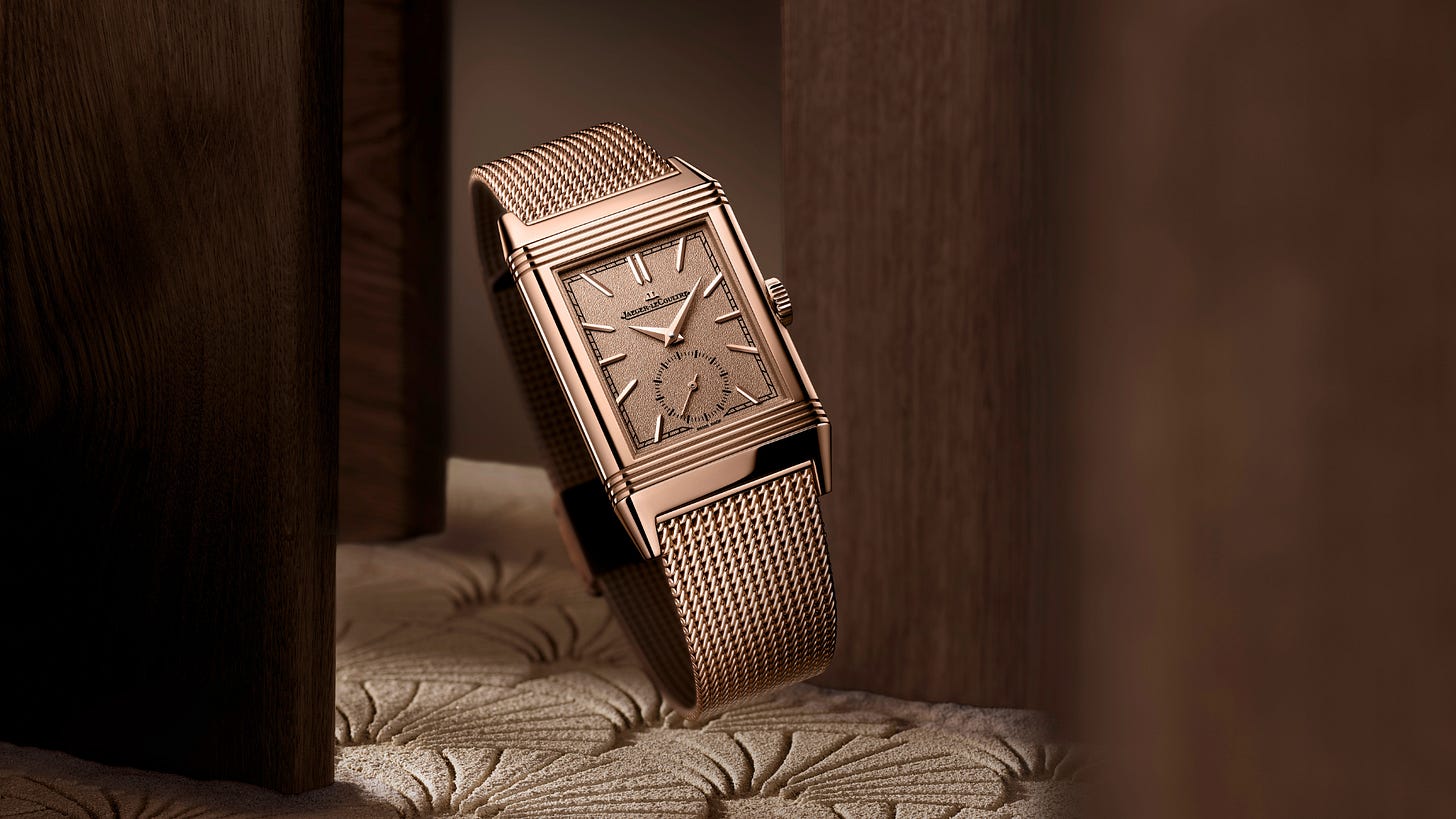
Finally, the Jaeger-LeCoultre Reverso Tribute Monoface ‘Or Deco’ fits a Milanese mesh bracelet, typically reserved for round dive watches, onto the Reverso’s rectangular case, a natural pairing given the mesh’s flat, straight-ended construction. Cast entirely in rose gold, it comes in two sizes to accommodate different wrist curvatures, since the dense mesh cannot bend as freely as other bracelet types.
No posts
Comments
Nothing yet. Say the first thing.
Sign in to join the conversation.