
About the podcast:
These are unscripted, early David J. Temple conversations where Dr. Marc Gafni, Ken Wilber and Dr. Zak Stein are unfolding the inner workings of CosmoErotic Humanism in real time. Formal statements and propositions will be published in forthcoming volumes by the World Philosophy and Religion Press.
About this episode:
This is the third in a series of dialogues between Marc Gafni, Ken Wilber, and Zak Stein, reconvening after the release of First Principles and First Values.
Philosophers and truth-seekers for thousands of years have wrestled with a timeless question: is life innately meaningful, or are we just merely the byproduct of a random cosmos?
In this dialogue, three great philosophers—Dr. Marc Gafni, Ken Wilber, and Dr. Zak Stein—take a radical stance. They argue that meaning and value are woven into the very fabric of reality itself—more fundamental to the cosmos than even space and time.
Throughout this discussion they explore how desire, prehension, value, and meaning are fundamentally interwoven, and how chemistry itself can be seen as the music of desire, with each element expressing unique scripts of desire.
They conclude that understanding desire and value as ontological primitives reveals a universe of intimate coherence, re-enchanting science and the internal daily experience with deeper meaning.
If you deploy any material from David J. Temple in this episode, please cite directly using the following reference:
Temple, David J., Conversations with David J. Temple, World Philosophy and Religion Press, July 2026, Episode: “Value and Desire Broken Open: The Ontological Structure of Cosmos”
Get the book:
First Principles and First Values is the tip of the spear in the fight for a humane future. Establishing frameworks for a new school of thought called CosmoErotic Humanism, the book is built around forty-two propositions that provide new source code for the future of planetary culture.
Like Europe in the early Renaissance, humanity is in a time between worlds, at a time between stories. First Principles and First Values contains blueprints for the bridge needed to cross from this world to the next.
About the Authorial Voice of David J. Temple:
David J. Temple is a pseudonym created for enabling ongoing collaborative authorship between Dr. Marc Gafni, Dr. Zak Stein and Ken Wilber at the Center for World Philosophy and Religion, a leading international think tank whose mission is to address existential risk by articulating a shared universal Story of Value for global intimacy and global coordination. The Center focuses its work on a world philosophy, Cosmo-Erotic Humanism, as the ground for a global vision of value, economics, politics, and spiritual coherence.
The Center for World Philosophy and Religion is a reader-supported publication. Consider becoming a paid subscriber and get instant access to a 7-day self-study course with Dr. Marc Gafni valued in $297, for only $9/month.
0:00 — Introduction
1:01 — Context Setting
1:49 — Desire, Prehension, Value, and Meaning Are All Words for the Same Thing
8:47 — Chemistry Is Literally the Music of Desire
12:36 — This Characterization of Chemistry Is a Way of Revivifying Logos Mysticism
15:33 — Chemistry Is a Desire Between Parts that Generates a Unique Whole, and the Cosmos Is Intimate Coherence All the Way Up and All the Way Down
20:45 — Value Is More Primordial Than Space and Time
26:11 — Three Stages of Scripts of Desire: A Degraded Condition, a Deed, a Condition That Can Be Clarified
29:18 — The Desire We Hold Is Continuous with the Animal Realm of Desire, but It Is Also More
33:20 — About First Principles and First Values
34:08 — Value Is Both the Field and the Emergent Properties of the Field
41:01 — Value Is Both the Cause and the Product
47:53 — In Order for My Desire to Be Dignified, Desire Has to Be a Value
52:55 — About Who We Must Become
End — Mentioned Sources
End — Mentioned People
Listen on your favorite podcast player
Marc: Thinking even a little more deeply, we’ll start maybe with holons and deepen a little bit into what we actually mean by value.
Ken, we had started last time, at the very beginning our conversation, throwing out a few understandings of value, so we thought we’d stay in that conversation, but before we did that, to circle back to holons, because holons always like being circled back to.
To find our way. So I’m just going to dive in.
I don’t know why, by the way, you started like three years ago on the hair thing, it’s getting better and better. This new iteration, it’s nice.
Ken: [Laughs]
Marc: Ok, so when we talk about value, we talk about Value as being the logical primitive of cosmos. Value is a given.
It’s not that value is equally primordial to space and time. It’s prior.
And it’s not that Value is equally primordial to space and time. Value is that in which space and time arise.
I’ve been thinking about this the last few days. So one way to say it, which is wrong, is, oh, value is equally primordial to space and time.
No, value actually operates both in the frame of being and becoming.
So value is that in which all being arises.
Or Value is being, and Value is also the space which is the ground of becoming.
It’s prior to space and time in that sense.
Ken: Since we’re circling back to holons, let me present it in a similar way.
All holons have prehension, or a small amount of awareness, or consciousness, or feeling, or however you would like to think of it.
And generally speaking, meaning has value because what meaning is, linguistically, let’s say, is a signifier.
Like the meaning of the word tree. The signifier is T-R-E-E. And the meaning is whatever the tree it’s pointing to.
That’s the value of that signifier.
So all holons have a signifier, which is prehension. Because prehension touches everything that it’s aware of. That’s Whitehead’s point.
And so value is an intrinsic part of the self-prehensive meaning system of the individual holon.
It has prehension, prehension reaches out and touches, sees, feels, knows something. And that’s its meaning.
The meaning of the word tree is the real tree, which is the referent to the signifier T-R-E-E.
You can see value as a sea that things arise in.
So you’re saying space and time arises out of Value, and that’s, in a certain sense, correct.
I just wanted to mention those couple of facts.
Marc: That’s great. In a certain sense, we’re in the elephant conversation.
There is a lot of ways to describe the elephant.
Let’s see if we can go into a couple of doors here, see how they work and just see what happens.
Let’s go to holons for a second, because that’s where we started.
So we have holons, which are whole parts. And we say that all of reality’s foundational structure is holons and that everything that exists in the world, in the universe, in any form, is either made up of holons or made by holons.
Holons are fundamental building blocks of the universe.
Now, of course, I’m just going to say the obvious, so I apologize for boring you both. I know you both know this well.
Let me just say it so we can have it on the table in the conversation.
A holon is anything that’s at the same time, both a whole and a part.
An atom is both a whole and a part of a molecule.
A molecule is both a whole and part of a macromolecule.
Macromolecules are wholes and parts of cells.
Cells are wholes and parts of organs, etc…
These are all holons.
Now here, what’s crucial for us is that holons are a structure of Value.
And there’s a currency of desire that runs through all holons.
In other words, parts come together in desire to form larger wholes.
The larger whole is formed in fulfillment of the desire of the parts.
Ken: And the prehension that’s in the holon is always reaching out and touching.
So Value is an inherent part of every holon.
Marc: Exactly. And touching is: I’m desiring deeper contact.
Ken: That’s right.
Marc: And then you get particular value because the whole itself, which comes from the part reaching out prehensively, is a direct result of a particular pattern or configuration of desire.
In other words, the unique configuration of desire in the parts forms the intimate coherence of the whole.
And we’ve been driving each other crazy in a good way. I’ve been just marinating, almost like in this insane ashram meditation on Value the last couple of weeks.
Zak and I have been going back and forth. It’s getting very clear.
The whole itself is the direct result of a particular pattern or configuration of desire.
This unique configuration of desire in the parts forms the intimate coherence of the whole.
Or said differently, you could say:
The intimate coherence of the whole is woven from the threads of the unique desire configuration that inheres in the parts.
We can say one more thing:
The parts can be said to share a common telos that’s implied by each of their respective—and I want to make up a word here—scripts of desire.
In other words, every part has a script of desire. But in order for these unique parts, these scripts of desire to come together and to create something new, a new value, there’s already a shared ground of Value between them, a shared telos.
The implicit ontological structure of the science in this regard, the disclosure is that diverse parts, each with their own quality of desire, both share a desired ender telos.
In other words, the ontological structure of reality is such that, again, diverse parts, each with their own quality of desire, both share a desired ender telos that’s enacted in the whole that emerges from the distinct parts.
So all of a sudden we have this realization that, literally, holons and desire generating new value are exactly the same.
I mean, it’s very beautiful. It’s so fucking elegant, you could cry.
And it’s structural to the fucking cosmos.
Ken: The script of desire is created by prehension.
Marc: Yes.
Ken: And it’s the very size and nature of the holon that determines how much prehension it has.
And that’s going to determine the type of desire that it engages in.
But all of those are always present.
Marc: Yes.
Ken: So desire, prehension, value, meaning, they’re all so many words for the same thing.
Marc: Right.
Marc: So look at this, and then, Zak, passing to you, brother. Let’s throw in chemistry, just to have chemistry on the table.
When you think of chemistry for a second, this is where it gets.
We have our friend Dmitri Mendeleev, that’s 1869. He formalizes this periodic table.
Ken, this is your original stomping ground in science, this is where you were originally going to go.
One of the ways people talk about chemistry, which is absolutely wrong, is that chemistry is this mechanical manual describing building blocks of cosmos.
But we forget that that’s not true. It’s not a mechanical manual.
Chemistry is actually the music of desire. Literally, ontologically. Right?
In other words, we forget that a chemical element is actually a particular configuration of desire and allurement that generates a unique structure of wholeness and reality.
Ken: Right.
Marc: And so that when we say, oh, wow, there’s chemistry between Zak and Florida, and the goddesses of Florida, when we say there’s chemistry, we’re not being metaphoric.
Ken: No.
Marc: We’re saying that the same structure of reality that creates chemistry down there in Florida or between the three of us, there’s chemistry, or we wouldn’t be talking to each other.
The structure of chemistry in reality is fucking literal. So that the whole thing is gorgeous.
Ken: And chemistry has a prehensive desire.
Marc: And therefore creates a unique value.
Ken: That’s correct.
Marc: And that value has meaning. So it’s actually meaning-value all the way down.
And all of a sudden, it just clarifies at the level of almost, like, beautiful idiocy. Meaning, we skip all the bullshit of hijacking physics to say things it’s not saying.
In other words, what we’re saying is, let’s skip over the Tao of Physics complexities that are over-claiming or miss-stating the observer effect.
Let’s put all that stuff aside.
Ken: Let’s really put that aside.
Marc: Let’s really put that aside. And that’s your Quantum Questions introduction point.
Ken: Right.
Marc: That essay. We put that aside.
We’re saying: there’s a much stronger structure of value in the world than bad interpretations of quantum entanglement, which is literally chemistry itself.
Chemistry all the way up and all the way down.
And when you get that, actually, there’s this table of periodic elements. You actually get those are all values in reality.
Ken: That’s right.
They’re all prehensive desires.
Marc: And so desire discloses value.
Ken: It creates value, however you want to see it…
Marc: However you want to tell that story.
Ken: That’s right. They’re absolutely interwoven.
Marc: They’re interdigitated, inter-included, interwoven. And here’s the last sentence.
Desire and need themselves are inseparable at foundational levels of Cosmos.
You can’t even separate them.
And all of a sudden, the hard problem falls away.
It’s gotten very soft and it just literally doesn’t exist anymore.
We’ve actually read science not through a dogmatic prism, in which science is actually disintermediating between the Cosmos by actually obfuscating the ontology through a series of words.
We’re reanimating, but we actually don’t need anything more than high school science.
Ken: That’s right.
Marc: Literally. Right? It’s high school science.
Desire and need disclose value.
Ken: And that’s the periodic table of desire-value.
Marc: Right. Exactly. It’s literally the periodic table of desire-value.
And all of a sudden, when you read this dogmatic notion of a meaningless cosmos, you’re like… I mean, let’s hold here.
Zak, what you thinking over there down in Florida?
Zak: [Laughs] All kinds of stuff.
A few things I’ll say.
One is that, of course, when you when you characterize the periodic table of elements as basically a script of desire, these complex interweaving scripts of desire, it’s a beautiful phrase.
You end up with both a re-enchantment of chemistry and also a way of revivifying logos mysticism, if I can put it that way. Which is the mysticism of the cosmic as semiotic, which is what Ken began us with.
Which is the cosmic scroll…
Ken: As logos.
Zak: With logos. Exactly. Precisely.
You have a logos mysticism. And so there’s a sense that it’s not chemicals we’re dealing with. In some sense, it is a signifier.
And each chemical signifies everything, but with a particular vector of desire and potential interaction with all things.
That’s what’s interesting about chemistry. It’s the base of the stack.
Ken: We should notice that desire itself doesn’t always latch on to something that is in a sense, correct or true.
I mean, desire can be misplaced.
Zak: Yes.
Ken: Let me give a quick example.
If I say the universe is meaningless, that’s a sentence that has a perfect meaning.
I know what you mean when you say the universe is meaningless. The problem is: it’s wrong.
Zak: Right, exactly. [Laughs]
Ken: It still has desire. It still has a signifier. It still has value.
But it’s a wrong conclusion.
Marc: Right. Yes, yes, yes. That’s right.
But underneath that sentence, “the universe is meaningless.”
That sentence is meaningless without meaning. You couldn’t even say the sentence.
I want to make a big point, but Zak, finish that point.
Zak: This is the point that Ken made. Ken was saying, you have the periodic table of elements, only some of them get together in certain configurations to make things that work.
They say, like: in physics, it breaks. In chemistry, it blows up, or it smells, or something…
If you try to mix things together and it doesn’t work, it doesn’t work.
So similarly, this reinterpretation of, back to the notion of normativity or rightness and these things, there are certain chemical reactions that are both possible and probable. There are others that are impossible. And others that you just shouldn’t do. [Laughs]
Although something happens.
So there’s a way of interpreting chemistry as a type of meaning-making, a type of inter-animating of these different scripts of desire.
That was something that came up.
And then this weaves into this history of logos mysticism, it weaves into this history of the universe as a process of self-writing, this process of signification.
That was very deep to me.
Ken: Which means correct desire.
Zak: Which means correct desire.
Marc: Which means right desire.
Marc: Let’s go back for a second before we get off of it, because we want to go down the logos mysticism road. But I want to, if I can, lulē d’mistafina.
It’s an Aramaic phrase, which means lest we overstep, which is what you always say right before you’re about to overstep. You say it in Aramaic and everyone’s good.
But I want to go back to chemistry for a second.
I just want to read a simple wiki just here. Just a random thing, okay?
So: “Each chemical element has a unique atomic number representing the number of protons in its nucleus.”
Ken: And therefore the size of its prehension.
Marc: That’s right! Exactly!
Again, it’s like it’s such a pleasure to talk. I’ve been so lonely in this. It’s so obvious.
Ken: [Laughs]
Marc: You know what I mean? It’s such a pleasure, right?
“All elements have multiple isotopes, variants with the same number of protons, but different number, numbers of neutrons.
For example, carbon has three naturally occurring isotopes. All of its atoms have six protons and most have six neutrons as well. About one percent have seven neutrons and a small fraction have eight neutrons.
And of course, you got to remember that isotopes are never separated.” That’s in the periodic table. “They’re always grouped together under a single element…
And then remember one last thing, when atomic mass is shown, it’s usually the weighted average of naturally occurring isotopes. But if no isotopes occur naturally in significant quantities, the mass of most stable isotopes usually appears off in parentheses.”
Thank you very much.
It looks like an innocent text, but actually, you could actually read that text and be completely uninspired because you didn’t actually realize what you were reading, because you got disintermediated from the field of pulsing Eros you just read.
This is actually hiding that chemistry is defined by chemistry. [Laughs]
In other words, that’s what it’s hiding, that actually at the very core, chemistry is a desire between parts that generates a unique whole.
And “chemical elements” means that there’s a particular pattern or configuration of desire, or Ken, you would call it a pattern of prehension between parts, borrowing from Whitehead, that generates an emergent whole, which is the chemical in question.
So every chemical has scripts of desire.
And actually, every human being is going to be a unique configuration of chemistry with unique scripts of desire.
And Ken, as you said, Zak, as you were referring to, we actually can sometimes have false scripts of desire.
You have to clarify your scripts of desire. You can have plagiarized scripts of desire. You can be wrong. Right?
In other words, the script of desire actually has to be aligned with something.
I mean, the reason the universe doesn’t stop with hydrogen, helium, lithium or carbon, and each one of those is a particular script of desire, is that each one of those is coded with its script of desire and its script of desire wants more.
The reason the universe doesn’t stop with hydrogen, helium, lithium or carbon, and each one of those is a particular script of desire, is that each one of those is coded with its script of desire and its script of desire wants more.
It takes you… It doesn’t take you all the way to the human being… It takes you to the next step.
Ken: Eros. There’s Eros.
It’s what pushes it higher and higher, and more whole and more whole, and therefore more valuable and more meaningful all the way up.
Marc: And that’s what—I don’t know if you guys heard about this, but there was this book by this dude, what the fuck I have here somewhere… This guy, some guy, Temple. David J. Temple.
David J. Temple did this little book called First Principles and First Values. And he has in there an Eros equation, which is:
Eros equals the experience of radical aliveness, desiring ever deeper contact and ever greater wholeness.
Ken: Yeah.
Marc: Which is the movement of reality towards ever greater Value. Right?
Ken: Right.
Marc: Even if you look at something like, we’re at the very first nanoseconds of the Big Bang and you have gazillions of fucking quarks. Right?
They literally are fucking quarks. [Laughs]
That’s actually what they are. This huge, crazy singles bar.
You have, let’s say, two down quarks and an up quark. Oh, a neutron.
Two up quarks and a down quark, oh, a proton.
Actually, what that is, is a configuration of desire that generates a unique value proposition.
And then you throw and make it into a ménage à trois 380,000 years later, you have an electron and now you literally have an atom, which is actually a new quality of interiority, a new structure, and it’s a new intimacy.
And all of a sudden we have our second Value of Cosmos more clearly alliterated, which is:
Intimacy equals:
the experience of shared identity—protons, neutrons, electrons;
in the context of otherness—there’s still protons and neutrons and electrons, even though there’s an atom;
times mutuality of recognition;
times the mutuality of pathos—they feel each other;
times the mutuality of value—there’s literally a shared Field of Value;
times the mutuality of purpose—they have a shared purpose.
And all of a sudden, the notion of a meaningless cosmos, which is the greatest source of the metacrisis and all suffering, evaporates, because you realize, literally, the Cosmos is intimate coherence all the way up and all the way down.
Ken: Right.
Marc: How could you not be ecstatic?
Ken: Right.
Marc: It’s right in front of us. Wow.
Fuck. Yeah. It’s crazy.
Zak: So, there’s a way that from that structure we just described, you end up having to boot time and space.
Because it’s weird to say, when all those quarks were moving around, way back in the day, that 30 million years went by. Because it’s like, really? Time was the way we think about it now?
When in fact, what you’re getting is, you’re starting to boot the temporal and you’re starting to boot space itself from the structure of Value.
So, for example, if the universe is booting from Value, then it has to have things separated from each other.
If the universe is booting from desire, then it has to have delayed gratification, which means something has to unfold.
And the structure of prehension is temporal by definition. The structure of prehension is me perceiving my past.
Another place I went was to William James, which is where, through Peirce, you end up getting Whitehead pulling out this notion of prehension from principles of psychology, where you have the drops of experience and the myself now looking back on my past self and moving into this future self through this stream of consciousness.
Therefore, you boot the temporal and phenomenological experience also from this stream of prehensive desire towards connection and the future.
So that place where you started, which is that actually Value is more primordial than space and time, is almost a little bit structurally in the definition, the way we just talk about Value.
Marc: Yes.
Zak: Which is, what other seed could boot a universe with space, time and this type of dynamism and this type of growth towards greater complexity?
It would be something like a seed of desire.
I think also about the skandhas in Buddhism, this basic unit of consciousness, which kind of iterates, in a way, around a desiring, booting consciousness.
Marc: Back to the skandhas. Skandhas are referring possibly in certain ways to pseudo-desire as well, but…
Zak: They are. And that’s what enters.
Marc: We’re talking about the ontological primitive. Yes.
Here’s the funny thing.
We think of will. We talk about willpower. We say, yeah, you have willpower.
What does willpower mean?
Oh, it means I have enough willpower to overcome desire.
That’s the way we think about it, which is, of course, a complete mistake.
Actually, will is desire. That’s what will is.
The original Hebrew word for will is ratzon, which is a Solomon word. And it comes from the Song of Solomon.
The Song of Solomon, as, Ken, you and I talked about in 2003 and 2004, back in the day when we first talked about Eros, Zak, we’ve talked about it so many times…
The Song of Solomon is called Sanctum Sanctorum.
It’s holy of holies of the entire esoteric Western lineage, which comes the account of the chariot, which forms all the mystery schools that Marsilio Ficino is teaching at the Florentine Platonic Academy, being funded by Cosimo de’ Medici, they’re teaching these core structures.
So this notion of will, will is ratzon.
The text is, mashkheni acharékha, draw me after you, kind of seducing, narutzah, and I will run after you.
We’ve literally lost our access both to what will means and to what seduction means.
For us, seduction is unholy seduction, degraded seduction, where I try and get you to violate your appropriate boundary for the sake of my greed. Unholy seduction.
But actually, seduction is the structure of Cosmos. Cosmos is a sacred seduction.
And that’s why Whitehead’s always talking about the lure, about the structure of seduction, where reality is seducing me to break the boundary of my contraction and to desire my larger wholeness.
Draw me after you, narutzah, ratzon, I will run towards you.
So, of course, ontologically, phenomenologically—they’re the same, ontology and phenomenology are the same here as they always really are—the description is: that place in the world of sensuality, where I give up my lower will in order to access the larger current of desire that’s moving through me.
We’ve lost access to that primal notion of will and we’ve now made will a materialist structure of your willpower that overcomes desire. No!
Actually, will is the deepest structure of desire, which you access, which then allows you to access your clarified desire.
So the clarification of desire becomes the human action.
At the foundational levels of Cosmos there’s no clarification of desire.
As we move up through matter to life and all the life’s levels, then life triumphs as the depth of the self-reflective human mind.
There’s a process of being more, having more and more capacity to edit my scripts of desire.
I become more participatory. But only if I understand that, can I actually have any dignity.
If I am will, will is what I am, and there’s no dignity to my desire, then my life is essentially degraded.
Ken: What do we mean by dignity?
Marc: That’s a great…
Ken: And also think about dignity of desire.
Marc: Yeah, totally, I appreciate it. Let me try and frame it this way.
It’s actually weird. This is the very first time, Ken, that we met, post that Steiner that brought us together.
It’s when I had written that article On the Erotic and the Ethical as the cover of 2003. And we were talking about those three levels.
And so the three levels, you talk about pre-trans fallacy, which is the way that you talk about that three. And I had written there about this thing about, She Comes in Threes, this tripartite structure of Cosmos.
Let’s take desire for a second, take it to dignity of desire.
Marc: In some sense, if you would read St. Paul and then Augustine, they would say that desire is not a deed. Desire is a condition of the human being. And it’s a degraded condition.
It’s not a deed. It’s a condition. The condition is degraded.
Then when you get to that station:
Station one of desire, of scripts of desire, desire actually doesn’t have dignity. Desire opposes dignity.
And the word for dignity in Hebrew is kavod. Kavod means honor, dignity, but it’s koved, it’s heavy, it has gravitas. It’s that which has gravitas.
Then level two would be, you go to your straight biblical reading, it is no, no, no.
Desire is not a condition. Desire is a deed. And that’s a deed that we enact.
Desire is nature, but I also have this divine force in me.
Because I have a divine force and divinity is not just imminent desire, divinity transcends desire.
So I have the capacity to control my desire.
So people like, let’s say, Dennis Prager, who’s a classical proponent of the biblical position, that’s what he’ll say all the time.
Ah, no, no, no. God is beyond desire. Therefore, you can control your desire.
And that was our basic response to paganism, and fair point. Script of desire, too.
But script of desire three is: you realize, again, at the trans level, using the Wilberian pre/trans observation here, at the trans level, you realize, no, no, no, desire is a condition.
[Laughs]
And it’s not just a deed. The desire is actually a condition.
Ken: And therefore, you can have a dignity of desire.
Marc: Yes! Yes! Motherfucker! Yes!
Right? Exactly!
Therefore, you can have a dignity of desire.
I could jump out of my chair. It’s so exciting.
You realize, oh, oh, oh, oh, yeah. No, it’s not a deed. It’s a condition.
Because it’s a condition, if I clarify that condition—and part of my dignity is that it’s a condition and that I have the capacity to clarify the condition.
That’s my dignity.
Zak: And it’s worth mentioning, Augustine and those guys were characterizing desire as continuous with the animal world’s desire and making no distinction between it.
That’s why it was debased and degraded and below what the human should be trying to achieve.
Ken: They were chakra three and below.
Zak: Exactly.
Zak: So what we’re saying is basically, the desire we hold is continuous with the animal realm of desire but it is also more. And it can be subject to the clarification of desire.
Marc: And this is where we have the principle that, if you guys remember, the same guy that wrote First Principles and First Values, Temple, has this principle of continuity and discontinuity.
It’s very important that there’s a continuity of desire and there’s a discontinuity, and that actually you can pathologize on either side.
a) Speciesism pathologizes on the side of continuity.
b) Descartes pathologized on the side of discontinuity, which is why he thought you could brutalize animals.
This notion of being participatory in the field of desire is absolutely critical because the clarification of desire is evolution itself.
The evolutionary process itself is the process of clarifying desire and the clarification of desire is the clarification of value. There’s no split between them.
And what’s so crazy exciting as we move towards this crisis of meaning, anthro-ontology writing, is like that old text in Deuteronomy, where: it’s lo ba-shamayim hi, it’s not in heaven, ve-lo me’ever la-yam hi, it’s not over the sea.
It’s not someplace else.
It’s so elemental. It’s so basic.
What we’re saying is so fundamental, and for whatever reason, I don’t know why, it’s clearer than it’s ever been. We can feel it. It’s bursting in its clarity.
From there, we can actually offer a couple of definitions of desire, of value.
So:
Value is clarified desire. Clarified desire equals value.
Period. End of conversation.
Or:
Clarified need equals value.
And then we make the point that the three of us talked about, that the foundational level and the aspirational level of Cosmos—aspirational meaning the highest level of the enlightened bodhisattva and the foundational, need and desire are the same—but at the middle levels, as you pointed out, Ken, desire can go wrong.
You can say a false sentence. Right? Need and desire split.
So now we begin to have a very, very serious theory of moral realism that’s not utilitarian or not deontological, it’s actually structural inherent in the very structure of cosmos, which actually breaks open value theory.
All of a sudden we’re talking:
a) About a Field of Value in which everything arises.
b) Value is both the irreducible rightness of the omni-coherent Cosmos and the aspirational ought of reality, the prehensive aspirational ought of reality.
c) And when we say something like, holons all the way up and all the way down, what we’re actually saying is Value all the way up and all the way down.
You know, there’s a very influential book, by the way, on Temple, early on, called Sex, Ecology, Spirituality. It’s a very influential book.
When he talks there about the four primary notions of a holon, what he’s describing there is actually the four qualities of value. The four dimensions of value.
Holons and Value become very much interchangeable, but Value is actually more primary, because a holon is an expression of the Field of Value.
So we’ve come very, very far, just to say from the beginning of our last conversation, we’ve clarified it.
In the beginning, at beginning of our last conversation, we were saying, how does this all fit together?
Now it’s kind of obvious. It’s become self-evidently clear. Right?
It’s crazy because it’s this is the next step that’s been waiting to be taken. And once you see it, it’s so clear, but the confusion around it is enormous.
Now it’s like we can actually cut through and get it quite clearly.
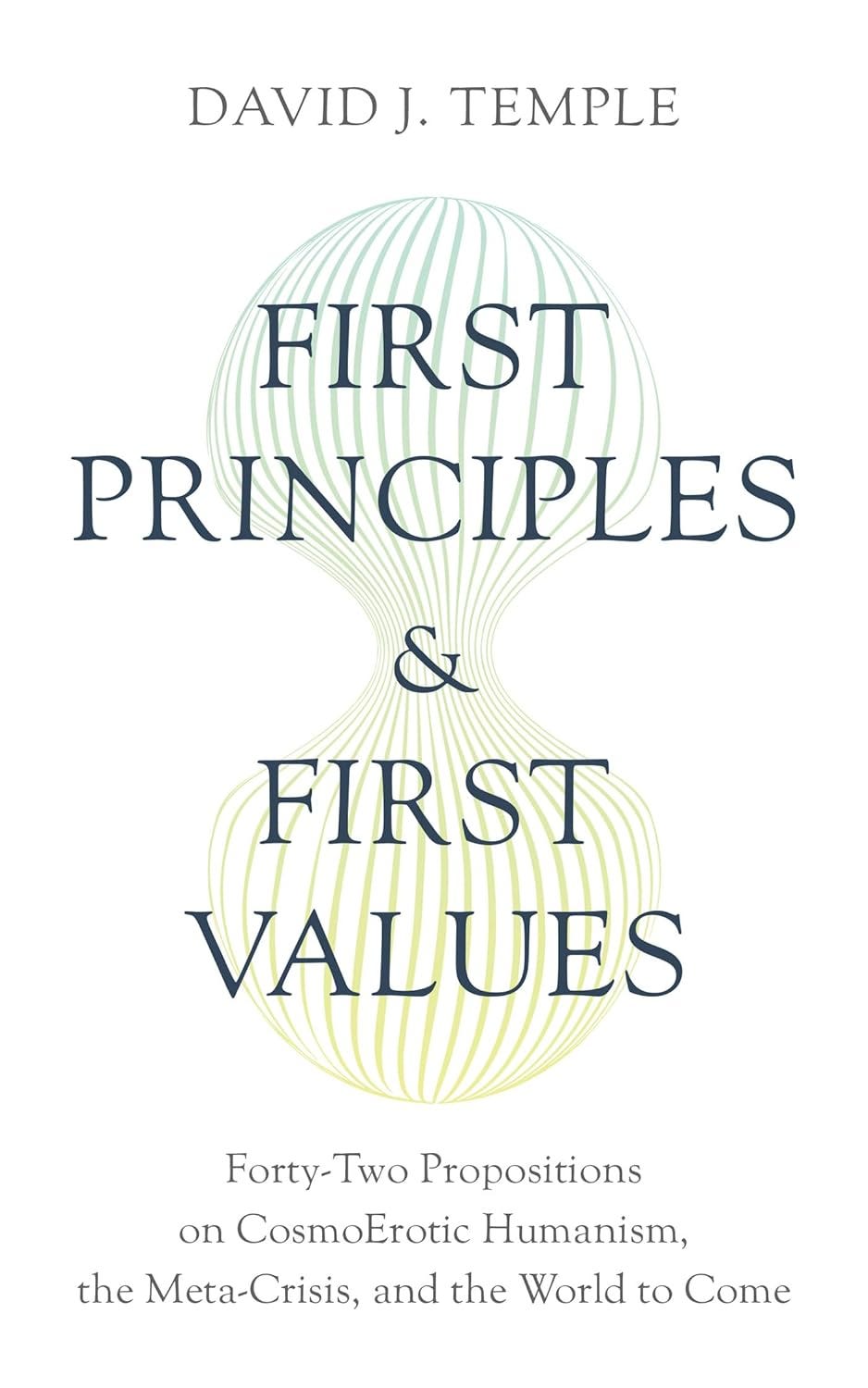
First Principles and First Values is the tip of the spear in the fight for a humane future. Establishing frameworks for a new school of thought called CosmoErotic Humanism, the book is built around forty-two propositions that provide new source code for the future of planetary culture.
Like Europe in the early Renaissance, humanity is in a time between worlds, at a time between stories. First Principles and First Values contains blueprints for the bridge needed to cross from this world to the next.
Join us in articulating a new, shared vision that can act as a bridge to enable global coherence and coordination.
Ken: Let me ask, where does value come from?
Because we were talking about prehension and its reaching out in a creation of meaning and therefore value. So we have to have something like prehension first, right?
Marc: Yes.
Ken: Okay. And prehension is defined as the core of a holon.
Marc: Yes. Now, where does prehension come from?
Ken: And where does a holon come from?
Because we’re hanging value and meaning off of holonic stuff.
In other words, value doesn’t come first before a holon.
Marc: Well, let’s go slow for a second.
In other words, a holon is a part-whole of the manifest universe.
Ken: Right.
Marc: The unmanifest generates the manifest.
Let’s say it a little differently.
I mean, cosmogenesis is under quite a bit of attack these days, but let’s bracket that issue for a second. Let’s just hold it for a second.
Let’s assume the Big Bang for the moments that we still can.
When reality explodes into—and we have those gazillions of quarks that were referred to earlier, raining down, and there’s only 16 basic configurations of quarks, and all the laws of mathematics, with all of the values and all of the mathematical (to-be-disclosed) equations are all operative.
Those are all inherent in reality as it arises, right?
Which is of course, why it makes very, very little empirical sense—forget about anything else—empirically, it doesn’t make sense to understand creatio ex nihilo, as creation from nothing.
It makes sense to make it as creation from no thing.
It’s creation from no thing, meaning no thingness. Right?
Some dimension of infinity generates finitude, which means—let me be an Abhinavagupta acolyte for a moment, right?
Thank you, Sally, for exposing me to Abhinavagupta, and thank you, Ken, for forcing Sally and I to talk like 20 years ago.
Ken: [Laughs]
Marc: When Ken brought Kabbalah to meet in Kashmir Shaivism, that was a successful conversation.
And we did balk a little bit at the beginning, if I recall, right? Back in the day.
So Abhinavagupta talks about a stirring of desire in the infinite.
A stirring of desire in the infinite.
Meaning, infinity desires finitude. Right?
So this something that’s going on other than “oops”, that something, whatever one’s cosmology is, what’s very clear is that the unmanifested infinity desires finitude.
And in effect, that’s what Blake meant when he said, eternities in love with the productions of time, right?
Ken: Right. And this, what comes out of infinity is prehensive.
Marc: Yes. So the tattvas can’t get lost in ultimate tattvaness in the cosmic Shaivite view or the Ein Sof in the sefirot.
I just had my dear friend Art Green up here who wants to, who’s going to join us for one of the future dialogues. He’s a great scholar of Hebraic mysticism and he wrote the definitive piece of scholarship at Yale University Press on Ayin.
On Ayin, on that infinite category.
And one of the issues in scholarship is Ein Sof, or Ayin, in any way separate from sefirot, the 10 luminations of the Tree of Life, and from the manifest world.
In some deep sense, when you read the sources, you realize, no, no, no, they can’t, because that would be duality.
So the desire that is inherent in the manifest is emerging from the infinite.
And how do we know that infinity desires finitude?
Well, there’s Zak.
You know what I mean?
It’s not just infinity desired finitude, infinity desired Zak.
I mean, that’s shocking.
Zak: Especially if he doesn’t know me.
Marc: Right. [Laughs]
It’s such a shocking realization.
You can actually access it in direct meditation, you have the sense of infinity desiring me, infinity therefore intending me. I’m intended.
The sense where you can actually get under your own finitude and experience this prior ontological primitive that’s intending you, then for the first time you actually experience yourself as being welcome in the universe.
We could cry.
You’re not welcome in the universe without that. You’re not desired.
Ken: And where does mathematics fit in this emergence?
Marc: Zak, you want to take a crack before I do? Take it away.
Zak: I’m still hung up on this, which comes first, value, the prehension or the holon—and thinking like, it’s all at the same time insofar as there’s a time.
[Laughs]
That’s how I’m holding that.
Marc: It’s a little bit of a holy trinity.
Zak: And they’re not the same thing.
Ken: When you have prehension, you have to have it encased. All prehension occurs within a holon. And all holons have prehension.
Marc: Which arises in the Field of Value.
Ken: Well, yes, because prehension reaches out and touches something and what it touches is Value.
Marc: Yes, I see what we’re dancing around here. Hopefully we’re spiraling and not circling.
Zak: Let me say that, in Charles Sanders Peirce’s objective idealism, every thing that appears as an object to me is itself a subject. Right?
This is Whitehead as well.
So that table over there actually is looking at me somehow. And vice-versa.
Similarly, as you’re saying, prehension reaches out, it hits a value.
But what is that value? That value is just another prehension reaching out.
[Laughs]
Right?
It’s this way in which the mirrored Indra’s net of all of these interconnected prehensions result in the appearance of objective and creates objective value.
So this question, where is Value? Where does it come from?
It is both the field and the emergent properties of the field.
Because it’s both there, as Marc’s been saying before at all, and yet it also gets increasingly characterized. It gets increasingly featured.
Marc: Yeah. Let’s throw a term on the table. Ken, a term that we played with before.
Temple mentions it in First Principles and First Values, it’s implicit in Sex, Ecology, Spirituality in other ways, but let’s put the term on the table, which is ErosValue.
It’s a great term, and it’s funny because, for many years—and this takes us directly back to the prehension value issue—I would talk about, Value has Eros.
I’d say something like, when we’re in the middle of COVID and one entire part of the political sector of reality believes that if you step out of your house, you will be killing 17,000 people, therefore you are evil.
And then Floyd is tragically killed, whatever happened there, but it was a tragic horror and everyone watches it on their phones.
So they have an experience of Value having been violated and all of sudden, fuck COVID, fuck killing 17,000 people, everyone pours into the streets the next day because Value arouses will. Right?
In other words, whatever was organized or not organized, there was still a spontaneous explosion because there was an experience of having seen Value being violated, which arouses will. And will is a quality of Eros.
I would say, okay, Value is filled with Eros. But then you say well, no, no, on the other side of it, Eros is a value of Cosmos. Right?
Eros is a value. Eros is not just a mechanical description Cosmos, Nietzsche’s point, it’s music. It’s not mechanics. Right?
You know, Nietzsche, famous, the last of the philosophers who pretends not to be a metaphysician, but who’s filled with Fields of Value every other page so gorgeously.
So, Value is Eros and Eros is Value. And then you realize, no, it’s one word.
It’s ErosValue. Right? It’s ErosDesire and ErosValue, or each ErosDesire and ErosValue.
Reality is not Eros and Reality is not Value. Reality is ErosValue.
It’s a new word and it’s a good word. We need to create that new field of language.
And ErosValue means that Eros is the value of Cosmos.
So prehension is value.
In other words, prehension is a value of Cosmos. Prehension is not a neutral mechanical function, it is actually value.
Which takes us back to the inquiry about mathematics, Ken, that you threw on the table.
In some sense, we could say that mathematics, music, and value, all three of those, are all interdigitated. They’re all forms of mathematics of intimacy.
In other words, Value is that structure in Cosmos which causes the movement of desire and which evokes our response.
Life is lived in response to the Field of Value.
What is life? Human life?
Human life, but all life, is that which is lived in response to the Field of Value, that which is evoked by the Field of Value.
So in that sense, thinking of Value as music is helpful.
And music and mathematics, we remember of course, from as far back as the Solomon mystics and obviously Pythagoras, that music and mathematics are flip sides of each other. Right?
They’re actually structurally the same. And we know that music is intervals, it’s forms of mathematics.
I would say, Value is the space in which it all arises, but then Zak, Ken, as you guys say, mathematics exists instantly at the first moment of the Big Bang. And mathematics are all values, they’re unique value structures.
And Value means a particular quality which evokes a field of desires which creates responses. That’s actually what it is.
Ken: I’m getting a little confused here.
Because we start with a series of definitions, rough definitions for prehension, value, meaning, and so on.
And by the way, almost any of the central terms we’re talking about can be hyphenated with all the others.
But when we want to emphasize the relation between Eros and Value, we can talk about ErosValue.
But we were moving towards defining value in a sense as a result or even a product of prehension.
Marc: It’s both.
Now we’re getting to the place we want to try and line and circle and spiral.
Value is both a product of prehension, which I totally understand exactly what you mean, both cognitive, but you can feel it, right? It’s more than cognitive, it’s visceral.
And prehension itself is a value.
Ken: Well, and we can assign the word hyphen value to almost anything.
Marc: Right. Something that gets very hard to disambiguate.
Ken: Right, because every object we see has value, every thought we think has value, every desire we have has certain value. But in all of those cases, it’s in the sense a bit of a product, even though it’s interwoven with the thing that it’s a product of.
Marc: Let’s stay with this for second.
Let’s say, when Abhinavagupta talks about—and Abhinavagupta, as you know, is this kind of materialist mystic. He’s just talking about the nature of what is.
When he describes this stirring of desire in the infinite, the infinite is, in a certain sense, the infinite Value.
The infinite is not just a mathematical set in a neutral sense. It’s not a mechanical mathematical set. By the infinite he means the infinite source of all Value, right?
There’s a stirring of desire that emerges and that desire is an expression of the infinite Field of Value.
Ken: Okay, wait, so now we’re having Value produce products.
Marc: I think it’s both sides.
Ken: Yeah.
Marc: That’s exactly right.
Ken: Well, that’s all I was getting confused over. Having value cause, in a sense.
Marc: Yes, that’s right. It’s both. Literally, Value does both.
Ken: Yeah.
Marc: And in a certain sense, if we get back to that notion of dignity...
In order for my desire to be dignified, then desire has to be a Value.
It’s not just that I desire value. It’s that my desiring has ontological value.
It’s not just, oh, I’m desiring a great car, a great man, a great woman, a great book, a great aesthetic. It’s not just 10 desires, really kind of a very particular kind of aesthetics.
I remember sitting with Ken in 2003-04, showing me the first mockups of Integral Naked in the art.
Ken: [Laughs]
Marc: It’s not just that Ken desires something that has high value aesthetically, it’s that Ken’s desire itself is a Value.
Ken: As long as you take seriously the phrase, “it’s not just.”
Marc: Right. Agreed. This is great.
Ken: And that’s just another way that we add a hyphen between words.
Marc: Yes. I mean, this hyphenation of words is, as I think we’re all pointing to, very important because there’s a paucity of language.
Language has become impoverished.
Zak: And postconventional cognition and perception usually involves the creation of new language, almost necessarily hyphenation of terms.
Some languages like German give themselves to this, like Habermas just makes these huge compound words which translate basically as a sentence in English. But that the hyphenating of the words is innovation with the language necessary to express these higher order cognitions and most metaphysics.
Ken: And that’s a real source of the famous German philosophical tendency.
Zak: I agree.
Marc: Yes, totally.
Because in order for us to enact a new Story of Value, it needs to be rooted, we’ve said, and this is a point that Temple, again, made—and it’s made in other ways in Wilber’s discussions of semiotics, you guys may or may not be familiar, I’ll point you guys to some footnotes—but this notion that we need to lay down what Temple calls a universal grammar of value.
And a Story of Value needs to be based on a universal grammar of value, which itself needs to be embedded in First Principles and First Values.
And those are not quite redundant to each other.
In other words:
There’s a Field of Value, that’s the field that’s beneath all values.
There are actually structural First Principles and First Values.
For example, Reality desires uniqueness. There’s a movement which is called—Herbert Spencer, chapter 15—differentiation and integration. It’s a particular First Principle and First Value.
There’s a grammar of value.
There’s a set, it’s a basic syntax out of which your Story of Value can be enacted, and it’s only that that can generate intimate coherence.
And without intimate coherence in Cosmos, you get extinction.
By definition. That’s what it does.
We’re feeling the need to lay down a new field of language at this moment, which in essence, we’re scaffolding, on integral, integral integrated all its multiple vectors and streams.
And now we’re saying, okay, now let’s enact this language, and a language is essentially code. That’s what a language is.
Ken: And it has a grammar, and the grammar is a system. That’s why.
And system is another word to put a hyphen between everything you see.
Marc: Right. It’s beautiful.
And it emerges from the silence.
Ken: Sure.
Marc: Ken, this is one of the very, very first things we talked about again, I don’t know why we’re harking back today, it just happens to be between 2003-04, this notion in the account of the chariot, Zak, that you and I have looked at together multiple times, where there’s the sense of ḥashmal.
This description of the chariot in Ezekiel and Isaiah and ḥashmal, which means the silence out of which words emerge.
The silence is the Field of Value. It’s a silence of presence. It’s not a silence of absence. It’s the suchness that you talk about Ken, all the time.
So I say we hold here, Davids and holy myth. This is fantastic and gorgeous and yay.
What crazy pleasure. This is great. Love mad, guys.
Zak: Yeah, love you all.
Ken: Much love. Bye bye.
Ken Wilber, Quantum Questions: Mystical Writings of the World's Great Physicists (Shambhala Publications, 1984)
Fritjof Capra, The Tao of Physics: An Exploration of the Parallels Between Modern Physics and Eastern Mysticism (Shambhala Publications, 1975)
Marc Gafni, "On the Erotic and the Ethical", Tikkun 18, no. 4 (July/August 2003)
Marc Gafni, She Comes in Threes: Reality's Plotlines Are the Three Stations of Eros: Trialectics Are the Structure of Cosmos (World Philosophy and Religion Press in conjunction with Integral Wisdom Publishers, 2024
Ken Wilber, Sex, Ecology, Spirituality: The Spirit of Evolution (Shambhala Publications, 1995)
Alfred North Whitehead (1861–1947)
Dmitri Ivanovich Mendeleev (1834–1907)
William James (1842–1910)
Charles Sanders Peirce (1839–1914)
Rudolf Steiner (1861–1925)
Paul the Apostle (c. 5–c. 64/65 CE)
Augustine of Hippo (354–430)
Dennis Prager (1948–present)
René Descartes (1596–1650)
Abhinavagupta (c. 950–c. 1020 CE)
Sally Kempton (1943–2023)
Arthur Green (1941–present)
Friedrich Nietzsche (1844–1900)
Pythagoras (c. 570–c. 495 BCE)
Jürgen Habermas (1929–2026)
Herbert Spencer (1820–1903)
If you’re enjoying these deep dive conversations with Dr. Marc Gafni, Ken Wilber and Dr. Zak Stein, then we have an epic opportunity for you to come closer and dive even deeper on your learning journey.
Join us at the Who We Must Become community, the band of Outrageous Lovers reclaiming meaning, value and purpose at the center of culture, in response to this great moment of metacrisis.
With daily practice, weekly study sessions and a plethora of new courses, come learn together and meet the ones who are already comitted to this path towards personal and planetary transformation.
Comments
Nothing yet. Say the first thing.
Sign in to join the conversation.