
About the podcast:
These are unscripted, early David J. Temple conversations where Dr. Marc Gafni, Ken Wilber and Dr. Zak Stein are unfolding the inner workings of CosmoErotic Humanism in real time. Formal statements and propositions will be published in forthcoming volumes by the World Philosophy and Religion Press.
Listen on your favorite podcast player
About this episode:
What if the simple act of paying attention was one of the most powerful forces in the universe? We often think of attention as something we do, but what if it’s something that does things—something that actually shapes the world around us?
In this dialogue, Dr. Marc Gafni, Ken Wilber, and Dr. Zak Stein propose a radical new idea: that attention is a First Principle of reality, a fundamental value that gives rise to everything else. They explore how this value expresses itself across five different dimensions of existence: the mathematical, the musical, the molecular, the moral, and the mystical.
You’ll also hear them discuss the deep connection between value and “gravitas”—the weight that creates integrity and coherence in reality. By the end of this conversation, you’ll be introduced to a completely new understanding of how the universe is held together and the crucial role your own attention plays in the unfolding of it all.
This is the fourth in a series of dialogues between Marc Gafni, Ken Wilber, and Zak Stein, reconvening after the release of First Principles and First Values.
If you deploy any material from David J. Temple in this episode, please cite directly using the following reference:
Temple, David J., Conversations with David J. Temple, World Philosophy and Religion Press, August 2026, Episode: “The First Principle and First Value of Attention; The Mathematical Value, to Musical, to Molecular, to Moral, to Mystical Value; Introducing ErosValue”
Get the book:
First Principles and First Values is the tip of the spear in the fight for a humane future. Establishing frameworks for a new school of thought called CosmoErotic Humanism, the book is built around forty-two propositions that provide new source code for the future of planetary culture.
Like Europe in the early Renaissance, humanity is in a time between worlds, at a time between stories. First Principles and First Values contains blueprints for the bridge needed to cross from this world to the next.
About the Authorial Voice of David J. Temple:
David J. Temple is a pseudonym created for enabling ongoing collaborative authorship between Dr. Marc Gafni, Dr. Zak Stein and Ken Wilber at the Center for World Philosophy and Religion, a leading international think tank whose mission is to address existential risk by articulating a shared universal Story of Value for global intimacy and global coordination. The Center focuses its work on a world philosophy, Cosmo-Erotic Humanism, as the ground for a global vision of value, economics, politics, and spiritual coherence.
The Center for World Philosophy and Religion is a reader-supported publication. Consider becoming a paid subscriber and get instant access to a 7-day self-study course with Dr. Marc Gafni valued in $297, for only $9/month.
0:00 — Introduction
1:01 — The Critique of the Tech-Plex Has Fallen Flat Because Its Critics Are Not Willing to Declare Attention as a Value
3:57 — Framing the Inquiry: Where’s The Continuity of Mathematical, Musical, Molecular and Moral Value?
8:38 — There are Two Dimensions to a Value: Quality and Configuration
12:19 — Three Things True of Every Value: Irreducibility, Depth, Quality
13:21 — Value Is Wholeness that Evokes Wholeness
16:06 — The Idea That a Part Ever-Evokes the Whole Is Present Across Several Domains
17:55 — The Elder and the Child Are Valued for their Different Forms of Evoking the Whole: The Elder’s Integration and the Child’s Undeterminedness
19:14 — We Could See Mathematical Value as Truth, Musical Value as Beauty, Molecular Value as Goodness
22:32 — Ken’s Question: What’s the Relationship Between Value, Gravitas and Weight?
23:39 — Part of the Nature of Mental Breakdown Is the Incapacity to Weight Things Properly
26:14 — Midah: Weight, Measurement, and Value in One Hebrew Word
28:58 — About First Principles and First Values
29:52 — There Is An Ancient Connection Between Weight, Our Ability to Measure It and the Value that Exists
31:59 — There’s Only One Gravitational Field: The Field of Gravitas Is a Moral Field
36:07 — Love Is Goldilocks: It’s Precisely The Right Weight Between Allurement and Autonomy
36:51 — You Can Be Wounded By Wrong Weighting
38:15 — Right-Weighting Is a Practice, Not a Finicky Thing
39:51 — Gravitas Is the Weight of Evolution
40:32 — Value Confers Dignity Because Value Means: You Are Weighty, You Have Gravitas
42:11 — A Number Is Always Telling a Story: A Question Left on the Table
45:12 — About Who We Must Become
End — Mentioned Sources
End — Mentioned People
Listen on your favorite podcast player
Marc: Zak, Ken, I want to try and clarify a couple of things here, throw some stuff down on the table, and then open it up in our usual style.
Ken, Zak and I were talking about—we wanted to share with you, but probably for next conversation—that as we deepen into value, we thought of the three of us taking one particular value which is not viewed as a value: attention. Paying attention. Attention as a value.
And you know, David J. Temple, being the three of us in this moment, has been talking a lot. These two components of David J. Temple, I would like to talk to that expression of David J. Temple about this value of Attention.
It is wildly important because, if I can just frame it in a sentence: you have someone like Shoshana Zuboff, who writes Surveillance Capitalism—just one example of a book—screaming against the tech-plex for essentially stealing attention. But then when she tries to locate what’s wrong with that, she makes this complete—what Walter Kaufmann, if you both remember, called “intellectual gerrymandering.” She makes this move and says, wow, attention, Sartre talks about the first person—and then she quotes Being and Nothingness.
Ken: [Laughs]
Marc: So she puts the apostle of cosmic meaninglessness as a source for critiquing the tech-plex for stealing attention. Meaning, she’s not willing to declare attention as a value. So, after we finished the meta-conversation on Attention, on Value, we want to turn our attention with you together to particular instantiations of Value which have enormous implications.
In some sense, David J. Temple might argue that one of the reasons the critique of the tech-plex has fallen flat is because—paradoxically—Shoshana Zuboff agrees, in her ground, with the people she’s critiquing: that there’s no Field of Value.
And so they’re like, huh.
Zak, you and I had talked about that the other day—when I was thinking, Ken, maybe when I come out, or we come out, we could spend that day just talking about attention. It would be crazy fun. And obviously your Buddhist training—that dimension of you—obviously has a lot to say about this, right?
Ken: Right. It does.
Marc: Okay, so I’m going to dive in. Again, thank you for your forbearance as I take a few minutes—then I will, as the Talmud says, third century, shut the fuck up, and turn it to you guys.
But I’m going to take a little time to try to identify a very particular issue which is core to this whole conversation. It takes us precisely to the next step. So, just bear with me to unfold a little bit, okay?
Marc: We could talk about Value in several registers at once:
Mathematical value.
Molecular value.
Musical value.
And—other than the fact that they all begin with M, which is helpful—we could add a fourth: moral value.
Now we already have, even in our framing, a very important and interesting thread.
In other words, there’s music at the very beginning of Cosmos. There’s an enormous literature of the kind of gong music that moves through Cosmos. Our friend Howard Bloom has collected a lot of that literature in his footnotes on pages 39, 40, and 41 of his The God Problem. One of his most interesting sections is where he adduces that literature; he has a good set of footnotes there.
But yes, we know there’s music at the beginning of Cosmos.
In other words, Cosmos does not emerge from music—part of manifestation is intervals in music, etc. So there’s music, there’s musical value. There’s clearly mathematical value at the very inception of the Big Bang...
Ken: Why are you limiting it to four values?
Marc: I’m being arbitrary. Completely arbitrary.
Ken: Okay.
Marc: This is just a way of talking about a broader field. This is not a clear boundary, and these are not absolute categories, as in, like, four quadrants in any way. These are just—if we can borrow a term from my Bar Mitzvah—a smorgasbord of values, right?
Zak: It was illustrative and alliterative, right?
Marc: That’s right.
But the point is that these are, from the inception: you have mathematical value, you have musical value. You don’t quite yet have, but you’ll have very soon, molecular value.
But you start very early with what we talked about last week—two up quarks and a down quark as a proton, two down quarks and an up quark as a neutron. Those are values that are going to lead to that reality—that leptonian, muonian, or hadronian reality is going to lead to an atomic reality, which is going to lead to a molecular reality.
So let’s talk about a molecular value just to stand for that whole vector.
I’m obviously jumping forward a little bit. And obviously, at some point, we’re going to incept a conscious realization of a moral value.
What we’re saying is that there’s this principle of continuity and discontinuity.
Clearly, we’re not making an absurd animistic claim that there’s a necessity for relational therapists to deal with protons and neutrons in the first nanoseconds after the Big Bang because they’re attracted and allured to each other, and they love each other, so they need relational therapists.
No, we don’t think that. [Laughs]
Clearly, there’s a principle of discontinuity.
In other words, the molecular attraction, the allurement, and the particular values—let’s say in the molecular vector, which goes all the way back to quarks—that’s not the same value that Dostoevsky is trying to figure out when Raskolnikov kills the old woman and wants to know how he feels in the aftertaste.
At the same time, we’re actually saying: there’s a continuity between those. There is an omni-coherent Cosmos. Those are not dissociated from each other.
This Raskolnikov aftertaste, when he kills an old woman—it doesn’t quite work for him well. That sense of dis-ease is not because he’s violated a social construction. Actually, Raskolnikov is filled with the molecular vector, the musical vector, and the mathematical vector. All of those lead to the moral vector. It actually emerges out of them—there’s continuity.
This is the principle of continuity and discontinuity, and Zak, as we’ve talked about often, there are intellectual sins on the side of continuity, which overstate continuity, and intellectual sins on the side of discontinuity.
But what we want to talk about today is: I want to try and throw out two or three formulations on how we would view that relationship, very precisely. Meaning, where’s the place? What’s the continuity? Let’s look today at the continuity, because we know the discontinuity. But what’s the continuity?
What’s the sense in which value means something in a shared sense—there’s a shared semantic field, a shared semiotic field, all the way down and all the way up the evolutionary chain?
That’s our frame.
So I want to make a couple of very simple suggestions—and here we need to be in the realm of second simplicity, so these are kind of second-simplicity suggestions—which would go something like this.
Marc: In a certain sense, there are two dimensions to a value.
One is that a value is a quality. It’s a particular quality of Cosmos.
We were listening—we were listening to Beethoven’s Fifth before, that we talked about. It’s so stunning. I mean, the first ninety seconds of Beethoven’s Fifth, they blow your heart. We just kept listening to it again and again and again. And it starts just with—da-da-da-da—right? And then it just goes...
The first ninety seconds are shocking, and it evokes a musical value. No matter how you interpret that value—that value might evolve, it might be interpreted by different conductors and different maestros—but there’s a value there.
It’s clear. It has a certain stability, just like in chemistry, a chemical has to have a certain stability. When we say it has a certain stability, we mean it’s real. It participates in some eternal dimension. It’s not just contrived. Once it’s there, it has a stability, and it’s a particular quality of Cosmos that evokes wholeness.
Right? It evokes wholeness. This is where wholeness is so important.
So:
1) A value is a quality of reality that either:
a) evokes wholeness, or
b) generates more wholeness, or
c) plants the seed for more wholeness.
Or another way to say it might be: it evokes more possibility.
Ken, you and I talked about this—my God, it was like 2004, I think I still have the recording of that loft dialogue. We talked about this phrase in Maimonides, where he talks about the famous Aristotelian notion—or medieval, it became much more popular then—of the not-possible. In other words, there’s nothing that’s not possible about the Infinite, meaning the Infinite or the Divine, in his perspective—The Guide for the Perplexed, chapters 50 through 70—the Infinite is the Possibility of Possibility.
If someone puts a gun to your head and says, “give me a definition of God or I’ll blow your brains out,” this is one possible way to save your life. It’s not bad:
God is the Possibility of Possibility.
It’s an ultimate wholeness in the sense that it contains all possible wholenesses, and it’s a wholeness that alludes to, that evokes, that generates, that seeds—four different words—more wholeness.
God is the Possibility of Possibility.
Another way to say it—a different dimension of value, which is slightly different but inter-included, not redundant or isomorphic—is:
2) Value is a configuration of parts which generates new possibility.
Now, I have to be precise there, because beauty, truth, goodness—let’s take that big three—those are all qualities, but they’re not qualities that live in isolation. Goodness obviously doesn’t, but neither does beauty. Ken, you have talked a lot about beauty as right relationship between dimensions.
So there’s the sense of value as a quality—or configuration of parts—that evokes new possibility, or greater possibility, or greater wholeness.
That’s a way to begin to discuss value. And here’s what’s so crazy and interesting: this value is this particular quality that evokes more possibility.
Marc: So:
It’s a quality that’s irreducible, that’s irreplaceable. It’s not reducible to another quality, not replaceable with another quality.
It has its own particular depth.
It points towards, it incarnates, a quality—a qualia of Cosmos—that’s not exchangeable with anything else, even as it evokes more potential wholeness, more possibility.
That’s true about the mathematical, that’s true about the musical, it’s actually true about the molecular, it’s actually true about the moral.
So, okay, now we’re in a conversation.
When you go to the core of them—how they actually function at their very, very constituent essence—there’s actually a similar, profoundly inter-included, even overlapping, even isomorphic, functioning.
This has been keeping me up, literally, all week. Right? Because we’re so close. It’s that leap.
What are you thinking, Ken?
Ken: You said value contains sort of two aspects.
One is quality, which evokes wholeness.
And the other is the configuration of parts, which evokes wholeness.
So we’re doing a lot of evoking of wholeness.
Marc: Well, you could say it is wholeness. It is wholeness.
Ken: Well, that’s what my question is. A value is wholeness.
Marc: That’s valid. Absolutely. A thousand percent, holy brother.
In other words, it actually is wholeness that evokes wholeness. Right?
It’s wholeness, which is, in some sense, your secret lover, Ken: the holon. It’s both whole onto itself—it is wholeness onto itself—and yet it evokes.
Ken: Right.
Marc: Because it’s a part of more wholeness. So it’s always evoking.
That’s right. It’s actually ever-evoking. It’s never static.
Ken: Right.
Marc: And it does it in different ways. We just kept listening, as I said, again and again, to the opening of the Fifth. And each musical value is both its own wholeness, and yet it’s literally evoking the next...
Ken: The whole that it’s a part of.
Marc: The whole that it’s part of, even though it’s a whole by itself.
And all of a sudden—the moral, the mystical, the molecular, the mathematical, and the musical, all five—you notice I slipped in another one. Because the mystical really is: I’m part of that larger wholeness. That’s what the mystical is.
The mystical is actually the realization that I am both whole, and I participate in that larger Field of Value. And then I’m ultimately isomorphic with that larger Field of Value, even as I’m irreducible.
And that was, Ken—remember when we were reviewing Unique Self at some point for JITP, the Journal of Integral Theory and Practice, one of the editions—as we talked about it, our friend Andrew, bless him, was talking about uniqueness being social, psychological, and cultural conditioning. And we said to Andrew—who we were loving dearly—we said, no, no, uniqueness is irreducible. Right?
It’s non-exchangeable. It’s not “merely”—it’s irreducible.
I am both an irreducible value, and I’m part of the larger whole at the same time. That is the mystical.
So all of a sudden, our alliteration, Zak, is doing well. We’re going to stop at five, right?
Ken: [Laughs]
Marc: But it’s very exciting, because we’re so in second simplicity here. We’re in kindergarten, which is the most advanced. Right? So, yay.
Zak, what are you thinking there?
Zak: I mean, the notion of the part ever-evoking the whole that it is a part of—even if it can’t quite grasp it, and even if you, seeing the part, don’t see that whole—is super interesting.
So as a piece of music begins, there’s something implied already, that is held in the completion of the end and the total listening.
In the single tree in the forest, you have this sense of containment of the entire forest, and the region, and the ecosystem, and the biosphere, and all that stuff.
There’s this ever-evoking, echoing harmonic.
And that idea is a pretty simple idea: the acorn and the oak, the sapling and each stage of the tree.
In human development, there’s that classic idea that you can see in the child, and then in the adolescent, that form that’s taking shape—which is very interesting. It’s not deterministic.
That’s what’s interesting to me about improvised music as opposed to written music.
You could sit with the Fifth for days and weeks and months with that introductory section, but then you have John Coltrane, who never played the same thing twice and yet had the same ability to evoke, trans-temporally, across genre and referencing prior—like, even ancient and canonical, hymnal and children’s tunes on the playground. All these things that you’re able to get into this association—the more of that you bring in, the greater the value of the gesture that’s being made.
The more that the gesture evokes that total personality, the more that has this value—there’s something in the charisma there.
The ability to speak from that total set of Self, and even the potential self you could be, and all of that stuff, is what’s brought.
Zak: That’s very deep from a meta-psychological, myth-of-the-self, personal-mythology place, which Marc and I have been working on.
That sense of—why are you more valuable as you grow older and mature and become more integrated? Why is the elder held in reverence? Or should be, ought to be.
A properly valued culture would hold the elder in reverence because of this—because of the structure of value. It’s how you get that integration.
And why is the child uniquely valuable?
Because so much is yet unset, because there’s so much potential value, because the possibility of possibility is more present in the child—you could argue. Because of the undeterminedness. And yet, clearly, the child depends on the elder, and the adult depends on their parent.
So there is that transmission of value.
The ever-evoking and the harmonic self-reflection, very much like Indra’s Net with the holonic theory, gets very deep.
Marc: Yeah.
The good, the true, and the beautiful are, of course, always both values onto themselves and inter-included with each other. That’s generally true.
Marc: Ken, you and I had a great conversation when we were doing Integral Sexuality—our first take on the seven levels of Eros, back in the day, which was massively fructified by our conversation—and that was, of course, an opportunity to use the word “fructified,” which one should not pass up easily.
But we were talking there about pleasure, and that pleasure would seem to be its own vector. The aesthetic, the beautiful, obviously, but we, the think tank, are now completing a book that we’ve been working on for a very long time, which is basically about pleasure as the source of ethics, and this notion of what Stuart Kauffman’s wife, Kathy, in one of her articles, calls “quantum hedonism”.
This notion that, if I would sum up the way we understand it: evolution evolves because it feels good.
In other words—as a very core notion, you and I talked about that then, Ken, you formulated, I believe, very beautifully, this notion of the interior of Eros being pleasure. I’m bringing together these conversations.
So one of the things we were moving towards then was the sense that pleasure, the beautiful, is inter-included with the good. And so now we’re completing—it’s been actually a ten-year project, since 2014. We did, like, a thirty-hour seminar on this notion of pleasure as the source of ethos.
But of course, what we mean by pleasure, to say it in a sharp way—in a painful way—is this: a couple walking to the gas chamber is getting more pleasure than the Nazi guard guarding them.
So when we talk about pleasure, obviously we’re talking about a very discerning sense of what levels of pleasure are, and what cultivation of pleasure is, et cetera.
Having said that—even though they’re inter-included, and that’s a whole conversation about the inter-inclusion of values with each other—we could for a moment step back from the inter-inclusion and think about mathematics as truth, music as beauty.
And the we could think about the molecular vector in terms of goodness, simply because it’s the coming together—it’s always a relationship between parts. The molecular vector is always about an intimate configuration, and other chemicals have a lot of chemistry, as we said last week.
So it’s actually very interesting that, in terms of value:
You have a mathematical vector in which the value is truth.
You have a musical vector in which the value is beauty.
You have a molecular vector in which the value is goodness.
Which is helpful just to see—that in different vectors, even though there’s an inter-inclusion between the value vectors, there’s often a primacy of one, a center of gravity of one. So, I think that’s helpful, right?
And then the second thing I thought was worth us talking about is the evolution of value. Part two, right? Let’s think about the evolution of value.
Ken: I want to ask a question before. How does value fit in with the notion of weight?
Marc: Gravitas.
Ken: Gravitas, weight—and how precisely does it do that?
Because weight tends to just be a thing, as opposed to value—say, attention. Attention is both a thing and a tool.
Marc: Yeah, I love that. Yeah.
Ken: I mean, weight is just the weight of something. You don’t usually use weight to get to something else. Like, you can use attention to get to something else.
Marc: Say a little bit more about how you’re using the word weight.
Ken: When I think of value, I think of the weight that I give something. It has value, it has weight.
Marc: That’s right—no, I love this. This is crazy exciting. My God, wow.
So, Zak, I’ll take a crack and pass it to you, brother. Okay?
I love that inquiry. I’m going to go from a kind of clinical place to a semiotic place, and move between them.
Marc: I want to start in the clinical place for a second.
I’m talking about our colleague, Ken—you’ve met her, she came to the loft with me, we’ve talked about her over the years. Zak, of course, you know her well—she was our board chair of the center in, 2013, ’14, ’15: Laurie Galperin, who is a brilliant clinical practitioner and theoretician.
Laurie is anti-cooking. Laurie, I apologize for sharing this publicly, because I assume you’ll hear it. We ate out every single night, seven nights a week. That was, you know—a lot of wine, man. That’s a lot of wine. And Laurie has several glasses of wine at dinner, so dinner was always good.
And what we would do, at the end of the day, without breaking any Hippocratic oaths or any confidentialities, we would go over her cases and talk about them, to try and understand them.
Zak: That’s probably worse than “she’s not into cooking,” I would say.
[Laughs]
Marc: Right. And most of the time, Ken—we were talking about, Zak—we were never able to quite work that out, so we just kept talking. But seriously, what emerged was something really fascinating, it was that part of the nature of mental breakdown was the incapacity to weight things properly.
I remember there was a particular story of a particular woman—I’m going to give her a name, I’ll call her Gila—that I knew when I was, I don’t know, 25, 27, 28. And she would always get these great jobs in Israel—fantastic jobs, assistant to the president, you know, incredibly high-powered jobs. And she would always get fired, or quit, within about three months.
And she would always come to me and my friend, Gedalia, Gary, she’d say, you know, he or she, whoever the boss was, said this, and that’s outrageous, and therefore I had to quit.
Now, it’s not that she was wrong—she wasn’t wrong, she was actually generally right that that was somehow out of bounds. But the way she weighted it was off.
And so one of the things that Laurie and I began to notice was that when we’re looking at the difference between bipolar one and bipolar two, the issue is always how you weighted something. Often a bipolar person saw something with more clarity, but with a worse capacity to weight it properly, right? The values.
Ken: Their values are screwed up. Right.
Marc: There was an inability to evaluate. The evaluative function is a function of weighting.
Ken: Right.
Marc: Now, here’s a crazy thing. Zak and I had a period—I don’t even remember why—where we stopped doing Holy of Holies, like, in the first half of 2011 or something like that. And I remember the first time we came back together—and Zak, of course, is one of the world’s experts in measurement, that’s Zak’s field—the first Holy of Holies we started again, I can remember where I was, I can remember the conversation.
Zak: Yes, that’s right. Me too.
Marc: We talked about the Hebrew word midah. Midah, a classical biblical word which means both measurement, weight, and value. The same word.
Ken: Right.
Marc: You’re directly speaking, brilliantly, into the semiotic field, where value is related to two things, both dimensions of value.
One is: the right relationship between parts is the right weight.
In other words, the valence—the atomic valence—is the right-weighted relationship that forms the configuration of intimacy that gives it a particular value, from which its strength comes. In Latin, valentia.
Valentia is to be strong, to stand strong—it’s the stability. The valence comes from the currency of valentios—Eros—which is based on its valence, its right relationship, which creates its self-evident validity, which is the source of its value.
You have this very beautiful semiotic field, and out of that comes the hero—and the hero is the one who has valor. Prince Valiant. And they weight things the right way.
It’s this very deep relationship.
And Zak, I’m crazy excited to hear how you’re going to think about this in terms of metrics—in terms of weighting—but they’re very deeply intertwined. It’s very exciting.
Ken: And weight has a physicality to it, which brings in that whole material dimension of all things. And that’s an important evaluative tool.
Marc: Yes.
Ken: When we think of value as the weight that we give something, if I really value something, I give it a lot of weight.
And a lot of weight, if you just take weight in its straight-out meaning, as physical heaviness—then that points out that whatever values we’re talking about, they do have a very real physical dimension, because they have a weight. And that hooks the four quadrants together, and all sorts of stuff.
Marc: Yes, I get it. Huge. It’s hugely important.
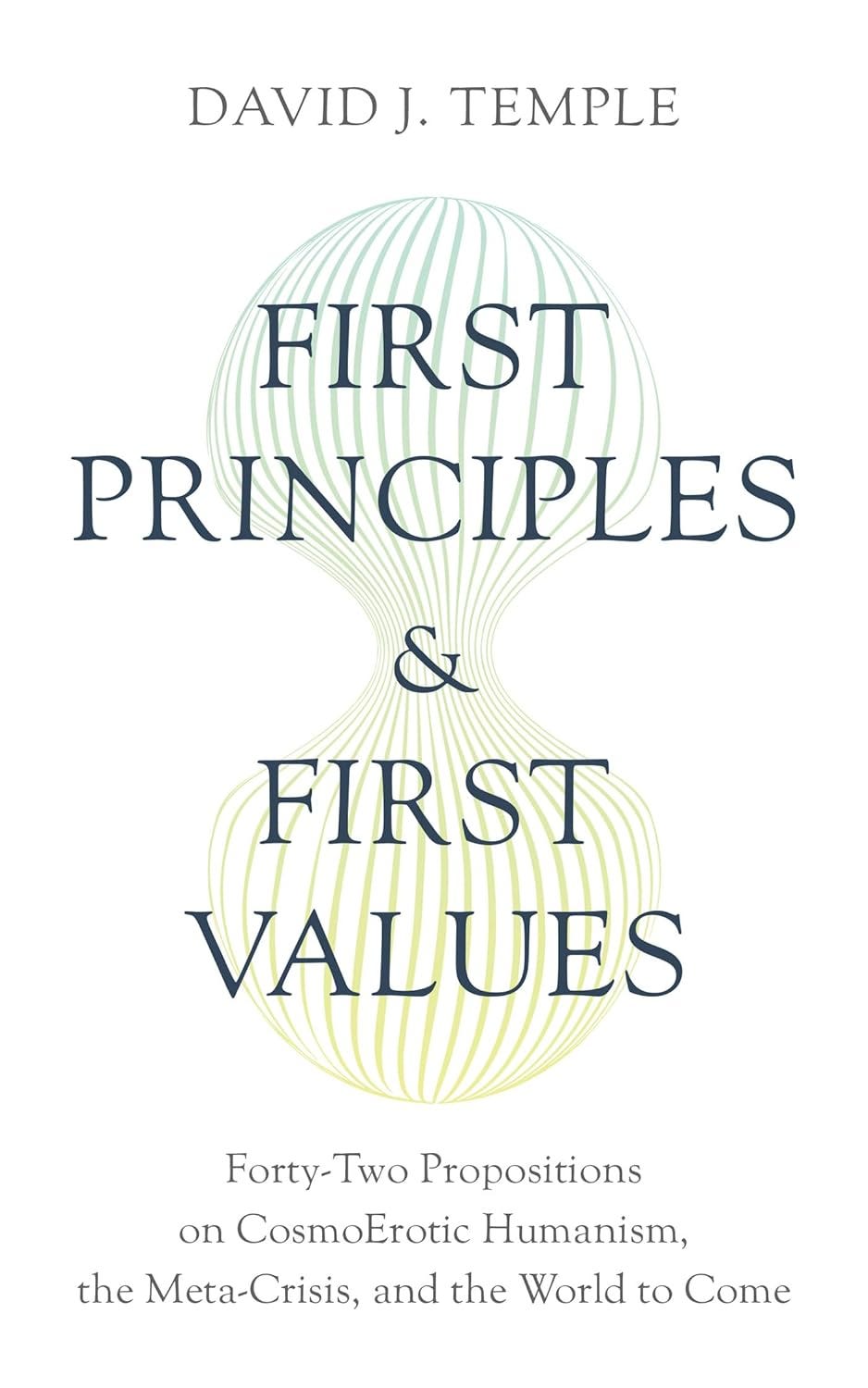
First Principles and First Values is the tip of the spear in the fight for a humane future. Establishing frameworks for a new school of thought called CosmoErotic Humanism, the book is built around forty-two propositions that provide new source code for the future of planetary culture.
Like Europe in the early Renaissance, humanity is in a time between worlds, at a time between stories. First Principles and First Values contains blueprints for the bridge needed to cross from this world to the next.
Join us in articulating a new, shared vision that can act as a bridge to enable global coherence and coordination.
Zak: Exactly. Yeah, totally. And if I go back to the ancient world, you think of monumental architecture, and why we would build pyramids and other things?
They’re massive physical objects, Stonehenge, these huge obelisks, these things were literally endowed with the most value. The sacred place was the place with the biggest, heaviest objects, basically. [Laughs]
Move a little forward in history, and you get the first laws—the laws of Manu, the laws that held the ancient Mesopotamian city-states together—and they were about measurement. A lot of them were about weight: are you dealing fairly in the marketplace with the weights of different things?
And currency piggybacks on the scales in the marketplace that say, this weighs as much as that, and therefore it’s worth this.
Then you move up into the Middle Ages, and you get all this folklore about unjust weights and measures with the different fiefdoms and the different aristocrats, each king has its own foot, and literally it’s the foot.
So you’re tying the value of the royal body itself to the thing you use to gauge distance.
Ken: It’s worth its weight in gold.
Zak: Yeah, it’s worth its weight in gold.
Ken: [Laughs]
Zak: There’s a very deep connection between literally the weight of things and our ability to precisely gauge differences in how heavy something is, and how much value there is.
The original coinage was—in Fort Knox, you had gold that was represented by paper, you had the gold. The coinage was the gold, the bullion. Then we had it represented.
And now there is no actual thing that backs the value of the currency, except measurement infrastructure. Except the sensor networks and the different measures that determine the precise weight and precision mechanics of the stuff...
So yeah, it’s a very, very interesting connection.
Ken: Well, that’s obviously, weight is an important consideration. And it does tie us in with the physicality of all value.
Marc: Let’s talk about that, this is important. Let’s stay perhaps in the semiotics, and then move from that to the felt, the cognitive, intellectual, conceptual.
So when we say something has gravitas, it means it’s weighty. This is a weighty issue. It’s not a flimsy issue, it’s not a light issue.
This is not Kundera’s Unbearable Lightness of Being. This is weighty.
And what we’re saying—it’s very beautiful—you’re talking about the relationship, Zak, between weights and currency.
So when we talk about valences, obviously we’re talking about currencies, if you will. And currencies are always—in other words, Reality is a currency of ErosValue.
Reality is a currency of ErosValue.
If you will, there are currencies of ErosValue, and then you need to evaluate: what is weighty?
So in some sense, you might say there are two forms of gravitational field.
You have one form of gravitational field which is, in an obvious way, about the weightiness of things—and that’s why, the image that a school child grows up with is of the apple falling down. That’s how we learn gravity, that’s the image we have of gravity.
And yet, at the same time, the gravitational field is a field of allurement and autonomy—whether you want to use terms like prehension, Ken, which I know you love, or we want to talk about allurement and autonomy all the way up and all the way down, or the lures that Whitehead talks about in Process and Reality.
Allurement means there’s this Eros allurement, which is in dialectical tension—and a constant larger wholeness—between allurement and autonomy, which is not a fifth force, but it animates the four forces. And one of those is the gravitational.
So this gravitational field is a field of gravitas, and of course it’s interiors and exteriors, all the way up and all the way down.
Of course there’s a field of gravitas. Of course there’s a gravitational field, which is about right weight, right value between things.
And again, this is what’s critical—the place where Brian Swimme’s approach to The Universe Story becomes not weighty—and blessings to Brian, if you’re listening, brother, blessings, we talked to him a little bit—is that it makes a mythopoetic move.
It says: there’s gravity—physical gravitational—and then there’s gravitas in Cosmos. Well, no. Actually it’s one Cosmos. And there’s a principle of continuity and discontinuity.
So yes, we’re not animists. But we’re also not ruptured, truncated, dissociated beings who are dangling modifiers in reality, or not part of the coherent grammar of reality. When you dislocate a person from grammar, they begin to stutter, and ultimately they become mules, they go silent and commit suicide.
So what we’re saying is that the gravitational nature of reality—which is the precise relationship of allurement and autonomy—is a moral relationship.
Ken: And there’s only one gravity field.
Marc: And there’s only—right, thank you, deep bow—exactly.
So actually the relationship between allurement and autonomy is a moral relationship.
Now, it might be an unconscious, implicit morality of Cosmos, but Cosmos is pretty fucking moral—because Cosmos militates towards life.
Cosmos is this huge militation towards this improbable, fine-tuned set of constants that somehow generates this thing called life.
Ken: Right. And it has arrows built into it. And that’s why it’s moral.
Marc: Yes, yes. That’s why it’s moral. That’s exactly why.
That’s what we were talking about a couple of weeks ago—maybe it was already a couple of months ago, in Boulder. That’s why you can’t say the word Eros without saying the word value. It’s a wrong word. It’s a mistake. It’s deceptive.
Ken: Gravitas. Gravitas is a great addition.
Marc: Gravitas, right, is great. It’s fantastic. Gravitas is really, really important.
Maybe last sentence: love is not allurement. Zak, I remember when we had this first conversation, back in 2015, right…
Ken: Love is gravitas.
Marc: Exactly. It’s gravitas. And gravitas is exactly the right-weighted relationship between allurement and autonomy.
If there’s too much allurement, there’s suffocation.
If there’s too much autonomy, there’s dissociation and alienation.
So love is not—we’re coming close. Love is Goldilocks. It’s just right. The right relationship between allurement and autonomy. It’s so fucking precise. Weight is everything.
Love is Goldilocks. It’s just right. The right relationship between allurement and autonomy.
Marc: If I could just say one personal thing—it’s a silly way to say it, but quite serious. My son got quite seriously injured. He’s okay, but he got quite seriously injured in the battle in Rafah. And I mentioned this to Colin in an email—but he wasn’t hit by a bullet. That’s not how he got injured. He was injured by wrong weight.
He leads a bunch of commandos. They’re carrying an enormous amount on their backs. They’ve got so much weaponry on them, launchers… He sends me sometimes pictures before they go out, and it’s like, don’t send those to me, I don’t want to see them, just tell me when you’re back.
But they’re weighted down. And the army didn’t actually have the right backpacks—they’re not backpacks, they’re these huge… And it was packed fast, incompetently, so the weight was slightly off, and he was moving very, very fast. He just got thrown onto the ground, and spasms—he couldn’t move for a week, and then another six weeks of intense pain. And now he’s going to be working on his back for the next five years, at least.
Ken: God.
Marc: But it’s weight—literally, in the strangeness of the intimate universe, it’s weighted the wrong way. It’s not about what’s in the bag, but it’s precisely how it’s weighted. And the gravitas is your ability to move between and balance the weight and get to the right place.
Marc: So on that—and I would just say one other image. Ken, we’ll take you a little bit into Zak-Marc world, at least one piece of it that’s interesting.
Zak and I have, for many, many years, an enormous rigor around right balances between autonomy and communion. So often I’ll leave a message about something, and I’ll erase it three times, so I can say it the right way, so that, whoever’s side it happens to be on, we pay a lot of attention to that. It’s this kind of right-weighting, right? Because it’s very easy, when you’re moving fast over many years, to have the band break up. And the band always breaks up because of bad weighting, and not paying attention to weighting.
I think that’s right, Zak. We pay an enormous amount of attention to right-weighting—not as a kind of finicky thing, and not as a lack of fierceness, but as a fierce commitment to right-weighting.
Zak: Yep.
Ken, you and I have done that over the years many, many times. So yeah—this quality of precision, and value.
Ken: Right weight.
Marc: Right weight.
Here’s my suggestion, you guys correct me: we have a whole new topic, but let’s start that next week, because it’s really, the evolution of value. That’s much more than ten minutes. We only have ten minutes left.
So I’m thinking—I want to have a right-weight moment, although I’m dying to get to the next topic. But this is such a good completion.
Any weighty comments remaining on weight?
Zak: Well, sometimes it’s good to wait. And there’s a value in the waiting. In fact, psychology confers us—sometimes the waiting is better than actually the getting of the thing.
Ken: And our connection to next week is that gravitas is the weight of evolution. It’s what moves evolution.
So we’ve got value built in to evolution. And the entire universe—every single holon in the universe is evolving because every one of them has gravitas.
Or value.
Marc: Value, value. Right, completely value, complete value. Two things are worth saying, just so we’ll be semiotically appropriate.
The Hebrew word for honor—kavod—as in Psalm 8:5, kavod v’hadar ta’atrehu—you crowned him, adorned him, the human being, with kavod—with honor—and hadar, a kind of radiant beauty.
But the word kavod, though it’s translated as honor, literally shares its root with kovid, and kovid means weight. Kavod—honor, or dignity—is kovid—literally, right weightiness.
Kavod—honor, or dignity—is literally right weightiness.
Reality has conferred on the human being this unique charisma, which is rooted in this unique kavod, this gravitas, this right-weighting—this capacity for weighting, which is very, very beautiful. And then it says—vat-tehasserēhu me-at me-Elohim—and in that, he became but a little less than the divine.
So the quality of kavod, dignity—value confers dignity because value means that you are weighty, that you have gravitas, and therefore it’s a non-nihilistic world.
You count, and therefore there’s accountability. And accountability, back to Zak, is right weights. You’re accountable—you have to count right.
Ken: Right. Which is dignity.
Zak: Right. Yep.
Marc: Gorgeous. Wow.
So, Ken, I’m going to leave this as a question—Zak, I’m leaving this for Ken, because I think this is less our field, but correct me if you have some massive—the relationship between number and story, because we just talked about accounting and accountability: you count, so you’re accountable.
In a text that Zak and I have worked with many times over the years—Ken and I talked about in 2004 or 2005—the original text of Western esotericism, which has, I don’t know, 455 words, called the Book of Creation [Sefer Yetzirah], dated somewhere between the second century before to the first century after the Common Era. It opens with a kind of verse-sutra that says, reality is constituted by mispar—number, or cipher.
It’s that same word in English, “cipher”: mispar, number, and sipur, story. Number and story.
We’ve talked about this in a different context, which I won’t evoke the depth of now—Zak, you and I, David J. Temple has begun to write on this notion of the ontology of story: it’s story all the way up and all the way down, in a particular way. Let’s bracket that—and the three of us talked about that in Dialogue 11, before the First Principles and First Values book.
But there’s this relationship between number and story. The cipher, or the mispar—the same root word—so that the word sefer, book or text, and mispar, number, and sipur, story, all come together to create the sapir—the sapphire, the radiance of reality.
So in mathematics, there’s this notion that a number is also a story. In other words, a number doesn’t stand by itself. A number is telling a story.
Two is not just a truth that stands by itself—two somehow leads to three, which leads to four.
I think this is important.
Zak: Phenomenologically—that’s how people who have great facility with number, who are, for example, autistic: when they see a number, they don’t just see the number, they see all of the connections a number has to all of the other numbers, and therefore, whole, huge, weird numbers live in their minds, because of this story that the number lives—it has a personality in relation to the other numbers.
That’s literally how they talk about it.
There is something about the uniqueness of each number which is weird, right? Because how is a number unique? And yet it is one of those things that are ontically unique.
Ken: There’s something in that story about sickness leading to a radiant reality. But that’s for another discussion.
Zak: Yeah, that’s true. [Laughs]
Marc: This last piece is important. Wow. There’s a lot to say about that. We have it on the table. What a crazy pleasure, my friends. What a crazy pleasure.
Shoshana Zuboff, The Age of Surveillance Capitalism: The Fight for a Human Future at the New Frontier of Power (PublicAffairs, 2019)
Howard Bloom, The God Problem: How a Godless Cosmos Creates (Prometheus Books, 2012)
Fyodor Dostoevsky, Crime and Punishment (first published in Russkiy Vestnik, 1866; first book edition, 1867)
Moses Maimonides, The Guide for the Perplexed, trans. M. Friedländer (George Routledge & Sons and E. P. Dutton & Co., 1904)
Marc Gafni, Your Unique Self: The Radical Path to Personal Enlightenment (Integral Publishers, 2012)
Journal of Integral Theory and Practice
Milan Kundera, The Unbearable Lightness of Being, trans. Michael Henry Heim (Harper & Row, 1984)
Alfred North Whitehead, Process and Reality: An Essay in Cosmology (originally published 1929; Free Press edition, 1979)
Brian Swimme and Thomas Berry, The Universe Story: From the Primordial Flaring Forth to the Ecozoic Era—A Celebration of the Unfolding of the Cosmos (HarperSanFrancisco, 1992)
Sefer Yetzirah (Book of Creation), traditionally attributed to Abraham (late antiquity).
Walter Kaufmann (1921–1980)
Ludwig van Beethoven (1770–1827)
Andrew Cohen (1955–2025)
John Coltrane (1926–1967)
Stuart Kauffman (1939–)
Katherine Peil Kauffman
Laurie Galperin
If you’re enjoying these deep dive conversations with Dr. Marc Gafni, Ken Wilber and Dr. Zak Stein, then we have an epic opportunity for you to come closer and dive even deeper on your learning journey.
Join us at the Who We Must Become community, the band of Outrageous Lovers reclaiming meaning, value and purpose at the center of culture, in response to this great moment of metacrisis.
With daily practice, weekly study sessions and a plethora of new courses, come learn together and meet the ones who are already comitted to this path towards personal and planetary transformation.
Comments
Nothing yet. Say the first thing.
Sign in to join the conversation.