
Our second stop in the chokepoint series is a place that was, for centuries, the end of the known world rather than a passage.
As always, thanks for reading. If you’re not a subscriber, you should subscribe! If you find some value in what you read here, consider becoming a paid subscriber. At $30 a year, it’s a bargain!
Were the Pillars of Hercules really pillars? Strabo, the Greco-Roman geographer, wasn’t sure. His explanation of where the pillars were — or whether they ever existed independent of natural landmarks — is convoluted, to say the least.
And Dicaearchus, too, and Eratosthenes and Polybius and most of the Greeks represent the Pillars as in the neighbourhood of the strait. But the Iberians and Libyans say that the Pillars are in Gades, for the regions in the neighbourhood of the strait in no respect, they say, resemble pillars. Others say that it is the bronze pillars of eight cubits in the temple of Heracles in Gades, whereon is inscribed the expense incurred in the construction of the temple, that are called the Pillars; and those people who have ended their voyage with visiting these pillars and sacrificing to Heracles have had it noisily spread abroad that this is the end of both land and sea. Poseidonius, too, believes this to be the most plausible account of the matter, but that the oracle and the many expeditions from Tyre are a Phoenician lie. Now, concerning the expeditions, what could one affirm with confidence as to their falsity of the trustworthiness when neither of the two opinions is contrary to reason?
After summarizing all of the different opinions about whether or not the Pillars of Hercules really existed, Strabo still thinks that the matter is worth investigating:
But to deny that the isles or the mountains resemble pillars, and to search for the limits of the inhabited world or of the expedition of Heracles at Pillars that were properly so called, is indeed a sensible thing to do; for it was a custom in early times to set up landmarks like that.
What were the Pillars of Hercules? The myths told that the Oracle at Delphi told Hercules that he had to atone for having killed his wife and child. So Hercules set out to do some hard stuff. He fought a lion and a hydra. He cleaned out some really dirty stables. He took an Amazon queen’s belt. And, in his tenth labor, he rustled some cattle owned by a three-bodied giant named Geryon.
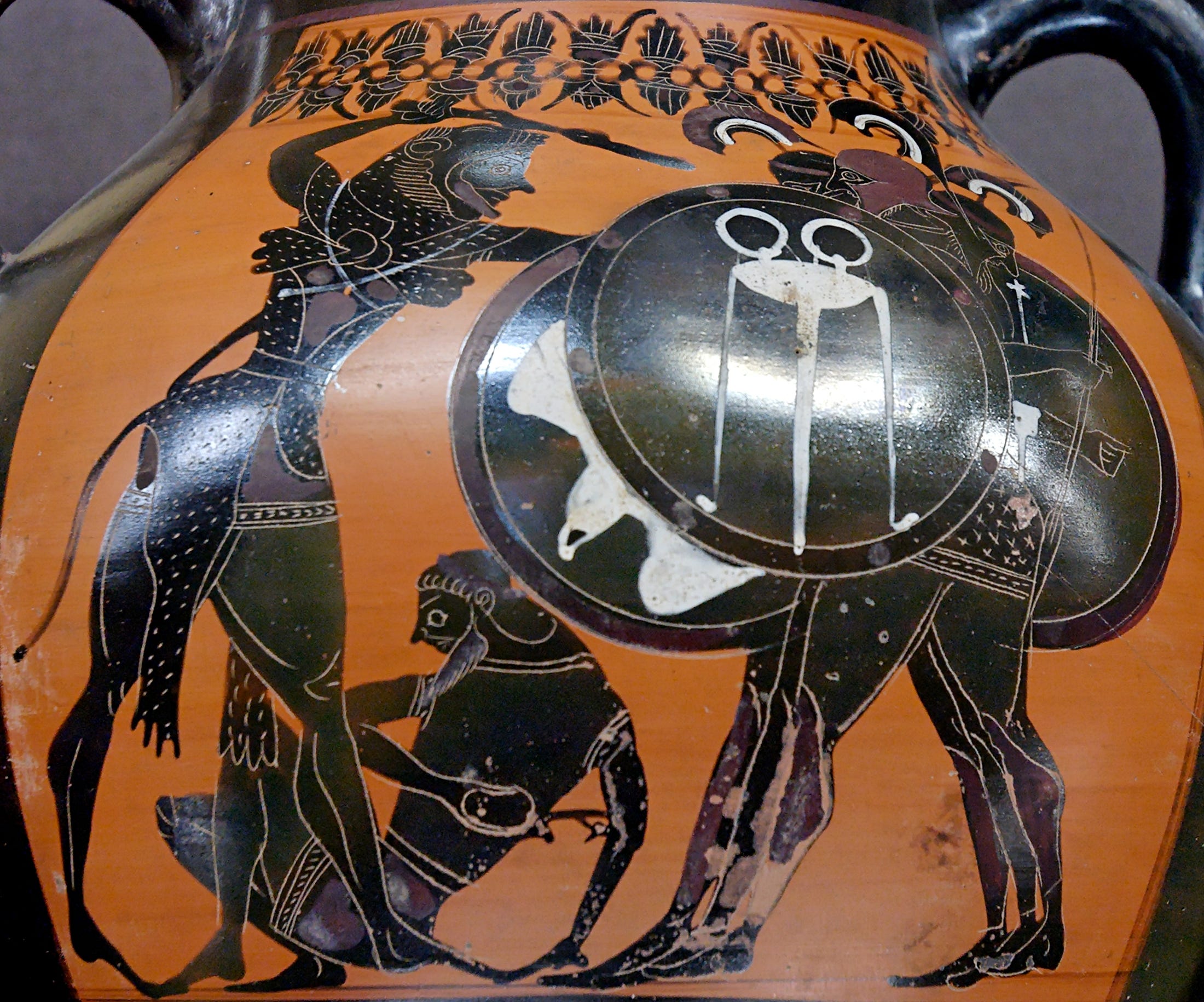
This task took Hercules to the end of the known world. In honor of his travels, Hercules erected pillars that, in some later traditions, were marked with the words “Non Plus Ultra” — there’s nothing more beyond this.
After Spain established an empire in the Americas, its kings cheekily depicted the pillars with “plus ultra” — further beyond — as in this emblem of Charles V:
The “pillars” were, in reality, giant rocks: Monte Hacho in Ceuta, a peninsula that juts out from North Africa into the Mediterranean, and its more famous cousin, Gibraltar, which does the same from the Spanish side. The Rock of Gibraltar looms imperiously over the strait of the same name, dominating one of the most significant chokepoints in world history.
For centuries, Gibraltar marked the limits of the world known to Europeans. You can see it represented as the Pillars of Hercules at the western edge (which here is at the very bottom) of this 1475 “world map” by Lucas Brandis:
And the pillars guard the western end of the Mediterranean in this 1460 map from Nicolaus Germanicus:
But once Europeans began to set sail beyond the Mediterranean, Gibraltar was portrayed a different way. There’s almost always a ship passing through, as on the title page of Francis Bacon’s Novum Organum. Here, the Pillars of Hercules represent not a boundary but a gateway to exploration:
This 19th-century illustration makes the straits look dramatic, with choppy water and the towering rock dwarfing the ships floating in the water:
This 18th-century depiction seems to show ships peacefully floating in the harbor, except for a puff of smoke coming from the ship in the center:
It’s a drawing of one of the most significant battles over Gibraltar, the siege of 1704, in which, as part of the War of the Spanish Succession, Anglo-Dutch and Spanish forces engaged in a back-and-forth struggle over the rock. It was much more chaotic than the placid scene above makes it look. First, the British and Dutch took control, looting the town and forcing out its Spanish inhabitants. Though the Spanish returned with French allies and launched another siege, they failed to take the territory back. Other depictions make the battle look more intense:
You can see here some of the fortifications that made this natural chokepoint even more difficult to conquer:
At the end of the war, Spain formally ceded Gibraltar to Great Britain. The British didn’t necessarily want to keep it — it was a strange little outpost far from the British Isles, expensive to defend and a possible trigger for further conflict with Spain. Meanwhile, the loss of Gibraltar — and the presence of a British base on the coast of Spain — was an intolerable insult to Spanish dignity.
The British expected to negotiate handing the rock back to Spain at some point, but, as so often happens with these things, never did. Britain was a rising power in the 18th century, and Spain was fading. Spain could not compel the British to cede the territory, and the British could not see a reason to hand land to a weaker power, even if it was land the British didn’t really want.
Over time, Gibraltar came to seem like a key node in the British Empire. And so the British built improved fortifications:
And defended them against attack:
After attack:
The “Great Siege” of Gibraltar, depicted in the three images above, lasted for four years between 1779 and 1783. It was part of the global conflict stemming from the American Revolution, and ended only when the revolution did.
After the Napoleonic Wars, Gibraltar ceased to be an active war zone, but the British still used it to interfere with their enemies’ trade. Once the Suez Canal opened, Gibraltar became even more important; Gibraltar and Suez served as twin gates that allowed quick passage to India.
So Gibraltar remained in British hands as a small, cosmopolitan outpost of the empire. It had a significant Italian population that had fled there during the Napoleonic conquests. There were large populations of Portuguese people, Spaniards, Jews, and British citizens as well. These groups did not necessarily live in harmony, and Gibraltar’s British rulers often discriminated against other populations.
As a common stop on shipping routes, Gibraltar was susceptible to terrible outbreaks of cholera and yellow fever. During a cholera outbreak in the 1880s, officials blamed the “barefooted” Maltese population. The governor wrote that
The departure of the Maltese from Gibraltar would be productive of unmitigated good; they are not required here; they do work which would naturally fall to the lot of the natives, and they, as shewn above, provide the greater number of the Criminal Class.
In 1913, a British soldier looked down his nose at many of the residents of Gibraltar:
That conglomeration of ill natured humanity known as “Rock scorpions” do not seem to have or to have had the slightest idea or notion of the subject and purposes for which this fortress is maintained. After 200 years of British occupation and rule, the installation of institutions, laws, sanitation, &c., which allows no comparison to that of existing neighbouring towns, these people are and presumably always will be the most ungrateful and ignorant gang that exists in any Crown Colony. The English language is seldom or never heard. The military are looked upon as their lawful prey and treated accordingly.
The British held on to Gibraltar through the 20th century — it proved a useful base in the world wars. The niftiest image I came across from the recent past was this one, in which searchlights sweep the sky in 1942:
As the British Empire shrunk and the contest for global supremacy shifted away from the Mediterranean, Gibraltar lost some of its strategic significance (although about 10% of global maritime trade still passes the rock every day). Despite its diminished status, the British hung on to Gibraltar. Now, it’s one of those little artifacts of the empire, like the Falklands or St. Helena. For what it’s worth, most Gibraltarians have voted to remain a part of Britain in referenda (in one, the tally was an overwhelming 17,900 to 187).
So Gibraltar remains in British hands, no longer a strategic chokepoint so much as a tourist destination and a tax haven for rich people who want to hide their money. It’s become quite rich. Having gained significance as a miserable rock whose geographical position allowed it to take advantage of global trade, Gibraltar seems to have done a nice job of getting astride more modern forms of commerce as well.
This edition of the newsletter is free to all, but I count on the kindness of readers to keep it going. If you enjoyed reading this week’s edition, there are two ways to support my work:
You can subscribe as a free or paying member, which gets you access to the archives and members-only posts:
Or you can “buy me a coffee” by sending me a one-time or recurring payment:
Thanks for reading!
No posts
Comments
Nothing yet. Say the first thing.
Sign in to join the conversation.