
To say I hated school suggests my antipathy had some discrete object, which it didn’t. As a boy I dreaded and loathed the whole edifice of “education” and its irrational authority, although hate probably suggests more conviction than I had. I went about under a cloud of confusion and turmoil that constantly pelted me for my ignorance and insubordination on behalf of authorities both educational and social. I was not a conspicuous misfit, and my class photos show an ingenuous, smiling boy. But something in me, or in the times, cast me as a rebel—and I would end up saying unwelcome things to those who had obvious power over me, which was stupid, of course. We were the tv generation, and young people were just beginning to notice that our share of the media spotlight was increasing, though most of us behaved as if the world still belonged to adults.
My family moved to Berkeley from the suburbs between my sophomore and junior year. Now that I think about it, it must have been precipitated, at least in part, by my own teenage dissipations, although they never said so. In fact, I am split down the middle about whether the move to Berkeley was merely convenient for Dad’s new job, or whether they simply had not heard that, next to the Haight-Ashbury district in San Francisco, the Telegraph Avenue area of Berkeley was ground zero for the counter culture. My folks were genuinely good people, but their willful innocence does not now seem to be without culpability. While their heads were in the sand, mine was awake to the world and all its opportunities for iniquity. And, about those last years in the suburbs, I still feel shame, sixty years hence, although, in truth, my feeble conscience back then was never pricked until I got caught red-handed.
The outskirts of my suburban town afforded a zone of independence felicitous to a boy’s enterprise. There was a seasonal creek flowing just beyond the town limit that created islands in its course, each stationed around a single cottonwood tree. At the time, I gave serious consideration to the apocryphal stories that the islands might actually be buried box cars. We built fortresses in the branches of the cottonwoods, and rafts to navigate the creek. Train tracks ran through the middle of town, only ten feet away from the corrugated metal shed where paper boys folded newspapers before dawn. The trains would barrel past, like black monsters with a rotating eye, and envelop the shed of stacked papers on hardboard tables with an enormous roar and rumbling.
I remember “going steady” with a girl named Linda because my class betters, especially the girls, had been inspired to matchmaking. We broke up amicably over the telephone after two weeks, both of us embarrassed and relieved at how mutual was our dissolution. The corded Bell telephone of those days had much better sound quality than a thousand-dollar iphone of today and afforded an intimacy in conversation that’s now just a memory. The restriction of those cords was constantly tested and tried, pulled around door jambs, twisted and stretched to the furthest extent. By seventh grade, all my teachers had hardwood paddles for corporal punishment which they affected to relish in a manner disconcertingly barbaric. Bending over with your hands around your calves was the position you were expected to assume—and when you were led back into the classroom from the hall, your classmates would ruthlessly search your eyes for evidence of tears.
Dad’s outrage was not much of a surprise. Nevertheless, its intensity became a cause of fearfulness in us both. He was grief-stricken, unable to contain himself, and I had to wonder if it was really about me, or a concern for his reputation as a Presbyterian minister. This observation may very well have been unfair to him, but I had never seen him like that. About my drug use, I could see no way to explain to him that my experimentation had led me to the conclusion that, actually, I didn’t really enjoy getting stoned. This was true enough, but concealed how strongly I was attracted to the thrill of transgression.
My friends and I imagined ourselves drug dealers because we divided ounces of marijuana into matchboxes that we sold on school grounds—and when we found out our activity had somehow made it onto the police radar, I was filled with criminal excitement. We would drive around town stealing stuff for the sake of stealing. But the worst came when my girlfriend’s mother suspected she was pregnant, and her parents called my parents. I cannot express how gravely my Presbyterian mom and dad took this news, or how grim was the subsequent meeting with the girl’s mom and dad, which I believed, with innocent obtuseness, would lead to a high school wedding. When weeks later, she announced, as it turned out, that she was not pregnant, that she had been mistaken, I had no reason to doubt her.
In my late teens, I was given a small, not very extraordinary, glimpse of myself, an insight that came in the form of revulsion, which separated me permanently from the path I had been on. It was not any kind of complete awakening, and the transition actually took place over months and years. But the change, as I have since described it to myself, became a narrative that I still carry around. Its events are loosely linked, and its resemblance to a story only exists in my head. In fact, it is its formlessness that prompts me to unbury it and prop it up.
I nominally attended Berkeley High from the fall of 1969 to the summer of 1971, and despite my best efforts, I graduated. My rationale for my lackluster scholastic performance was the vague expectation that we would all soon be living in communes, and that my “generation” would never reconcile with the world of business. I couldn’t have been more wrong, although I don’t think the events of those times were counterfactual to my presumption—including the assassinations of Martin Luther King and Bobby Kennedy, the highest number of American deaths in Vietnam, the Chicago Democratic Convention riots that injured 500 protestors and 152 police, the bombings of the Weather Underground which stretched on through the years into absurd irrelevance, and the tv posturing of the Black Panthers in matching leather jackets, shades, berets, and shotguns, looking more like a jazz quartet than revolutionaries. All of it was broadcast to every American household on three national television channels, readily discernible to everyone back then, although now I couldn’t describe the differences to save my life.
As expected, Berkeley was not Kansas. Riding my bike to get a feeling of my new home, I pedaled into a People’s Park demonstration that would come to be known as Bloody Thursday, the day James Rector was shot dead by police. As I stepped off my bike at Telegraph and Dwight, hundreds of people surrounded the vacant lot of “people’s park,” shaking the chain-link fences that had been erected by the university overnight. I was sixteen—and the great adventure of civil disobedience beckoned.
On my first day at Berkeley High, ascending the glass stairwell to the lunch room, my way was blocked by two black high school girls engaged in a razor-blade fight, their arms and faces striped with blood. Berkeley High had three thousand students, triple my suburban high school, and the strangers with whom I attended class were different from period to period. Berkeley had been among the first schools in the country to integrate, although integration meant in reality that, for lunch, all the black students sat along a waist-high brick wall on the quad while all the white students sat on the steps to the community theatre, fifty feet away.
These perplexing inconsistencies had the effect of garbling the ideological purity of my liberal upbringing. By their own choice, the black students separately attended their own school within a school, while adhering more generally to the mores of suburbia, wearing school jackets with block “B” letters, participating in school government and sports. I joined “The Rat Pack” of radical students, loosely affiliated with the Panthers in Oakland, and quickly learned that cutting school entirely was the ultimate solution, spending a majority of class hours at Sproul Plaza on the UC Berkeley campus where noisy, open-air political discussions took place daily, and most Berkeley demonstrations originated.
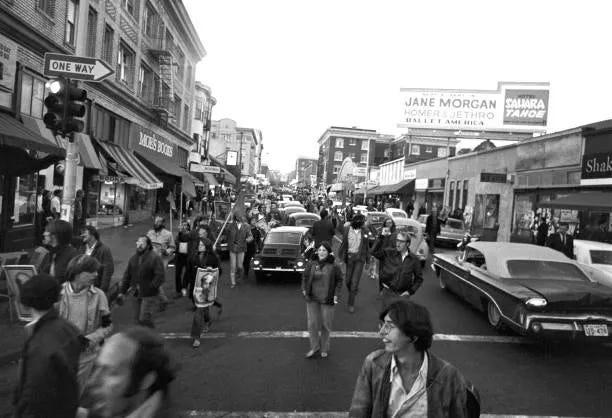
A demonstration begun on Sproul Plaza could go in one of two directions. For the leader who chose incorrectly, a mob could melt in an instant. Marching down Bancroft to Shattuck Avenue in downtown Berkeley was always the riskier choice—because police defended the staid downtown more assiduously. A crowd was a living thing, and its disposition depended on the presence and mixture of basic elements, like fire. Outrage was one of those elements, and was just as much a commodity then as it is now. The less risky option for a leader was to march down Telegraph Avenue for three blocks past the hippies, head shops, and drug dealers—what was essentially our home territory—to the fences of People’s Park, regardless of what the demonstration had been about. And I realized that if People’s Park hadn’t existed, it would have needed to have been invented. Which, in fact, it was.
Early in 1969, activists appropriated the vacant lot of “people’s park” from the university with the public planting of “gardens” and the university’s attempt to recover its property became the original conflict, which more or less ended when Ronald Reagan called in the National Guard, although skirmishes continued. However, for the next couple years, in a very pragmatic way, the park provided not just a symbol of dissent, but a tactical objective for any demonstration that happened to be mounted from Sproul Plaza. And so, with my flexible school schedule, I was present at many of those demonstrations, where speakers would explicitly incite the crowd: “Let’s take the park!”
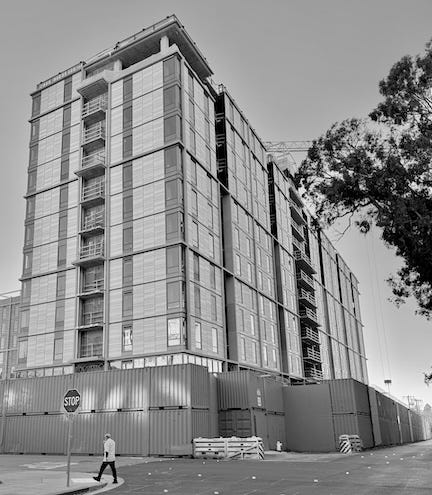
The history of People’s Park recently wrote its last chapter when UC Berkeley managed to construct a ten-story student apartment building by fencing People’s Park with a stacked-up ring of shipping containers. Without those containers, the now geriatric street-fighters of Berkeley—many of whom have since served on the Berkeley City Council—would have certainly overrun the park again, presumably in their wheelchairs. Throughout the fifty years of its history, People’s Park has suffered many incarnations, but the highpoint of its service to the community was as an early prototype for homeless encampments, decades before homeless encampments became universal in California.
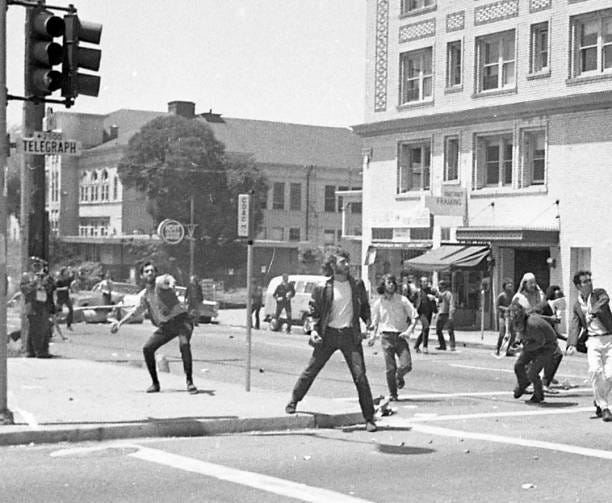
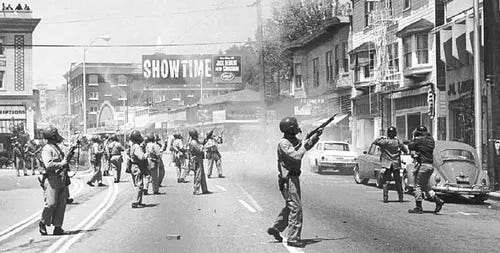
If shaking the fences around People’s Park was the participation trophy of most of the demonstrations mounted from Sproul Plaza, a few busted out into a real melee—with the rioters, including myself, breathless and shouting and running at top speed down sidewalks, smashing windows, constantly moving to avoid being bottled by the police. On one occasion, the police pushed us deeper onto the UC campus with tear gas, and for ten minutes a couple dozen of us put up a hopeless stand, spaced widely apart, hurling rocks and canisters, our eyes and faces burning from the gas. I was far from the boldest in that line of teenagers and twenty-somethings. I knew none of them and none of them knew me, although I couldn’t help but wonder how much of our motivation was the same. And I envied them simply for their obvious fervor.
The intensity of those moments was the consummation of what I, in my sixteen-year-old brain, had imagined myself becoming, which now, in harsher light, seems like what anyone of ordinary decency would know to be wrong. It had nothing to do with the war. It was the high of transcending the swirling uncertainty of my sixteen years, pure and simple as a jolt of dexedrine. But in the midst of my exhilaration, I also had a sense, a small one, that what I was doing was fake and false and would leave a residue of regret. As a would-be foot soldier of the revolution, I realized the point of my participation was not to man the barricades of resistance, despite the high drama of my imagining. The point was to bleed on tv.
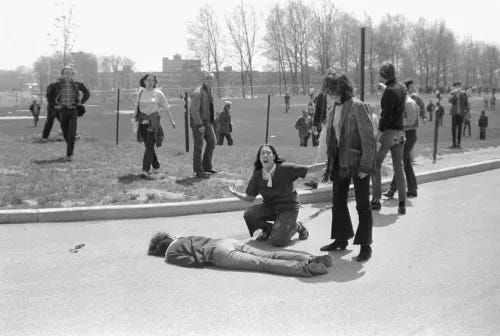
The Kent State shooting, as I remember it, was the highwater mark of this theory of political protest for my generation, and was, without question, the cause of the increasing magnitude of the protests. The deaths in Ohio said nothing coherent about the rightness or wrongness of the war, but the blood on the ground made even normal people angry, and those four deaths, televised from coast to coast, did more to stop the Vietnam war than all other protests combined. What all the other protests had attempted and failed, Kent State achieved in an instant. And from that perspective, People’s Park was relegated to become a footnote to the same failure, enacted over and over.
Some passages in our lives need more explanation than others, and some defy explanation. I frankly confess my memory has places I know to avoid, and those places are where regret is inculcated, rising up in old age to plague us. Frequently, our explanations only serve to pave over some rough patch, and even science is on difficult terrain when attempting to explain the things that humans do, which is partly why stories persist. In this instance, a story is like a toiletry kit: handy for holding some things together, but untidy and potentially embarrassing.
A survey of those years includes my attendance at the Altamont Rock Concert, the malign twin of Woodstock, where 300,000 were spread over the surrounding hills. I had managed to get within twenty feet of the stage, and was almost crushed in the surging mass as a Hells Angel with a pool cue beat the crap out of some poor half-naked fat guy, and a man was reportedly stabbed to death under the stage. After that, I made the decision to put more than a philosophical distance between myself and that assemblage of more humanity than I had ever seen.
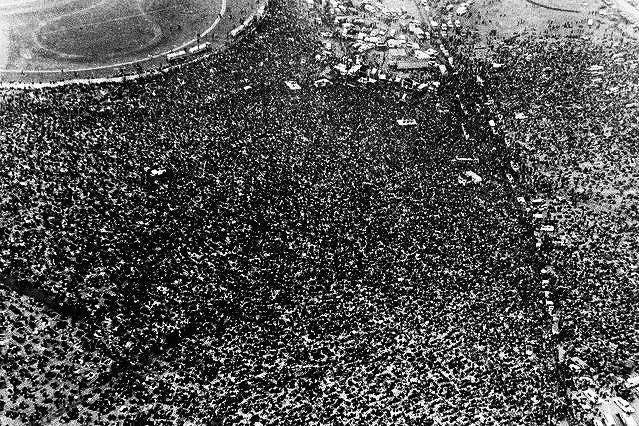
Mick Jagger was onstage singing “Street Fighting Man” when I finally managed to get to my car, but for the twenty minutes that it took me to get through the crowd in front of the stage, excusing myself through the seated throngs of stoned and distracted young people, I could distinctly hear the fear in Mick Jagger’s voice as he tried to pacify the crowd. My wife, who is ten years younger than me, asked me this morning if I think the hippies were the origin of all the bad ideas that beset our present moment. At this distance from those times, I don’t have a word to say in opposition to her theory—and every time I hear John Lennon singing “Imagine there’s no heaven,” it never fails to make me shudder.
(Dear Reader: My personal idea of Substack is to work on a piece until it is as good as I can make it. As a consolation for my erratic posting, Working Man is free to all subscribers as well as 100% AI-free. If you enjoy a post, please like it. Thank you so much for reading!)
Comments
Nothing yet. Say the first thing.
Sign in to join the conversation.