
Why You Might Want To Read This: There is a larger lesson from the revelations about Caesar Chavez’s crimes against women and girls—authoritarianism cripples the labor movement, breeding careerism, institutional paralysis and the seeds of a culture that tells us a lot about why labor is failing to meet the current moment [by the way, are you a paid subscriber yet for the bargain price of ONLY $50 a YEAR?].
I’m offering this especially to readers who are only generally familiar with the culture of authoritarianism within unions, which is a deep-seeded, root cause of the decline in labor power.
Three background points:
First, Chavez committed horrific crimes against women and girls. I start there so that this post, which tries to dig into a bigger issue, doesn’t soft pedal, obscure or distract from what we now know about Chavez.
Second, while the Chavez revelations are horrific, they are not, as many folks are opining, “shocking”. The “shock” is only so, perhaps, because the crimes were committed by an icon but this isn’t a one-off: women have long been targets of harassment inside unions for decades, including in my own union, the United Auto Workers.
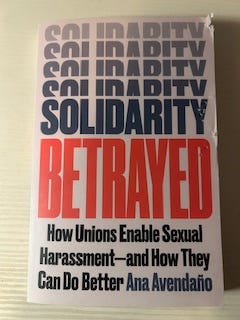
There is often a massive gap between the high-minded statements condemning sexual harassment that pass at conventions and, then, are avidly pursued in national policy versus what actually happens to women within the walls of unions. Have things improved over the past three decades? I’d invite labor women to comment below. Be the judge: long-time union leader and activist Ana Avendano has written the most recent extensive view in her book, “Solidarity Betrayed: How Unions Enable Sexual Harassment – And How They Can Do Better”. Buy her book.
Third, without a doubt, the single biggest threat to unions are the m-f-ing employers and greedy scum like Jeff Bezos and the Waltons of Wal-Mart who bludgeon workers, attack union organizing efforts and do so at the behest of a political system that shackles working people with an absolute joke of a labor law system that accepts and enforces poverty wages and dangerous workplaces.
BUT, BUT, BUT… Authoritarianism inside labor is a cancer. And not talked about enough. When authoritarianism is raised by labor union members or staff or some leaders, the ship-of-state leaders at the top typically attack critics, painting them as “divisive” and an enemy that is aiding employers with the criticism.
To simplify what could be a book-length explanation (which I did 30 years ago):
Why does someone decide to vie for union office? Similar to electoral public office, some folks feel passionately about the mission of their unions, and are swept up in the idealism of unionism. That’s a really good thing. I’ve met scores of great people who have taken on leadership roles in unions, and many are friends.
The problem in modern-day labor is that many union elected positions, especially the top positions, pay really well (that doesn’t include some unions, principally entertainment industry unions, where elected office is usually an unpaid volunteer post). Union elected leaders get wall-to-wall benefits including pensions that most rank-and-file members don’t enjoy. And the pay and benefits in elected office are certainly better than a newly-elected leader had in his/her factory or office or other workplace. It’s driven a culture of careerism in labor not similar from what we see in the political electoral arena.
In some unions, the pay is staggering, compared to what the average member gets: as an example, one national union president right now earns $460,000, with a raft of great benefits, while most members in that same union struggle to make ends meet, face layoffs and too often end up house-less; this union leader lives an upper middle-class life, far from the daily experiences of the membership. It’s not quite the multiples of executive-versus-regular worker pay one sees in the outside world (The average CEO-to-worker pay ratio was 285-to-1 for S&P 500 Index companies in 2024) but, in any union, a wide gap in pay between leaders and members should be considered obscene.
I was recently re-reading an account of the sit-down strikes against General Motors in 1936-1937. What stood out, among other things (I’ll write about this more down the road), was that elected union leaders were in pretty much the same boat as the regular workers—trying to make ends meet in very difficult economic times. There wasn’t a huge union apparatus. Leadership pay was very modest.
I’m not begrudging decent pay for a hard job. But, the pay is pretty sweet and does inject a very concrete reason, aside from the ego trip, that explains why an elected leader will want to stick around for as long as possible—and stitch together the political apparatus to ensure longevity in office.
It’s human: Wouldn’t you rather have a fairly comfortable job, surrounded by staff who do your bidding, rather than being back at your old job being yelled at by a fool-for-a supervisor? Duh.
Which, then, breeds…
The union version of Louis XIV’s “L'État, c'est moi”.
The elected leadership, over time, views the union as equivalent to himself/herself. It’s the nature of politics, right?
Patronage is the tool to keep a grip on the institution by filling elected positions (folks want to be on the slate of the incumbent) and staff jobs with loyalists and political allies. It’s especially corrosive in unions because, in my observation of top union leaders over many decades, across every industry, most are just awful administrators and even worse at supervising people.
Again, this is a fairly typical human condition: good administration and knowing how to supervise people are not skills most people are born with; it takes both training and experience—which few people elected to union office have a chance to foster in their pre-union office jobs.
Rather than hire staff people who are really good at running the day-to-day, it’s all to common for senior level jobs to get doled out to satisfy political considerations. To be sure, there are absolutely fantastic staff people who are qualified—and, in plenty of cases, staffers are over-qualified, or at least they are people who could pull down more pay in jobs outside of unions. [A side note: some of the best political organizers, especially younger ones, end up in union jobs for a simple reason: the pay at other progressive/community organizations sucks, and good organizers who have worked on electoral campaigns have nowhere to turn for a secure gig to bridge the time between campaign seasons]. Yet, enforcing loyalty often takes on a higher priority than running the damn place effectively.
Patronage, and the fear of losing a job or elected position, begets loyalty and silence. And, that silence creates the “cover” for bad behavior and abuse of power, sexual harassment being at the top of mind right now.
It has to be said here that authoritarianism inside labor is not obvious outside inner circles. People aren’t being taken out and shot in the courtyard or carted off to secret prisons. It’s part of the organizational plumbing, a part of the mundane, day-to-day heartbeat and happens almost seamlessly. Most folks are not venal or even outwardly repressive.
People just know.
Not to point out the lack of new member organizing success.
Or to openly debate the corrosive relationship with the Democratic Party, the support for candidates who aren’t reliable once they get in office but still get the automatic incumbent’s endorsement and the outlays of hundreds of millions of dollars each election cycle that leave very little in place to build on.
Or to insert into serious consideration the embrace of a real General Strike (in other words, not a one-day, for-show strike but one without an end date) because that means going all-in on something that puts institutions’ financial resources into a raging fire, the outcome of which cannot be predicted with certainty.
Why should any of this matter?
Because…
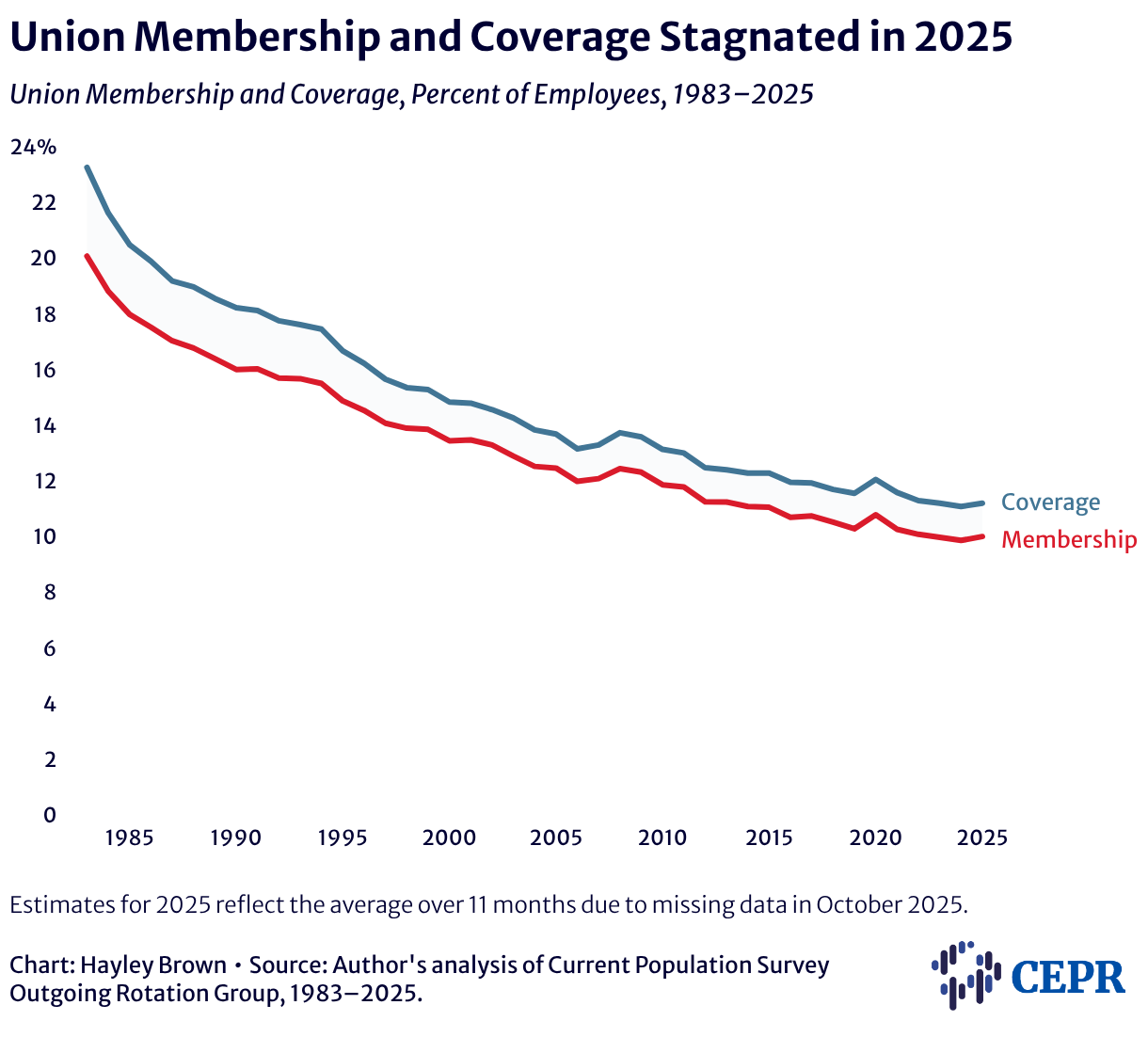
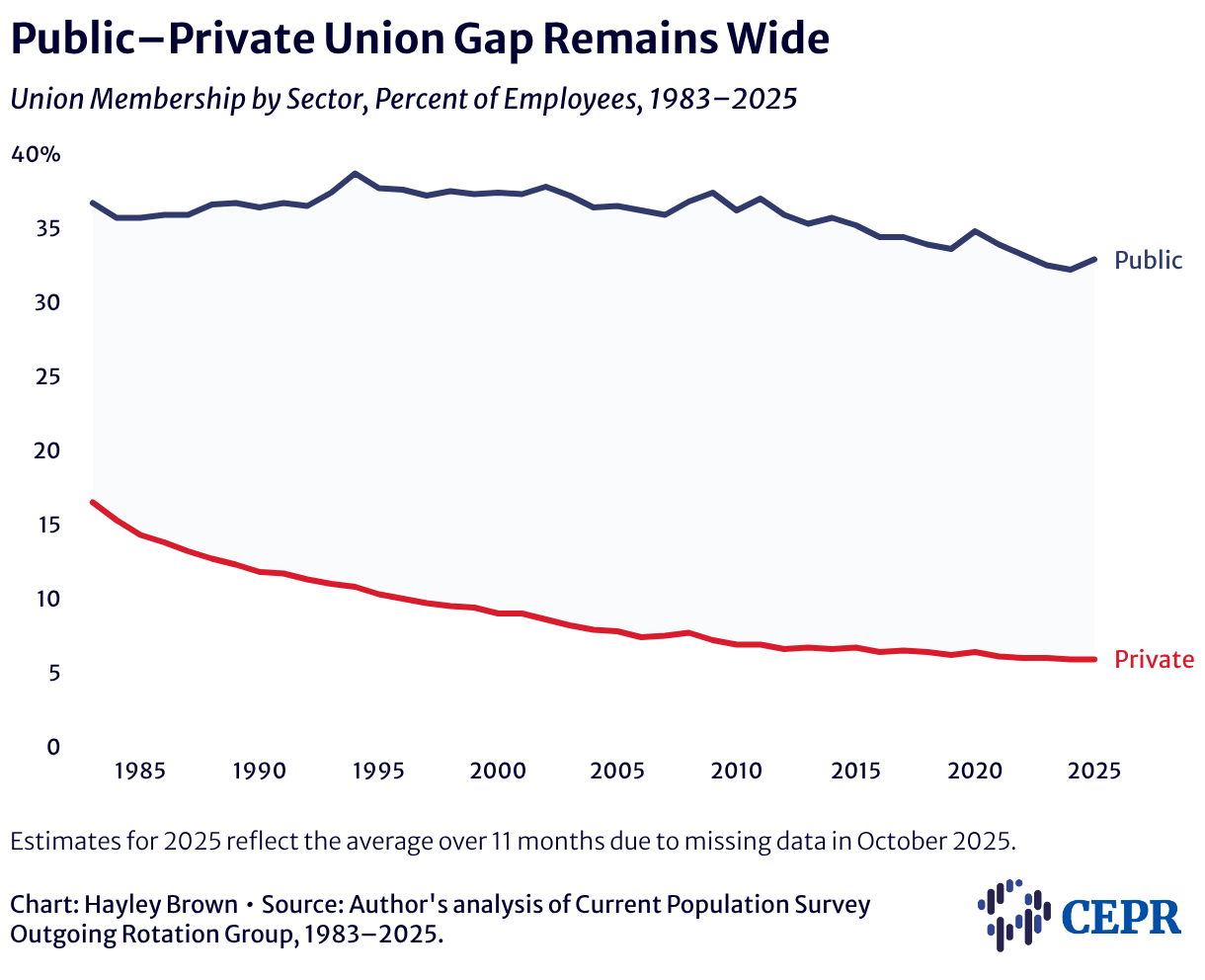
The labor movement is dying. When a movement represents less than 6 percent of the workers in the private sector, it’s basically an irrelevant economic force outside of a few industries (e.g., airlines can’t fly if pilots strike).
And:
Actually, it’s not accurate to call labor a “movement” if that conjures up a picture of a stream of organizations heading together in unison and reading from the same page of ideas, goals and strategies. Sure, there are some easy lift issues—like supporting the doomed, never-will-pass PRO Act—that make it possible to see the outlines of a unified “movement”.
But, typically, we have a jumble of often fractious organizations that are not greater than the sum of all parts. When people still refer to the “House of Labor”, the above charts tell us that, if a house is the metaphor of the overall universe of the economy, labor is crowded into the outhouse in the backyard.
Which brings us—finally, you might say!—to the critical point of this post: Authoritarianism is a principle reason labor is missing the current economic crisis moment.
Yes, as I said at the outset, one can’t sleep on the brutality of the employers. But, that was even more true back during the sit-down strikes of 1936, and, yet, that was the dawn of large-scale union organizing. Because folks felt they had no choice. It was organize or go hungry.
Authoritarianism has bred complacency.
Authoritarianism has discouraged initiative.
The message of authoritarianism is “don’t take risks” because preserving the institution is paramount.
Those charts above scream “FIVE ALARM EMERGENCY”—not to build a new website, or issue another in the 1,000s of press releases decrying the actions of the malignant narcissist in the White House, or call another conference or round-table to say the same exact things every time or order up a new study or research paper to be thrown on the mountain-high pile of existing studies and research papers.
And so…
What to do?
There’s the rub. I don’t have a perfect answer. No one does. I’m not convinced that more “democracy” is the magic bullet because I can point to plenty of unions with democratic principles that imposes a kind of “soft” authoritarianism of “get with the program” group-think.
Nor whether the long thumb-sucking debate between the “organizing” versus “servicing” model of unionism is relevant (FWIW, I don’t think these are mutually exclusive models, and need to live together).
Here, I also mix in my slightly eroded opposition to term limits in the broader electoral arena (because I’ve maintained term limits would have the negative effect of “If the bum will be gone in two terms, no need for me to get involved”)—maybe every union needs term limits (a few do but most do not).
To maybe spark a conversation, I circle back to a whole book I wrote about this thirty years ago, entitled “The Edifice Complex” , which used the physical buildings of labor in Washington, D.C. as a metaphor. Crazily, if I just re-read the first intro paragraphs, it’s mid-blowing that, while the specifics of 2026 are different, the basic analysis is, sadly, still accurate thirty years later:
These buildings are the symbols of our own Edifice Complex. These structures have ensnared us in a political culture that chokes off our lifeblood and is alienating unions from their members and potential new recruits. The buildings also represent a division of fiefs that no longer makes sense in the global economy of today. Indeed, their very existence is giving comfort and sustenance to a political system dedicated to eradicating the labor movement. And, finally, from a very practical perspective, these monuments are worth multi-millions, perhaps a billion dollars of resources that lie fallow at a time when more money is needed to organize new members. For labor to survive into the 21st Century, we must sell off these buildings and return to the heartland, to the cities and small communities in which the desperation, frustration and pain of millions of working people grow every day.
Why now? We are dying. To say anything else to our members is a lie. By any measure, we are in a crisis. We are in a time of great danger, a moment when labor, here and around the world is under the most concerted, effective and powerful attack in this century and teeters on the verge of extinction. The seamless global economy, oiled by the vast technological revolution sweeping the world and the unabated dash towards an international order with virtually no minimum labor standards, is humming every day with only token resistance from unions. Billions of dollars flow in seconds from country to country, handing control over our working lives from politicians to money managers who are so powerful that even Business Week took the step of asking whether they have become “a shadow world government-one that is irretrievably eroding the concept of the sovereign powers of a nation-state.” Without a doubt the staggering power of corporations has, in part, come from the acquiescence and outright support of the political system, which has been poisoned and warped by the influence of money.
At the same time, we must accept some responsibility for the crisis, rejecting the easy but deadly course of blaming all of our ills on external forces. We can no longer simply point to the media’s relentless stereotyping of unions as the reason we fail to organize. Nor can we use the imbalance of the legal system, weighted at every level in favor of corporate interests, to shield us from a tough look at the way we function. In the 1920s and 1930s, company and government goons openly threatened, beat up and killed union organizers and striking workers. Yet, that period saw a great wave of union organizing. In Pennsylvania, public employees organized a union and had more strikes long before the right to collectively bargain passed into law.
Pointing fingers at the outside enemy and making excuses cannot explain our embrace of a political system that inspires deep disgust and rejection from a cross-section of America, including many union members. It will not help us see the reality of the Ross Perot buttons worn by our members. Nor will it help us understand how too many Americans see labor institutions as incapable of helping them cope with the daily grind of the workplace.
Ironically, during this dark time a great opportunity lies before us. If we seize the moment, we can have an unparalleled, honest, frank, sometimes painful but, hopefully, an ultimately productive debate over our future. Freed from the Cold War’s ideological polarization, which paralyzed many into opposite camps; sobered by the Republican ascendancy in Congress, which obliterated labor’s access to the political levers of power and should have wiped away our illusion of influence, we can perhaps look at ourselves with a clarity unimaginable just a few years ago. We can ask deep, penetrating questions about how we spend our money. We can wonder whether the way we are structured makes sense. We can rethink and recapture our role as the leader of community-based social movements, raising our moral voice with a keen vision that sees beyond the walls of our workplaces.
What is maddening is that what was true 30 years ago is even more so true today: a great opportunity is within labor’s grasp because people are just enraged, pissed off, scared and fed up with the political and economic system.
Comment below!!!
Thanks for reading Working Life Newsletter! This post is available to the public for a limited time so feel free to share it to help grow the community.for reading Working Life Newsletter!Working Life Newsletter!
Comments
Nothing yet. Say the first thing.
Sign in to join the conversation.