
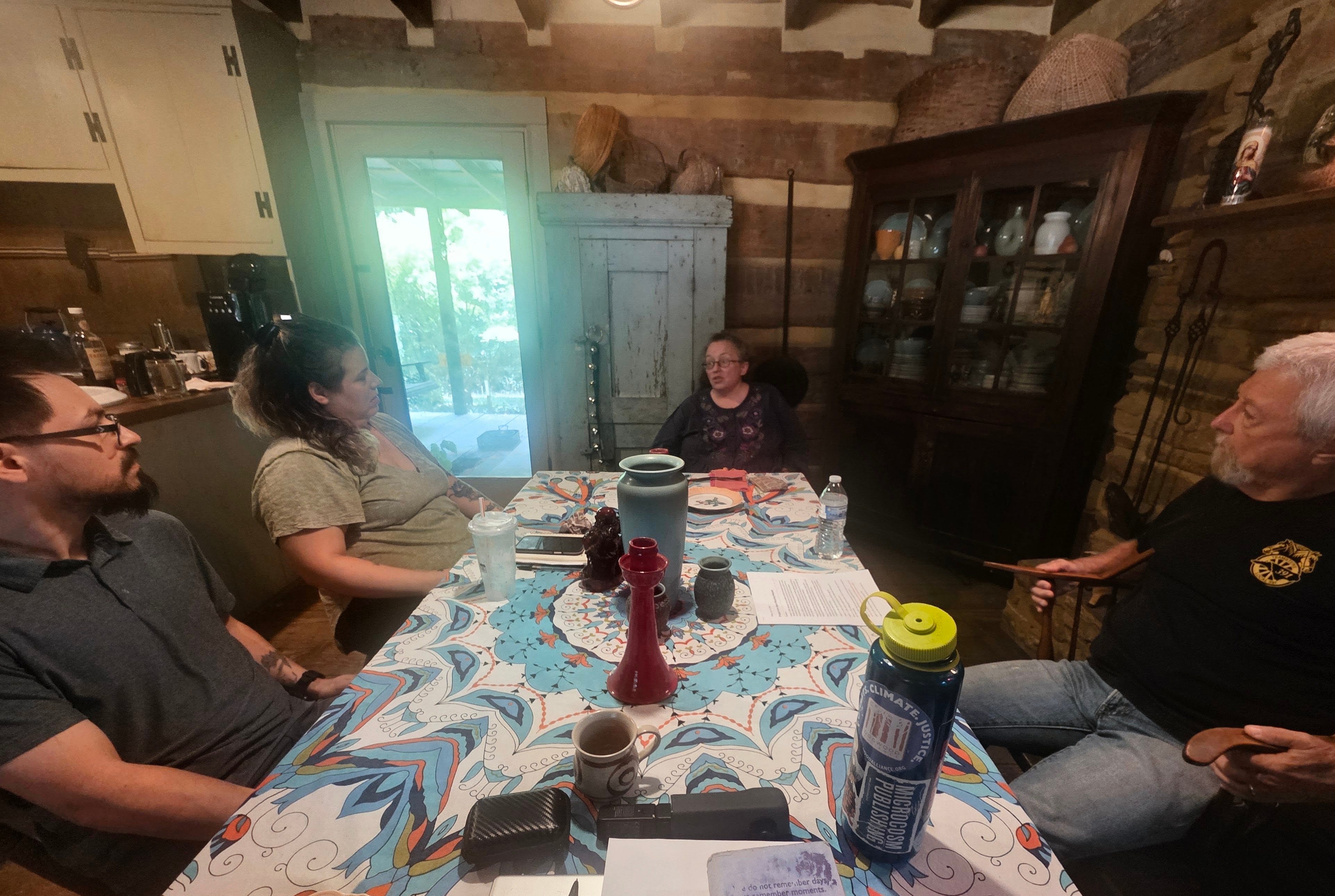
It’s a hot day, but it’s cool inside Carol Newsome’s thick-walled family cabin. Outside the trees are humming with cicadas and peepers in the humid North Carolina heat.
The kitchen table is crowded with donuts and coffee mugs. A small group of Rural Hall locals sit around it, chatting. They talk like close friends, but just a few months ago many of them didn’t know each other yet, even though most of them have lived here for years.
They’ve been brought together under the most surprising circumstances, something they never could have predicted: Their tiny little town has been targeted for a huge data center.
“When I first heard what they were proposing, I said, oh no, we don’t want this at all,” explains retired truck driver Randy Adams, in his soft southern accent.
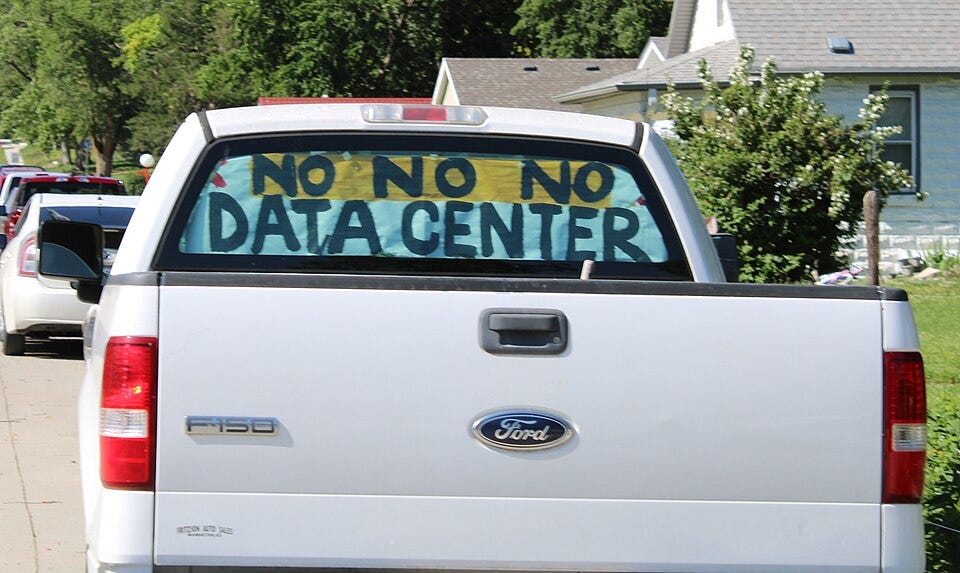
Local residents are now fighting Project Iron Spur tooth and nail. They’ve been showing up to town council, holding protests, writing letters to the editor, posting yard signs, filing public records requests, knocking on their neighbors’ doors, and hosting huge community meetings.
“I told my mom: ‘We can’t let this happen,’” says Jean Jones, whose property sits across from the proposed build site. “We’ve got to organize.
As data center companies race to secure land, small-town residents all across the country have been getting a crash course in local democracy. 67% of proposed data centers are planned for rural communities. In places like Jackson, Georgia (population 5,970) and Cave City, Kentucky (population 2,404), local residents are pushing back against Big Tech coming to their towns.
Traditionally sleepy small-town council meetings have been packed with protestors, and rural residents have been practicing serious organizing and mobilizing in numbers more often associated with urban centers.
Why are data centers the proverbial straw that broke the camel’s back? Corporate America has never been kind to small towns. Over the decades, rural America has been treated like a colony by big businesses; a place to extract from. Drive through any small town and see the Dollar Generals that have shut down mom-and-pop stores; look at the brown, polluted water running out of local taps as factories chug away upstream; witness the opioid crisis that has ravaged holler after holler; ask about paychecks so low you can’t believe this is the United States. Rural people have always fought against these things, but it’s undeniable that the data center pushback has taken on a life of its own.
In places like Lochbuie, Colorado, a galvanizing issue is water. Reporting in June revealed that two-thirds of new data centers are to be built in some of the driest places in the country, including places currently experiencing serious drought.
“Water is a huge issue,” Mayor Jamie Jeffrey of Lochbouie explains. “With these data centers, you can get into open- and closed-loop discussions, but no matter what, it impacts the water. And if I’m trying to think about the future of this town and the people who live here, I know that water is one of the most important resources we have—and could lose.”
In other places, it’s about electrical prices.
“If the data center is built, our electric prices will skyrocket,” says a woman who asked not to be named in this story. She helped circulate a petition against a proposed data center in her hometown of Front Royal, Virginia, earlier this year. “I already can’t afford my power bill—what will I do?”
Back in Rural Hall, North Carolina, one of the main issues local residents have around the data center proposal is related to land use. “We need things like more affordable housing, not data centers, to be built on that land,” says Jean Jones. “Things that fit here and are actually for the people.”
But beyond water, electricity, and land use, there is something more existential behind these anti-data center fights. There’s general anxiety about Big Tech, AI, and, more broadly, profit and technology; a real sense that the “winners” of the future have already been decided.
This Big Tech future is largely being built without the consent of the people it impacts. “They’re shoving AI in everything, so it’s unavoidable,” says Andrew Rojas, an opponent of the Rural Hall data center. “And then, later on, they kind of push it on us, like, oh, well, you’re relying on data centers, so that’s why we have to build them. But we didn’t ask for this technology, we didn’t ask for it to be in everything, and we certainly didn’t ask for this data center.”
In these towns, data centers represent the lopsided economy; the grift of Big Tech and billionaires and the exploitation of everyday people. They also represent a loss of local control and the ability of people and towns to make their own decisions about their own futures.
In Lochbuie, Marylou Withrow tells me that she has been asking her neighbors what they want to see built in town. Many have told her that they want more activities for kids, especially teens; maybe a youth center, a rec center, and more places to go and things to do. Other people talk about wanting more shops, a grocery store, a coffee shop, a bakery. Marylou would like a library.
But no one mentions a data center. “That is something a big company that doesn’t live here wants, not us,” she says.
The resistance is working. Three weeks ago in Lochbuie, Mayor Jeffrey proposed a data center moratorium, backed by residents including Marylou Withrow. The town council passed a five-year data center moratorium—the longest in Colorado so far. Two weeks ago in Front Royal, the town passed the data center ban requested in the local petition. And just last week in Rural Hall, Carol, Randy, Jean, and Andrew all rejoiced when Project Iron Spur’s rezoning request was denied.
Nationally, hundreds of data center proposals have been derailed through local organizing, blocking about $64 billion in tech dollars. Over 500 moratoriums have been passed, and polling finds that a majority of voters (63%) support pausing the construction of AI data centers for at least one year. Senator Bernie Sanders of Vermont and Representative Alexandria Ocasio-Cortez of New York have also introduced a national data center moratorium.
As I sit in Carol’s cabin, listening to the passion of these Rural Hall neighbors and witnessing their powerful organizing, I don’t think this resistance to data centers, AI, and Big Tech will fade away. Nor do I think it’s going to stay contained. These fights are uncovering a different but related tension in these small towns.
People are now asking: Will it be big corporations and the wealthy elite who chart our town’s future, or will the rest of us, those of us who live here, get our say?
In case you missed it:
From Minnesota to Wisconsin to North Carolina, working-class communities are fighting to protect our public goods from being sold to private buyers. Read more here:
Don't Let Them Take What's Ours
·
Aug 18
Kaaha Kaahiye is showing me around Glendale Homes, where she grew up. She talks quickly and enthusiastically, pointing out a playground she used to play on and then a lush vegetable garden, a squash so big it’s pulling over its trell…
Long mocked as anti-social, gamers are proving that their digital neighborhoods are anything but. Read more…
Comments
Nothing yet. Say the first thing.
Sign in to join the conversation.