
In the rapidly evolving landscape of generative AI, Steffi Kieffer occupies a unique niche. Coming from a background in Design Thinking and human-centered design, she doesn’t just teach people how to prompt; she teaches them how to understand their own minds in relation to the machine.
Through her platform, Human-First AI Strategy, she helps teams and leaders move beyond “AI hype” to implement practical AI workflows. She is a partner at the strategic design consultancy Revelate, where she has spent nearly two decades designing digital products and services. Steffi also co-leads the AI & Future Skills Retreat, which combines AI training with mindfulness and “future skills” like deep work and resilience.
As the world oscillates between AI utopia and existential dread, Kieffer argues that our biggest hurdle isn’t the technology – it’s our own psychological biases and the way we structure our work.
Steffi, you help people navigate the world of AI, but your approach is notably different. You don’t start with the software; you start with the human. Why is that?
Steffi Kieffer: I’ve always believed in human-centered work – designing things so that they actually make our lives better. With AI, we’re facing a technology that affects us on multiple levels, and to use it well, we need to understand how we “tick” psychologically and neuroscientifically.
If you understand your own quirks – the things that a machine might misinterpret – it becomes much easier to collaborate with that machine. You have to understand the technology, yes, but you also have to understand where you, as a human, fit into the equation for the whole thing to work.
But we didn’t need a psychology degree to use PowerPoint or Photoshop. Why is AI different?
Because those are deterministic tools. You provide an input, and you get a specific, concrete output. AI is probabilistic; it deals in likelihoods. That changes everything.
Humans are weird. When we prompt an AI, we often unconsciously bake our own biases and colorings into the request. If I approach a prompt with a specific bias, the result will reflect that distortion. For example, there’s the anchoring effect – we tend to latch onto the first answer the AI gives us and ignore better possibilities. If you aren’t aware of that tendency, you fall victim to “Shit In, Shit Out”. You end up frustrated with mediocre results because you didn’t realize you were the one steering the machine into a corner.
You’ve mentioned that working with AI is becoming more cognitively demanding. You even used the term “agentic burnout.”
Exactly. I often work with tools like Claude, where multiple sub-agents are working in parallel while I act as the orchestrator. It is incredibly taxing. You are constantly in evaluation mode, judging the output of several processes at once. Our brains aren’t wired to do that for hours without a break.
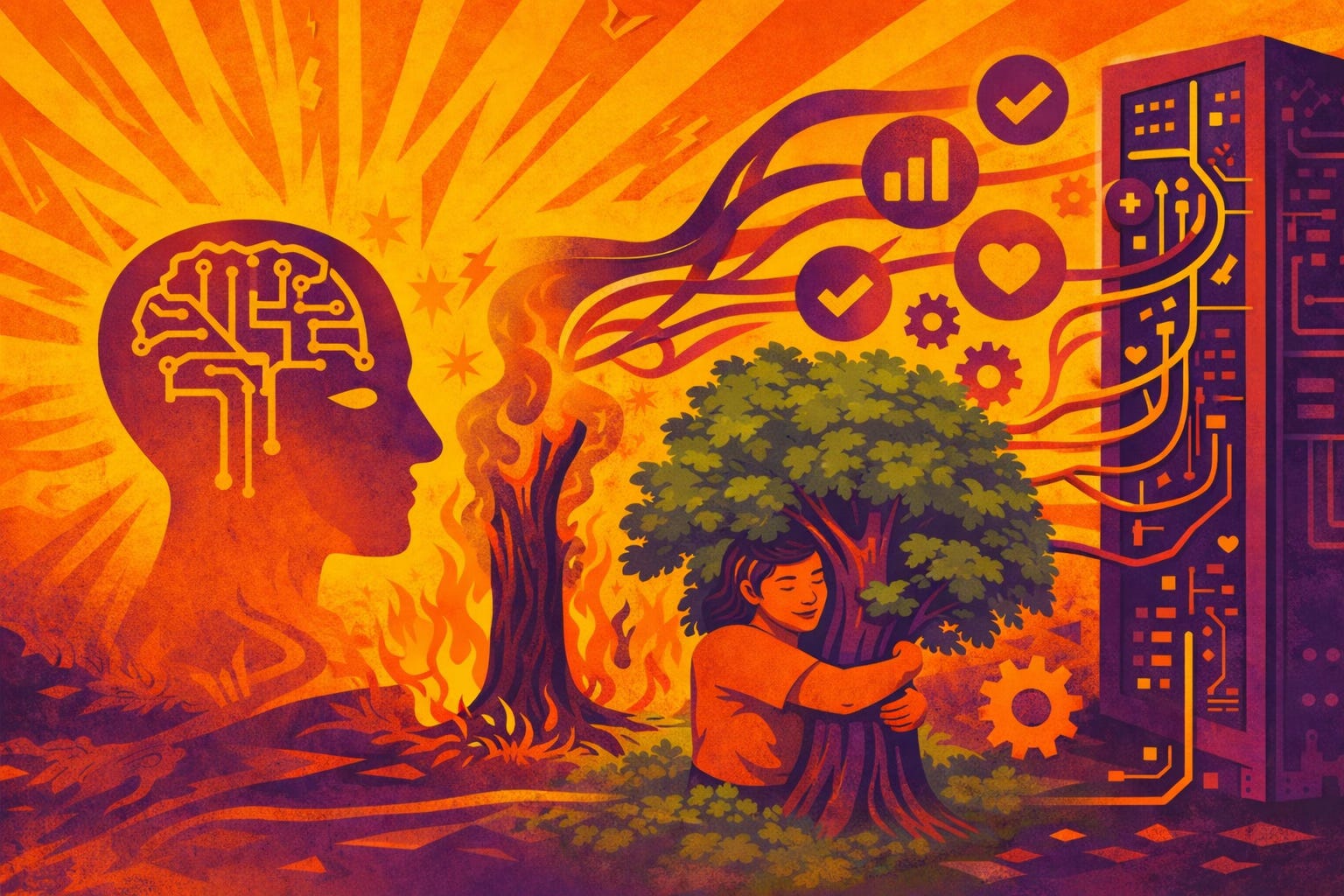
This is why I’m a huge advocate for getting out into nature. I’ve even become a fan of hugging trees. It sounds special, I know, but a tree doesn’t move. It’s stable. It’s the polar opposite of an AI that gets a new update every 24 hours. We need that grounding to stay sane.
Does that impact creativity as well?
Absolutely. We are being bombarded with output. If I don’t take the time to think for myself first – to write something down on a piece of paper – the AI output just rushes through my brain without sticking. You’ll find yourself explaining a plausible AI result to a colleague five minutes later and realizing you have no idea what it actually meant. You need time to digest.
I’m deeply uncomfortable with tech-feudalism – the idea that a handful of individuals in Silicon Valley are essentially dictating global geopolitical situations.
You recently made waves by announcing you were canceling your ChatGPT Plus subscription. What was the final straw?
It had been brewing for a while. When Google released Gemini 3.1 Pro, I realized it worked significantly better for my specific use cases. I’m a tool hopper – I use different models for different tasks because they all have different qualities.
But the ethical side became impossible to ignore. OpenAI’s decision to introduce ads into the free version was a major turn-off. It felt like a step toward a Black Mirror scenario. More broadly, I’m deeply uncomfortable with tech-feudalism – the idea that a handful of individuals in Silicon Valley are essentially dictating global geopolitical situations. I want more choice, and I’d love to see a stronger European alternative. We talk a lot about digital sovereignty, but for me, that means being independent of these massive American or Chinese players.
But you aren’t using European models like Mistral either?
Honestly? No. Because right now, they can’t compete with what Anthropic is offering with Claude. In my tech bubble, I have to use what works, even if I’m not happy with the politics behind it.
In large companies, I see a lot of AI fatigue. Employees are being told from the top down: “Use these tools to be more efficient”. But efficiency in a corporate context often just means writing emails faster so you have time to handle more emails.
You run workshops for both freelancers and large corporations. Do they see the AI revolution differently?
Night and day. Freelancers are in survival mode – they know if they don’t learn to swim now, they’ll sink. But they also see the massive opportunities to do things they never could before.
In large companies, I see a lot of AI fatigue. Employees are being told from the top down: “Use these tools to be more efficient”. But efficiency in a corporate context often just means writing emails faster so you have time to handle more emails. People are already overworked; they don’t want another tool that just tightens the screws of productivity.
Companies are missing the “What is possible now?” thought process. Instead of just saving time, we should be experimenting with things that were previously impossible.
Can you give an example of that “impossible” potential?
Just last Sunday, I woke up, grabbed a coffee, and instead of scrolling social media, I built myself a mini-app using Claude. I wanted a personalized communication coach – something that would give me voice-to-text feedback on how I present myself. I built it in five minutes. The weekend before, I built a protein tracker because I realized I wasn’t eating enough protein.
These are apps built specifically for me, by me, in minutes. That level of personal agency was unthinkable a year ago. But in a big organization, you aren’t allowed to do that because of “sensitivity” and IT restrictions. We’re losing the “spark” of innovation to red tape.
If the knowledge worker middle class is displaced by AI agents, the entire economic cycle collapses – no consumption, no taxes.
If you had to sketch a positive vision of the future of work, what does it look like?
Roles will dissolve. In tech, the hard lines between project managers, UX designers, and developers are blurring. One person with the right expertise can now build products end-to-end.
Teams will get smaller because we can all achieve more. We won’t have the same bottlenecks where a designer hands off to a developer who hands off to someone else. Instead, we will be orchestrating swarms of AI agents.
The critical shift will be in accountability. Anyone can generate code, but you still need a human expert to say, “I am responsible for this going live. I know it’s safe”.
Coming back to policy: Does the state have a role in this?
We need a serious discourse on Universal Basic Income (UBI). If the knowledge worker middle class is displaced by AI agents, the entire economic cycle collapses – no consumption, no taxes. We can’t just wait for the tech companies to solve this for us.
My positive hope for Germany and Europe? Maybe our obsession with regulation will actually help us skip the most chaotic phases of this transition. We’ll take a little longer, work a little less, and hopefully, spend a little more time in nature.
Comments
Nothing yet. Say the first thing.
Sign in to join the conversation.