

Siddhi Pal leads the AI & Labor Markets programme at Interface, Europe’s premier think tank on digital policy. Siddhi focuses on global talent flows, innovation and inclusion. Based in Brussels, Siddhi previously worked in the UK’s Government Department for Science, Innovation and Technology and was programme lead for Girls Up India, a UN Foundation’s gender justice campaign.

One of the key questions when it comes to AI and labor is which skills will be in demand now and in the future. You looked at this topic in detail and have developed an AI skills framework to help us think differently about this topic. What is this framework and what does it tell us?
Siddhi Pal: My research focus for the last two years has been AI talent and how it is dispersed geographically so we can identify where talent hubs might emerge. We quickly realized it’s a big challenge to define what AI talent even means. Often, the focus is on technical AI talent, but even that is fairly broad: It includes everyone from people building large language models to people using them in their daily jobs.
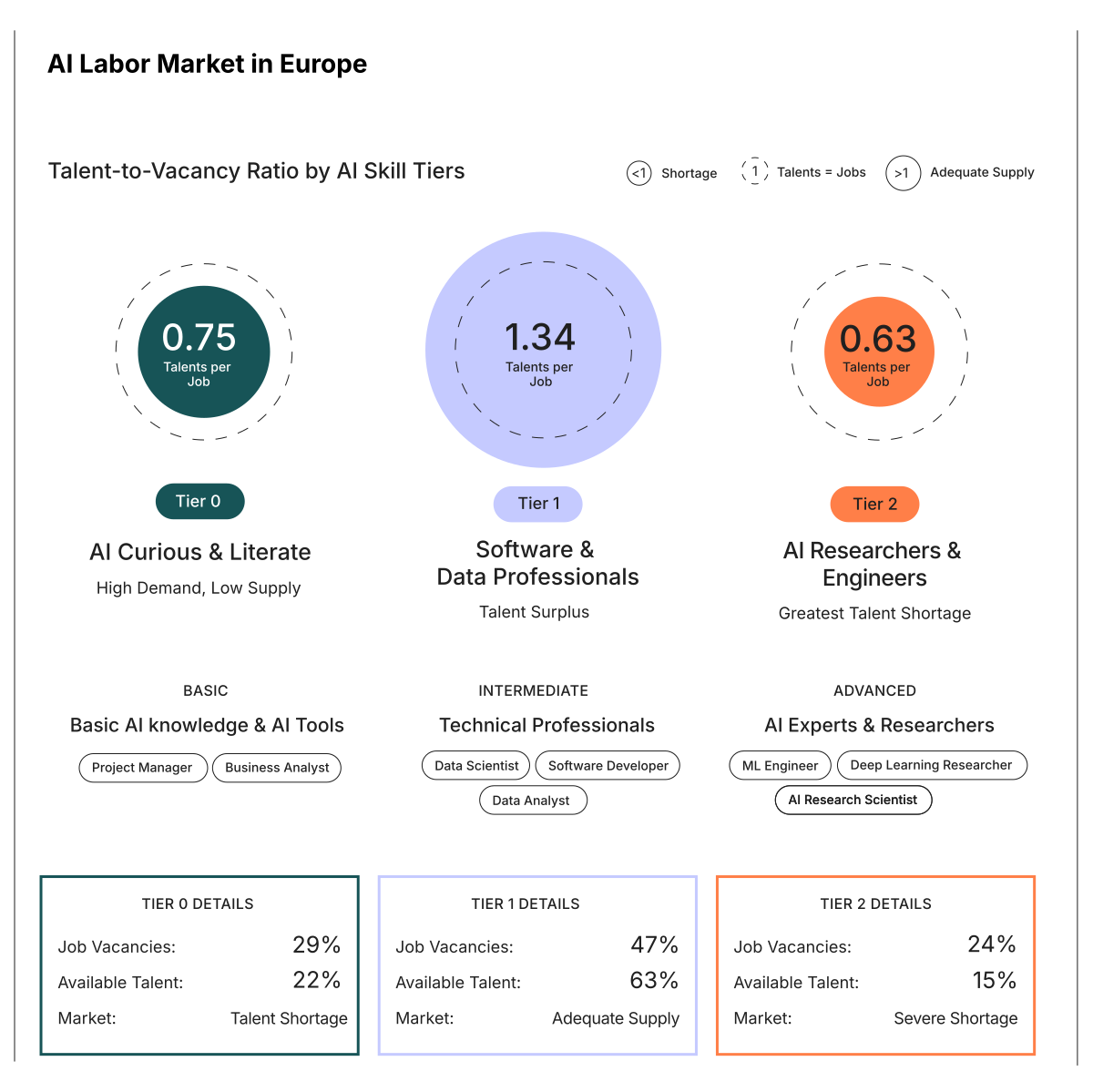
So we decided to focus on the technical AI talent pool and came up with a three-tiered classification: Tier 0, Tier 1, and Tier 2. Tier 2 is the most technical: AI engineers, machine learning experts, people building AI technology. Tier 1 includes software engineers and data scientists who are using or working on AI applications in their day-to-day jobs. And Tier 0 is AI-literate people like project managers or consultants who are heavy users of AI tools.
When we applied this framework to Europe, we found that the two ends – Tier 0 and Tier 2 – are where most job vacancies go unfilled or where we have a skills gap. The middle layer, people in tech but not necessarily working on AI, is where we actually have more talent than job vacancies.
So what this framework allows us to do is to not just focus on top talent, but also on normal users and advanced technology users.
What does this mean for someone who runs a company in Europe? How can they apply this framework to their organization?
Not everyone needs to attract Tier 2 talent – the top AI researchers. Instead, companies should take a more holistic view.
First, try to better understand what type of talent you need for the type of company you run.
Second, realize that these skills are stackable. For example, if you need people in Tier 2, focus on Tier 1 talent and build up their skills to Tier 2. Or likewise, upskill talent from Tier 0 to Tier 1.
Understanding what type of talent you need helps to upskill faster.
If Europe has too few AI top talent and too few professionals who effectively use AI in their jobs: Which gap is more concerning for you?
Tier 0 is more concerning right now. If you look at the data in the European Commission’s Apply AI Strategy from October 2025, only 13.5 per cent of EU companies use AI. A lot of resources go into building top-tier AI infrastructure for attracting AI talent, but there’s not enough focus on Tier 0, the people who ensure that AI adoption in companies is successful.
How should companies think about upskilling when we assume that AI skills are stackable?
First, you need to understand the current level of AI literacy among your employees. This is already a challenge because there is no commonly accepted definition of the term “AI literacy”.
Just recently, the European Commission and the OECD worked on a joint definition of AI literacy.
When we move to the next level – data scientists and software engineers – similar questions arise: Should we even train people to become data scientists and software engineers, or will those roles evolve?
The basic principle is knowing that there are different skill layers that might still be changing, and creating targeted upskilling policies rather than saying “we need more AI talent” without knowing what that actually entails.
Do younger employees have an advantage because they have more practical experience with using AI tools?
Well, that’s the question. Recently, there’s been a lot of reporting about graduates struggling to find jobs. But a recent report says the number of graduate jobs is consistent; the reason why graduates struggle to enter the job market is that the degrees they’ve graduated with are not a direct fit for the jobs people are hiring for.
This points to a problem about how academic programs prepare graduates for jobs. Many degrees now have AI in the title, but the underlying curriculum hasn’t changed.
When we don’t know what skills will be required in the future, the ability to move between roles, evolve, and upskill is in itself something that we need to teach and prepare people for.
A lot of the AI professionals in Europe are foreign nationals. Does immigration policy actually have a bigger impact than education and training on making the EU an AI continent – at least in the short term?
Indeed, there is a heavy dependence on international talent in the AI talent pool across Europe and even in the US. In Ireland, 30 per cent of the AI workforce comes just from India alone.
There is a growing awareness around talent circularity and learning from different educational ecosystems.
There’s a lot of power in having international talent and learning from them, but at the same time, there’s also a parallel conversation about sovereignty and building stronger local talent pools.
But even if we could rely more on local talent, is it something we should be aspiring for? That’s a question that needs further exploring.
There is now a new EU initiative to attract more Indian talent specifically in the ICT sector. It’s going to be a one-stop shop for young talent to get information about visas, jobs, and more. In the research space, research partnerships will allow Indian researchers to come to the EU and vice versa. And the Horizon Europe budget is going to be shared with Indian researchers.
So a lot is happening and it comes with the recognition that there is a need for international talent.
How important is the availability of AI infrastructure for attracting talent into Europe?
The AI Continent Action Plan and the Apply AI Strategy broadly follow the line that talent will follow where AI infrastructure is built.
We did a case study specifically on this topic where we looked at Finland which has set up a world-class infrastructure. But this didn’t translate into attracting an equivalent amount of talent.
We then explored where all the announced thirteen AI factories will be set up, we realized they won’t be set up close to any existing talent pools.
And even if AI talent were to move closer to the factories, they would likely come from existing talent pools, leading to internal competition for AI talent between member states.
Infrastructure alone doesn’t attract talent. There needs to be a lot more targeted policies.
So what should Europe do? Where should Europe put our money to become an AI continent?
Europe has a lot of attractive benefits, such as work-life balance, good healthcare, and so on. And while we can see that in some tech hubs, the cost of living rises faster than salaries, keeping these soft factors in place would attract talent to Europe.
In addition, training local talent is important, but so is allowing international talent to enter the local ecosystems – and not just top-tier AI talent.
Finally, what should governments, businesses, and individuals do to increase the competitiveness of the European economy?
Starting with individuals: Everybody needs to commit to lifelong learning. Everyone needs to upskill – that mindset change needs to happen at an individual level to keep up with the changing jobs landscape.
That’s sometimes referred to as “T-shaped skills” where you have very deep expertise in your core competence, but also broader knowledge in adjacent skills; I’m a political scientist for example, but I also need some AI skills and legal skills.
Right. And people need to keep an open mind. It’s hard to predict what skills are needed in five years’ time, so workers need to remain flexible.
The same applies for companies. First, there needs to be a better understanding of what type of talent you’re looking to hire. A lot of companies are moving away from credential-based hiring – such as having a specific education – to skills-based hiring, where you are looking at what skills are needed to thrive in a certain role.
Comments
Nothing yet. Say the first thing.
Sign in to join the conversation.