
My conversation with Stefanie on how growing up with a breadwinning mother shaped her views on gender and work, the way she’s built a career through cold emailing and developing a resilience against rejection, why it’s so rare to see heterosexual relationships in which men are openly supportive of their more successful female partners (like Doug Emhoff with Kamala Harris or Travis Kelce with Taylor Swift), how she landed her first public speaking gig, the alignment-based framework she uses to make decisions, why she’s always been a long-term thinker who frames her perspective in terms of “seasons,” seeing peers as collaborators instead of competitors, the strategy she used to grow her widely popular Instagram to over 94,000 followers and sell her first book, how she developed the deadline-driven workflow that enables her productivity, & so much more.

With her debut book, Stefanie presents a deeply researched examination of the hidden structural forces that continue to shape women’s careers. Her focus is on a phenomenon she describes as the ‘ambition penalty’: “the sum of the professional, financial, social, and personal costs women face when asking for or pursuing more.”
The result is a highly readable study which dispels the myth that women are simply lacking in professional ambition or the skills needed to succeed at their jobs. What remains at issue, rather, is how the outside world tends to respond to women’s contributions, both in the workplace and beyond—and, as we discuss, a good deal of inequality outside of the home stems from inequality within it.
I learned so much from our exchange.
Jana M. Perkins, PhD
Host, Women of Letters
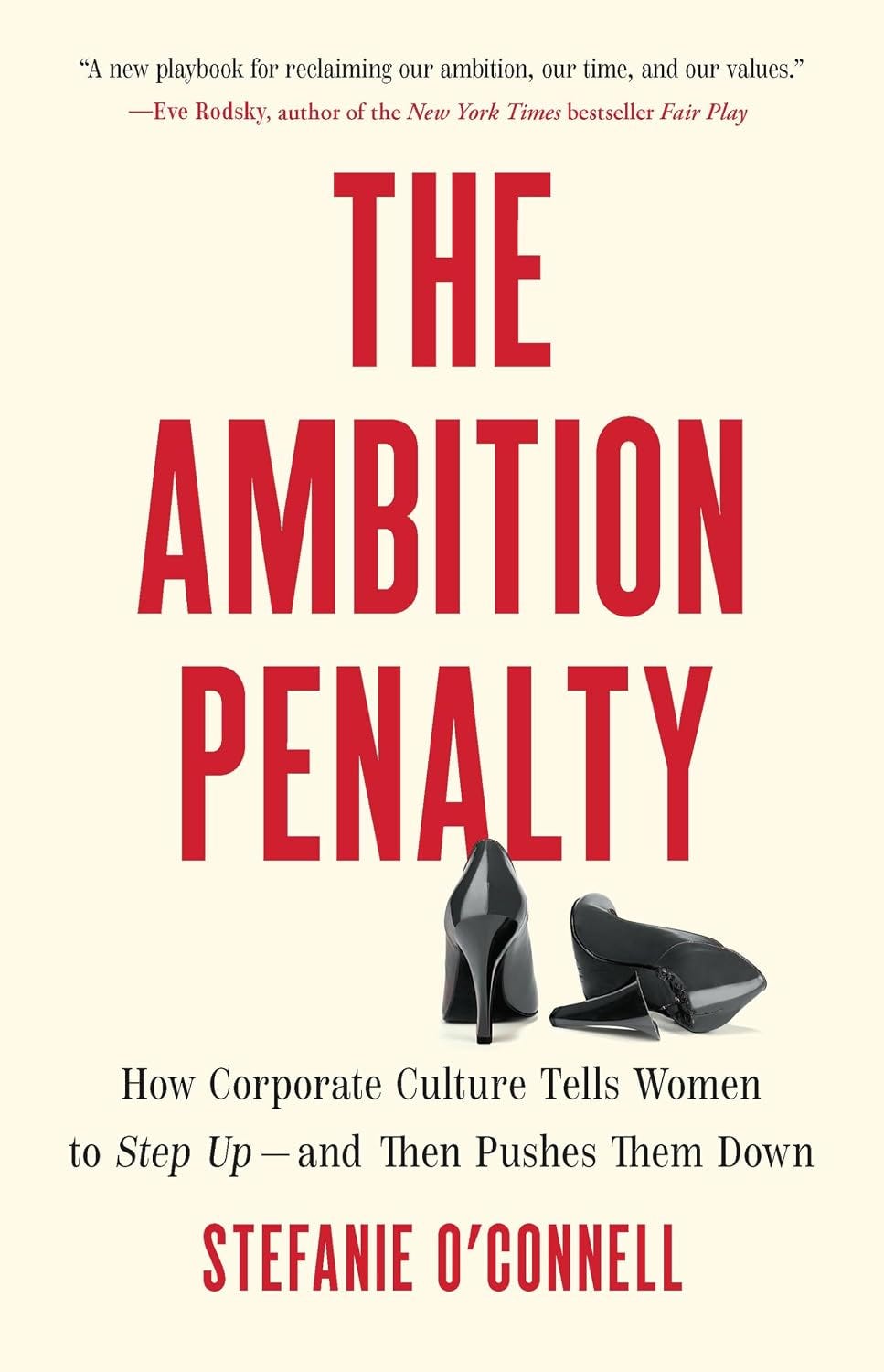
Stefanie O’Connell is an award-winning writer covering ambition, money and power with bylines in The Guardian, Slate, Bloomberg, CNBC, Fast Company, MarketWatch, Glamour UK, Newsweek, USA Today and Business Insider. She also wrote, hosted and co-produced the WEBBY award-winning podcast “Money Confidential” for REAL SIMPLE magazine. Her book The Ambition Penalty: How Corporate Culture Tells Women to Step Up—and Then Pushes Them Down (May 2026, Basic Venture) is an essential guide to dismantling the hidden forces that hold women back, burn them out & make us all pay. With over 100,000 followers across her social media channels and Too Ambitious newsletter, Stefanie uses data to expose how power and gender collide to keep women “in their place.” And shows how liberating women’s ambitions can liberate us all.
You can follow Stefanie at @stefanieoconnell and order her book The Ambition Penalty here.


Stefanie O’Connell: I grew up in a home where both of my parents were in the paid labour force, and my mother was the breadwinner. So I never really understood the cultural gendering of labour in a way that I now understand—as someone who is an adult and feels the weight of the expectations—because the expectations of labour were shared in my household growing up.
I didn’t understand that that was different in the outside world, and I think a lot of my interest in the subject has come from that kind of disconnect. Even now, in 2026, and certainly in the last 20 years that I’ve been navigating my professional life with those expectations, how much that winds up being something that is an underlying theme in conversations around what we’re allowed to want, or be, or do, depending on our gender identity.
That’s certainly one of the most foundational aspects of my value system, my world view, and something that has informed so much of the way I think about life and work and ambition.
Jana M. Perkins: How much of that was made explicit to you? Were your parents having conversations with you about that, or was it more so that you observed that dynamic?
Stefanie O’Connell: It’s interesting—now that you ask that, I’m like, “I don’t know why I knew my mom made more money.” Because it’s not like it was obvious, necessarily, from their career choice.
They met in business school. My father was an attorney, so it’s not like he had a job where it was obvious that he would be making less money. But it was clear that my mother had a more demanding schedule, and more demanding work, and yet she did still come to everything and was such an involved parent. Both of my parents were involved, but my mother really was that woman who kind of did it all in terms of carrying the mental load, being there to coordinate anything no matter what was going on in her paid work life.

Stefanie O’Connell: I studied theatre and psych, and as I had started my career pursuing those things it became really clear how financially unviable it was within the context of a very narrow view of what those skills were for. And graduating in 2008.
I graduated college in 2008, the year of the recession. That obviously changed the landscape for everyone, and much more so for people who worked in ‘non-steady’ career paths. Even my friends who got ‘good’ majors in practical jobs also were struggling, and also couldn’t find work, and also couldn’t figure out what to do. I think that deep anxiety around money and that constant feeling of scramble really made me curious about money in a way that I had never been curious about before.
I think what happened is I took all of my storytelling experience, and my psych interest, and started to say, “Okay: why are we talking about money without this perspective? Why are we talking about money with the perspective that you’re in the same job for 40 years, and it’s very clear, and you have benefits and healthcare and 401k or pension or some pot of gold at the end of the rainbow, when literally nobody I know is experiencing their working life that way?” So that became an obsession of mine, to really think about the way we spoke about money in more practical terms, and more relevant terms to people—especially of my generation—who were living through this upheaval in the economy.
I wanted to create a new way of speaking about it for them, and that really drove my interest in writing about money. Eventually, starting to report on money, all of that led into what I’ve been doing for the last half decade, which is writing and researching the way our experience of money differs very differently across identity. My work has focused primarily on gender identity, specifically, but certainly that intersects with so many other forms of identity.

Stefanie O’Connell: I think everyone has this experience of changing the pronoun in front of the word ‘ambitious’ and it completely changing the connotation. When we say “he’s ambitious,” it implies something praiseworthy: something we should reward, something we want. That guy we want on our team—“he’s such a go-getter.” As soon as you change that pronoun to “she’s ambitious,” it changes the connotation in a negative way.
“She’s so selfish.” “She’s just out for herself.” “She’s not a team player.” “She’s maybe kind of cold, or calculating, or the b-word.” That’s a very linguistic way of looking at it. But we also see this in the research, in terms of what happens when men and women engage in the exact same behaviours—particularly when those are advancement behaviours: trying to get a promotion, trying to get a raise, trying to assert themselves, trying to take on positions of leadership or exert their authority. We see that same pattern play out with real material consequences where men are praised, celebrated, rewarded, supported in doing so. Women—not always, but are much more likely to—face backlash and penalties for doing the exact same thing.
I spoke to women who negotiated raises and had job offers rescinded for doing so. I spoke to women who, even if they got the raise, were then kind of cast aside because they were seen as too difficult to work with or self-interested, so they weren’t going to be considered for future advancement opportunities. It really speaks to how we treat a lot of advancement and career advice as gender-neutral when it’s not. Even when it does work relatively similarly, it actually doesn’t, because there winds up being this larger fallout around, “Okay: we can placate her for now, but in the future we’re not going to be considering her for future opportunities. At least not at the same rate as her male peers.”
I argue that this kind of gendered double standard has effectively become a way of reinforcing the same inequality without being as explicit about it. People aren’t out here being like, “Well, we can’t hire her because she’s a woman,” or, “We’re not going to promote her because she’s a woman.” Instead, we kind of have this, like, “Well, she’s not really a good culture fit, and not really the team player we need her to be.”
That kind of more soft form of this discrimination winds up really producing the same outcome. But it’s almost more insidious, because you can’t necessarily call it out in the same way unless you’re taking a step back—as I’m trying to do in this book—and look at it over the course of a thousand negotiations. Saying, “Oh, no: this isn’t just this one instance, with this one woman, and the way she said it.” It’s the way we view women: as not being deserving, as they shouldn’t be speaking up and asserting themselves, because it violates our expectations of how women ‘should’ behave, which is deferential. Be grateful, serve others above yourself—while, for men, those opposite expectations wind up really serving them when they do the same thing.

Stefanie O’Connell: I think the girlboss backlash started in good faith. There was, as you said, a recognition of the way in which so much of the girlboss ethos really imagined that a woman’s greatest barrier to opportunity—personally, professionally, economically—was herself. If she was just competent enough, or assertive enough, she just asked for more. It positioned it as internal and individual instead of what we’re talking about here, which is an environment around women that penalizes them for the exact same behaviours that are rewarded in their male peers. It really belies the whole philosophy that this is an individual or internal problem to be borne by women while overlooking the environments and the way they penalize and reward us differently.
Those critiques, I think, are incredibly important, incredibly well-founded. My book starts out with a similar critique, and that’s the way the girlboss kind of takedown started. And I think fairly so. There was also a lot of racial dynamics in this; a lot of the women who were celebrated during this period—this was really the early 2010s, the publication of books like Lean In, like Girlboss, where the name came from. This is the rise of a lot of female founders, and a lot of since-disgraced female founders, including Elizabeth Holmes, who founded Theranos and is now serving a prison sentence because of fraud. These women were really elevated and celebrated as the pinnacle of women’s achievement, even as they were often getting ahead through the same exact kind of exploitative practices and racist practices that their male peers were also implementing.
Just as girlboss put the barrier within individual women and blamed women, it also celebrated individual women over women’s collective well-being, because these individual women were getting ahead at the expense of women collectively—and especially some women more than others, particularly women of colour. Is that really a win for women, or is it a win for this woman? So those are the important critiques, and I think that’s how it started.
However, what I will say is that over the course of the late 2010s into the shift to the pandemic and coming out of the pandemic, we’ve really seen this kind of backlash culture taking hold. By that, I mean the rise of the manosphere, the second term of Donald Trump’s presidency, and the kind of authoritarian leadership that has been happening around the world in a way that is very integrated with misogynistic principles and white supremacist principles and this kind of regressive ideology of, “What we really need is to go back to an earlier time, because that was better for everyone.” But, really, the question is, “Well, was it better for everyone? Or was it better for white men?”
I think because the girlboss backlash had already been seeded, there was something very easy to pick up and say, “Yeah: the girlboss was the problem.” For these kind of regressive patriarchal movements to say, “This is what happens when you allow women to access paid labour force participation, or positions of power, or leadership. You get these environments that exclude, that burn people out. Now nobody can’t afford to live anymore.” Basically, what they do is they put all of the blame for modern ills—and real ills; these aren’t manufactured ills. It is too expensive. We’re all working too hard. We don’t have enough access to security or leisure money. But then they say, “Well, that’s the fault of feminism. That’s the fault of girlbossing, of women who are trying to succeed in the public sphere.” And because that backlash, I think, started from a good place, it has wound up making right-wing regressive talking points more palatable to people who otherwise would never engage in a conversation over whether women should have access to paid labour.
The book really winds up following that arc, going from the beginning of this kind of girlboss backlash and interrogation of the girlboss, to what we see now with the rise of tradwife influencers and soft life, and basically this whole media ecosystem promoting the idea that the real problem is women wanting too much and asserting themselves in the public sphere, and they would all really just be better off if they stopped trying to be so ambitious and let go of their ambitions altogether. It’s very similar to the girlboss ideology, in that it continues to be a very individualistic and very internal ideology wherein the blame is still put on women. The prescription is different; the girlboss wanted you to say, like, “You can’t get ahead because you’re not speaking up, or you’re not confident, or you’re not assertive.” The tradwife is saying, “Well, the problem is you’re speaking up too much. So be less assertive, scale back more, be less ambitious, and then that will unlock peace and security and freedom.” But that’s a lie. We know it’s a lie.
I lay it out very clearly in the data. I like to point out that opting out of the paid labour force will not reduce your workload probably, but it will certainly reduce your access to economic stability, security, and the things you can do to actually access the things you did want more of.

Stefanie O’Connell: It’s not only so rare to see; it is so rare to experience. I wound up dedicating a huge portion of my book to the data on this. I think we’ve kind of been sold a bill of goods in the idea that men were ready to be equal partners to women, because the data suggests there is not even remotely a pool of men ready to be equal partners to women. There are men who claim they are, or say they believe they are, but in practice—I mean, I think, best case scenario, it’s like 10% of heterosexual couples.
We see in the data that, of course, with household labour, women are still carrying the vast majority of childcare and unpaid household labour. I say “of course” not because that’s the way it should be, but because this has been true for decades. It remains true even when women out-earn male partners, out-work male partners, have less flexibility than their male partners. It is true in basically every single scenario that women are still carrying more of the load. And this is not something women choose to do. In fact, women’s household labour goes down when they divorce men. Even if they have primary custody of children, they still do less household labour after divorce, which suggests that being a single mother is more relaxing—not more relaxing, because there’s a lot of other stressors in terms of economic resources and other constraints—but they, technically speaking, have more access to leisure time and free time, and they have less household labour relative to women who are in relationships with men.
It’s really telling to the extent of which this is not something that’s chosen. It’s not something that’s natural; it is something that’s being enforced through what I would argue is not just expectations—very patriarchal expectations that remain in heterosexual relationships—but the extent to which men are willing to weaponize women’s love for them. I spoke to women who had partners withdraw love, support, so then they’re motivated to do what they need to do to get it back. And they’ll double down: “If I clean the house enough, if I care enough, if I step up enough, then I can reinforce that stability and that love.” I argue that is basically a form of emotional abuse, and we don’t recognize it as such. And it’s so common.
I also spoke to women who, any time they had some kind of professional success or opportunity, the men in their lives would weaponize household labour or childcare against them: refusing to watch the children, or leaving suddenly when she had to go out for a networking event or a business trip. And then women were kind of stuck in this bind, where they couldn’t seize those opportunities. Or, if they could, then they were worried about the backlash and the resentment they would face at home if they did. These are the calculations that are going on behind the scenes. That’s kind of more of the anecdotal, but again, statistically, the numbers are brutal.
We know that violence against women rises when they earn more than male partners in their relationships. We know that emotional abuse against women rises when they earn more than male partners, in these heterosexual relationships. We know infidelity rises in these scenarios, too. One of the most fascinating parts about that is it’s not about women’s absolute income; it’s about their relative income. It doesn’t matter how much women actually make. It’s not that successful women in and of themselves are, like, somehow unlovable, or whatever other ridiculous stereotype the culture wants to portray this as. It’s actually that, as soon as a woman makes more than 50% of the household income, the backlash—her male partner’s backlash against her—the likelihood of that rises. That’s true at low income levels. It’s true at high income levels.
In fact, the more money women make, the more the household benefits, relationship satisfaction benefits. Basically, it’s a net positive. It’s only when they make more relative to men that we start to see instability. That tells us this is not a problem of women’s ambition or their professional success; it’s a problem with the way men are still responding to it. And I don’t think I could overstate how much of an issue I think this is. I think this is one of the fundamental building blocks for all other inequality we see. I didn’t realize when I started writing this book; I knew household inequality was a thing, I knew the numbers, but I didn’t realize just how much inequality outside of the home really rests on inequality within it.
Back to your question of what do we do about it, how do you navigate dating in this kind of scene. I think it was important to lay out the landscape of what is actually happening, because there’s been so much gaslighting. We’ve been conditioned into this idea of, like, “Well, if you can just be nice enough, or warm enough, or ask the right way, then you will be treated as an equal partner.” And I just don’t think we have the evidence to suggest that’s true. The people who are in equal partnerships, I think, are lucky, because it’s just such a fluke. It’s so unrepresentative that I don’t think we see enough evidence to suggest that doing this is what gets you that. Again, speaking of putting the onus on women: this is not a women’s problem. This is something that men are doing, and yet we take it on as this kind of personal project, because we’ve been so conditioned our entire lives to think we are the problem.
When we take that into our personal relationships, it really sets us up for disappointment. I think that’s why it’s so important to look at the data, and look at it collectively, and think about these things not as one-off instances but as a repeated pattern of men’s interests and needs being prioritized over women’s, and directly at women’s expense. Understanding that landscape, I think, is the first thing; contextualizing your own experience within the broader experience of what all women are experiencing—very, very important. It lets you let go of the self-blame. It lets you start to see these relationships not as these individual entities, but as institutions. A heterosexual relationship is a norm. It is an institution. Marriage, especially, is an institution shaped by broader cultural and social norms, regardless of the individuals partaking in it.
That’s not to say each relationship isn’t different. It is, but each relationship is still subject to ideals of what it means to be a good girlfriend, or boyfriend, or wife, or husband, or mother, or father. Those ideals, I would argue, are incredibly patriarchal, and incredibly harmful to women. To be a good mother in this culture is still to be completely self-sacrificing, to never put your needs above anyone else’s, and to be judged every step along the way.
To be a good wife is the same thing. Thinking of relationships as having these kind of institutional pressures is a way for us to understand them a little bit more critically and think about those cultural forces and political forces and social forces that are pressuring us. Then, we can think more intentionally about, “Okay: how is that a kind of system and institution that I want to step up and challenge, or reinforce?” Systems are all around us. Systems are interpersonal. Systems are institutional. Systems are cultural and political.
Because of this reality, I think it’s also very, very important that we expand our sources of meaning and love and support. Because of those cultural pressures, it’s so, so much more important that we diversify our sources of the things that we turn to heterosexual relationships for. That isn’t just love and support. It’s also community. It’s also economic stability. It’s everything. Cultivating friendships—probably the biggest thing I did in my 30s, probably the most meaningful thing I did in my life in the last decade. When you are able to have diverse sources of meaning and support and economic access and stability, then when one of them is problematic it is not so hard to let go of. Or you can more afford to assert a boundary within the relationship.
Often, what I see happen is, “Okay, I can’t say, ‘Well, if you’re not going to do this, then I’m leaving,’ or, ‘I’m going to do it anyway.’” Because if you can’t afford the reaction—you can’t afford them skipping out—you have to step up more, and make yourself smaller, and shrink and shrink and shrink to remain palatable.

Stefanie O’Connell: Coming back to the hundred email strategy—I did get my first paid speaking gig that way. I was still working mostly in personal finance, and I started with a very niche-down approach, which…
My conversation with Stefanie continues on the podcast. I’d love for you to hear this one in full—over nearly two hours, we dive deeper into the questions above and explore an entirely new set of topics we haven’t yet covered here.
You can listen to the full episode for free on Apple Podcasts and Spotify.


woman of letters (n). an intellectually accomplished woman, esp. in literary, scientific, or artistic domains; in some cases, an author or a scholar; an expert.
The namesake WOMAN OF LETTERS hat is here.
Made to order & designed in-house, with worldwide shipping. Make it yours. 🛍️
Comments
Nothing yet. Say the first thing.
Sign in to join the conversation.