
April was a relatively quieter month when it comes to women in politics. Unless you were in India, where the conversation on the implementation of a quota for women in legislatures dominated the national discourse for much of the month.
A quick context-setting for those not very familiar with what happened: In 2023, India passed a law that would reserve one-third of seats for women in the lower chamber of the national parliament as well as in sub-national state legislatures. However, while the law was passed, its implementation was deferred to an open-ended date in the future based on India undertaking a delimitation exercise.
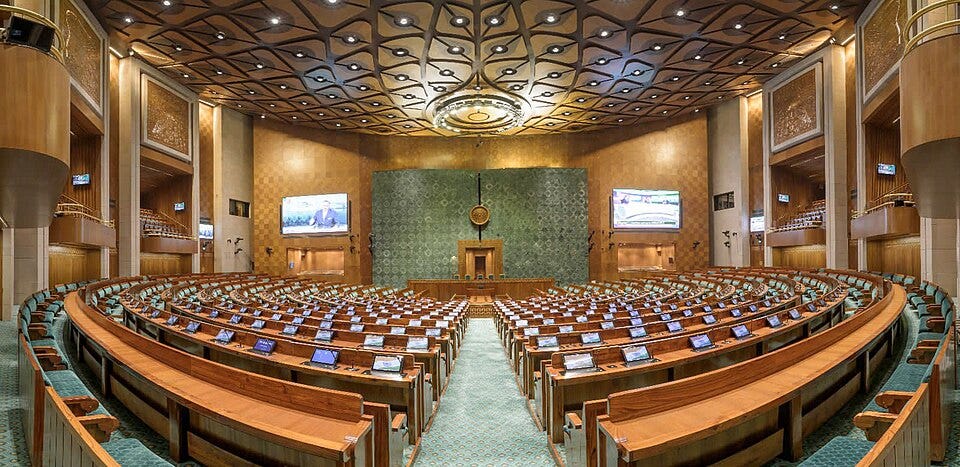
Delimitation is essentially about updating the number of electoral constituencies based on evolving population distribution. But this is a sensitive issue since no state would want to see its share in the parliament getting reduced.
In April, the Indian government called a special session of the Parliament to supposedly fast-track the implementation of the 2023 women’s quota law and introduced a bill that would lead to a delimitation exercise. Two critical political developments were intertwined and entangled. There were political debates and resistance. The bill was not passed given the sensitivity of the proposed delimitation exercise.
Needless to say, the linking of quotas and delimitation was complex, and many experts argued was unnecessary—but at least for a change, parties were seen swearing by their commitment to women’s political representation on the national stage. (The last time it happened was in 2023 when they passed the quotas bill unanimously, though that commitment has not been evident in the number of women candidates they fielded in all elections in the years since then.) As an illustration of this – four states and one union territory held legislative polls also in April. Women made up only eleven percent of all candidates across them all (source: MyNeta). We will know tomorrow (May 04) how many of them end up making it as elected legislators.
Beyond this, I have updates from Bulgaria and the Netherlands in this edition, along with some reading recommendations. In case you missed last month’s edition, you may find it here.
Think more people should know about these updates? Share this edition with them or on your social media!
Tracking women among candidates and winners
🇧🇬 BULGARIA: In April, Bulgarians voted in the eighth parliamentary elections held in the past five years. Fifty-seven women were elected as MPs, data from the Inter-Parliamentary Union shows. Their combined share stands at 23.8 percent, an improvement compared to the previous election of 2024 (when this was 20.8 percent).
🇳🇱 NETHERLANDS: The Netherlands uses a proportional representation electoral system i.e. parties get representation in legislatures in proportion of the share of votes they receive. Political parties come up with lists of candidates, and based on the number of seats the party wins, the candidates ranked from the top onward end up getting elected. So the higher a candidate is ranked on the list, the more likely they will end up getting elected.
Voters can also indicate preference for specific candidates, and if candidates placed lower on the list receive a high share of preferential votes by voters, they are moved up and can win a seat.
This system had ensured five additional women were elected to Netherlands’ parliament in the 2025 national election (when women’s overall share had reached 43.3 percent).
The same system has now helped ensure a higher representation of women in Dutch local politics too. An estimated 504 additional women have made it to local councils in a March election, according to Stem op een Vrouw (translates to Vote for a Woman), a campaign that encourages people to indicate their preference for female candidates when voting. As a consequence, women now comprise 37 percent of the local councillors (while they made up 32.7 percent of the candidates).
The more one learns, there’s only more to learn
“We ❤️ women, but not in the House”: Hindustan Times
“[Four] female premiers on whether Christine Fréchette can avoid the ‘glass cliff’”: CBC/Radio Canada
“Ensuring diverse voices in parliaments: Lessons from 2025”: Inter-Parliamentary Union
“Are Westminster politicians taking misogyny seriously enough?”: Huffpost
“Women and political parties”: Center for American Women and Politics
“Seeing women govern encourages support for women in politics – with no apparent backlash among men”: The Conversation
That’s it for the month! Liked this edition? Then press the ❤️ button and show us some love! And do share this with a friend or on your social media accounts. There’s frankly nothing quite like reader love and endorsement, so please keep it coming! Thank you!
Disclaimer: #WomenLead is a non-partisan newsletter produced in a personal capacity, and does not reflect any institutional affiliation/opinion. In case of any questions, please drop in a message at womenlead.project@gmail.com.
Comments
Nothing yet. Say the first thing.
Sign in to join the conversation.